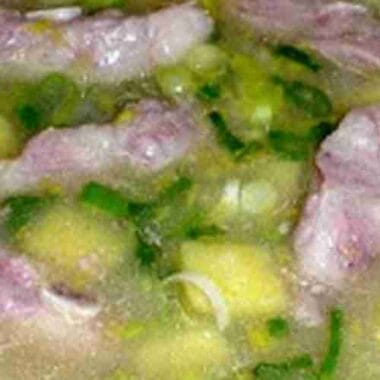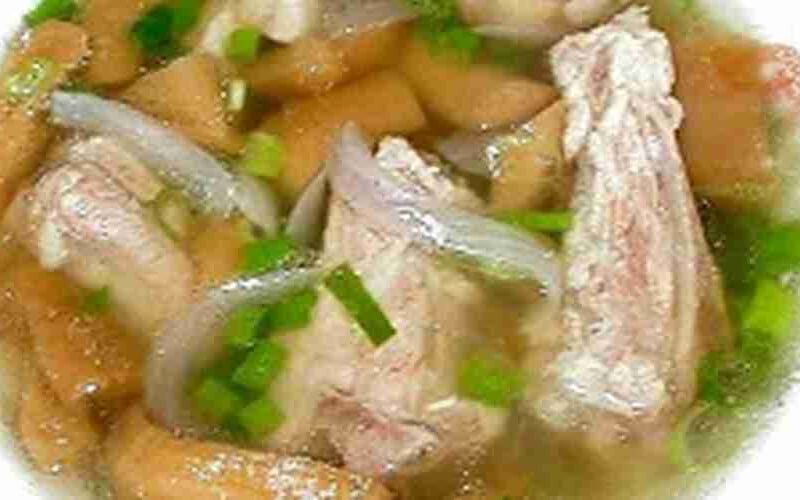
There are some days when you just need a bowl of something warm. Something simple that doesn’t ask for much attention but gives so much comfort in return. This preserved turnip with pork ribs soup is exactly that for me.
I first learned this recipe from my grandmother’s neighbor back in the village near Siem Reap. She was an older Chinese-Khmer woman who made the most incredible soups with just a few ingredients from her pantry. I remember watching her hands move so confidently, never measuring anything, just knowing by feel and by memory.
What I love most about this soup is how the humble preserved turnip transforms everything. It melts into the broth, giving it this beautiful golden color and a flavor that’s hard to describe – salty, yes, but also deep and almost sweet in a way that fresh vegetables just can’t achieve.
If you’ve never cooked with preserved turnip before, don’t worry. This recipe is forgiving and simple. By the end of this post, you’ll feel confident making a soup that tastes like it’s been simmering for hours, even though the active work is just a few minutes.
Why You’ll Love This Soup
This isn’t a fancy restaurant soup with twenty ingredients you can’t pronounce. It’s real food made from real things you can find at any Asian grocery store or well-stocked supermarket.
The beauty of preserved turnip with pork ribs soup is how the flavors work together. The pork ribs get tender and sweet. The preserved turnip slowly releases its salty depth into the broth. The onion melts away, leaving just its essence behind. And that simple combination creates something so much bigger than the parts.
It’s also incredibly affordable. Pork ribs are usually reasonably priced, and a little bit of preserved turnip goes a long way. You can feed your whole family for just a few dollars.
And honestly? It’s almost impossible to mess up. You put everything in a pot, you wait, and soup happens. That’s the kind of cooking I love – food that doesn’t demand perfection, just patience.
My Personal Experience
The first time I made this soup by myself, I was maybe nineteen years old, homesick and lonely in Phnom Penh. I had just moved to the city for university, and everything felt too fast, too loud, too expensive. My little rented room had a hot plate and one pot, and I missed my grandmother’s cooking so much it hurt.
I called her one afternoon, feeling sorry for myself, and asked how to make something simple. Something that would taste like home. She laughed and said, “You want home? Make the soup with the salty radish. Even you can’t ruin that one.”
So I walked to the local market, found a small bag of dried preserved turnip, bought the cheapest pork ribs I could find, and went back to my tiny room. I didn’t have a real kitchen. I chopped everything on a plastic cutting board balanced on my bed. I used a spoon to taste because I forgot to buy a ladle.
But when that soup started simmering, something magical happened. The smell filled my little room, and suddenly the city noise outside faded. I sat on my floor, eating that soup with rice, and for the first time in weeks, I felt okay. I felt connected to something real.
Now, years later, I still make this soup on days when I need that feeling back. When I’m tired or worried or just wanting something familiar. My kids love it too, which makes me happy – maybe someday they’ll make it in their own small apartments and think of me.
Easy-to-Find Ingredients
Here’s the thing about preserved turnip – it might sound exotic, but it’s actually one of the easiest ingredients to find. Look in any Asian grocery store, and you’ll see it. Sometimes it’s labeled as “salted radish” or “preserved radish.” It comes in little plastic bags, usually looking like small, shriveled, brownish strips. Don’t let the appearance fool you – this stuff is magic.
For the pork ribs, I like to use baby back ribs or country-style ribs. You want meat that’s going to get tender and flavorful after simmering. The bone adds something to the broth too, so don’t go for boneless if you can help it.
Everything else is probably already in your kitchen. Onion, fish sauce, black pepper, green onions. That’s it. Four simple ingredients plus the pork and preserved turnip. Sometimes the best food really is the simplest.
Ingredients List
- 6 oz (170 grams) preserved salted radish (sometimes called preserved turnip)
- 1 lb (450 grams) pork ribs, cut into bite-sized chunks
- 1/2 large red or yellow onion, sliced
- 4 cups water
- 1 teaspoon fish sauce
- 1/4 teaspoon black pepper
- 2 stalks green onion, chopped
Why These Ingredients Are Used
- Preserved salted radish: This is the heart of the soup. It’s daikon radish that has been salted and dried, which concentrates its flavor and gives it that incredible savory depth. As it simmers, it releases salt and umami into the broth while becoming tender and almost sweet.
- Pork ribs: The bones add richness to the broth, and the meat becomes fall-apart tender. Pork and preserved vegetables are a classic combination in Cambodian cooking – the richness of the meat balances the saltiness of the preserved ingredients.
- Onion: A simple onion adds natural sweetness that rounds out the salty broth. It melts away during cooking, so you won’t have big chunks of onion in your soup – just its gentle flavor throughout.
- Water: Four cups creates the perfect amount of broth – enough to be satisfying without being too thin. The water transforms into something so much more as it simmers with the other ingredients.
- Fish sauce: Just a tiny bit at the end brightens everything and adds that essential savory note. Good fish sauce doesn’t taste fishy – it tastes like depth.
- Black pepper: A pinch of pepper adds warmth and cuts through the richness of the pork. Freshly ground is always best if you have it.
- Green onion: The fresh green onion at the end adds color and a mild oniony freshness that contrasts beautifully with the rich, salty broth.
Cooking Equipment Needed
- Soup pot or Dutch oven: Any pot that holds at least 2 quarts will work. You want something with a lid to keep the steam in while the soup simmers.
- Cutting board and knife: For chopping the preserved turnip and onions. A regular chef’s knife is fine – nothing fancy needed.
- Measuring cups and spoons: While many Cambodian cooks just estimate, using measurements helps when you’re learning.
- Colander: For rinsing the preserved turnip. This step is important to remove excess salt.
- Ladle: For serving the soup. A spoon works too – I’ve definitely done that.
- Small bowl: For holding your chopped ingredients before they go into the pot. Mise en place makes everything easier.
Cooking Instructions
Let me walk you through this like we’re cooking together in my kitchen. The stove might be different, but the process is the same.
Start by taking that preserved turnip out of its package. Put it in a bowl and cover it with warm water. Let it sit for about 10 minutes while you get everything else ready. This soaking removes some of the excess salt and rehydrates the radish a bit. After it’s soaked, drain it well and give it a rough chop into pieces about the size of your thumbnail. Don’t worry about being precise – this is rustic food.
Now for the pork ribs. Rinse them under cool water and pat them dry with paper towels. Cut between the bones to separate them into individual ribs, then cut those into smaller chunks if they’re large. You want pieces that are easy to eat, maybe two bites each.
Slice your onion into thin half-moons. It doesn’t have to be perfect – just slice it, separate the layers, and set it aside.
Put your pot on the stove and add the pork ribs, sliced onion, chopped preserved turnip, and all four cups of water. Turn the heat to high and bring everything to a boil. You’ll see some foam and scum rise to the top – that’s normal. Use a spoon to skim most of it off if you want a clearer broth, but don’t stress about getting every bit.
Once it’s boiling, turn the heat down to low, put the lid on, and let it simmer. This is the waiting part. Let it cook for about an hour, or until the pork is very tender. The meat should be pulling away from the bones easily when it’s done.
When the pork is tender, turn off the heat. Add the fish sauce and black pepper. Stir gently and taste the broth. Does it need more salt? Remember that the preserved turnip is already salty, so go slowly. Does it need more pepper? Adjust to your liking.
Right before you serve, stir in most of the chopped green onions, saving a little bit to sprinkle on top of each bowl for color.
That’s it. Really. Soup is ready.
Step-by-Step Directions
- Soak the preserved turnip in warm water for 10 minutes, then drain well and chop into bite-sized pieces.
- Prepare the pork ribs by rinsing, patting dry, and cutting into chunks between the bones.
- Slice the onion thinly and set aside.
- Combine ingredients in a soup pot – pork ribs, sliced onion, chopped preserved turnip, and 4 cups of water.
- Bring to a boil over high heat, then skim off any foam that rises to the surface.
- Reduce heat to low, cover, and simmer for about 1 hour until the pork is very tender.
- Turn off the heat and add fish sauce and black pepper. Stir and taste, adjusting seasoning if needed.
- Stir in chopped green onions, reserving a little for garnish.
- Serve hot with steamed rice and extra green onions on top.
Tips for Best Flavor
- Don’t skip the soaking step for the preserved turnip. If you don’t soak it, your soup might be too salty to enjoy.
- Use good quality fish sauce. There’s a big difference between cheap fish sauce and one from a brand you trust. A better fish sauce makes a better soup.
- Simmer gently, not vigorously. A hard boil will make the pork tough and the broth cloudy. Gentle bubbles are what you want.
- Taste before adding more salt. The preserved turnip continues releasing salt as it cooks, so what tastes right at the beginning might be too salty at the end.
- Let it rest off the heat for a few minutes before serving. The flavors settle and come together during this brief rest.
- Save the bones after eating. You can freeze them and use them to make broth another day. Nothing wasted.
Variations and Adaptations
- Add vegetables near the end of cooking – chopped carrots, daikon radish, or napa cabbage would all be delicious. Add them in the last 15-20 minutes so they don’t get mushy.
- Use chicken instead of pork. Chicken thighs on the bone work beautifully. Adjust cooking time – chicken cooks faster than pork, so check for doneness around 30-40 minutes.
- Make it spicy by adding a fresh Thai chili or two while the soup simmers. Remove them before serving if you don’t want to bite into one accidentally.
- Add tomatoes for a different flavor dimension. Throw in a couple of quartered tomatoes during the last 10 minutes of cooking. They’ll soften and add gentle acidity.
- Use pork neck bones if they’re cheaper than ribs. They have lots of connective tissue that makes the broth extra rich and silky.
- Make it a complete meal by adding soaked rice noodles to the bowl before ladling the soup over them. This turns it into a noodle soup that’s hearty enough for lunch.
Serving Suggestions
- Serve with plenty of steamed jasmine rice. The slightly salty broth is perfect spooned over plain rice.
- Offer extra fish sauce and fresh ground pepper at the table so everyone can adjust their own bowl.
- Add a simple cucumber salad on the side for freshness and crunch.
- Serve with sliced fresh chilies in fish sauce for anyone who wants more heat.
- Pair with stir-fried morning glory if you want a complete Cambodian meal at home.
- Garnish each bowl generously with fresh green onions and maybe some cilantro if you have it.
Storing Leftovers
- Cool completely before storing. Hot soup in the refrigerator will raise the temperature and potentially spoil other foods.
- Store in an airtight container in the refrigerator for up to 3 days.
- Keep the bones in the soup while storing – they continue adding flavor as it sits.
- Reheat gently on the stovetop over medium-low heat. The microwave works too but may make the pork slightly tougher.
- Add a splash of water when reheating if the soup has thickened too much from the collagen in the bones.
- Freeze for up to 3 months in freezer-safe containers. Leave some headroom for expansion. Thaw overnight in the refrigerator before reheating.
Final Thoughts
This preserved turnip with pork ribs soup has been with me through so many phases of my life. From that homesick student in a tiny Phnom Penh room to the mother I am now, cooking for my own family in our little kitchen with the afternoon light coming through the window.
Food does that, doesn’t it? It connects us across time and distance. When I make this soup, I can still see that older Khmer woman’s hands, so sure and gentle. I can hear my grandmother’s voice on the phone, laughing at me for not knowing how to cook something so simple. And I can feel that moment of peace in my rented room, when everything felt hard and this warm bowl made it better.
If you’re new to Cambodian cooking, this is such a good place to start. It teaches you about how we use preserved ingredients, how we let simple things become complex through patience, how we build meals around a bowl of soup and a mound of rice. For more traditional recipes, you might also enjoy our Khmer Ginger Catfish Soup or the classic Cambodian Chicken Noodle Soup that’s perfect for cold mornings.
I learned so much about this style of cooking from reading Andrea Nguyen’s Vietnamese food blog – she explains Asian pantry ingredients so well, and her approach to teaching has influenced how I write my own recipes.
Make this soup on a day when you need something gentle. Make it when you’re tired or lonely or just want to fill your kitchen with a smell that feels like coming home. Make it for people you love, and watch them find comfort in a bowl.
However you make it, I hope it brings you the same peace it’s brought me, over and over again, for all these years.
Cook with love, friends.
Frequently Asked Questions
Q: What exactly is preserved turnip? I’ve never seen it before.
A: It’s actually daikon radish that has been salted and dried until it shrivels and turns brown. The process concentrates its flavor and gives it that characteristic salty-savory taste. You’ll find it in plastic bags in the refrigerated section or on shelves at Asian markets.
Q: Can I use something else if I can’t find preserved turnip?
A: The flavor is quite unique, but you could try using salted mustard greens (often called u0022kiam chyeu0022 in Thai markets) for a different but still delicious soup. The texture and taste won’t be the same, but it’s a decent substitute in a pinch.
Q: How do I know when the pork is done?
A: The meat should be very tender and pulling away from the bones easily. If you poke it with a chopstick, it should slide in with almost no resistance. This usually takes about an hour of gentle simmering.
Q: My soup came out too salty. What did I do wrong?
A: You probably didn’t soak the preserved turnip long enough, or you added too much fish sauce at the end. Next time, soak it for at least 10 minutes, and taste the broth before adding any extra salt or fish sauce. For this batch, try adding more water and simmering for another 10-15 minutes to dilute the saltiness.
Q: Can I make this in a slow cooker or Instant Pot?
A: Yes! For slow cooker, add everything except the fish sauce, pepper, and green onions. Cook on low for 6-8 hours or high for 3-4 hours. Add the seasonings at the end. For Instant Pot, cook on high pressure for 25 minutes with natural release, then add final seasonings.
Q: Is this soup supposed to be clear or cloudy?
A: It will be somewhat clear but not perfectly transparent. If you skim the foam at the beginning, it will be clearer. If you don’t, it will be cloudier. Both are fine – it’s about personal preference, not right or wrong.
Q: Can I use pork with more fat?
A: Absolutely. Pork shoulder or pork neck bones with lots of connective tissue will make an even richer, more flavorful broth. Just be aware that there will be more fat floating on top, which you can skim off if you want.
Q: How do I store leftover preserved turnip?
A: Keep it in its original package or transfer to an airtight container and store in the refrigerator. It will last for months. No need to freeze it.

Preserved Turnip with Pork Ribs Soup
4
servings30
minutes40
minutes300
kcal1
hour10
minutesThis preserved turnip with pork ribs soup is a simple Cambodian dish where tender pork simmered with salted radish creates a deeply flavorful broth perfect for pouring over steamed rice.
Ingredients
6 oz 6 (170 gram) of preserve salted radish
1 lb 1 (450 gram) of pork ribs, cut chunks bite sizes
1/2 large 1/2 Red or Yellow onion, sliced
4 cups 4 water
1 teaspoon 1 fish sauce
1/4 teaspoon 1/4 black pepper
2 2 stalks green onion, chopped
Directions
- Soaked preserved salted radish in warm water, drained and cut into bite sizes.
- Put pork ribs, onion, preserved salted radish and water in a soup pot and cook till pork ribs tender.
- Seasoning with fish sauce and black pepper.
- Top with green onion before serve.
Recipe Video
Recipe Notes
- Preserved turnip is very salty, so always soak it before using. Don’t skip this step
- The soup improves as it sits. Leftovers often taste even better the next day.
- Cut the pork ribs into uniform sizes so they cook evenly. Some pieces being bigger than others means some will be done sooner than others.
- If you want a richer broth, you can quickly brown the pork ribs in a hot pot before adding the water. This adds color and deeper flavor.
- The onions will completely soften and almost disappear into the broth. If you want onion texture, add some fresh sliced onion at the end.
- Adjust the water amount based on how soupy you want it. Some people like more broth, some prefer less.
- This soup freezes beautifully. Make a double batch and save half for a busy day.
- Serve with lime wedges if you like a touch of acidity. A squeeze of lime brightens everything.
Nutrition Facts
- Serving Size: 1
- Total number of serves: 4
- Calories: 250kcal
- Fat: 15g
- Saturated Fat: 5g
- Trans Fat: 0g
- Polyunsaturated Fat: 2g
- Monounsaturated Fat: 6g
- Cholesterol: 70mg
- Sodium: 800mg
- Potassium: 450mg
- Carbohydrates: 10g
- Fiber: 2g
- Sugar: 4g
- Protein: 20g
- Vitamin A: 10IU
- Vitamin C: 25mg
- Calcium: 30mg
- Iron: 3mg
- Vitamin D: 0mg
- Vitamin E: 1mg
- Vitamin K: 2mg
- Thiamin: 0.5mg
- Riboflavin: 0.3mg
- Niacin: 4mg
- Vitamin B6: 0.5mg
- Vitamin B12: 1mg
- Folate: 15mg
- Biotin: 1mg
- Pantothenic Acid: 1mg
- Phosphorus: 150mg
- Iodine: 0mg
- Magnesium: 30mg
- Zinc: 2mg
- Selenium: 15mg
- Copper: 0.3mg
- Manganese: 0.4mg
- Chromium: 0mg
- Molybdenum: 0mg
- Chloride: 0mg
Did you make this recipe?
Tag @cambodiarecipe on Instagram and hashtag it
Like this recipe?
Follow us @cambodiarecipe on Pinterest
Did you make this recipe?
Follow us on Facebook