Khmer New Year: A Foreigner’s Guide to Cambodia’s Biggest Celebration
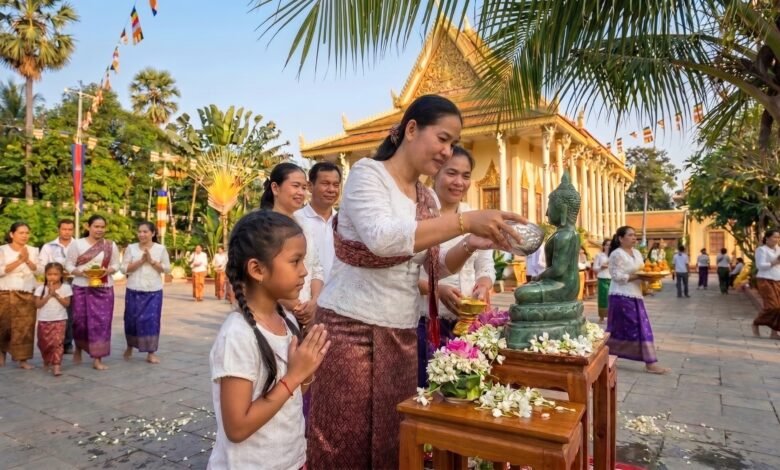
Imagine a country where the entire nation stops for three days. Offices close. Traffic thins. Millions of people travel back to their home villages. Pagodas fill with families carrying food and incense. Buddha statues are gently bathed in perfumed water. Children play traditional games in temple courtyards, and the sound of laughter mixes with the chanting of monks.
This is Khmer New Year—and it’s unlike any New Year celebration you’ve ever experienced.
If you’re planning a trip to Cambodia in April, this guide will help you understand what’s happening around you, why it matters so deeply to Cambodians, and how you can experience the celebration respectfully.
Quick Festival Information
Festival: Khmer New Year
Khmer name: Choul Chnam Thmey (ចូលឆ្នាំថ្មី), also called Moha Sangkran
Typical time: April 13–14 (three-day celebration)
Length: 3 days
Type: National, cultural, religious, and seasonal
Main locations: Nationwide; major public events in Phnom Penh and Siem Reap
Main activities: Pagoda visits, food offerings to monks, Buddha statue procession, sand stupa building, traditional games, family gatherings
Visitor experience: Cultural performances, traditional games, festive atmosphere, temple ceremonies
What Is Khmer New Year?
Khmer New Year is the most important traditional celebration in Cambodia. It marks the end of the harvest season and the beginning of a new year on the solar calendar. The Khmer name is Choul Chnam Thmey, which literally means “Enter New Year”.
For Cambodians, this isn’t just a holiday. It’s a homecoming. It’s a time to reconnect with family, honor ancestors, and renew spiritual commitments. The celebration is deeply rooted in Buddhist and Brahmanist traditions, and it carries layers of meaning that go far beyond simply marking a date on the calendar.
The festival is also a public holiday. Schools, government offices, and many businesses close for the three days, though some services continue for tourists and essential needs.
When Is Khmer New Year Celebrated?
Khmer New Year generally falls in mid-April, usually beginning on April 13 or 14. The exact date is determined by the Cambodian lunar calendar, so it shifts slightly from year to year.
In 2026, the celebration ran from April 14 to 16. The Year of the Horse began at 10:48 AM on April 14.
For travelers planning a trip, the key takeaway is this: mid-April is the time. If you’re in Cambodia during this period, you’ll experience the celebration—whether you seek it out or not.
The Three Days of Khmer New Year
Each of the three days has its own name and traditional focus. Understanding these helps you make sense of what you’re seeing.
Day 1: Mohasangkrana (មហាសង្ក្រាន្ត)
This is the first day of the new year. According to ancient belief, a new angel or deity is appointed to protect the world for the year ahead. Families clean their homes, prepare offerings, and welcome the new angel with candles, incense, and food on altars.
Day 2: Vorak Vanabatt (វារៈវ័នបត)
This is the middle day of the celebration. A key tradition is Pithi Srang Preah, the bathing of Buddha statues with perfumed water. Families bring their Buddha statues to the pagoda for this cleansing ritual, which symbolizes the washing away of sins and the purification of the soul.
Day 3: Leang Sak (ឡើងស័ក)
The final day focuses on blessing and renewal. Families perform water blessings for their parents and elders—a deeply emotional ritual that honors those who came before. The elderly receive water poured gently over their shoulders while receiving wishes for health and long life.
Why Khmer New Year Matters So Much
To understand why this celebration matters, you need to understand what it means to Cambodian families.
In many Cambodian communities, people move to cities like Phnom Penh for work. They live far from their parents and grandparents. Khmer New Year is the time when everyone returns home. Buses and taxis fill up days in advance. Roads become busy with travelers heading to their home provinces.
At the pagoda, families offer food to monks. This isn’t just charity—it’s a way of making merit and dedicating blessings to ancestors who have passed away. The act of giving food, lighting incense, and listening to monks chant connects the living with the spiritual world.
And then there’s the water. Water is central to Khmer New Year. It’s used to bathe Buddha statues, to bless elders, and—yes—to playfully splash friends and strangers in the streets. Water symbolizes cleansing, renewal, and the washing away of misfortune from the previous year.
The History Behind the Celebration
The origins of Khmer New Year are connected to ancient Brahmanist traditions, which were practiced in Cambodia before Buddhism became the dominant religion. Over centuries, these traditions blended with Buddhist practices to create the celebration as it exists today.
During the Angkor era, the New Year was reportedly celebrated at a different time of year—on the first day of the first lunar month. The shift to mid-April is linked to the end of the harvest season, a practical timing that allowed farming communities to celebrate after their work was done.
There are also legends associated with the festival. One well-known story tells of a clever boy named Thom Ma Bal who defeated a Brahmanist deity in a contest of wits. The story is often understood as symbolizing the triumph of Buddhism over Brahmanism.
It’s important to note: this legend is part of the festival’s cultural storytelling, not a documented historical event. The festival’s true origins lie in ancient agricultural and religious traditions that evolved over many centuries.
How Cambodian People Celebrate
The celebration combines religious devotion, family bonding, and community fun. Here’s what traditionally happens:
At the Pagoda
Families wake early to visit the local pagoda. They bring food—rice, fruit, traditional cakes—to offer to the monks. They listen to Buddhist teachings, chant prayers, and make merit. Some families build small sand stupas in the temple grounds, a tradition believed to bring good fortune.
At Home
Homes are cleaned thoroughly before the New Year. Families prepare special foods and set up altars with candles and incense. On the final day, younger family members perform water blessings for their parents and grandparents.
In the Community
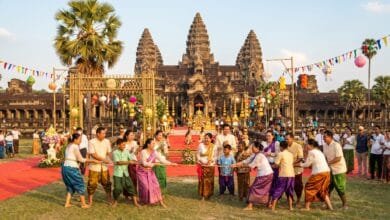
Traditional games are a big part of the celebration, especially for young people. Games like Leak Kanseng (hide the scarf) and Chol Chhoung (scarf throwing) are played in temple courtyards and public spaces. There are also tug-of-war games, dancing, and cultural performances.
Water Blessings
Water blessings are everywhere. Families gently pour water over Buddha statues. Children pour water over their elders’ hands or shoulders as a sign of respect. And in the streets, there’s playful splashing—though authorities remind everyone to do this respectfully and safely.
Food and Family Traditions
Food plays a central role in Khmer New Year. It’s not just about eating—it’s about offering, sharing, and celebrating abundance.
Nom Banh Chok (Khmer noodles) is one of the most beloved dishes during the celebration. It’s a breakfast staple, but during New Year, it becomes a communal food, served at family gatherings and public events. In 2026, crowds at the Nokor Sankranta event in Phnom Penh gathered to enjoy authentic Nom Banh Chok.
Traditional cakes are also essential. Families prepare Num Ansom (sticky rice cake, often filled with banana or pork), Num Korm (steamed glutinous rice cake with coconut), and Num Bot (sticky rice with beans). These cakes are offered to monks, shared with neighbors, and enjoyed at family meals.
The food traditions of Khmer New Year reflect the agricultural roots of the celebration. The end of the harvest means fresh ingredients are available, and families celebrate the abundance of the season together.
What Visitors May See
If you’re in Cambodia during Khmer New Year, here’s what you might notice:
- Pagodas are busy. Families arrive throughout the day, carrying food and offerings. The atmosphere is respectful but lively, with children running around and elders chatting.
- Streets are quieter than usual in some areas, especially in Phnom Penh, as many residents return to their home provinces.
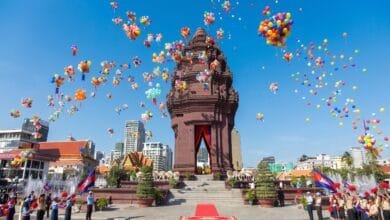
- Public celebrations are vibrant. In Phnom Penh, the Nokor Sankranta event at Wat Phnom and surrounding areas features traditional games, cultural performances, and food stalls. In Siem Reap, the Angkor Sankranta festival brings the celebration to the temple complex.
- Traditional games are happening. You’ll see young people playing Leak Kanseng and other folk games in open spaces.
- Water blessings are visible. You’ll see gentle water pouring at pagodas and, in some areas, playful splashing in the streets.
- Cultural performances are everywhere. Traditional dance, music, and theater performances are common during the celebration.
Can Tourists Participate?
Yes—but respectfully. Tourists are welcome to observe and, in some cases, participate in public celebrations. You can watch traditional games, enjoy the food, and even join in the festive atmosphere. Some public events are specifically designed to welcome visitors and share Khmer culture.
However, there are limits. Religious ceremonies at pagodas are primarily for Cambodian Buddhists. You can observe from a respectful distance, but you shouldn’t interrupt or try to take part in rituals that are meant for the faithful. If you’re unsure, ask—but ask quietly and respectfully.
The key principle is simple: observe, don’t intrude. Your presence is welcome, but the celebration isn’t a performance for tourists. It’s a sacred and deeply personal time for Cambodian families.
How Visitors Should Behave Respectfully
Official sources, including the APSARA National Authority, offer clear guidance for visitors during Khmer New Year:
Dress modestly. When visiting temples or pagodas, cover your shoulders and knees. Shorts and skirts should be knee-length or longer. This is a sign of respect for the sacred space.
Ask before taking photos. If you want to photograph people, especially during religious ceremonies, ask first. A smile and a gesture toward your camera usually works.
Follow temple rules. Don’t touch stone statues or carvings. Don’t move or take decorative items. Don’t disturb monks who are praying or chanting.
Be careful with water. Playful splashing is part of the celebration, but authorities remind visitors to avoid spraying dirty water, throwing water bags, or splashing elderly people or monks.
Avoid alcohol and food inside temple precincts. This is explicitly requested by the APSARA National Authority at Angkor.
Follow local instructions. If there are signs or staff directing traffic or crowd flow, follow them. Large crowds can be overwhelming, so stay aware of your surroundings.
What Makes This Celebration Special
Khmer New Year is special because it’s not just about having fun—though there’s plenty of that. It’s about connection. Connection to family, to community, to faith, and to ancestors.
For Cambodians, the three days of New Year are a reset. They wash away the old year, honor those who came before, and step into the new year together. The celebration is a reminder that no matter how far life takes you, there’s always a place to come home to.
For visitors, Khmer New Year offers a rare window into Cambodian life. It’s a time when the country’s cultural heart is on full display—not for tourists, but for Cambodians themselves. If you’re lucky enough to be here during this time, you’re not just seeing a festival. You’re seeing a nation renew itself.
Frequently Asked Questions
When is Khmer New Year celebrated?
Khmer New Year generally falls in mid-April, usually beginning on April 13 or 14. The exact dates shift slightly each year based on the lunar calendar.
Is Khmer New Year a public holiday in Cambodia?
Yes. It’s one of Cambodia’s most important public holidays. Government offices, schools, and many businesses close for the three days.
Can tourists participate in Khmer New Year?
Tourists are welcome to observe and enjoy public celebrations. You can watch traditional games, try festival foods, and experience the festive atmosphere. Religious ceremonies at pagodas are for Cambodian Buddhists, so observe respectfully from a distance.
What should tourists wear during Khmer New Year?
Dress modestly, especially when visiting temples. Cover your shoulders and knees. Lightweight, comfortable clothing is best for April’s hot weather.
What food is associated with Khmer New Year?
Traditional foods include Nom Banh Chok (Khmer noodles), Num Ansom (sticky rice cakes), Num Korm, and other festive dishes prepared for family gatherings and temple offerings.
Where can visitors experience Khmer New Year?
Public celebrations happen nationwide. Major events take place in Phnom Penh (Nokor Sankranta at Wat Phnom) and Siem Reap (Angkor Sankranta). Local pagodas in any town will also be busy with families celebrating.
How is Khmer New Year different from other New Year celebrations?
Khmer New Year is not a single-night party. It’s a three-day spiritual and family celebration centered on Buddhist traditions, water blessings, and community bonding. The focus is on renewal, respect for elders, and honoring ancestors.
Is it a good time to visit Cambodia?
It depends on what you want. The festive atmosphere is amazing, but many businesses close and travel can be crowded. If you want to experience Cambodian culture at its most vibrant, it’s an incredible time to be here. If you prefer quiet sightseeing, you may want to visit at another time.
Conclusion
Khmer New Year is more than a holiday. It’s a window into the soul of Cambodia—a celebration of family, faith, and renewal that has been passed down through generations.
If you’re in Cambodia during mid-April, take the time to understand what’s happening around you. Visit a pagoda respectfully. Try the traditional food. Watch the games. And remember that behind the festive atmosphere is a deeply meaningful celebration that matters to millions of people.
The best way to experience Khmer New Year is with curiosity and respect. Learn a few words of Khmer. Ask questions politely. And let the celebration teach you something about Cambodia that no guidebook can capture.