Khmer Pronunciation Guide: How to Say Common Cambodian Words and Place Names

You step out of a tuk-tuk in Siem Reap. The driver smiles and says something that sounds like “Sue-saw-day.” You want to say thank you, but you’re not sure if it’s “Or-kun” or “Aw-koon.” And the name of the city you just left—Phnom Penh—sounded nothing like the “Fnom Pen” you practiced at home.
You’re not alone. Khmer, the official language of Cambodia, is spoken by more than 16 million people, but its sounds and rhythms are very different from English. The good news is that you don’t need to learn the entire language to travel comfortably. A handful of well-pronounced words and a basic understanding of how Khmer works will make your trip smoother, more respectful, and more fun.
This guide is written for English-speaking travelers—especially those from the United States—who want practical pronunciation help. We’ll cover the words you’ll actually hear and use, the place names that trip people up, and the simple reasons why Khmer sounds the way it does. No linguistics degree required.
Quick Answer: The 5 Most Useful Khmer Words for Travelers
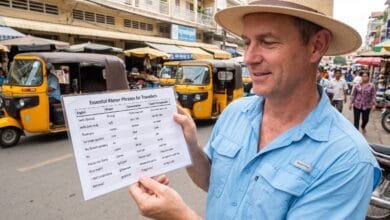
If you only learn five things, learn these. The pronunciation guides below are written for English speakers, with syllables in CAPITALS where the stress falls.
| English | Khmer | Simple Pronunciation | When to Use It |
|---|---|---|---|
| Hello | សួស្តី | soo-SDAY | Casual greeting |
| Thank you | អរគុណ | aw-KOON | Showing gratitude |
| Yes (male) | បាទ | BAHT | Agreeing (if you’re male) |
| Yes (female) | ចា៎ | JAH | Agreeing (if you’re female) |
| Sorry / Excuse me | សុំទោស | sohm-TOH | Apologizing or getting attention |
A quick note about “yes”: Khmer uses different words depending on whether the speaker is male or female. If you’re a man, say baht. If you’re a woman, say jah. This is one of the most distinctive features of Khmer that travelers notice right away.
How Do You Pronounce the Place Names You’ll See Everywhere?
Cambodian place names are often transliterated into English letters in ways that don’t match English pronunciation rules. Here’s how to say the ones you’ll encounter most often.
Phnom Penh
The capital city. Pronounced: pe-NOM pen. The “Phnom” is one syllable with a soft “p” sound at the start—almost like “nohm” with a “p” before it. The “Penh” rhymes with “ten”.
The name literally means “Penh’s Hill” or “Hill of Pen.” It refers to a legendary woman named Penh who is said to have found statues of Buddha in a log floating on the Mekong River and built a hilltop temple to house them.
Siem Reap
The gateway city to Angkor Wat. Pronounced: see-em reep. The first part sounds like “see” plus a soft “em.” The second part rhymes with “deep”.
Locals sometimes say it with a slight roll of the “r” — more like “Se-em Ree-ap” — but “see-em reep” will be perfectly understood. The name translates to “Siam Defeated,” a reference to a historical victory over the Thai kingdom of Ayutthaya. Some locals prefer a more positive interpretation: “Siem Rising”.
Angkor Wat
Pronounced: ANG-kor waht. The first syllable rhymes with “sang.” The “Wat” rhymes with “hot” (not “what”).
“Angkor” comes from the Sanskrit word nagara, meaning “city.” “Wat” means “temple” in Khmer.
Battambang
Pronounced: bat-tam-BANG. The final syllable is stressed and rhymes with “sang.” The name means “Lost Staff,” referring to a legend about a king who threw his staff and where it landed became the city’s location.
Why Does Khmer Sound So Different from English?
Khmer is not related to English, Chinese, or Thai. It belongs to the Austroasiatic language family, which means its sounds and grammar developed independently over thousands of years. Here are the main differences that affect pronunciation:
1. Two consonant series. Khmer consonants come in two “series” — the a-series and the o-series. The same vowel symbol is pronounced differently depending on which series the preceding consonant belongs to. This is why romanized Khmer can look inconsistent: the same vowel letter may represent different sounds in different words.
2. Final consonants are soft or silent. In English, we pronounce the final “t” in “cat” clearly. In Khmer, final consonants are typically unreleased — the tongue moves into position but doesn’t release a puff of air. Some final consonants are not pronounced at all.
3. Different vowel sounds. Khmer has vowel sounds that don’t exist in English. The most important one for travelers is the “eu” sound (written as “eu” in many romanizations), which is a bit like the “u” in “fur” but shorter. It appears in common words like “thank you” (aw-kun) and “yes” (baht).
4. Tone is not the main challenge. Unlike Thai or Vietnamese, Khmer is not a tonal language. You don’t need to worry about changing pitch to change meaning. This makes it more forgiving for English speakers than many other Southeast Asian languages.
Common Khmer Words and Phrases You’ll Actually Use
Here’s a practical phrase list for travelers. The pronunciation guides are approximations — Khmer sounds don’t map perfectly onto English, so think of these as starting points, not exact equivalents.
| English | Khmer | Pronunciation | Notes |
|---|---|---|---|
| Hello (informal) | សួស្តី | soo-SDAY | Most common greeting |
| Hello (formal) | ជំរាបសួរ | jum-reap-SUOR | More respectful |
| Thank you | អរគុណ | aw-KOON | Sounds a bit like “raccoon” without the “r” |
| Thank you very much | អរគុណច្រើន | aw-koon CHRAAN | Adds emphasis |
| Yes (male) | បាទ | BAHT | Only for male speakers |
| Yes (female) | ចា៎ | JAH | Only for female speakers |
| No | អត់ទេ | ot-DAY | “Ot” is short, “day” is stressed |
| Sorry / Excuse me | សុំទោស | sohm-TOH | Useful for getting attention |
| Goodbye | ជំរាបលា | jum-reap-LEA | More formal |
| How are you? | សុខសប្បាយទេ? | sok-sa-BAI day? | Friendly check-in |
| I’m fine | សុខសប្បាយ | sok-sa-BAI | Standard reply |
| Please | សូម | SOAM | Polite request marker |
| Where is the toilet? | បង្គន់នៅឯណា? | bang-KON nov ai-NA? | Very useful |
Sources for these phrases include the Michigan State University Basic Khmer textbook and the Sygic Travel Khmer phrasebook.
The Romanization Problem: Why You See Different Spellings
If you look at multiple Khmer phrasebooks, you’ll notice that the same word can be spelled in different ways. “Hello” might be written as Sua-sdey, Sous-dey, Sou s’day, or Chum reap suor (for the formal version). This isn’t a mistake — it reflects the fact that Khmer sounds don’t map neatly onto English letters.
The United Nations recommended a romanization system for Khmer in 1972, based on an earlier French colonial system. It’s used for official place names and geographical references. But for everyday traveler use, most phrasebooks use simpler, more intuitive systems designed for English speakers.
What this means for you: Don’t worry about finding the “one correct” romanization. If you see a Khmer word spelled two different ways, both are probably trying to represent the same sound. Focus on the sound, not the spelling. And when in doubt, show someone the Khmer script — most Cambodians will appreciate the effort.
What About the Khmer Script?
Khmer script looks complicated — and it is, at least at first. The script has 74 characters, including 33 consonants, 24 vowels (which can be written as independent letters or as marks around consonants), and various diacritics.
The script is written from left to right and doesn’t use spaces between words in the way English does. Word division is not ordinarily indicated in Khmer writing. This is why learning to read Khmer script takes much longer than learning to speak basic phrases.
Do you need to learn the script to travel in Cambodia? No. Most signs in tourist areas include English translations. But learning to recognize a few common words can be helpful and impressive. For example:
- សូម (soam) — “please” — often seen on signs
- ទឹក (tuk) — “water” — useful for reading drink menus
- បាយ (bai) — “rice” — appears on many food signs
You won’t learn to read Khmer in a week, but recognizing a few symbols is a fun way to engage with the language.
Common Pronunciation Mistakes Travelers Make
1. Pronouncing every letter. In Khmer, final consonants are often soft or silent. Don’t force a hard “s” or “t” at the end of words.
2. Using English vowel sounds. Khmer vowels are different. The “a” in baht is not like the “a” in “bat” — it’s more open, like the “a” in “father.”
3. Stressing the wrong syllable. Khmer words often have stress on the final syllable, unlike English which tends to stress earlier syllables. Say aw-KOON, not AW-koon.
4. Ignoring the male/female distinction. If you’re a man and you say jah for “yes,” it will sound feminine. If you’re a woman and you say baht, it will sound masculine. This is a small detail, but Cambodians will notice.
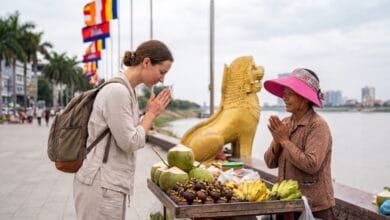
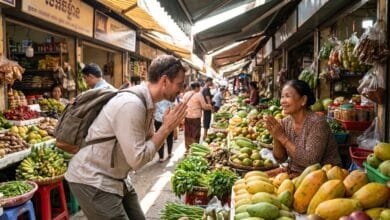
5. Forgetting the sampeah. When you say hello or thank you, pressing your palms together at chest level (the sampeah) shows respect and is appreciated. You don’t need to do this with everyone, but it’s a nice gesture with elders, monks, or in formal settings.
Other Useful Khmer Words Travelers Might Hear
At a market: T’lai ponman? (How much?) — pronounced “tlai pon-MAHN”
In a restaurant: K’nyom chaeng bai (I want rice) — “knyom CHAENG BAI”
In a tuk-tuk: Tov na? (Where to?) — “tov NAH”
At a hotel: K’nyom chong check-in (I want to check in) — “knyom CHONG check-in”
These are simplified phrases that will be understood in tourist areas. In more rural settings, English may not be as widely spoken, so a phrasebook or translation app can be helpful.
Frequently Asked Questions
What language do people speak in Cambodia?
Is Khmer difficult for English speakers?
It’s moderately challenging. The grammar is simpler than English in some ways (no verb conjugation for tense, for example), but the sounds are very different. Pronunciation is the biggest hurdle for most learners. However, you don’t need to master the language to travel — a few key phrases and a willingness to try will earn you goodwill.
What’s the easiest Khmer word to learn?
“Hello” (sua-sdey) or “thank you” (aw-kun) are the easiest and most useful. They’re short, straightforward, and you’ll use them constantly.
Do I need to learn Khmer to travel in Cambodia?
How do you say “yes” in Khmer?
It depends on your gender. Men say baht (បាទ). Women say jah (ចា៎). This is one of the most noticeable gender differences in the language.
Why is “Phnom Penh” spelled that way if it’s pronounced “pe-NOM pen”?
The spelling comes from French colonial transliteration. French spelling conventions represent Khmer sounds differently than English ones. The “Ph” represents a soft “p” sound, and the “nh” at the end is a nasal sound that doesn’t exist in English.
Conclusion
Khmer pronunciation doesn’t have to be intimidating. You won’t get every sound right, and that’s okay. What matters is that you try. A well-intentioned sua-sdey or aw-kun — even if the vowel isn’t perfect — will almost always be met with a smile.
The words in this guide are the ones you’ll actually hear and use while traveling in Cambodia. Practice a few before your trip, keep this article handy, and don’t be afraid to point at words on your phone when speaking gets tricky. The effort you put into pronunciation is an effort that Cambodians notice and appreciate. Language is one of the easiest bridges you can build when you travel — and in Cambodia, a little goes a very long way.