What Language Do People Speak in Cambodia? A Traveler’s Guide to Khmer
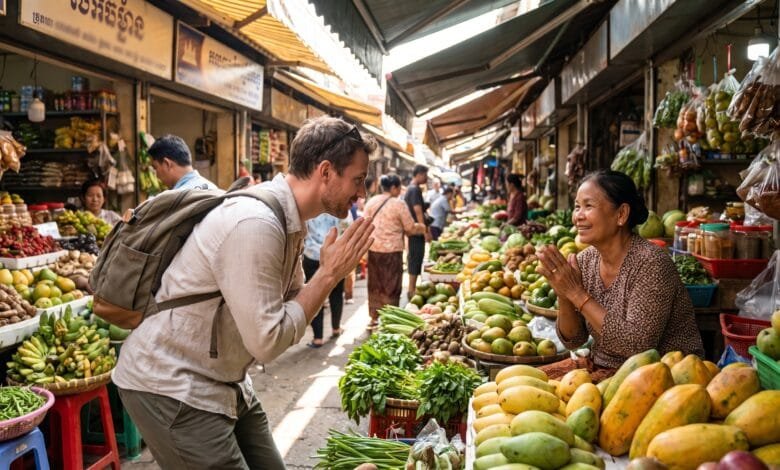
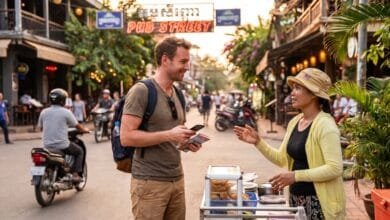
The first Khmer word most travelers hear is almost always the same: susadei. It comes from a hotel receptionist, a tuk-tuk driver, or a server at a street food stall. It sounds soft, almost musical, and completely unlike anything you’ll hear in neighboring Thailand or Vietnam.
That word — and the language behind it — is your first introduction to Cambodia. Understanding what language people speak here, how it sounds, and what a few key phrases mean will change how you experience the country.
Quick Answer
The official language of Cambodia is Khmer (pronounced kuh-MY), spoken by approximately 95.8% of the population as their mother tongue. It is a member of the Austroasiatic language family — the same broad family that includes Vietnamese — but it is not a tonal language, unlike Thai, Lao, and Vietnamese. English is widely understood in tourist areas, and French is still spoken by some older Cambodians.
What Is the Khmer Language?
Khmer (ខ្មែរ) is the national and official language of Cambodia. It is also the second most widely spoken Austroasiatic language in the world, after Vietnamese. Approximately 16 million people speak Khmer in Cambodia, with another 1.2 million speakers in Vietnam and smaller communities in Thailand, the United States, France, and Australia.
The language has been written in its own distinctive script for over 1,400 years. The Khmer script is an abugida — a writing system where each consonant carries an inherent vowel, and additional vowels are written as separate marks around the consonant. It was originally derived from a South Indian script brought to the region along with Hindu and Buddhist influences.
What makes Khmer especially interesting for travelers is what it doesn’t have: tones. In Thai or Vietnamese, saying a word with a rising or falling pitch can completely change its meaning. In Khmer, it doesn’t. This makes Khmer, in some ways, more forgiving for English speakers to attempt than its tonal neighbors.
How Does Khmer Sound to English Speakers?
Khmer has a distinctive sound that travelers often describe as soft, flowing, and sometimes a little nasal. It uses a range of vowel sounds that don’t exist in English, and some consonants are pronounced further back in the mouth than English speakers are used to.
Unlike English, Khmer does not use inflections — no verb conjugations, no plurals, no gendered nouns. Context and word order do the work. This means that when you learn a Khmer word, you can use it in almost any situation without worrying about changing its form.
You will also notice that Khmer is written without spaces between words. The script runs continuously, with spaces only marking phrase or sentence boundaries. This can make written Khmer look dense and intimidating at first, but for travelers, recognizing even a few common words on signs can be genuinely helpful.
Do People Speak English in Cambodia?
Yes — especially in tourist areas. In Siem Reap, Phnom Penh, and other popular destinations, you will find English speakers working in hotels, restaurants, markets, and tour companies. English has been replacing French as the primary foreign language since the early 1990s.
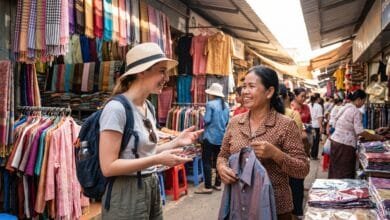
That said, English proficiency drops significantly outside tourist zones. In rural areas and smaller towns, you may encounter vendors, drivers, or guesthouse owners who speak little or no English. A few words of Khmer go a long way in these situations — not just for practical communication, but as a gesture of respect.
French is still spoken by some older Cambodians, particularly those who lived through the colonial period or studied in French-funded schools. But for most younger Cambodians, English is the foreign language of choice.
8 Khmer Words Every Traveler Should Know
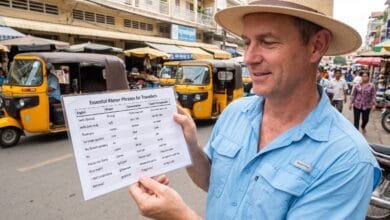
You don’t need to become fluent in Khmer to travel comfortably in Cambodia. But learning a handful of words will make your interactions warmer and more meaningful. Here are the essentials:
| English | Khmer | Romanization | Simple Pronunciation |
|---|---|---|---|
| Hello (informal) | សួស្តី | Susadei | soo-sa-day |
| Hello (formal) | ជំរាបសួរ | Chom Reap Sour | chom-ree-up-soo |
| Thank you | អរគុណ | Awkun | aw-koon |
| Sorry / Excuse me | សុំទោស | Som Toh | sohm-toh |
| Yes (male speaker) | បាទ | Baat | baht |
| Yes (female speaker) | ចា៎ះ | Jah | jah |
| No | ទេ | Te | tay |
| How are you? | សុខសប្បាយទេ? | Sok Sabai Te? | sok-sa-bye tay |
The informal susadei is what you’ll hear between friends and in casual situations. The formal chom reap sour is more appropriate for elders, officials, or someone you’ve just met in a professional setting. If you’re unsure which to use, susadei is almost always safe.
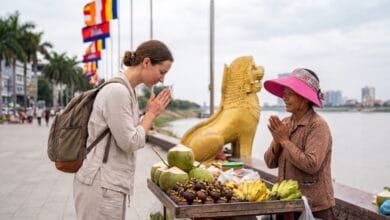
When you say awkun (thank you), pairing it with the traditional sampeah gesture — palms pressed together in front of your chest with a slight bow — shows extra respect. The sampeah is how Cambodians traditionally greet each other, show thanks, or apologize.
How Do You Pronounce Cambodian Place Names?
One of the most practical language tips for travelers is learning to pronounce place names correctly. Here are the ones you’ll encounter most often:
| Place | Khmer | Simple Pronunciation |
|---|---|---|
| Phnom Penh | ភ្នំពេញ | pnom penh |
| Siem Reap | សៀមរាប | see-em reep |
| Angkor | អង្គរ | ang-kor |
| Battambang | បាត់ដំបង | bat-dum-bong |
| Kampot | កំពត | kam-pot |
A common mistake is pronouncing “Phnom” as “fuh-nom” or “puh-nom.” The “Ph” in Khmer romanization represents a *p* sound followed by a slight breath, not an *f* sound. Try saying “puh-nom” with a soft *p* — that’s much closer.
Similarly, “Siem Reap” is not “see-em reap.” The vowel in “Siem” is closer to “see-em” said quickly, and “Reap” rhymes with “deep” rather than “reep.”
What About Minority Languages?
Khmer is not the only language spoken in Cambodia. The country is home to numerous indigenous minority languages, particularly in the northeastern provinces of Ratanakiri and Mondulkiri. These include languages like Tampuan, Kreung, Brao, Kavet, and Jarai.
There are also significant communities of Cham speakers (a Muslim ethnic group), ethnic Chinese, and ethnic Vietnamese, each with their own language traditions. However, Khmer remains the language of government, education, and national media, and most ethnic minorities also speak Khmer to some degree.
For travelers, this means that while you may occasionally hear another language in remote areas, Khmer is the one language that will serve you everywhere in Cambodia.
Common Mistakes Travelers Make
Assuming Khmer is tonal. Because Thailand, Vietnam, and Laos all have tonal languages, many travelers assume Cambodia does too. It doesn’t. You don’t need to worry about getting the pitch “right” in the same way you would in Bangkok or Hanoi.
Using “hello” without the sampeah. The word susadei is fine on its own, but pairing it with the sampeah gesture shows you’ve made an effort to understand Cambodian culture, not just the language.
Trying to read the script too literally. Khmer script doesn’t work like the Latin alphabet. Letters can be stacked, vowels can appear above, below, before, or after consonants, and there are no spaces between words. Don’t expect to sound out words letter by letter.
Forgetting that “yes” depends on your gender. Men say baat, women say jah. Using the wrong one isn’t offensive, but getting it right shows attention to detail.
Frequently Asked Questions
What language do they speak in Cambodia?
Is Khmer difficult to learn?
Khmer grammar is relatively simple — no verb conjugations, no plurals, no gendered nouns. The script is the biggest challenge, but spoken Khmer is achievable for travelers who want to learn a few phrases. The lack of tones makes pronunciation more forgiving than Thai or Vietnamese.
Do I need to speak Khmer to travel in Cambodia?
No. English is sufficient in tourist areas. But learning a few basic words — hello, thank you, sorry — will make your interactions warmer and more meaningful.
How do you say hello in Khmer?
Susadei (soo-sa-day) is the informal greeting. Chom Reap Sour (chom-ree-up-soo) is the formal greeting, used with elders or in professional settings. Pair either with the sampeah gesture for extra respect.
Is Khmer similar to Thai?
They are different languages from different families. Khmer is Austroasiatic; Thai is Kra-Dai. Khmer is not tonal; Thai is. They share some vocabulary through historical contact, but they are not mutually intelligible.
What is the Khmer script like?
Khmer script is an abugida — each consonant carries an inherent vowel, and additional vowels are written as marks around the consonant. It is written from left to right without spaces between words. It has 33 consonants and 24 dependent vowels
Conclusion
Cambodia’s language is one of the country’s most distinctive features. Khmer is not tonal like its neighbors, it has its own beautiful script, and it carries centuries of history in its Sanskrit and Pali influences. For travelers, understanding even a little Khmer transforms the experience. You’ll recognize words on signs, greet people more warmly, and hear the language not as background noise but as part of the country’s identity.
You don’t need to be fluent. You don’t even need to be good. A simple susadei with your hands pressed together in a sampeah will open more doors than you might expect. And when someone smiles and responds in Khmer, you’ll understand — even just a little — what they’re saying back.