The Cambodia Rice Farming Experience: From Planting to Harvesting to Eating
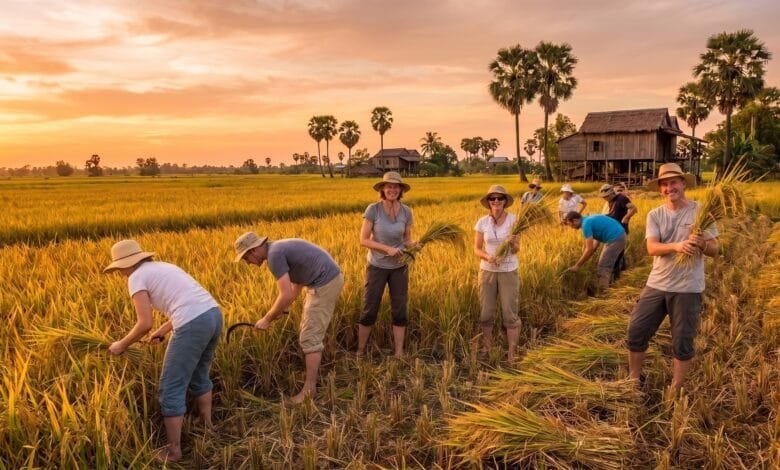
In a small village outside Siem Reap, a farmer bends over a flooded field, her hands moving with practiced speed as she pushes young rice seedlings into the mud. Beside her, a traveler from across the world does the same—learning, slowly, what it means to grow the food that feeds a nation.
This is the Cambodia rice farming experience. And it is one of the most authentic ways to understand this country.
Rice is not just food in Cambodia. It is life. It is culture. It is the story of the Khmer people. To understand Cambodia, you must understand rice—how it is planted, how it is harvested, and how it ends up on your plate.
This guide takes you through the complete journey. You will learn when rice is grown, how farmers work the land, what ceremonies celebrate the rice cycle, and which rice dishes you must try as a traveler.
What Is the Cambodia Rice Farming Experience Like?
The Cambodia rice farming experience is a journey through the agricultural heart of the country. It begins with the first rains of the monsoon and continues through months of careful work in the fields. It ends at the table, where rice appears in countless forms—steamed, fried, pounded into noodles, or simmered into porridge.
For travelers, this experience offers something rare: a chance to see where food actually comes from. You can walk through rice paddies, talk to farmers, and even join in the planting or harvesting. You will taste rice in ways you never imagined. And you will leave with a deeper appreciation for every grain.
Cambodia grows rice year-round in two main seasons. The wet season is the primary growing period, accounting for about 70 percent of annual production. The dry season provides a secondary crop.
Understanding these seasons helps travelers plan their visit.
When Is Rice Planted and Harvested in Cambodia?
The rice farming calendar follows the rhythm of the monsoon.
Wet Season (Primary Crop)
- Planting: May to June, when the rains arrive
- Harvest: August to September for short and medium-term varieties; October to January for long-term varieties
Dry Season (Secondary Crop)
- Planting: November to December
- Harvest: February to April
The cycle usually begins in May or June with the arrival of the monsoon rains. Farmers prepare the soil by ploughing their fields, often using water buffalo or hired tractors. Next, seeds are sown densely in small nursery beds. Once the seedlings are strong enough, farmers pull them up and transplant them by hand into the larger, flooded main fields.
This stage is very labor-intensive and often involves the whole family or village working together.
Finally, around November or December, the rains stop and the rice plants turn from green to golden yellow. This signals the harvest season, when the rice is cut, collected, and prepared for eating or selling.
Traditional Rice Farming Methods
Traditional rice farming in Cambodia is mostly done by hand. Farmers use techniques passed down through generations.
Ploughing is often done with oxen or water buffalo pulling a wooden plough. This prepares the soil for planting.
Transplanting is the most labor-intensive stage. Farmers pull seedlings from nursery beds and plant them one by one in the flooded fields. Families and neighbors often help each other, turning planting into a community event.
Harvesting is traditionally done with sickles. Farmers cut the rice stalks by hand, bundle them, and thresh the grain. In some remote areas, indigenous communities still practice hand-harvesting using a method called Bot Srov, where each stalk is plucked by hand.
While modern machinery is becoming more common, especially in larger farms, many Cambodian farmers still rely on traditional methods. This is part of what makes the Cambodia rice farming experience so authentic.
The Sacred Side of Rice: Ceremonies and Beliefs
Rice is deeply connected to Cambodian spirituality. Farmers believe rice has a spirit that must be treated with respect. In rural areas, rice is not just a crop—it is culture.
The most important rice ceremony is the Royal Ploughing Ceremony, known in Khmer as Pithi Chrat Pheah Neang Korl. This ancient royal ceremony marks the beginning of the planting season and is celebrated as a national public holiday.
The ceremony takes place in May each year, usually on May 15. The King presides over the event. A designated “king” ploughs the field using royal oxen, while a designated “queen” sows seeds in the furrows.
After ploughing, the oxen are offered seven plates of food: rice, corn, green beans, sesame, water, fresh-cut grass, and wine. The oxen’s choices predict the coming harvest. In 2025, the oxen ate 95 percent of the rice and corn and 80 percent of the beans—a very good sign.
For travelers, this ceremony is a fascinating window into Cambodian culture. It shows how deeply rice is woven into the national identity.
The Ok Om Bok festival, also known as the Moon Worship Festival, is celebrated after the harvest is completed. Families prepare offerings of flattened rice and other agricultural products to thank the moon god for the harvest.
Cambodia’s Award-Winning Rice
Cambodia grows many types of rice. The most famous is Phka Rumduol, a premium fragrant rice that has won the World’s Best Rice award seven times, most recently in 2025.
Phka Rumduol belongs to the Jasmine rice family. It is known for its extra-long grain, soft texture, and natural fragrance. Other popular fragrant varieties include Phka Malis, Phka Romeat, and Somali.
Traditional varieties like Neang Om are also being preserved. This fragrant rice was saved by an elderly farmer in Kratie province in the 1980s and officially recognized by the Ministry of Agriculture in 2018. Today, over 60 farming households in Siem Reap province cultivate Neang Om.
Cambodia produced approximately 14.6 million tonnes of rice in 2025, about 17 percent above the five-year average. The country exported 940,321 tonnes of milled rice in 2025, a 45 percent increase from the previous year.
For travelers, tasting Cambodian rice is an experience in itself. The fragrant varieties have a subtle floral aroma and a soft, slightly sticky texture that pairs perfectly with Khmer dishes.
What Travelers Can Eat: Rice in Cambodian Daily Life
Rice is eaten at every meal in Cambodia. Most Cambodians feel they haven’t eaten if a meal does not include rice.
Here are the rice dishes every traveler should try:
Steamed White Rice (Bai Sach Chrouk)
Plain steamed rice is served with almost every meal. It accompanies grilled meats, fish, soups, and stir-fries. The quality of the rice matters—Cambodian Jasmine rice is among the best in the world.
Rice Porridge (Bobor)
Bobor is Cambodia’s version of congee—a silky rice porridge that is the gentlest of breakfast options. Jasmine rice is simmered until it breaks down into a thick, creamy consistency, then topped with shredded chicken, pork, or fish, ginger slices, fried garlic, and green onion.
Rice Noodles (Nom Banh Chok)
Nom Banh Chok is Cambodia’s quintessential breakfast dish. Fresh, hand-pressed rice noodles are served with a fish-based green curry sauce, topped with fresh vegetables, herbs, and edible flowers. It is a true taste of Cambodia.
Sticky Rice (Bai Domneib)
Sticky rice is especially popular in desserts or eaten with grilled meats. You will find it wrapped in banana leaves and grilled, or served with mango and coconut milk.
Deep-Fried Rice Cakes
Rice is also eaten as street-side snacks, such as deep-fried rice cakes with chives and spinach.
Every meal tells a story of the rice that made it possible.
How Travelers Can Experience the Rice Journey
Travelers can experience the Cambodia rice farming experience in several ways.
Join a Village Tour
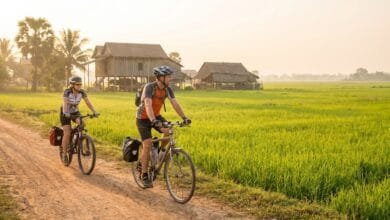
Several tour operators offer village experiences where travelers can join farmers in the fields. In Siem Reap province, foreign tourists have been photographed transplanting rice seedlings alongside local farmers in Preah Dak commune.
These tours typically include:
- Walking through rice paddies
- Helping with planting or harvesting (season dependent)
- Learning about traditional farming methods
- Visiting local homes and markets
Visit Rice-Growing Provinces
The main rice-producing provinces are Prey Veng, Takeo, Battambang, and Banteay Meanchey. Battambang is especially popular with travelers for its scenic rice fields and rural tours.
Attend a Rice Ceremony
If you visit in May, try to attend the Royal Ploughing Ceremony. It is held in a different province each year. In 2025, it was held in Kampong Chhnang province.
Visit a Rice Mill
Some tours include visits to rice mills where you can see how paddy rice is processed into the white rice you eat.
Eat Like a Local
The simplest way to experience the rice journey is to eat Cambodian rice dishes. Visit local markets, try street food, and order rice with every meal. Each bite connects you to the farmers who grew it.
Best Time to Go
The best time for the Cambodia rice farming experience depends on what you want to see:
- May to June: Planting season—see farmers transplanting seedlings
- August to January: Harvest season for wet-season rice—golden fields and harvesting activity
- February to April: Dry-season harvest
- May: Royal Ploughing Ceremony
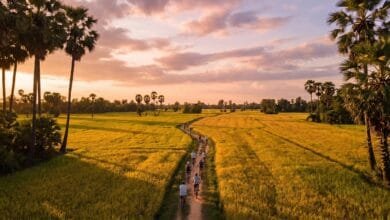
The rice fields are most beautiful during the harvest season, when the green turns to gold.
How Long to Spend
A half-day village tour is enough for a basic experience. For a deeper understanding, consider a full-day or multi-day agricultural tour. Some travelers spend 2–3 days in a rice-growing province like Battambang.
What to Bring
- Sun protection (hat, sunscreen, sunglasses)
- Comfortable clothes that can get dirty
- Closed-toe shoes or boots for walking in fields
- Drinking water
- Camera
- Insect repellent
Practical Tips
- Respect farmers and their work. Ask permission before taking photos.
- The rainy season (May to October) can make fields muddy and roads difficult.
- Dry season (November to April) offers clearer skies and easier travel.
- Many village tours are available through local operators in Siem Reap and Battambang.
Responsible Travel
When visiting farming communities, remember that these are people’s homes and livelihoods. Treat everyone with respect. Support local businesses. Do not treat farmers as attractions—engage with them as people.
Things to Do Nearby
- Siem Reap: Visit Angkor Wat, explore the Old Market, take a cooking class
- Battambang: Ride the bamboo train, visit Phnom Sampov, explore colonial architecture
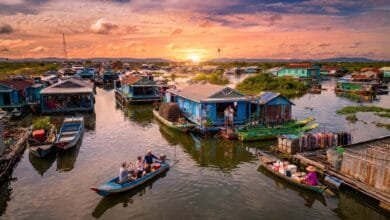
- Kampong Chhnang: Visit floating villages, explore the wetlands
Where to Stay
- Siem Reap: Wide range of hotels and guesthouses
- Battambang: Boutique hotels and riverside guesthouses
- Countryside homestays: For the most authentic experience
Frequently Asked Questions
What is the best time to see rice fields in Cambodia?
The rice fields are most beautiful from August to January, when wet-season rice turns golden and is harvested.
Can tourists help plant rice in Cambodia?
Yes. Many village tours in Siem Reap and other provinces offer hands-on rice planting or harvesting experiences, depending on the season.
What is the Royal Ploughing Ceremony?
It is an annual royal ceremony in May that marks the beginning of the rice planting season. Royal oxen are used to plough a field, and their food choices predict the coming harvest.
What rice dishes should I try in Cambodia?
Try steamed white rice, rice porridge (bobor), rice noodles (nom banh chok), and sticky rice desserts.
What makes Cambodian rice special?
Cambodia grows premium fragrant rice varieties like Phka Rumduol, which has won World’s Best Rice seven times. The rice has a natural fragrance, soft texture, and is grown using traditional methods.
How long does the rice farming cycle take?
Short-term varieties take about 90–110 days. Medium-term varieties take 120–150 days. Long-term varieties take 155 days or more
Where are the best places to see rice fields in Cambodia?
Battambang, Siem Reap, Prey Veng, Takeo, and Banteay Meanchey provinces have extensive rice fields.
Final Thoughts
The Cambodia rice farming experience is more than a tour. It is a journey into the soul of the country.
You will see farmers working under the hot sun, their hands in the mud. You will taste rice in forms you never knew existed. You will learn about ceremonies that have been performed for centuries. And you will understand why rice is not just food in Cambodia—it is identity.
When you sit down to eat in Cambodia, take a moment to look at the rice on your plate. Think about the rain that fell, the hands that planted, the sun that ripened, and the traditions that brought it to you. That is the real taste of Cambodia.
Every grain tells a story. And now, you know how to read it.