How Smartphones Are Changing Everyday Life in Cambodia
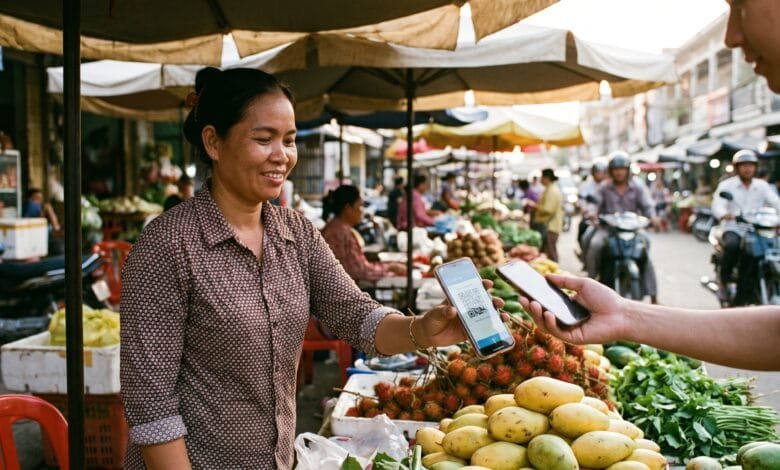
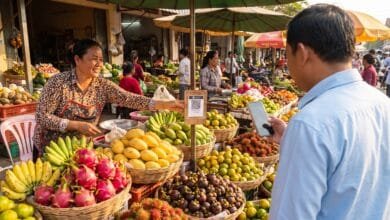
Walk through almost any market in Cambodia today and you will see something that would have been hard to imagine twenty years ago. A fruit vendor weighs mangoes with one hand and holds a smartphone in the other, ready to accept payment through a QR code. A tuk-tuk driver checks Google Maps between fares. A group of university students sit at a coffee shop, not talking to each other, but filming short videos for TikTok.
For a visitor arriving from the United States, the level of mobile connectivity can be genuinely surprising. Cambodia, a country where the average income remains far below Western levels, has one of the highest rates of smartphone adoption in Southeast Asia. Understanding how this happened — and what it means for daily life — offers a window into how modern Cambodia actually works.
What Is Happening in Cambodia Today?
The numbers tell a striking story. Smartphone penetration in Cambodia has surpassed 94%, according to industry analysis published in 2026. Entry-level 4G handsets from Chinese brands, priced between $50 and $100, made smartphones affordable for a much wider share of the population than many observers had predicted.
Cambodia recorded 20.69 million mobile phone users and 19.62 million internet subscribers as of April 2025. Those figures exceed the country’s estimated population of roughly 17.7 million, reflecting a pattern where many people maintain multiple SIM cards or devices. The penetration rate stands at 117.75% for mobile services and 111.62% for internet subscriptions.
In other words, mobile phones are not a luxury item in Cambodia. They are close to universal.
Why Did Smartphones Spread So Fast?
Several factors combined to accelerate adoption. The first was infrastructure. Cambodian telecom operators invested heavily in mobile networks, effectively leapfrogging older fixed-line technology. Rather than building extensive landline systems, the country moved directly to mobile. By 2026, 4G coverage reached approximately 94.7% of the population, and commercial 5G service launched in January 2026.
The second factor was cost. The three major mobile network operators — Cellcard, Smart Axiata, and Metfone — compete aggressively on price. This competition has driven down the cost of data plans and handsets, making connectivity accessible to a broad segment of the population.
The third factor is demographic. Cambodia has a young population, with a large share of citizens under 30 who have grown up with digital technology as a normal part of life.
What Does It Look Like in Everyday Life?
The most visible change may be in how people pay for things.
Cambodia’s Bakong payment system, developed by the National Bank of Cambodia, has become a remarkable piece of national infrastructure. By 2026, Bakong reached 39 million accounts — a figure 2.2 times the country’s total population — and over 4.5 million merchants accept Bakong payments across Cambodia. In 2025 alone, the system processed 1.3 billion transactions, a 118.7% increase from the previous year.
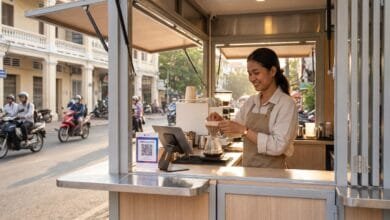
In practice, this means that a street vendor selling grilled bananas, a motorbike mechanic, or a family-run noodle shop can all accept digital payment through a standardized QR code. For travelers, this changes the experience of spending money in Cambodia significantly. You can pay for almost anything with a scan, including at small businesses that would never accept credit cards.
Social media usage is equally widespread. Facebook leads with over 15.6 million accounts — approximately 86% of the population — followed by TikTok with over 10.7 million users, according to a 2026 report from Cambodia’s Ministry of Information. Telegram has also become a major platform, with over 10 million users, partly because it functions as a messaging tool for businesses and community groups.
Food delivery apps like Nham24, foodpanda, and BLOC have become common in Phnom Penh and Sihanoukville. These apps let users order meals, groceries, and even transportation from their phones — a service model that barely existed in Cambodia a decade ago.
How Is It Affecting Cambodian Life?
The effects go beyond convenience. Smartphones have created new economic opportunities.
Young Cambodians are using platforms like Upwork and local job marketplaces to find freelance work in software development, graphic design, and digital marketing. Remote work and co-working spaces have grown in Phnom Penh, connecting Cambodian professionals to international clients in ways that were not possible before smartphones and reliable internet.
In rural areas, smartphone-based tools are slowly reaching farming communities. The Mekong Farm app, piloted in Battambang province, connects smallholder farmers with buyers and provides agroecology advice. The project reported high smartphone ownership among farmers but also found that platforms need to be simpler and more intuitive than many existing agricultural apps.
But the transformation also brings challenges. A 2025 study found that while 89% of surveyed participants owned smartphones, only 17% had a digital bank or mobile account. The gap points to limited digital literacy as a key barrier — owning a device does not automatically mean having the skills to use digital financial services safely.
Online fraud has also become a real concern. Cambodian authorities reported that citizens lost over $45 million to online scams in 2025. The government has launched awareness campaigns and a smartphone app designed to teach students how to recognize scams and disinformation.
What Might Travelers Notice?
If you visit Cambodia, a few things about smartphone culture may stand out.
First, connectivity is easy to access. Local SIM cards are cheap and widely available at airports and convenience stores. Most hotels, cafes, and restaurants offer free Wi-Fi. Staying connected is rarely a problem.
Second, cash is still king in many situations — but digital payment is catching up quickly. While credit cards remain limited outside major hotels and upscale restaurants, QR code payments through Bakong are widely accepted. The National Bank of Cambodia even introduced the Bakong Tourist app specifically for international visitors, with approximately 37,000 accounts registered as of 2026.
Third, you may notice how integrated phones are in public life. Vendors use them for inventory. Tuk-tuk drivers use them for navigation. Students use them for both study and entertainment. Monks at pagodas sometimes use them to livestream ceremonies or share teachings.
How Is This Different From the Past?
It is worth remembering how recent this change is. As recently as the early 2010s, mobile phone ownership in Cambodia was far less common, and internet access was limited mostly to urban areas and internet cafes. The smartphone era in Cambodia is essentially a story of the past decade.
The speed of the shift explains why some older Cambodians find digital life harder to navigate than younger ones, and why digital literacy programs have become a priority for the government and NGOs. The Ministry of Posts and Telecommunications launched a Digital Skill Development Roadmap 2024–2035 to address this gap.
What Could Happen Next?
The commercial launch of 5G in January 2026 marks a new phase. Faster connectivity could accelerate the growth of digital services — from mobile banking to online education to e-government platforms.
Cambodia’s e-commerce market, valued at approximately $1.1 billion in 2025, is projected to reach $1.8 billion by 2029. The Bakong system continues to expand cross-border payment connections, including with India’s UPI network, making it easier for international visitors to pay digitally.
At the same time, the digital literacy gap and the rise in online scams suggest that Cambodia’s digital transformation will need to be matched by efforts to ensure that people can use these tools safely and confidently.
Frequently Asked Questions
Is mobile internet reliable in Cambodia?
Yes, in most areas. 4G coverage reaches about 94.7% of the population, and 5G service began in 2026. Urban areas have strong connectivity, though rural coverage can be less consistent.
Can I use my US phone in Cambodia?
Most unlocked smartphones work in Cambodia. You can buy a local SIM card for a few dollars at the airport or in convenience stores. Many travelers also use eSIM services.
Do Cambodians use cash or digital payments?
Both. Cash is still widely used, especially in rural areas. But QR code payments through Bakong are accepted at over 4.5 million merchants, including many small street vendors.
What social media apps are popular in Cambodia?
Facebook is the most widely used, with over 15.6 million accounts. TikTok is also very popular, with over 10.7 million users. Telegram is widely used for messaging.
Is it safe to use mobile banking in Cambodia?
Mobile banking is widely used and generally secure. However, online scams are a real issue. Cambodia’s central bank does not charge service fees for Bakong transactions, but users should be cautious about phishing links and unfamiliar requests.
Will I need a smartphone to travel in Cambodia?
Not strictly, but it helps enormously. A smartphone makes it easier to navigate, translate, pay, and book transport. Most travelers find that a local SIM card or eSIM is one of the most useful things they can buy on arrival.
Conclusion
Smartphones have become woven into the fabric of daily life in Cambodia. For a device that most Cambodians did not own a generation ago, its reach is extraordinary — from street-level QR payments to nationwide digital banking, from social media to rural farming tools.
For international visitors, this transformation changes what Cambodia feels like on the ground. It is a country where a tuk-tuk driver can navigate by app and a market vendor can accept payment with a scan. It is a place where traditional life and digital life coexist, sometimes seamlessly, sometimes awkwardly.
Understanding this shift helps travelers see Cambodia not as a country stuck in the past, but as one actively shaping its own modern identity — on its own terms, and often faster than outsiders expect.