Visiting the National Museum of Cambodia: What First-Time Visitors Should Know
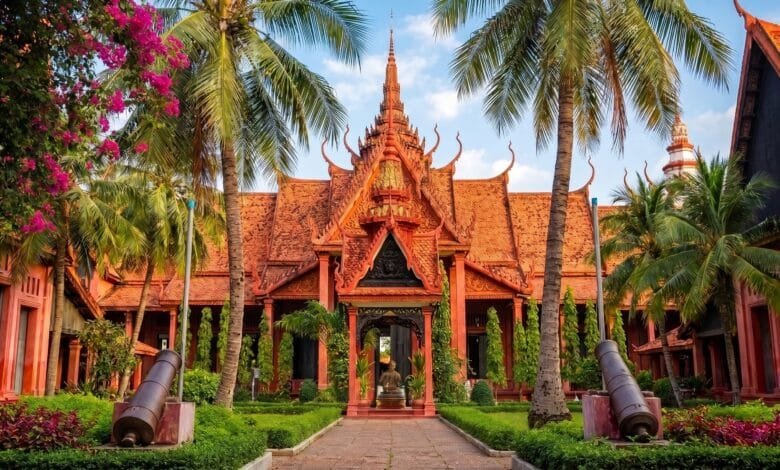
If you walk north from Phnom Penh’s Royal Palace, you will soon see a building that looks like it belongs in a different century. Its terracotta walls glow in the afternoon light. Its tiered roof rises in the style of traditional Khmer temples. A quiet courtyard with lotus ponds sits just inside the entrance.
This is the National Museum of Cambodia. It holds one of the world’s largest collections of Khmer art and artifacts. For many travelers, it is the best place to understand Cambodian history before or after visiting the temples of Angkor.
The museum is not large. But what it contains is remarkable. More than 14,000 objects tell the story of Cambodia from prehistoric times through the great Angkor period and beyond. For a first-time visitor, this guide explains what you will see, what to expect, and what you should know before you go.
Quick Travel Information
Location: Street 13, just north of the Royal Palace, Phnom Penh
Type of destination: National museum of cultural history and archaeology
Province/City: Phnom Penh
Known for: One of the world’s finest collections of Khmer sculpture and art
Main experience: Viewing stone and bronze sculptures from the pre-Angkorian, Angkorian, and post-Angkorian periods
Main access: Tuk-tuk, taxi, or walking from nearby Riverside hotels
Recommended visit time: 1.5 to 2 hours
Entrance fee: $10 for foreign adults (18+); $5 for foreign youth ages 10–17; Cambodians pay 500 Riels; children and school groups are free
Opening hours: 8:00 AM to 5:00 PM daily; last admission tickets sold at 4:30 PM
Useful to know: Photography is not permitted inside the museum galleries, but you may photograph the exterior and courtyard
What Is the National Museum of Cambodia?
The National Museum of Cambodia is the country’s leading museum of cultural history. It is located in central Phnom Penh, immediately north of the Royal Palace. The building itself is a landmark.
It was constructed between 1917 and 1920 during the French colonial period. The design was inspired by traditional Khmer temple architecture, with a blend of French colonial elements. The result is a building that feels both ancient and elegant, with tall roofs, open courtyards, and warm terracotta coloring.
Inside, the museum houses approximately 14,000 items. These include stone sculptures, bronze statues, ceramics, and ethnographic objects. The collection spans from prehistoric times through the pre-Angkorian period (Funan and Chenla), the great Angkorian period (roughly the 9th to 14th centuries), and the post-Angkorian era.
For travelers, the museum serves a practical purpose. It provides context. If you are planning to visit Angkor Wat or other temple sites, the museum helps you understand what you are looking at. If you have already visited the temples, it deepens what you saw.
Why Visit the National Museum of Cambodia?
There are several factual reasons this museum is worth your time.
It holds the world’s finest collection of Khmer sculpture. Lonely Planet describes the museum as home to “the world’s finest collection of Khmer sculpture: a millennium’s worth and more of masterful Khmer design”. This is not a promotional claim — it is a widely recognized assessment among art historians and travel authorities.
It gives context to Cambodia’s temples. Many travelers visit Angkor Wat and other temples without understanding the artistic and religious traditions behind them. The museum’s chronological layout helps you see how Khmer art developed over more than a thousand years. Seeing the museum before Angkor is a common traveler recommendation.
The building itself is worth seeing. The architecture blends Khmer temple style with French colonial design. The courtyard, with its lotus ponds and quiet atmosphere, offers a peaceful break from the busy streets outside.
It is convenient. The museum is located in the heart of Phnom Penh, within walking distance of the Royal Palace, the Riverside area, and other major attractions. It is easy to add to a morning or afternoon of sightseeing.
What to See
The museum’s collection is organized in a roughly chronological order. Most visitors begin on the left side of the central courtyard and move clockwise.
The Reclining Vishnu
One of the first major works you will encounter is a large bronze Reclining Vishnu. This statue was recovered from the Western Mebon temple near Angkor Wat in 1936. It is considered a masterpiece of Khmer bronze casting. The figure originally measured over two meters long. Today, the surviving fragments — including the head, shoulders, and arms — convey the monumental scale of the original work.
Pre-Angkorian Sculptures
The southern pavilion contains works from the pre-Angkorian period. This section shows the transition from Indian-influenced forms to distinctly Khmer styles of sculpture. Highlights include an eight-armed Vishnu statue from Phnom Da and a Harihara sculpture from Prasat Andet.
Angkorian Masterpieces
The Angkor collection is the heart of the museum. It includes several striking statues of Shiva from the 9th through 11th centuries. You will also see a giant pair of wrestling monkeys from Koh Ker and a beautifully carved stele from Oddar Meanchey Province depicting scenes from the life of Shiva.
The Seated Jayavarman VII
Perhaps the most famous single piece in the museum is the seated statue of King Jayavarman VII. This sculpture dates to the late 12th century, from the Bayon style period. The king is shown with his head slightly bowed in a meditative pose — an image that has become one of the most recognizable symbols of Khmer art.
Pottery, Bronzes, and the Royal Barge
The museum also contains displays of pottery and bronzes from the Funan, Chenla, and Angkor periods. One notable later work is a beautifully carved wooden royal barge.
What to Do
Most visitors spend their time walking through the galleries and viewing the sculptures. Here are realistic ways to experience the museum:
Take a guided tour. Guides are available at the museum entrance in Khmer, English, French, and Japanese. A guide can explain the religious and historical context of the major works, which makes the experience much more meaningful for first-time visitors.
Use an audio guide. Audio guides are available in multiple languages for approximately $5. They provide commentary on the major pieces and allow you to explore at your own pace.
Buy a guidebook. The museum shop sells a comprehensive guide called The New Guide to the National Museum (approximately $15) and a smaller booklet called *Khmer Art in Stone* (approximately $2) that covers the signature pieces.
Sit in the courtyard. The central courtyard is a quiet, peaceful space with lotus ponds and seating. It is a good place to rest and reflect between gallery visits.
Visit the museum shop. The shop at the main entrance sells postcards, souvenirs, replica sculptures, and books on Cambodian art and culture.
The Story and History of the National Museum
The National Museum of Cambodia was founded during the French colonial period. The foundation stone was laid on August 15, 1917. The museum was officially inaugurated in 1920 and was initially named the Musée Albert Sarraut, after the Governor-General of Indochina at the time.
The driving force behind the museum was George Groslier, a French museum director and scholar of Khmer art. He envisioned a museum that would preserve and display Cambodia’s cultural heritage in a building inspired by traditional Khmer architecture.
Over the decades, the museum faced significant challenges. During the Khmer Rouge period (1975–1979), the museum was closed and its staff were displaced. The collection survived, though much of the documentation and records from that era were lost.
Since the 1990s, the museum has undergone extensive restoration and modernization. With support from UNESCO, the French government, and other international partners, conservation workshops were established, storage facilities were improved, and the collection was inventoried and protected.
In recent years, the museum has played an active role in the restitution of looted artifacts. Several important pieces have been returned to Cambodia from international institutions and private collections, including works from the Metropolitan Museum of Art in New York.
Culture and Local Meaning
The National Museum is more than a tourist attraction. It is a national institution that preserves and protects Cambodia’s cultural identity. For Cambodians, the museum represents a connection to the country’s ancient past and a source of national pride.
The museum also serves a religious function. It houses important Buddhist and Hindu sculptures, and parts of the collection are used for worship. A permanent exhibition called “Post-Angkorian Buddha” was opened in 2000 to extend the museum’s religious role.
Visitors should treat the museum with the same respect they would give a temple or religious site. The artifacts are not just art objects — they are sacred and culturally significant to many Cambodians.
What the Experience Is Like
The National Museum is a calm, quiet place. It is rarely as crowded as the Royal Palace next door. This makes it a good choice if you want a slower, more contemplative experience.
The building is open-air in design, with galleries arranged around a central courtyard. Natural light enters through the roof and open spaces. This gives the museum a soft, peaceful atmosphere. It is cool inside compared to the street outside, though it can still feel warm during the hottest part of the day.
Most visitors spend between one and two hours at the museum. Some spend longer if they hire a guide or use an audio guide. The pace is slow and relaxed. There is no rush.
The museum is particularly good for travelers who want to understand what they are seeing at Angkor. The chronological layout helps you see how Khmer art evolved. It is also a good rainy-day activity, since much of the museum is indoors.
How to Get There
The National Museum is located on Street 13, just north of the Royal Palace. The visitor entrance and ticket booth are at the corner of Street 13 and Street 178.
By tuk-tuk: Tuk-tuks are the most common way for tourists to get around Phnom Penh. You can hire one from most hotels and guesthouses in the city center. The ride from the Riverside area or central hotels typically takes about 10 minutes.
By taxi: Metered taxis and ride-hailing apps like Grab are available in Phnom Penh. They offer a comfortable alternative to tuk-tuks, especially during hot or rainy weather.
On foot: If you are staying near the Royal Palace or the Riverside area, the museum is within walking distance. It is about a 5-minute walk from the Royal Palace’s north entrance.
How to Visit
What to bring: Bring water, as the museum can be warm. A small bag is fine, but large bags should be left at the cloakroom near the main entrance.
What to wear: There is no strict dress code at the museum, but respectful clothing is appreciated. Since the museum houses religious artifacts, avoid very revealing clothing. Comfortable walking shoes are recommended.
Photography: Photography is not permitted inside the museum galleries. You may take photos of the building exterior and the courtyard. If you want images of the collection for study or publication, you must contact the museum in advance.
Rules: Smoking is not permitted inside the museum. Do not touch the artifacts. Keep your voice low and respect other visitors.
Accessibility: The museum is primarily on one level with a courtyard layout. The pathways are generally flat and walkable. However, some areas may be difficult for wheelchairs or strollers due to uneven surfaces. It is best to inquire at the entrance if you have specific accessibility needs.
Time needed: Most visitors spend 1.5 to 2 hours at the museum. This allows time to walk through all the galleries and rest in the courtyard.
Best Time to Visit
Season: The dry season in Cambodia runs from November to March. This is the most comfortable time to visit Phnom Penh, with cooler temperatures and lower humidity. The dry season is also the peak tourist season, so the museum may be busier.
Time of day: Morning is generally the best time to visit. The museum opens at 8:00 AM, and arriving early means fewer crowds and cooler temperatures. Late afternoon is also a good option, as the light through the courtyard is beautiful and the museum is quieter.
Avoid: The hottest part of the day (around noon to 2:00 PM) can be uncomfortable, especially if you are walking from nearby attractions.
How Long to Spend
Most travelers spend about 1.5 to 2 hours at the National Museum. This is enough time to see the major galleries at a relaxed pace.
If you hire a guide or use an audio guide, you may want to allow 2 to 3 hours. If you are particularly interested in Khmer art or archaeology, you could easily spend half a day.
A common approach is to visit the museum in the morning, then walk to the Royal Palace next door for the afternoon. This makes efficient use of your time in Phnom Penh.
Nearby Places to Combine With Your Visit
The National Museum is located in one of the most convenient areas of Phnom Penh for sightseeing. Several major attractions are within walking distance.
Royal Palace and Silver Pagoda: The Royal Palace is immediately south of the museum. It is one of Phnom Penh’s most important landmarks. The Silver Pagoda, located within the palace compound, is famous for its floor covered in silver tiles.
Wat Phnom: This historic temple is located a short distance north of the museum. It is the namesake of Phnom Penh and an important Buddhist site.
Riverside area: The Sisowath Quay riverside promenade is a short walk from the museum. It is a good place for an evening stroll, with restaurants and cafes overlooking the Mekong River.
Central Market (Phsar Thmei): This art deco market is a short tuk-tuk ride from the museum. It is a good place to see local life and shop for souvenirs.
FCC Colonial Cafe: A popular spot near the Riverside for a drink or meal after your museum visit. It offers a relaxed atmosphere and views of the river.
Travel Tips
Visit before Angkor if you can. Many travelers find that visiting the National Museum before going to Siem Reap and Angkor Wat helps them understand the temples better. The museum provides historical and artistic context that makes the temple experience richer.
Hire a guide. The museum’s collection is impressive, but without context, it can be hard to appreciate. A guide can explain the religious stories, the artistic techniques, and the historical significance of the major works.
Go in the morning. The museum opens at 8:00 AM. Arriving early means fewer people and cooler temperatures.
Combine with the Royal Palace. The two attractions are next to each other. Visiting both in one day is easy and efficient.
Check current information before you go. Opening hours, ticket prices, and rules can change. It is always a good idea to verify current details with the museum or a reliable travel source before your visit.
Responsible Travel
The National Museum of Cambodia is a place of cultural and religious significance. Visitors can help protect it by following a few simple guidelines:
Do not touch the artifacts. The oils on your hands can damage ancient stone and bronze. Even a light touch can cause harm over time.
Respect the photography rules. Photography is not allowed in the galleries. This rule exists to protect the artifacts and to preserve a quiet atmosphere for all visitors.
Keep your voice low. The museum is a place for quiet reflection. Loud conversations disturb other visitors and show disrespect for the cultural setting.
Follow the rules. Do not smoke inside the museum. Do not bring food or drinks into the galleries. Leave large bags at the cloakroom.
Support the museum. Donations are welcome and help fund conservation, education, and maintenance programs. You can also support the museum by buying from the shop or hiring a local guide.
Be mindful of the museum’s religious role. Some of the sculptures are objects of worship. Treat them with the same respect you would give a temple or shrine.
Frequently Asked Questions
Is the National Museum of Cambodia worth visiting?
Yes, for most travelers interested in Cambodian history and culture. It houses the world’s finest collection of Khmer sculpture and provides essential context for understanding Cambodia’s temples. If you are planning to visit Angkor Wat, the museum is especially valuable.
How much does it cost to enter the National Museum?
Can I take photos inside the National Museum?
How long does it take to visit the National Museum?
Most visitors spend 1.5 to 2 hours. If you hire a guide or use an audio guide, you may want to allow 2 to 3 hours.
What is the best time to visit the National Museum?
Morning is generally best. The museum opens at 8:00 AM, and arriving early means fewer crowds and cooler temperatures. The dry season (November to March) is the most comfortable time of year.
Is the National Museum accessible for wheelchairs?
The museum is primarily on one level, but some pathways may be uneven. It is best to inquire at the entrance about specific accessibility needs.
Conclusion
The National Museum of Cambodia is not the biggest museum you will ever visit. But it may be one of the most memorable. It offers a quiet, focused look at a thousand years of Khmer art and culture, all housed in a beautiful building that is itself worth seeing.
This museum is a good fit for cultural travelers, history enthusiasts, and anyone who wants to understand Cambodia beyond the temples. It is easy to visit, conveniently located, and affordable. For many travelers, it becomes one of the highlights of their time in Phnom Penh.
If you are planning a Cambodia itinerary, consider placing the National Museum early in your trip. The context it provides will make everything you see afterward — especially at Angkor — feel richer and more meaningful.
One practical takeaway: Go in the morning, hire a guide, and take your time. The museum rewards a slow, curious visit.