Cambodia’s Royal Ploughing Ceremony: When Sacred Oxen Predict the Harvest
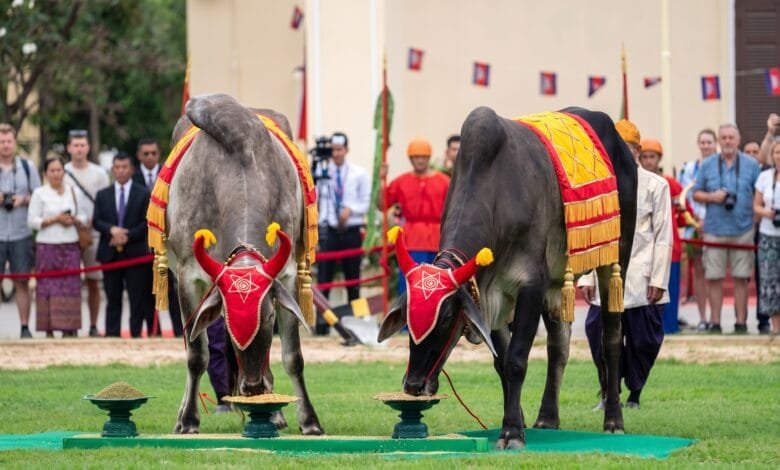
On a warm May morning in Cambodia, two royal oxen are led across a ceremonial field. Before them, seven golden trays are set on the ground, each filled with something different: rice, corn, green beans, sesame, fresh grass, water, and wine.
The oxen lower their heads. They choose.
What they eat — and what they ignore — will be read by royal Brahmin priests as a prediction for the entire coming harvest season. In a country where most families depend on rice farming, this is no small matter. It is the moment when the kingdom’s agricultural future, at least symbolically, is revealed.
This is the Royal Ploughing Ceremony, one of Cambodia’s oldest and most important royal traditions. It marks the official start of the rice-growing season, and it’s one of the most accessible royal ceremonies a visitor can witness.
Quick Festival Information
Festival: Royal Ploughing Ceremony
Khmer name: Preah Reach Pithi Chrot Preah Neangkol (ព្រះរាជពិធីច្រត់ព្រះនង្គ័ល)
Typical time: Early-to-mid May (determined by the lunar calendar)
2026 date: Tuesday, May 5
Length: One main day (often with multi-day celebrations in the host province)
Type: Royal, agricultural, and national observance
Main locations: Traditionally Veal Preah Meru, in front of the National Museum near the Royal Palace in Phnom Penh; rotates to provinces in some years (2026: Prey Veng province)
Main activities: Royal procession, ceremonial ploughing, oxen divination ritual, traditional music and performances
Visitor experience: Free, open to the public, early morning start
What Is the Royal Ploughing Ceremony?
The Royal Ploughing Ceremony is an ancient royal rite that marks the traditional beginning of the rice-growing season in Cambodia. It combines royal pageantry, Brahmin ritual, Buddhist blessing, and agricultural tradition into a single ceremonial event.
At its heart, the ceremony is a prayer for a good harvest. It formally announces to the entire country that the planting season has arrived — a signal for farmers across Cambodia to begin preparing their fields.
The ceremony is known in Khmer as Preah Reach Pithi Chrot Preah Neangkol. The name combines royal titles with words meaning “to plough,” reflecting both the royal nature of the event and its connection to the land.
Why Does This Ceremony Matter So Much in Cambodia?
Cambodia is an agricultural country. More than 80 percent of the population depends on farming, and rice is the single most important crop. A good harvest means food security, income, and stability for millions of families.
That is why this ceremony carries meaning far beyond its ceremonial role. It is a ritual that acknowledges the deep connection between Cambodian people, the land they farm, and the natural cycles that determine whether the year ahead will bring abundance or hardship.
There is also a spiritual dimension. The ceremony is traditionally understood as a way to pray for sufficient seasonal rainfall, protect against disease, and ask for blessings on the kingdom. It reflects the belief that the king, as the protector of his people, also plays a role in ensuring their prosperity.
When Is the Royal Ploughing Ceremony?
The ceremony follows the Khmer lunar calendar. It is traditionally held on the 4th day of the 6th lunar month’s waning moon, which usually falls in May.
In 2026, the Royal Ploughing Ceremony falls on Tuesday, May 5. It is a national public holiday in Cambodia. The exact date is set by royal astrologers and announced in advance, so visitors should always verify the current year’s date before planning a trip around it.
The Lunar Calendar Connection
Many Cambodian festivals are tied to the lunar calendar, which means their dates shift from year to year. The Royal Ploughing Ceremony is no exception. Its timing is determined by astrological calculations rather than a fixed date. This is similar to how Easter moves each year in the Western calendar — the underlying principle is religious and traditional rather than fixed.
The History Behind the Ceremony
The history of the Royal Ploughing Ceremony in Cambodia can be traced back to the Funan period, roughly the 1st to 6th century CE. The tradition was introduced from ancient India, where royal ploughing ceremonies were performed to ensure agricultural prosperity.
One of the earliest pieces of physical evidence is a 6th-century statue of Balarama holding a plough, found in Angkor Borei, the former capital of Funan. This statue is considered the earliest archaeological evidence connected to the ploughing ritual in Cambodia.
Over the centuries, the ceremony evolved. It absorbed elements from Brahmanism, Hinduism, and later Theravada Buddhism, reflecting Cambodia’s layered religious history. At some point, two similar ceremonies — one Hindu and one Buddhist — merged into the single ceremony that exists today.
The ceremony has been performed by Cambodian kings since ancient times. Even in periods when the monarchy faced challenges, the tradition was preserved.
How the Ceremony Unfolds
The Royal Ploughing Ceremony follows a precise sequence that has been refined over centuries. Here’s what typically happens.
The Royal Procession
The ceremony begins with a formal procession. Royal officials, Brahmin priests, and dignitaries move through the ceremonial grounds, often accompanied by traditional musicians and dancers. Officials wear elaborate traditional Khmer dress, and the atmosphere is both solemn and festive.
The Ploughing Ritual
A specially appointed official — traditionally a provincial governor or high-ranking figure — takes the role of the “Lord of the Ploughing.” He drives a pair of royal oxen attached to a decorated plough across a ceremonial field three times. A “Queen of Sowing” follows, scattering rice seeds from golden and silver baskets.
The act of ploughing is symbolic. The king himself does not normally plough — instead, he appoints a representative to perform the physical ritual on his behalf. This reflects the traditional belief that the king is the “lord of the earth” and that the ceremony demonstrates royal care for the people’s livelihood.
The Sacred Oxen’s Prediction
This is the most anticipated part of the ceremony. After the ploughing, the royal oxen are led to seven trays of food. The trays contain:
- Rice
- Corn
- Green beans
- Sesame
- Fresh-cut grass
- Water
- Wine
The oxen choose what they want to eat. A royal Brahmin priest then reads their choices and announces a prediction for the coming agricultural season.
The Rush for Sacred Soil
After the prediction is announced, the crowd is allowed onto the field. People rush to collect grains of rice and handfuls of soil from the ceremonial field. These are believed to bring good luck and are sometimes kept in homes or scattered on family farms as a blessing.
What the Oxen’s Choices Mean
The traditional interpretation of the oxen’s choices follows a set of long-established meanings:
- If the oxen eat rice, corn, or beans: A good harvest is predicted for those crops.
- If the oxen eat a lot of food overall: Agricultural yields will be high.
- If the oxen eat little: Yields may be low.
- If the oxen eat grass: Cattle may face disease or epidemics.
- If the oxen drink a lot of water: Floods may be expected.
- If the oxen drink wine: Trade may prosper, though some traditional readings also associate it with social or political uncertainty.
It’s important to understand that these predictions are a matter of tradition and cultural belief, not scientific forecasting. Many Cambodians follow the predictions with interest, while others treat the ceremony primarily as a cultural and royal tradition rather than a literal forecast.
What Visitors Can Expect to See
If you attend the Royal Ploughing Ceremony as a visitor, here is what you might experience:
An early morning start. The ceremony typically begins around 7–8 AM, and the best viewing spots fill up by 6 AM. You’ll want to arrive early.
A colorful, formal atmosphere. Officials in traditional dress, Brahmin priests in white, and royal guards create a visual spectacle unlike any typical Western festival. The mood is respectful and ceremonial — think of it more like a state occasion than a street party.
Traditional music and performance. Court musicians play traditional instruments throughout the ceremony, and there are often cultural performances before or after the main ritual.
A large, diverse crowd. The ceremony draws thousands of Cambodians — farmers, families, students, and officials — along with a smaller number of foreign visitors. The atmosphere is calm and orderly despite the crowds.
The moment of prediction. The most dramatic moment comes when the oxen approach the food trays. The crowd goes quiet as the oxen make their choices and the Brahmin priest announces the results.
The post-ceremony rush. After the official ceremony ends, there is often a lively scramble as people collect sacred soil and rice grains from the field. It’s chaotic but good-natured, and it gives you a glimpse of how deeply the ceremony resonates with ordinary Cambodians.
Can Tourists Attend the Royal Ploughing Ceremony?
Yes — and it’s one of the easier major Cambodian ceremonies for visitors to attend. The ceremony is free and open to the public, with no tickets required. You simply show up and find a spot to watch.
That said, there are some practical considerations:
- Verify the location. In most years, the ceremony is held at Veal Preah Meru in Phnom Penh, in front of the National Museum near the Royal Palace. However, it sometimes rotates to a province. In 2026, it will be held in Prey Veng province. Always confirm the current year’s location before making travel plans.
- Arrive early. The best viewing areas fill up quickly. Plan to arrive by 6 AM if you want a good spot.
- Bring sun protection. The ceremony takes place in an open field with minimal shade. A hat, sunscreen, and water are essential.
- Be patient. The ceremony involves a lot of waiting and formal ritual. It’s not a fast-paced event.
How Visitors Should Behave Respectfully
The Royal Ploughing Ceremony is both a royal event and a religious observance. Respectful behavior is expected and appreciated.
Dress respectfully. This is not a beach or a backpacker bar. Smart casual clothing is the minimum — think long pants or a skirt that covers the knees, and a shirt that covers your shoulders. You are near the Royal Palace and in the presence of royal officials.
Follow instructions. Security and event staff will direct where you can stand or sit. Follow their guidance without argument.
Don’t interrupt the ceremony. Photography is generally allowed from public areas, but avoid moving into restricted zones or blocking the view of others. Do not approach the oxen, the food trays, or the officiating priests during the ritual.
Observe quietly. The ceremony has moments of silence and prayer. Match the mood of the crowd — if people are quiet and attentive, so should you be.
Ask before photographing people. This is good practice everywhere in Cambodia. If you want a close-up photo of someone in traditional dress, ask first with a smile and a gesture toward your camera.
Be careful in the crowd. The post-ceremony rush for sacred soil can get crowded and pushy. If you’re not comfortable in tight crowds, step back and watch from a distance.
Food and Family Traditions Connected to the Ceremony
Unlike festivals such as Pchum Ben or Khmer New Year, the Royal Ploughing Ceremony is not primarily a family-centered food festival. It is a public, ceremonial event rather than a household celebration.
However, food does play a symbolic role. The seven trays of food presented to the oxen represent the kingdom’s agricultural abundance. After the ceremony, some families collect sacred rice grains and mix them with their own seed rice before planting, as a blessing for the coming season.
For visitors, the ceremony is more about witnessing a tradition than participating in a feast. That said, the public holiday means many Cambodians have the day off, and you may find families gathering for meals after the ceremony, especially in the host province.
What Makes This Ceremony Special
There are few ceremonies like this left in the world. The Royal Ploughing Ceremony is a living link to Cambodia’s ancient past — a tradition that has survived for more than a thousand years, through empires, wars, and profound social change.
It is also a ceremony that speaks to something universal. The hope for a good harvest, the anxiety about rain and drought, the belief that leaders have a responsibility for the well-being of ordinary people — these themes resonate across cultures, even if the specific rituals are uniquely Cambodian.
For travelers, the Royal Ploughing Ceremony offers something rare: a chance to witness a genuine royal ceremony, rooted in centuries of tradition, without paying for a ticket or joining a tour group. You simply need to show up with respect and curiosity.
Frequently Asked Questions
When is the Royal Ploughing Ceremony in 2026?
What does the Royal Ploughing Ceremony celebrate?
It marks the traditional beginning of the rice-growing season in Cambodia. It is a royal and agricultural ceremony that formally announces the start of planting season and offers prayers for good rainfall and a bountiful harvest.
Where is the Royal Ploughing Ceremony held?
Traditionally, it is held at Veal Preah Meru, the field in front of the National Museum near the Royal Palace in Phnom Penh. In some years, it rotates to a province. In 2026, it will be held in Prey Veng province.
Can tourists attend the Royal Ploughing Ceremony?
Yes. The ceremony is free and open to the public. No tickets are required. Visitors are welcome to watch from designated public viewing areas.
What should I wear to the Royal Ploughing Ceremony?
Dress respectfully. Smart casual clothing is appropriate. Cover your shoulders and knees. Avoid beachwear, tank tops, or shorts above the knee. You are attending a royal and religious ceremony.
Is the Royal Ploughing Ceremony a public holiday in Cambodia?
Yes. It is an official national public holiday. Government offices, schools, and many businesses will be closed or operate with reduced hours.
What do the royal oxen predict?
The oxen choose from seven trays of food: rice, corn, green beans, sesame, grass, water, and wine. Their choices are interpreted by Brahmin priests as predictions for the coming harvest — for example, eating rice and corn suggests a good harvest, while drinking a lot of water may signal floods.
Conclusion
The Royal Ploughing Ceremony is more than a colorful royal ritual. It is a window into how Cambodians understand the relationship between their king, their land, and their future. In a country where rice feeds the nation and farming sustains millions of families, a ceremony that asks for a good harvest is not just tradition — it is a matter of deep cultural importance.
For visitors, witnessing the ceremony offers a rare chance to see Cambodia’s royal traditions alive and in motion. There are no barriers between the ceremony and the public — you stand with Cambodian families, farmers, and students, watching the same ritual that has been performed for over a thousand years.
If your travels bring you to Cambodia in early May, consider making time for this ceremony. Arrive early, dress respectfully, and watch. You’ll leave with a deeper understanding of a country where the ancient and the modern still walk side by side.