Bai Sach Chrouk: Cambodia’s Beloved Grilled Pork and Rice Breakfast
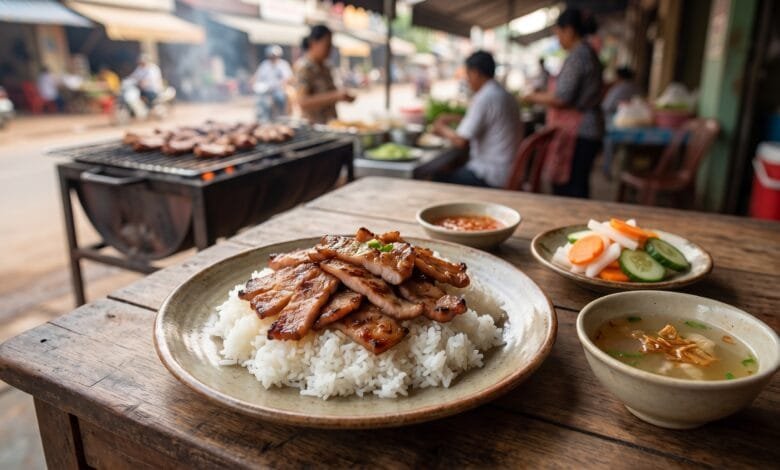
If you wake up early in Phnom Penh or Siem Reap, you will smell it before you see it — the sweet, smoky aroma of pork sizzling over charcoal, drifting from street corners and market stalls. This is Bai Sach Chrouk (បាយសាច់ជ្រូក), Cambodia’s most popular breakfast dish. It is simple, affordable, and deeply satisfying: thin slices of marinated pork, grilled until caramelized, served over rice with tangy pickles and a small bowl of clear broth. For travelers, trying Bai Sach Chrouk is not just a meal — it is a window into everyday Cambodian life.
What Is Bai Sach Chrouk?
Bai Sach Chrouk literally means “rice and pork” in Khmer — bai (rice), sach (meat), and chrouk (pig). It is a breakfast dish, though you will also find it served at lunch in some local restaurants.
The dish consists of thinly sliced pork — usually pork shoulder, pork loin, or thin-cut pork chops — marinated in a mixture of garlic, coconut milk, palm sugar, soy sauce, and fish sauce. The pork is then grilled over charcoal until the sugars in the marinade caramelize, creating a slightly charred, smoky exterior. It is served on a plate of steamed rice (often broken rice, which has a distinctive fluffy texture) alongside pickled vegetables, fresh cucumber, and a small bowl of clear broth.
Bai Sach Chrouk is distinctive because of its balance of flavors: sweet from palm sugar, savory from fish sauce and soy sauce, smoky from the charcoal grill, and tangy from the pickles. Despite its simplicity, it showcases the Khmer preference for balancing sweet, salty, sour, and umami flavors in a single dish.
What Does Bai Sach Chrouk Taste Like?
The first thing you will notice is the smoky aroma — the char from the charcoal grill is essential to the dish’s character. The pork itself is thin and tender, with a mild sweetness from the palm sugar marinade. Because the pork is sliced thin and grilled quickly, it stays juicy rather than drying out, though some vendors deliberately grill it a bit longer to develop more char and crispness at the edges.
The flavor profile is gently sweet and savory, not spicy. Think of it as Cambodia’s answer to a breakfast sandwich — comforting, protein-rich, and satisfying without being heavy. The coconut milk in the marinade adds a subtle richness, while garlic provides depth.
The pickled vegetables (typically daikon radish, carrot, and cucumber) are a crucial contrast — they are tangy, slightly sweet, and crunchy, cutting through the richness of the pork. The clear broth on the side is light and savory, often made from pork or chicken bones, and is meant to be sipped between bites or poured over the rice.
If you are sensitive to spice, you can relax — Bai Sach Chrouk is not a spicy dish. However, some vendors may offer a dipping sauce on the side made with chili, garlic, and fish sauce if you want to add heat.
The Ingredients Behind the Flavor
Understanding the key ingredients helps you appreciate what makes Bai Sach Chrouk taste the way it does:
Pork. Thinly sliced pork shoulder, loin, or thin-cut chops are the standard. The thin cut is important — it allows the marinade to penetrate quickly and ensures the meat cooks fast over high heat.
Palm Sugar. This is the signature sweetener. Cambodian palm sugar has a deep, caramel-like flavor that contributes to the char and caramelization on the grill.
Coconut Milk. Used in the marinade to add richness and help tenderize the pork. Not every vendor uses it, but it is a common ingredient in the classic Phnom Penh style.
Fish Sauce (Tuk Trey). Cambodia’s essential condiment provides umami depth and saltiness. It is used in the marinade and sometimes in the dipping sauce.
Garlic. Fresh minced garlic is a cornerstone of the marinade, giving the pork its savory backbone.
Soy Sauce. Adds color and a mild saltiness, and reflects the Chinese culinary influence present in many Cambodian dishes.
Pickled Vegetables (Chruk). A mix of daikon radish, carrot, and cucumber, lightly pickled in vinegar, sugar, and salt. These provide the tangy, refreshing counterpoint to the grilled pork.
Broken Rice. The rice served with Bai Sach Chrouk is often broken rice — rice grains that have cracked during milling. This is partly a practical choice (broken rice is cheaper) and partly a textural one: broken rice is fluffier and absorbs the juices from the pork better than whole-grain rice.
Kampot Pepper. Cambodia’s famous pepper is sometimes used in the marinade or offered as a condiment, adding a subtle floral heat.
How Is Bai Sach Chrouk Traditionally Prepared?
Traditional preparation begins the night before. The pork is sliced thin and placed in a marinade of garlic, palm sugar, fish sauce, soy sauce, and sometimes coconut milk. It rests for several hours or overnight in the refrigerator.
In the early morning — often before sunrise — vendors fire up their charcoal grills. The marinated pork is placed on a wire rack over the burning coals and grilled slowly, turned occasionally, until the edges caramelize and develop a smoky char.
The rice is steamed separately, and the pickled vegetables are prepared in advance by simmering a brine of vinegar, sugar, and fish sauce, then pouring it over the sliced vegetables and letting them pickle for at least several hours.
The broth is typically a simple clear soup made from pork or chicken bones, sometimes with fried garlic or green onions as a garnish.
When serving, the vendor places a portion of rice on a plate, lays the grilled pork slices on top, adds the pickles and fresh cucumber on the side, and pours a small bowl of broth. A fried egg or omelet slices are common additions in many stalls.
Note: This article explains traditional preparation, not a complete recipe. For a step-by-step recipe, see our recipe section.
The Story and History of Bai Sach Chrouk
The precise origins of Bai Sach Chrouk are not clearly documented in historical records. What is known is that it is identified with Cambodia and particularly with Phnom Penh, and is one of the country’s most iconic breakfast dishes.
The dish reflects Cambodia’s culinary geography — a country with abundant rice paddies, coconut palms, and sugar palm trees, all of which provide essential ingredients. The grilling technique over charcoal is a traditional Cambodian cooking method used across many dishes.
Some sources describe Bai Sach Chrouk as a “purely Cambodian” breakfast that developed independently of significant foreign culinary influence, though the use of soy sauce and the practice of pickling vegetables show broader Southeast Asian and Chinese connections that are common across the region.
What is clear is that Bai Sach Chrouk has been a staple of Cambodian morning life for generations, particularly in urban areas where street vendors set up early to serve workers, students, and families before the day begins.
Honest note on uncertainty: We do not claim that Bai Sach Chrouk is “thousands of years old” or that it originated in the Angkor Empire. There is no reliable evidence to support such claims. Its history is best understood as part of Cambodia’s living street food tradition rather than an ancient royal cuisine.
Why Bai Sach Chrouk Matters in Cambodian Food Culture
In Cambodia, breakfast is serious business. Bai Sach Chrouk is one of the most popular morning meals, sold from street carts, market stalls, and small family-run restaurants across the country. For many Cambodians, it is a daily ritual — a quick, affordable, and satisfying start to the day that costs only about $1 to $2.50.
The dish represents several things at once:
Accessibility. It is one of the most democratic foods in Cambodia — everyone eats it, from construction workers to office employees to students.
Balance. Bai Sach Chrouk embodies the Khmer culinary principle of balancing flavors: sweet, salty, sour, and savory in a single meal. This balance is not just a cooking technique — it reflects a broader Cambodian cultural preference for harmony.
Daily life. Unlike festival dishes or ceremonial foods, Bai Sach Chrouk is a window into ordinary Cambodian life. Eating it is not a special occasion; it is a Tuesday morning. That is precisely what makes it special for travelers.
Local resilience. The dish is prepared and sold by small-scale vendors, often women, who set up their stalls before dawn and work through the morning. Supporting these vendors is a direct way for travelers to participate in Cambodia’s local economy.
Regional and Family Variations
While the classic version of Bai Sach Chrouk — grilled marinated pork over rice with pickles and broth — is consistent across Cambodia, there are meaningful variations:
Phnom Penh Style. The capital’s version tends to feature a sweeter, more caramelized marinade, often with coconut milk. Vendors in Phnom Penh are known for grilling over charcoal and serving with broken rice.
Bai Sach Chrouk Khâ (Braised Pork Version). Instead of grilling, the pork is braised in a caramelized sauce with palm sugar and sometimes hard-boiled eggs, resulting in a richer, saucier dish.
Bai Sach Chrouk Cha (Stir-Fried Version). Minced or sliced pork is stir-fried with garlic and soy sauce rather than grilled.
With Egg. Many vendors add a fried egg or a slice of omelet on top of the rice for extra protein. This is extremely common and often considered part of the standard experience.
Regional Pickle Variations. While daikon, carrot, and cucumber are standard, some vendors in different provinces use shredded green mango or other seasonal vegetables for the pickles.
Where Can Travelers Experience Bai Sach Chrouk?
Bai Sach Chrouk is available across Cambodia, but the experience varies by location:
Phnom Penh. The capital is the heartland of Bai Sach Chrouk. Street stalls are everywhere in the early morning. The area around Orussey Market and Kandal Market is known for good vendors. A well-regarded stall operates directly across from the Russian Market’s main entrance on Street 155, where locals consider the charcoal-grilled pork rice among the city’s best.
Siem Reap. The Old Market area and the back lanes around Pub Street have many authentic stalls. Many food tours in Siem Reap include a Bai Sach Chrouk breakfast stop.
Battambang and Kampot. These smaller cities also have excellent morning vendors, often with a more relaxed atmosphere and lower prices.
Timing Is Everything. Bai Sach Chrouk is a breakfast dish. Vendors typically start around 5:30 AM and close by 9 AM. Some popular stalls sell out by 7 AM, so plan to arrive early if you want the best meat and the full experience.
What to Look For. A good Bai Sach Chrouk stall is usually identifiable by the smell of charcoal smoke and the sight of pork sizzling on a grill. Look for stalls with a steady stream of local customers — that is always the best sign.
How to Order and Eat Bai Sach Chrouk
Ordering is straightforward, even if you do not speak Khmer.
Basic Ordering. Simply say “Bai Sach Chrouk” and point to the pork on the grill. Most vendors will understand. Hold up one finger to indicate one portion.
With Egg. If you want an egg on top, say “bai sach chrouk moan” (moan = egg). Many vendors will offer this automatically.
How to Eat It. There is no wrong way, but the traditional approach is to take a bite of pork and rice, then a bite of pickle, then a sip of broth. Some people pour the broth directly over the rice. You can also add chili sauce or fish sauce to taste.
Utensils. You will typically be given a spoon and fork. Cambodians generally use the spoon for eating rice and the fork for pushing food onto the spoon. Chopsticks are not standard for this dish.
Condiments on the Table. You will often find small containers of pickled chilies in fish sauce, sugar, and sometimes extra fish sauce. Feel free to use them.
Paying. The meal is inexpensive — usually between 6,000 and 10,000 riel (about $1.50 to $2.50). Payment is in cash.
What Travelers Should Know Before Trying It
Spice Level. Bai Sach Chrouk is not spicy. The marinade is sweet and savory. If you want heat, add chili sauce from the condiment tray.
Pork. This dish is made with pork. If you do not eat pork, this is not the dish for you. There is no standard vegetarian version, though some vendors might substitute tofu if asked (this is not traditional).
Allergens. The marinade contains fish sauce and soy sauce, so it is not suitable for those with fish or soy allergies. It is generally gluten-free (depending on the soy sauce used) and dairy-free except for coconut milk, which is not a dairy product.
Texture. The pork is thinly sliced and grilled, so it can be slightly chewy or dry at some stalls. The pickles and broth help balance this.
Rice. If you prefer whole-grain rice, note that many vendors serve broken rice. You can ask for regular steamed rice if you prefer.
Hygiene. Street food in Cambodia is generally safe, but choose stalls with high turnover and visible cooking. Busy stalls are your best bet. Stick to cooked foods and avoid raw vegetables that may have been washed in tap water if you have a sensitive stomach.
Cultural Respect. This is a breakfast dish eaten by working people. It is not a “tourist attraction” — it is daily life. Enjoy it simply and respectfully, and you will have a wonderful experience.
Frequently Asked Questions
What is Bai Sach Chrouk?
Bai Sach Chrouk is a traditional Cambodian breakfast dish of thinly sliced pork marinated in garlic, palm sugar, fish sauce, and coconut milk, then grilled over charcoal and served over rice with pickled vegetables and a clear broth.
What does Bai Sach Chrouk taste like?
It tastes smoky, mildly sweet, and savory. The pork is tender with a slight char from the grill. The pickled vegetables add a tangy, crunchy contrast, and the broth is light and savory.
Is Bai Sach Chrouk spicy?
No. Bai Sach Chrouk is not a spicy dish. The marinade is sweet and savory. Any heat comes from optional chili sauce served on the side.
What is Bai Sach Chrouk called in Khmer?
Where can I try Bai Sach Chrouk in Cambodia?
You can find it across Cambodia — from street stalls in Phnom Penh and Siem Reap to local markets and family restaurants. It is typically sold from about 5:30 AM to 9 AM. Go early for the best quality.
How much does Bai Sach Chrouk cost?
A plate of Bai Sach Chrouk typically costs between 6,000 and 10,000 Cambodian riel (about $1.50 to $2.50), making it one of the most affordable meals in Cambodia.
Conclusion
Bai Sach Chrouk is more than just Cambodia’s most popular breakfast — it is a daily ritual, a street-side institution, and one of the most accessible ways for travelers to experience authentic Khmer food culture. The smoky aroma of charcoal-grilled pork, the tangy crunch of pickles, and the simple comfort of rice and broth come together in a dish that costs less than a coffee in most Western cities but delivers a genuinely memorable experience. Whether you try it from a bustling stall in Phnom Penh or a quiet morning market in Battambang, Bai Sach Chrouk offers a taste of Cambodia that is honest, satisfying, and entirely its own. Wake up early, follow the smoke, and order a plate — you will understand why it has been the country’s favorite breakfast for generations.