A Brief History of Cambodia: From Ancient Kingdoms to the Present Day
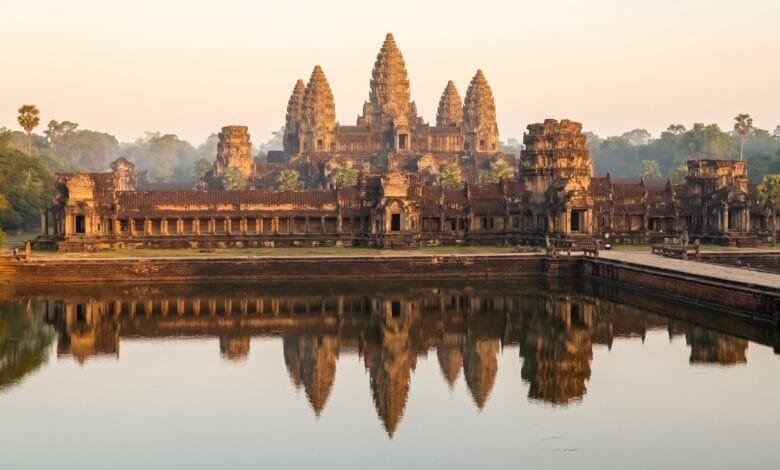
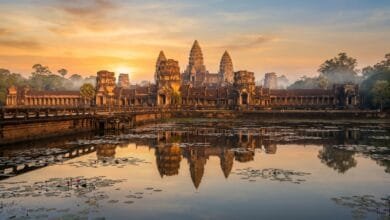
When travelers stand before the towers of Angkor Wat at sunrise, they are seeing only one chapter of a story that stretches back more than two thousand years. That story includes mighty empires, foreign rule, a devastating civil war, and a long, determined recovery. Understanding even the broad outlines of Cambodia’s past transforms a visit from sightseeing into something much deeper — because the temples, palaces, and memorials you encounter along the way are all part of one continuous narrative.
This article provides a clear, reliable overview of Cambodian history from its earliest known states to the present day. It is written for travelers, students, and anyone who wants to understand how this remarkable country became what it is today.
Quick History Information
| Information | Details |
|---|---|
| Historical Period | Prehistory to present day |
| Approximate Dates | c. 500 BCE – 2026 |
| Main Location | Modern Cambodia, with historical territory also in parts of modern Thailand, Vietnam, and Laos |
| Key Figures | Jayavarman II, Jayavarman VII, King Norodom, King Norodom Sihanouk, Pol Pot |
| What Happened | Early kingdoms → Khmer Empire → Post-Angkor period → French colonial rule → Independence → Civil war → Khmer Rouge → Peace process → Modern constitutional monarchy |
| Why It Matters | Cambodia’s history explains its culture, its architecture, its political system, and its social resilience |
| What Remains Today | Temples of Angkor, colonial architecture, independence monuments, memorial sites, and the living traditions of the Khmer people |
Early Cambodia: Funan and Chenla (1st–8th Century)
Cambodia’s recorded history begins with two early states known from Chinese records and archaeological evidence: Funan and Chenla. Britannica describes these as Hindu-Buddhist kingdoms that flourished from the 1st to the 8th century CE.
UNESCO identifies Angkor Borei and Phnom Da in modern Takeo Province as an important center of “one of the earliest complex polities in Southeast Asia,” with evidence of occupation beginning between 500 BCE and the late 6th century. This region was part of what early Chinese chronicles called Funan — a maritime trading state that connected Southeast Asia with India and China.
Funan was gradually absorbed by Chenla, a northern vassal that rose to power. Historical evidence suggests that by the mid-6th century, Chenla had become dominant. Chenla later fractured into competing factions, setting the stage for the emergence of a unified Khmer state.
These early kingdoms were not yet a single “Cambodia” in the modern sense. They were complex societies influenced by Indian religions, political ideas, and writing systems — influences that would shape Khmer civilization for centuries to come.
The Khmer Empire and the Age of Angkor (802–15th Century)
The classical age of Cambodian history begins with Jayavarman II, who around 802 CE united the Khmer states and laid the foundations of what historians call the Khmer Empire. UNESCO notes that this empire became “the major power in south-east Asia for nearly five centuries”.
Jayavarman II established his court in the region north of Tonle Sap, the great lake that remains central to Cambodia’s geography and economy. Half a century later, his descendants established a permanent capital that would become known as Angkor — from the Sanskrit word nagara, meaning “city”.
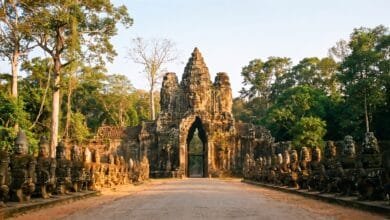
The Khmer Empire reached its height in the 12th century under kings like Suryavarman II, who built Angkor Wat as a state temple dedicated to Vishnu, and Jayavarman VII, who built the Bayon temple and the walled city of Angkor Thom. Britannica describes this period as one of “massive temple complexes” and imperial power extending over territories now part of Thailand, Vietnam, and Laos.
The reasons for Angkor’s decline remain debated among scholars. What is clear is that by the 15th century, the Khmer capital had been abandoned or significantly reduced, and the empire’s territory had contracted. UNESCO describes the site as containing “the magnificent remains of the different capitals of the Khmer Empire, from the 9th to the 15th century”.
Angkor was inscribed as a UNESCO World Heritage Site in 1992 and remains one of the most important archaeological sites in Southeast Asia, covering approximately 400 square kilometers.
Post-Angkor Cambodia: Longvek and Oudong (15th–19th Century)
After the decline of Angkor, the Khmer capital shifted several times. Historical research documents the movement of the royal capital from Angkor to locations including Basan (Kampong Cham), Phnom Penh, Longvek (Kampong Chhnang Province), and Oudong (Kampong Speu Province).
Longvek was built in 1528 and served as the royal capital until it fell under Siamese attack in 1594. After this defeat, the capital was eventually re-established at Oudong in 1623, where it remained the royal seat for approximately 250 years.
This period was marked by pressure from neighboring powers. The Oxford Research Encyclopedia of Asian History describes how Cambodia, once a regional great power, “faced extinction as a sovereign state” by the late 18th century as it was caught between Siamese (Thai) and Vietnamese expansion.
The kingdom survived, but it had lost much of its territory and autonomy. This vulnerability set the stage for the arrival of European colonial powers.
The French Protectorate (1863–1953)
In 1863, King Norodom signed an agreement with France that established Cambodia as a French protectorate. The Oxford Research Encyclopedia explains that the protectorate was intended to defend Cambodian sovereignty from foreign and neighboring invaders, but it resulted in the loss of internal and external sovereignty by 1897.
French colonial rule brought significant changes. The U.S. Department of State records that Cambodia became part of French Indochina in 1887. The colonial administration restructured governance, introduced French education and legal systems, and invested in infrastructure — particularly in Phnom Penh, which still bears the architectural marks of French influence today.
The colonial period was not without tension. French ideas of governance collided with Cambodia’s ancient traditions of kingship and Buddhist social organization. Nationalist sentiments began to emerge in the early 20th century.
During World War II, Japan occupied Cambodia from 1941 to 1945, though the French administration initially remained in place. In March 1945, three days after Japanese forces removed the French from power in Indochina, King Norodom Sihanouk declared Cambodia’s independence under Japanese sponsorship. This independence was short-lived; after Japan’s surrender in August 1945, French control was restored.
The postwar period brought renewed pressure for genuine independence. In 1953, King Norodom Sihanouk — who had taken a direct role in politics — successfully negotiated full independence from France. The U.S. Department of State records that full independence came on November 9, 1953.
Independence and the King Norodom Sihanouk Era (1953–1970)
After independence, Cambodia became a constitutional monarchy under King Norodom Sihanouk, though he later abdicated in favor of his father and became head of state under the title of Prince. For nearly two decades, Sihanouk dominated Cambodian politics.
His foreign policy was characterized by an attempt to maintain neutrality in the Cold War, balancing relations with the United States, China, and North Vietnam. This was a difficult position as the Vietnam War intensified in neighboring Vietnam. The U.S. Department of State records that Cambodia’s situation “remained uncertain” until the 1954 Geneva Conference settled the French-Indochina war.
By the late 1960s, Cambodia was increasingly drawn into the wider conflict. North Vietnamese and Viet Cong forces used Cambodian territory as a sanctuary and supply route. The United States conducted secret bombing campaigns in eastern Cambodia. Domestic political tensions grew.
On March 18, 1970, while King Norodom Sihanouk was abroad, the National Assembly voted to depose him. General Lon Nol took power and established the Khmer Republic. Sihanouk went into exile in China.
Civil War and the Khmer Rouge (1970–1979)
The 1970 coup plunged Cambodia into five years of civil war. The U.S. Department of State records that “in April 1975, after a five-year struggle, Communist Khmer Rouge forces captured Phnom Penh and evacuated all cities and towns”.
On April 17, 1975, the Khmer Rouge entered Phnom Penh and established what they called Democratic Kampuchea. The ECCC — the Extraordinary Chambers in the Courts of Cambodia — documents that this regime lasted from April 17, 1975, to January 7, 1979.
During this period, the Khmer Rouge implemented a radical transformation of Cambodian society. The ECCC describes forced displacement of populations, forced labor, torture, executions, forced marriage, and persecution of specific groups including former government officials, Buddhists, Cham Muslims, and ethnic Vietnamese. Cities were emptied. Money was abolished. Families were separated.
The ECCC investigated more than 100 crime sites across Cambodia and concluded that the Khmer Rouge committed genocide, crimes against humanity, and war crimes. The tribunal was the first internationally supported domestic tribunal to convict a former head of state for the crime of genocide.
Regarding the death toll, the ECCC cites estimates of approximately 1.5 to 2 million deaths during the Khmer Rouge period. Britannica similarly notes that “at least 1.5 million Cambodians were killed or died”. Different credible sources provide varying estimates within this range, and precise figures remain impossible to establish.
Vietnam, Isolation, and the Peace Process (1979–1993)
The Khmer Rouge regime ended when Vietnamese forces entered Cambodia and took Phnom Penh on January 7, 1979. The ECCC refers to this as “the fall of the Khmer Rouge regime”.
The Vietnamese intervention was followed by more than a decade of complex politics. Vietnam installed a new government in Phnom Penh, while the Khmer Rouge and other resistance groups continued to fight from border areas. The United Nations General Assembly demanded Vietnam’s withdrawal, and Cambodia remained internationally isolated and divided.
Diplomatic efforts to end the conflict gained momentum in the late 1980s. On October 23, 1991, the Agreements on a Comprehensive Political Settlement of the Cambodia Conflict — commonly known as the Paris Peace Agreements — were signed in Paris. These agreements invited the UN Security Council to establish the United Nations Transitional Authority in Cambodia (UNTAC) to implement the peace plan and organize free and fair elections.
UNTAC was set up in February 1992 and became one of the UN’s most ambitious peacekeeping operations, with responsibilities including supervising ceasefire arrangements, repatriating refugees, and organizing elections. Elections were held in 1993, and a new constitution established a constitutional monarchy with Norodom Sihanouk as King.
The Restoration of the Kingdom and Modern Cambodia (1993–Present)
The 1993 constitution restored the monarchy and established the Kingdom of Cambodia as a constitutional monarchy. The U.S. Department of State records that the Royal Cambodian Government was established on September 24, 1993, on the basis of elections recognized internationally as free and fair.
The period since 1993 has seen significant development alongside continuing challenges. Cambodia has experienced substantial economic growth, particularly in textiles, tourism, and construction. The temples of Angkor — especially after their UNESCO World Heritage inscription in 1992 — became a major driver of international tourism.
For travelers, modern Cambodia is a country of striking contrasts. Phnom Penh’s Royal Palace and Silver Pagoda stand near the Tuol Sleng Genocide Museum, a former Khmer Rouge prison. Siem Reap, the gateway to Angkor, combines ancient temples with modern hotels and restaurants. The countryside remains largely agricultural, with rice farming still central to rural life.
Why This History Matters to Travelers
Understanding Cambodia’s history changes how you see the country.
When you visit Angkor Wat, you are not just seeing a beautiful temple — you are seeing the center of an empire that dominated Southeast Asia for centuries. Knowing this makes the scale and ambition of the site easier to appreciate.
When you walk through Phnom Penh’s colonial-era streets, you are seeing the legacy of a protectorate that shaped the country’s modern institutions and architecture.
When you visit the Tuol Sleng Genocide Museum or the Choeung Ek memorial, you are encountering a period of history that still shapes Cambodian society and memory today. The ECCC’s work — documenting crimes and providing a measure of justice — remains a significant part of how Cambodia continues to process its past.
And when you meet Cambodians today — at markets, restaurants, or temples — you are meeting the inheritors of a long history of resilience. The country has endured empire, colonialism, war, and genocide. It has rebuilt. That story is part of every interaction.
Frequently Asked Questions
When did the Khmer Empire begin?
Why is Angkor important to Cambodia?
What happened to Angkor?
The reasons for Angkor’s decline are debated among historians. Available evidence suggests a combination of factors may have contributed, including changing religious practices, shifts in trade routes, and pressure from neighboring powers. The capital was eventually abandoned or significantly reduced, and Cambodia’s political center shifted south.
When did Cambodia gain independence from France?
Cambodia gained full independence from France on November 9, 1953, under the leadership of King Norodom Sihanouk. The U.S. Department of State records this as Cambodia’s Independence Day.
What happened during the Khmer Rouge period?
Who was Pol Pot?
Pol Pot was the leader of the Khmer Rouge and the head of Democratic Kampuchea during the 1975–1979 period. The ECCC investigated and prosecuted senior leaders of the regime for crimes committed during this time.
What did the Paris Peace Agreements do?
Signed on October 23, 1991, the Paris Peace Agreements established a comprehensive political settlement for the Cambodia conflict. They led to the creation of UNTAC, which organized elections and helped restore a constitutional monarchy in 1993.
What is Cambodia like today?
Cambodia is a constitutional monarchy with a growing economy and a population of approximately 17.5 million. It is known for its temples, its food, its textiles, and its complex political history. For travelers, it offers a blend of ancient heritage, modern development, and deeply meaningful historical sites.
Conclusion
Cambodia’s history is a story of rise and fall, loss and recovery, tragedy and resilience. From the early trading states of Funan and Chenla, to the empire that built Angkor Wat, to the colonial period and the trauma of the Khmer Rouge, each chapter has left its mark on the country travelers visit today.
The temples of Angkor are the most visible reminder of Cambodia’s imperial past. The French-influenced streets of Phnom Penh tell the story of colonial rule. The memorial sites of the Khmer Rouge era preserve the memory of one of the 20th century’s darkest periods. And the everyday life of Cambodians — at markets, in rice fields, in cities — reflects a society that has endured much and continues to build its future.
For travelers, knowing this history is not just background information. It is the key to understanding what you are seeing, why it matters, and why Cambodia remains one of the most fascinating and resilient countries in Southeast Asia.