Cambodia’s Riel: A History of Money, War, and Rebirth
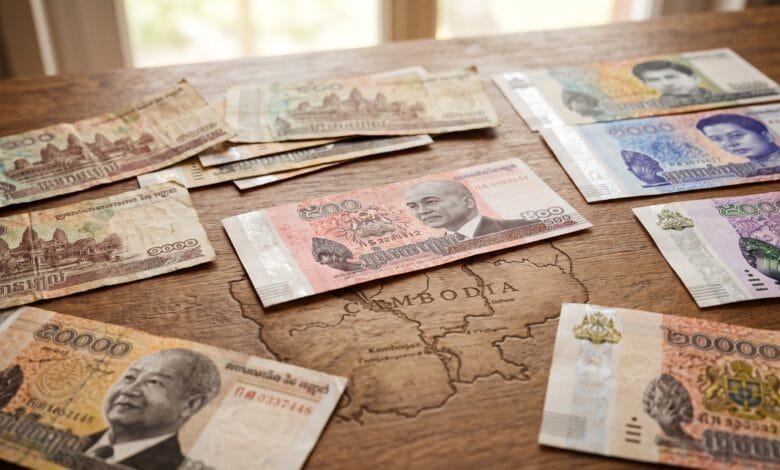
Every day in Cambodia, travelers hand over crisp riel notes adorned with Angkor Wat and ancient kings. They receive change in worn bills that have passed through thousands of hands. Yet few realize they are holding a story of national survival — a currency that was abolished entirely, only to be reborn from the ashes of one of the 20th century’s darkest chapters.
The Cambodian riel is more than money. It is a document of independence, a witness to genocide, and a symbol of national identity. Its history spans colonial rule, war, revolution, and recovery. Understanding this story helps travelers see Cambodia not just as a destination, but as a nation that has fought to define itself — sometimes literally printing its identity on paper.
This article traces the history of Cambodian banknotes from the colonial piastre to the modern riel, explaining what each era reveals about the country’s past.
Quick History Information
| Information | Details |
|---|---|
| Historical Period | 1885–Present |
| Approximate Dates | Piastre: 1885–1952; First Riel: 1955–1975; No Currency: 1975–1980; Second Riel: 1980–Present |
| Main Location | Cambodia (Phnom Penh, National Bank of Cambodia) |
| Key Figures | King Norodom Sihanouk, Pol Pot, National Bank of Cambodia officials |
| What Happened | Cambodia moved from colonial currency to national currency, then abolished money entirely under the Khmer Rouge, and finally reintroduced the riel in 1980 |
| Why It Matters | The riel represents Cambodia’s sovereignty, its darkest historical period, and its recovery |
| What Remains Today | The riel circulates alongside the US dollar; the SOSORO Museum in Phnom Penh preserves this history |
Before the Riel: Money in French Indochina
Before Cambodia had its own currency, it used the Indochinese piastre. This currency was introduced in the 1880s by France, which controlled Cambodia as part of French Indochina — a colonial territory that also included Vietnam and Laos.
The piastre was issued by the Bank of Indochina, a private French institution. According to the National Bank of Cambodia, the piastre was intended to finance trade and modernization across the region. But in practice, the Cambodian economy was not a priority for the profit-oriented Bank of Indochina, which focused on wealthier areas of Vietnam. As a result, the piastre’s role in Cambodia remained limited compared to its use in other parts of Indochina.
The piastre banknotes were designed to reflect French colonial power. They displayed references to all three Indochinese countries, but also prominently featured French symbols like Marianne and Roman laurels. Denominations appeared in four languages: French, Khmer, Lao, and Vietnamese. The Bayon temple and apsara dancers appeared alongside smiling local women in traditional dress — a colorful mix of romanticized cultural imagery and clear colonial authority.
As Blaise Kilian, Co-Director of the SOSORO Museum, explained in an interview with the Khmer Times, this design “conveyed the French conception of its colonial empire” — a blend of cultural appreciation and unmistakable sovereignty claims. For Cambodians, the piastre was a daily reminder that their economy was not fully their own.
The Birth of the Riel (1953–1955)
Cambodia gained independence from France on November 9, 1953. For a newly independent nation, establishing a national currency was not just an economic necessity — it was a statement of sovereignty.
The National Bank of Cambodia was established on December 23, 1954, after the Institut d’Émission (the printing house for the three Indochina countries) was closed. The NBC then printed its own national currency, the riel, which was first circulated in September 1955.
The name “riel” has an interesting origin story. Popular belief in Cambodia links it to a small Mekong river fish called “riĕl,” but historical evidence more likely points to the Spanish-American dollar, a high-silver coin widely used in the region. The riel’s subunit, the “kak” (1/10 riel) and “sen” (1/100 riel), are no longer in common use due to inflation.
The first riel banknotes were printed by Thomas De La Rue, a British security printing company. They featured Khmer text, the temple of Banteay Srei, and the Central Market (Phsar Thmey) building in Phnom Penh. The 1 riel note depicted a Kinnari (a mythical half-bird, half-human figure) with the national arms, and a royal boat on the reverse.
These early banknotes represented a new national identity. They featured Cambodian temples, Cambodian landscapes, and Cambodian cultural symbols — not French colonial imagery. As the Khmer Times noted, this was part of a broader nation-building vision under King Norodom Sihanouk, who saw the riel as a pillar of independence.
War and Collapse (1970–1975)
Cambodia’s relative stability ended in 1970 when General Lon Nol overthrew Prince Sihanouk in a coup. The country descended into civil war, and the riel’s value and stability deteriorated.
Between 1970 and 1975, the Khmer Republic (Lon Nol’s government) continued to use banknotes printed during the Sangkum Reastr Niyum era, while also printing new ones on the same model. Some cultural references were added, such as the portrait of celebrated poet Krâm Ngoy. According to the Khmer Times, the general appearance of the national currency did not evolve much during this period — the riel continued to display references to national culture, traditional activities, and modernization.
But as the war intensified, the economy weakened. The riel’s purchasing power declined, and daily life became increasingly difficult. The currency remained in circulation, but its value was eroded by conflict and instability.
The Abolition of Money (1975–1979)
On April 17, 1975, the Khmer Rouge captured Phnom Penh. What followed was one of the most radical economic experiments in modern history: the complete abolition of money.
On that same day, the National Bank of Cambodia was closed. According to the NBC’s official history, “the building was destroyed, the banking system collapsed, and the use of Khmer riel notes was eliminated.” The Khmer Rouge, led by Pol Pot, believed that money was a tool of capitalism and oppression. In a speech on May 20, 1975, Pol Pot declared: “Stop using money and eliminate markets. If there are markets and bartering, there will be the oppressed and the oppressor. Therefore, the people must stop using money.”
The Khmer Rouge abolished not just currency, but markets and bartering as well. As the Khmer Times reported, the regime’s slogan became: “No sale, no exchange, no gain, no theft, no robbery, no personal ownership.” By September 1976, Pol Pot reinforced this stance, stating: “Money is very poisonous, for it can pull us back into a society of privacy.”
The ECCC (Extraordinary Chambers in the Courts of Cambodia) documents the Khmer Rouge period from April 17, 1975, to January 7, 1979, as a time of mass crimes including forced displacement, forced labor, torture, and executions. The abolition of money was part of this broader radical restructuring of Cambodian society.
Interestingly, the Khmer Rouge had actually printed their own currency in early 1975, before they took full power. According to a 1975 communique from the RGNUC Bank of Cambodia, seven new banknotes were prepared, ranging from 1 kak to 100 riel. The designs featured soldiers, peasants, workers, and Angkor Wat. But in the end, the Khmer Rouge decided not to use this currency. Instead, vast quantities of newly printed banknotes became worthless artifacts of an unrealized economic plan.
For nearly four years, Cambodia had no money. People survived through barter, state distribution, and forced labor. The riel — and the economic system it represented — had been completely erased.
Rebirth of the Riel (1979–1980)
The Khmer Rouge regime collapsed on January 7, 1979, following a Vietnamese-led intervention. The task of rebuilding Cambodia — including its economy and its currency — began almost immediately.
On October 10, 1979, the National Bank of Cambodia was reestablished as the central bank, renamed the “People’s Bank of Kampuchea.” According to the NBC, the challenges were enormous. Many intellectuals had been killed or had fled the country. There was very little knowledge, expertise, or experience to draw from. There was also a severe lack of financial resources.
On March 20, 1980, the People’s Bank of Kampuchea reissued the riel banknotes. According to the NBC, this was done “to facilitate the exchange of goods and payment of civil servants’ salaries.” The reintroduction of the riel was more than an economic measure — it was a statement of national sovereignty and a step toward normalcy.
The first notes of this new era were printed abroad due to the lack of domestic printing capacity. According to the National Bank of Cambodia, the riel was reintroduced “to contribute to the development of the country and to demonstrate our sovereignty in the region and the world.”
The Riel in Modern Cambodia (1993–Present)
The modern period of Cambodian currency began with the restoration of the monarchy and the adoption of a new constitution in 1993. The National Bank of Cambodia was renamed back from the “People’s Bank of Kampuchea” on January 30, 1992, with the law promulgated on February 8, 1992.
Today’s riel banknotes reflect Cambodia’s national identity through royal, cultural, and religious imagery. Angkor Wat — the iconic temple that has appeared on banknotes issued by all regimes since 1955 — remains a central motif. The Bayon temple’s four-faced Bodhisattva Avalokiteshvara, a symbol of compassion, has been repeatedly depicted since the 1955–56 series.
According to an NBC document on religious references in banknotes, Buddha Avalokitechvara from the Bayon temple has appeared as watermarks and illustrations in 1955–56, 1961, 1963, 1972, and other series. Between 1979 and 1995, the only note to bear this image was the 50 Riel note of the 1979 series. After the adoption of the present-day Constitution and the reinstatement of Buddhism as the state religion, the image returned on the 1,000 and 10,000 Riel banknotes in the 1995 series, later joined by the 5,000 and 10,000 Riel denominations in the 2001–2007 series and the 20,000 Riel note in 2008.
Today’s banknotes also feature the Royal Arms of Cambodia, the mythical Naga (serpent) sculpture, and scenes of modern Cambodia such as bridges and agricultural activities. The 500 Riel note, for example, features Angkor Wat at center, a Naga head sculpture at lower left, and a bridge spanning the Mekong River at Kampong Cham.
Since the late 1990s, the riel has had an unofficial fixed exchange rate of approximately 4,100 riel to 1 US dollar. The US dollar is also used as a de facto currency for commercial transactions, creating a dual-currency system that travelers encounter daily.
Where Travelers Can See This History
Travelers who want to explore Cambodia’s monetary history in person can visit the SOSORO Museum (Preah Srey Içanavarman Museum of Economy and Money) in Phnom Penh. Established and fully financed by the National Bank of Cambodia, the museum uses currency as a lens to tell Cambodia’s broader economic and political history.
According to the Khmer Times, the museum’s permanent exhibition traces the Khmer riel from its creation during the independence era, through its disappearance during the Khmer Rouge regime, to its rebirth and modern development. A large interactive touchscreen allows visitors to explore banknotes issued since 1993, decoding the imagery printed on them. The museum also participates in nationwide “Khmer Riel Days” to promote financial literacy and awareness of the national currency.
The National Bank of Cambodia headquarters in Phnom Penh is another place where visitors may find mint-condition banknotes for collection purposes, according to traveler reviews.
Frequently Asked Questions
What is the Cambodian riel?
The riel is Cambodia’s official currency, abbreviated KHR. It was first introduced in 1955 after independence from France. The riel was abolished during the Khmer Rouge period (1975–1979) and reintroduced on March 20, 1980.
Why is Angkor Wat on Cambodian banknotes?
Angkor Wat is Cambodia’s most important national symbol. It has appeared on banknotes issued by all regimes since 1955, representing the country’s ancient heritage and cultural identity.
What happened to money during the Khmer Rouge period?
The Khmer Rouge abolished all currency, markets, and bartering when they took power on April 17, 1975. The National Bank of Cambodia was closed and destroyed. For nearly four years, Cambodia had no monetary system.
When was the riel reintroduced?
The riel was reintroduced on March 20, 1980, by the People’s Bank of Kampuchea (now the National Bank of Cambodia).
Can travelers use US dollars in Cambodia?
Yes. The US dollar is widely accepted in Cambodia, especially for larger transactions. The riel is used for smaller purchases. The exchange rate is approximately 4,100 riel to 1 US dollar.
Are Cambodian banknotes valuable to collectors?
Some Cambodian banknotes, particularly early issues from 1955–1956 and the never-circulated Khmer Rouge currency, are collectible. However, most modern riel notes are common and not particularly valuable.
Where can I learn more about Cambodian currency history?
The SOSORO Museum in Phnom Penh, established by the National Bank of Cambodia, is dedicated to the history of Cambodian economy and money. It is an excellent resource for travelers interested in this subject.
Conclusion
The history of Cambodian banknotes is a story of national identity told through paper and ink. From the colonial piastre that never fully belonged to Cambodia, to the first riel that proclaimed independence, to the abolition of money under the Khmer Rouge, to the riel’s rebirth as a symbol of sovereignty — each era of Cambodian currency reflects a chapter in the country’s turbulent modern history.
For travelers, understanding this history adds depth to everyday experiences. The riel notes in your wallet are not just money. They are documents of a nation that lost everything and rebuilt from nothing. They feature the temples and kings that define Cambodian identity. They represent a people who, after nearly four years without money, chose to print their future once again.
When you pay for a meal in Phnom Penh or buy a ticket to Angkor Wat, you are participating in a story that is still unfolding. The riel is more than currency. It is Cambodia’s story, printed on paper and passed from hand to hand.