Jayavarman VII: The King Who Built Angkor Thom
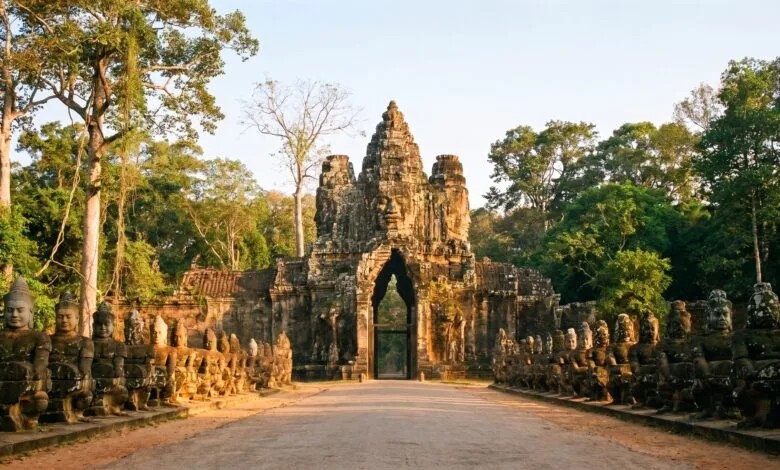
Most travelers who walk through the great gates of Angkor Thom do not realize they are entering the vision of a single man. They pass under stone faces that have watched over this place for more than eight centuries, cross causeways lined with gods and demons, and step into what was once the beating heart of Southeast Asia’s most powerful empire.
That man was Jayavarman VII. And Angkor Thom was not just his capital. It was his statement to the world about what a king should be.
This article tells the story of the king behind the city — who he was, what he built, and why his reign still shapes how we understand Cambodia today.
Quick History Information
| Information | Details |
|---|---|
| Historical Period | Late 12th to early 13th century CE |
| Approximate Dates | Reign: 1181–c. 1218 |
| Main Location | Angkor Thom, near modern Siem Reap, Cambodia |
| Key Figures | Jayavarman VII, Cham invaders, his son Indravarman II |
| What Happened | Defeated Cham invaders, built Angkor Thom and the Bayon, expanded the Khmer Empire |
| Why It Matters | Marked the peak of the Khmer Empire and introduced Buddhist-inspired public works |
| What Remains Today | Angkor Thom, the Bayon, Ta Prohm, Preah Khan, and many other monuments |
The World Before Jayavarman VII
To understand why Jayavarman VII built Angkor Thom, you need to understand what came before.
The Khmer Empire had been a major power in Southeast Asia for centuries. Its earlier kings had built extraordinary temples — most famously Angkor Wat, constructed under Suryavarman II in the first half of the 12th century. The empire’s capital, known as Yasodharapura, was a sprawling urban center near the modern city of Siem Reap.
But by the late 12th century, the Khmer Empire faced a serious threat. Its eastern neighbor, the kingdom of Champa — located in what is now central and southern Vietnam — had grown powerful and hostile.
The Cham Invasion and the Fight for Survival
In 1177, the Chams launched a surprise attack. According to historical sources, a Cham fleet sailed up the Mekong River and across the Tonle Sap lake to strike the Khmer capital directly. The city was sacked. The reigning Khmer king was killed.
The Khmer Empire was thrown into crisis. For several years, the Chams occupied parts of Khmer territory. But resistance formed. A prince — likely a member of the royal family who had been away from the capital — began to gather forces. His name was Jayavarman.
By 1181, Jayavarman had defeated the Cham forces and reclaimed the Khmer throne. He took the royal name Jayavarman VII. According to Britannica, he was 61 years old when he assumed the throne.
Instead of simply rebuilding the old capital, Jayavarman VII chose to build something entirely new.
Building Angkor Thom: A New Capital for a New Vision
Angkor Thom means “Great City” in Khmer. According to the APSARA National Authority, the site spans approximately 900 hectares and was the center capital of the Khmer Empire from the late 12th century.
The city was surrounded by a wall and a wide moat. Five monumental gates allowed entry — four facing the cardinal directions, plus a Victory Gate to the northeast. Each gate was topped with massive stone faces, similar to those on the Bayon temple.
As you approach the gates today, you cross a causeway flanked by 54 gods and 54 demons pulling on a giant snake. This represents the Hindu myth of the Churning of the Ocean of Milk — a story about gods and demons working together to create the nectar of immortality.
The fact that this Hindu myth appears so prominently in a city built by a Buddhist king tells you something important about Jayavarman VII. He did not reject Cambodia’s Hindu heritage. He incorporated it into his new vision.
The Bayon: The Enigmatic Heart of the City
At the center of Angkor Thom stands the Bayon, the temple that has puzzled and fascinated visitors for centuries.
The Bayon was erected under Jayavarman VII toward the end of the 12th century. Its most distinctive feature is the multitude of serene, massive stone faces on its towers. Only 37 towers remain standing today, out of an original 49 or 54.
The APSARA National Authority describes these faces as “enigmatic” — a word that has fueled endless discussion and debate. Many scholars believe the faces represent Jayavarman VII himself, based on similarities to other statues of the king. Others argue they depict the Bodhisattva Avalokiteshvara, the Buddhist figure of compassion. Some suggest they may represent both — a king who saw himself as a spiritual protector of his people.
What makes the Bayon truly remarkable, however, are its bas-reliefs. Unlike the grand mythological scenes at Angkor Wat, the Bayon’s carvings show something more intimate: the daily life of ordinary Khmer people. According to APSARA, the bas-reliefs depict market stalls, construction workers building roads, women preparing fish, and even women suffering from illness. Chinese traders appear in the scenes, described as “shop-owners with Khmer women as wives, and in drunken dance aboard a boat”.
This was not accidental. Jayavarman VII wanted his temple to reflect the lived reality of his kingdom, not just the glory of its gods.
More Than Temples: Roads, Hospitals, and Rest Houses
If you only visit the major temples, you might think Jayavarman VII was obsessed with monuments. But inscriptions tell a different story.
Jayavarman VII initiated what some scholars describe as one of the most ambitious building programs in history. His inscriptions record the construction of 102 hospitals distributed throughout the kingdom. These were not just for the elite. Inscriptions state they were open to all four castes and built around shrines.
He also built rest houses along major roads. One source describes 121 rest-houses at intervals along extensive raised highways. These roads connected the capital to distant provinces and served as both infrastructure for trade and as a network for collecting tribute.
This was a king who understood that power was not only about armies and temples. It was about caring for the people who made the empire work.
The Empire at Its Greatest Extent
Under Jayavarman VII, the Khmer Empire reached its greatest territorial extent.
According to Britannica, he expanded the empire to include Champa, parts of Laos, the Malay Peninsula, and Burma. The empire stretched from the Mekong Delta in the south to the borders of modern-day Thailand and Laos in the north and west.
This was not just military conquest. Jayavarman VII was also skilled at diplomacy and alliance-building. The Asian Network Exchange journal notes that he brought “numerous small, fragmented Khmer and Cham kingdoms together through political and military alliances”.
But expansion came at a cost. Sustained military campaigns and massive construction projects consumed resources. Some historians suggest that the strain of these projects contributed to the empire’s later decline.
A Buddhist King in a Hindu World
Jayavarman VII was a committed follower of Mahayana Buddhism. This set him apart from many of his predecessors, who had been Hindu.
The scholar Paul Nietupski describes him as “especially committed to Mahāyāna Buddhism, evidenced by the remarkable extent of his support for Buddhist monuments, and attested in many hundreds of Sanskrit inscriptions”.
But Jayavarman VII did not impose Buddhism by force. Britannica notes that he “tolerated Hinduism and local ancestor cults”. The Bayon itself incorporates Hindu imagery, including the Churning of the Ocean of Milk carved into its walls.
This religious openness was part of his broader vision. He saw himself as a compassionate ruler — a Buddhist king who served both the spiritual and physical needs of his people. Britannica describes him as having “dedication to both the spiritual and physical needs of the people,” which has made him “a national hero to modern Cambodians”.
What Happened After Jayavarman VII?
Jayavarman VII died around 1218–1220, after a reign of nearly four decades. He was reportedly over 90 years old.
His son Indravarman II succeeded him. According to Britannica, he “continued his father’s Buddhist policies,” but the scale of construction declined noticeably. Later kings, particularly Jayavarman VIII, shifted back toward Hinduism and may have ordered the destruction of Buddhist images.
The circumstances of the succession are described as “very obscure” in academic sources. What is clear is that the era of grand building projects was over. The Khmer Empire continued for another two centuries, but its period of peak power had passed.
What Remains Today — and Why Travelers Should Care
When you visit Angkor Thom today, you are walking through the remains of Jayavarman VII’s vision.
The South Gate is the best preserved and the busiest, due to tourist traffic between Angkor Wat and the Bayon. The APSARA National Authority recommends climbing up onto the wall and walking a little away from the gate to appreciate the view of the causeway.
At the Bayon, you can still see the bas-reliefs that show Khmer daily life — the markets, the workers, the traders, the families. These carvings make the past feel human in a way that grand temples sometimes do not.
Ta Prohm, with its giant trees growing out of the ruins, was originally a Buddhist monastery built under Jayavarman VII. Its original name was Rajavihara. Preah Khan was built on the site of his victory over the invading Chams in 1191.
These places are not just monuments to a king. They are windows into a civilization that was, at its peak, one of the most sophisticated in the world.
Understanding Jayavarman VII helps you see Angkor Thom not as a collection of ancient stones, but as a deliberate statement about what a society should be. He built a capital that blended Hindu and Buddhist traditions. He built hospitals for the sick and rest houses for travelers. He carved the faces of his people into the walls of his temple.
That is the story behind the smiling faces of the Bayon.
Frequently Asked Questions
Who was Jayavarman VII?
Jayavarman VII was a king of the Khmer Empire who reigned from approximately 1181 to 1218–1220 CE. He is best known for defeating the Cham invaders, building the new capital of Angkor Thom, and expanding the Khmer Empire to its greatest territorial extent.
When did Jayavarman VII rule?
Why did Jayavarman VII build Angkor Thom?
What is the Bayon temple known for?
Was Jayavarman VII a Buddhist?
How large was the Khmer Empire under Jayavarman VII?
What happened after Jayavarman VII died?
His son Indravarman II succeeded him. Building activity declined noticeably after his reign, and later kings shifted away from Buddhism back toward Hinduism.
Can travelers still see what Jayavarman VII built?
Yes. Angkor Thom, the Bayon, Ta Prohm, Preah Khan, and many other monuments attributed to Jayavarman VII are open to visitors in the Angkor Archaeological Park near Siem Reap.
Conclusion
Jayavarman VII is often called Cambodia’s greatest king. The evidence for that reputation is everywhere: in the towering gates of Angkor Thom, in the enigmatic faces of the Bayon, in the overgrown ruins of Ta Prohm, and in the inscriptions that record hospitals and rest houses built for ordinary people.
But what makes his story truly remarkable is not just what he built. It is why he built it. After a devastating invasion, he did not simply rebuild what had been destroyed. He created something new — a capital that blended Hindu and Buddhist traditions, a temple that honored both gods and people, and a kingdom that cared for the sick and the traveling.
When you visit Angkor Thom today, you are not just seeing ruins. You are seeing the vision of a king who believed that power should serve compassion. That vision, more than any single temple, is the true legacy of Jayavarman VII.