The Khmer People: Who They Are and How They Live in Cambodia
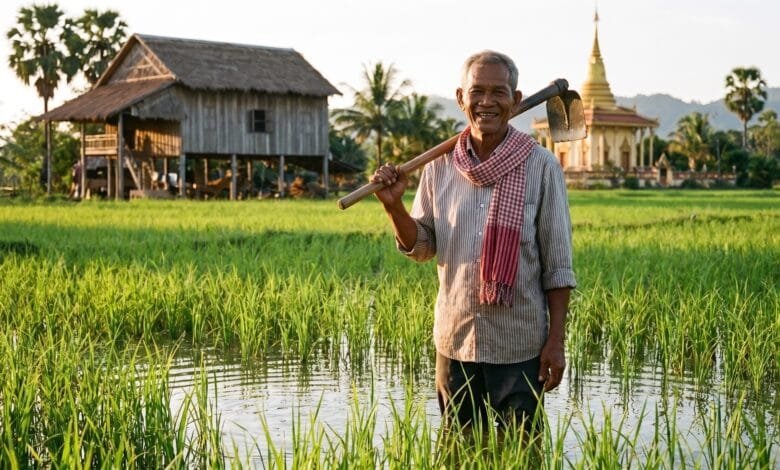
If you walk through almost any village in Cambodia, you will hear the same language, see the same wooden houses on stilts, and pass the same kind of Buddhist temple at the center of the community. These are the Khmer people — the ethnic group that makes up the vast majority of Cambodia’s population, and the people most travelers will meet during their journey.
But who exactly are the Khmer? What do they do for a living? How do they organize their families and communities? And how is their life changing today?
Understanding the Khmer people is the key to understanding Cambodia — not just its temples and beaches, but the country behind them.
Who Are the Khmer People?
The Khmer (pronounced kuh-MY) are a Southeast Asian ethnic group native to Cambodia. According to Cambodia’s 2019 General Population Census, conducted by the National Institute of Statistics of the Ministry of Planning, 14,893,134 people — 95.8% of the population — reported Khmer as their mother tongue. The total population was projected to reach approximately 17.28 million by December 2024.
Cambodia is the country in Southeast Asia with the smallest ethnic minority population, both relatively and in absolute numbers. Ethnic Khmer make up approximately 90–94% of the entire population, with the remainder comprised of Cham, indigenous highland communities, ethnic Chinese, ethnic Vietnamese, and smaller groups such as the Khmer Krom and the Kuy people.
Khmer (also called Cambodian) is the official language and is spoken by more than 95% of the population, including many ethnic minorities.
The Khmer are the descendants of the builders of the Angkor Empire, which dominated mainland Southeast Asia from the 9th to the 15th centuries. The temples of Angkor remain a powerful symbol of Khmer identity, but the Khmer people today are not defined only by their ancient past. They are farmers, fishers, traders, students, factory workers, and monks — a diverse population navigating rapid change.
Where Do the Khmer Live?
The Khmer are concentrated in the central and southeastern lowlands of Cambodia, particularly in the fertile plains around the Tonlé Sap Lake and the Mekong River. These waterways have shaped Khmer settlement patterns for centuries, providing water for rice cultivation and fish for family meals and trade.
The majority of Khmer people live in rural villages. As of 2012, only about 20% of Cambodia’s total population was living in urban areas, though this figure has been rising. As of 2023, approximately 26 percent of Cambodia’s population resided in urban areas, and this figure is expected to double by 2050.
Phnom Penh, the capital, is the most important urban center and the main destination for rural-to-urban migration.
How Do the Khmer Live?
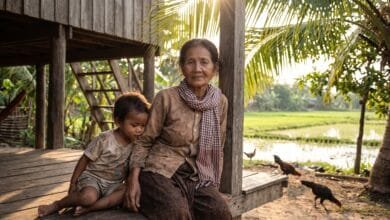
In rural Cambodia, the Khmer live in villages centered around a Buddhist temple, or wat. The Khmer concept of community is rooted in the word phum, which denotes “an inhabited space in the rural areas in general, and for the peasant it means his home area in a loose sense rather than a specific agglomeration of houses or a bounded organizational entity” (Ovesen et al., 1996: 68).
The traditional Khmer house is a large structure on stilts with a rectangular roof and two doors on the lateral sides — one door reserved for visitors, the other for the women of the family. The interior is divided lengthwise by a wooden beam, while the front section is divided into three compartments: a communal area in the middle and men’s bedrooms on either side. The back section is partitioned into two bedrooms for women.
Labor exchange is common in Khmer communities. Neighbors and friends help build houses for one another, and rice cultivation often involves shared labor. Many community events — religious celebrations, weddings, and funerals — are organized around the pagoda and attended by the whole village.
Buddhism has shaped Khmer community life since the 13th century. The vast majority of Khmer people follow Theravada Buddhism, and Buddhist principles such as tolerance, calmness, and taking responsibility for one’s own actions are values found throughout Khmer culture.
How Do the Khmer Make a Living?
The majority of Cambodians live in rural villages either as rice farmers or fishermen. Rice is more than a crop — it is the foundation of Khmer livelihoods, diets, and culture.
The Khmer have long experience in wet-rice cultivation. They choose seeds appropriate to the soil, the topography of each plot, and meteorological conditions. They are also skilled in irrigation, using water from wells dug in the middle of fields or ponds on burnt-over land. Water is brought to fields by buckets on shoulder-poles, chains of buckets used as scoops, and long-handled buckets hung on a tripod. In some places, people use tidal flows and construct small barrages.
Rice field fisheries are a vital part of rural livelihoods. These systems combine agriculture and aquatic ecosystems to provide critical nutrition and economic benefits, with each hectare producing an average of 97 kg of fish. Fish and other aquatic animals are vital sources of protein and micronutrients, accounting for up to 70% of fish consumption in some areas.
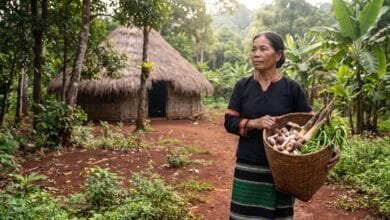
The Khmer also grow dry-crops on burnt-over land, including vegetables, beans, maize, sweet potatoes, sugar cane, onions, and sometimes fruit trees such as longan, watermelon, and mango. Livestock rearing is still associated with agriculture — oxen and buffaloes are kept as draught animals, while chickens, ducks, and geese supplement family meals.
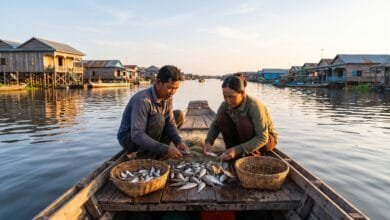
In coastal areas, fishing is a sideline occupation. On large rivers, fishing is carried out with nets or lines, but on small rivers, canals, or submerged fields, people use harpoons, eel-pots, square dip-nets, or a locally designed basket called a xa neng.
Fish is preserved in different ways — cooked with brine in a slow oven, smoked, dried, or pickled with salt. The pickled fish paste called prahoc is a traditional Khmer dish and a staple of Khmer cooking.
What Makes Khmer Communities Distinct?
Several features distinguish Khmer communities from others in the region:
The centrality of the pagoda. In Khmer villages, the Buddhist temple is not just a religious site — it is the community’s social, cultural, and educational center. Festivals, weddings, funerals, and community meetings are all organized around the pagoda. Monks are respected figures who provide spiritual guidance and often teach children.
Labor exchange traditions. Work exchange groups called dok day or dok day pevah knea assist peasants with tasks such as house-building, weddings, and funerals. This tradition reflects the importance of mutual aid in Khmer community life.
A culture of calmness and tolerance. Buddhist principles such as tolerance, calmness, and taking responsibility for one’s own actions are values found throughout Khmer culture. These values shape how people interact and resolve disputes.
Connection to water and land. Khmer livelihoods and daily routines are closely tied to the rhythms of the monsoon, the rising and falling of the Tonlé Sap Lake, and the cycles of rice cultivation. Fishing and farming are not just occupations — they are ways of life passed down through generations.
How Is Khmer Life Changing?
Khmer communities are changing rapidly. Several forces are reshaping rural and urban life:
Migration to cities. Internal migration from rural to urban areas has increased significantly in recent decades, driven by debt and limited economic opportunities. Many individuals relocate to Phnom Penh in search of better livelihoods. Migration is highly gendered: men often leave to seek agricultural work in another rural area, while women leave for urban areas to work in garment factories.
Debt and land loss. Microfinance debt has risen to $60 billion as of December 2024, leaving farmers and low-income families in remote provinces vulnerable. Many have sold farmland due to limited access to financial education. This is a growing concern in rural Khmer communities.
Climate change. Cambodia’s wet season is becoming unpredictable, affecting rice harvests. Farmers are increasingly turning to climate-resilient seeds and practices such as cover cropping to improve soil health and adapt to a changing climate.
Urbanization. As of 2023, approximately 26 percent of Cambodia’s population resided in urban areas, and this figure is expected to double by 2050. Migration to Phnom Penh has been particularly rapid.
Generational change. Young Khmer people are increasingly likely to work in factories, tourism, or services rather than farming. While rice farming remains the backbone of rural Cambodia, many young people see their futures in cities.
What Might Foreign Visitors Notice?
Travelers in Cambodia will encounter Khmer people in many settings: as farmers working rice paddies, fishers on the Tonlé Sap, market vendors selling vegetables and fish, monks collecting alms at dawn, students in school uniforms, and families gathering at the pagoda on festival days.
Visitors may notice that many Khmer people are welcoming and curious about foreigners, especially in rural areas where tourism is less common. They may also notice that daily life is closely tied to the rhythm of the rice-growing season and the availability of fish. In many villages, the day begins early — before sunrise — and slows during the hottest hours of the afternoon.
Travelers should understand that rural Khmer communities may have limited experience with international visitors and that customs around dress, photography, and personal space may differ from what they are used to. A respectful, patient approach goes a long way.
How Can Visitors Be Respectful?
- Dress modestly when visiting villages or pagodas. Cover shoulders and knees.
- Ask before taking photographs of people, especially monks and elders.
- Remove your shoes before entering a pagoda or a home.
- Accept offers of food or tea when they are made — it is a sign of hospitality.
- Learn a few words of Khmer. Simple greetings like sua sdei (hello) and aw kun (thank you) are appreciated.
- Avoid touching people on the head or pointing your feet at people or religious objects.
- Be mindful that many rural families have limited resources. Avoid ostentatious displays of wealth.
- Support local businesses and community-based tourism initiatives where possible.
Frequently Asked Questions
Who are the Khmer people?
The Khmer are a Southeast Asian ethnic group native to Cambodia. They make up approximately 90–95% of Cambodia’s population and are the descendants of the builders of the Angkor Empire. Khmer is the official language of Cambodia, and most Khmer people follow Theravada Buddhism.
What language do Khmer people speak?
Khmer (also called Cambodian) is the official language of Cambodia and is spoken by more than 95% of the population. It is a member of the Austroasiatic language family and has its own unique script.
What do Khmer people do for a living?
The majority of Khmer people live in rural areas and work as rice farmers or fishers. Rice cultivation is the backbone of rural livelihoods, often combined with fishing, livestock raising, and the cultivation of vegetables and other crops. In cities, Khmer people work in garment factories, tourism, services, and trade.
How do Khmer people live in rural areas?
Rural Khmer communities are centered around a Buddhist temple, or wat. Traditional houses are built on stilts, and community life involves shared labor, religious festivals, and mutual aid. Extended families often live near one another.
How is life changing for Khmer people?
Khmer communities are experiencing rapid change. Many young people are migrating to cities for work, particularly in garment factories and tourism. Climate change is affecting rice harvests, and debt is a growing concern for rural families. Urbanization is increasing, with about 26% of the population living in urban areas as of 2023.
What should foreign visitors know before interacting with Khmer communities?
Visitors should dress modestly, ask before taking photographs, remove shoes before entering homes or pagodas, and learn a few words of Khmer. A respectful, patient approach and awareness of local customs will make interactions more meaningful.
CONCLUSION
The Khmer people are the heart of Cambodia. They are the farmers who grow the rice that feeds the nation, the fishers who work the waters of the Tonlé Sap and the Mekong, the families who gather at the pagoda, and the young people who are moving to cities in search of new opportunities. Their lives are shaped by ancient traditions and modern pressures, by the rhythms of the monsoon and the forces of globalization.
For foreign travelers, understanding the Khmer people transforms a trip to Cambodia. The temples of Angkor are breathtaking, but they are the creation of the Khmer people. The markets, the food, the music, the warmth of a greeting — all of it comes from Khmer communities.
When you meet a Khmer farmer in a rice paddy, a fisher on the lake, or a vendor in a market, you are meeting the inheritors of a culture that has endured for centuries. Travel with curiosity, respect, and an openness to learn — and you will come away with a deeper understanding not just of Cambodia, but of the people who make it what it is.