Inside Cambodia’s Indigenous Highlands: The Communities Fighting to Keep Their Forests — and Their Future
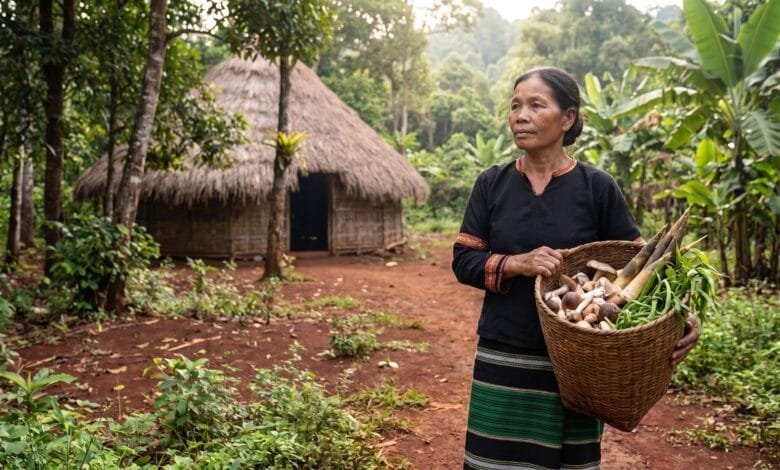
In the far northeastern corner of Cambodia, where the country meets Laos and Vietnam, more than 35,000 people live within and around Virachey National Park. Over 85% of them identify as Indigenous — primarily Kavet, Brao, Lun, and Kreung. These are communities whose ancestors lived in these forests for thousands of years, long before the Khmer Empire rose in the lowlands. Today, they are working to ensure their way of life survives for the next thousand.
Who Are Cambodia’s Indigenous Communities?
Cambodia’s Indigenous peoples are diverse — not a single group with a single culture. The 2019 national census recorded 22 Indigenous groups with a combined population of 172,980, about 1.11% of Cambodia’s total population. The largest groups are the Bunong (36,585), Tampuan (36,373), Jarai (26,922), Kreung (21,453), Kui (16,762), and Prao (10,086).
Each group has its own language, social structure, and traditions. The Jarai, for example, are matrilineal, with inheritance and clan relationships passed down through the female line. The Bunong have developed an extensive traditional healthcare system using hundreds of plant and animal species. The Kreung are known for their distinctive wedding traditions and community decision-making practices.
What they share is a deep connection to the forests and highlands of northeastern Cambodia — and a history of living in those landscapes in ways that outside authorities have often misunderstood.
Where Do They Live?
Approximately 94% of Cambodia’s Indigenous population lives in six northeastern provinces: Ratanakiri, Mondulkiri, Kratie, Preah Vihear, Stung Treng, and Kampong Thom. Ratanakiri and Mondulkiri together hold more than half of the national Indigenous population, and in both provinces, Indigenous peoples form a majority of residents.
Virachey National Park, one of Cambodia’s largest protected areas, is home to five Community Protected Areas covering around 20,000 hectares of forest, river, and grassland under direct Indigenous stewardship. These CPAs are legally recognized zones where Indigenous communities hold formal rights to manage and conserve natural resources.
How Do They Make a Living?
For generations, the primary livelihood across these communities has been rotational farming — also called swidden or shifting cultivation. Families clear a plot of forest land, farm it for several years, then allow it to regenerate while moving to a new plot. Among the Bunong, the traditional cycle used one site for up to five years before moving on, with a 15–20 year fallow period.
This system is often misunderstood. Outside observers sometimes label it “slash-and-burn” and assume it destroys forests. But research shows that Bunong rotational farming should be understood as a form of forest care, not a threat to it. The fallow periods allow forests to regenerate, and the farming system is embedded in a broader relationship of stewardship.
Indigenous communities also rely heavily on non-timber forest products — wild honey, mushrooms, vegetables, medicinal plants, and resins — for both household consumption and income. A 2023 study by WWF-Cambodia found that 18 Community Protected Areas generated approximately US$18 million in annual income from harvesting non-timber forest products, one-third of which came from wild honey alone.
What Makes These Communities Distinct?
Several characteristics set northeastern Cambodia’s Indigenous communities apart:
Community land stewardship. The Community Protected Area model gives Indigenous communities formal legal rights to manage forests — a recognition that their traditional practices are not obstacles to conservation but essential to it. As the CPA leaders in Virachey wrote: “Ecotourism can only succeed when local people are recognized as its rightful custodians and beneficiaries”.
Traditional ecological knowledge. The Bunong use 214 plant species, one mushroom species, and 22 animal species in traditional healthcare practices to treat 51 different ailments. This knowledge is passed down through generations and represents a form of science that predates written records.
Collective land titling. Cambodia’s 2001 Land Law created a pathway for Indigenous communities to obtain collective land titles — a legal recognition of communal rather than individual ownership. The process is lengthy, requiring community consensus, legal documentation, and government approval. Since 2020, 30 Indigenous communities have received collective titles, and by 2025 more than 7,000 hectares had been brought under communal title.
Community-led ecotourism. The Bunong community of Andaung Kraloeng in Mondulkiri owns and operates the Jahoo Gibbon Camp, which has trained and employed 24 local people in hospitality, guiding, and research roles since 2013. In Virachey National Park, five Indigenous communities have signed a five-year roadmap to develop their own ecotourism enterprises and a co-managed destination management company.
How Is Life Changing?
Indigenous communities in northeastern Cambodia are navigating rapid change on multiple fronts.
Land pressure. Agro-industrial concessions, illegal logging, and in-migration of lowland Khmer settlers have reduced the land available for rotational farming and forest gathering. A 2025 study on climate-related loss documented how land dispossession and indebtedness reduce smallholder farmers’ capacity to cope with climate impacts.
Generational shifts. Younger people are increasingly drawn to wage labor, urban migration, and consumer culture. Community leaders in Mondulkiri express concern that traditional dance and music are losing young practitioners, with performances now mostly limited to national programs and special ceremonies.
Climate change. Lower fish stocks in the Mekong, changing rainfall patterns, and more frequent extreme weather events are affecting both farming and forest-based livelihoods. Indigenous communities are on the front lines of climate impacts despite contributing little to the problem.
Language and education. The Jarai language is now the sixth Indigenous tongue taught in Cambodian schools, part of an effort to preserve native cultures and traditions. But access to education in Indigenous languages remains limited, and many children face instruction only in Khmer.
Women’s leadership. Indigenous women are increasingly visible as community leaders and defenders of land and water resources. In Ratanakiri, Tampuan women like Aunt Pav Mach are recognized as “Village Specialists” — respected figures who preserve ancestral heritage and traditional knowledge.
What Might Foreign Visitors Notice?
Travelers who venture to Ratanakiri or Mondulkiri may notice several things:
- Landscapes shaped by Indigenous stewardship. The forests and grasslands you see are not untouched wilderness — they are landscapes that Indigenous communities have managed for generations.
- Communities that are both traditional and modern. You may see families farming rotational plots alongside children using smartphones, or traditional gong music performed for tourists alongside community meetings about land titling.
- A different pace of life. Life in Indigenous villages often follows seasonal rhythms — planting, harvesting, forest gathering — rather than the 9-to-5 schedules familiar to many foreign visitors.
- Complex relationships with tourism. Some communities have embraced ecotourism as a way to generate income while sharing their culture. Others remain wary of outside attention. Both responses are understandable.
How Can Visitors Be Respectful?
If you travel to northeastern Cambodia, keep these principles in mind:
Ask before photographing. Some communities are comfortable with photography; others are not. Always ask first, and respect a “no.”
Support community-owned businesses. Choosing Indigenous-owned homestays, tour operators, and craft businesses keeps tourism revenue in the community.
Understand that you are a guest. Indigenous communities are not tourist attractions. They are places where people live, work, and raise families. Behave accordingly.
Be patient with language. Many Indigenous people speak their own language as well as Khmer. English proficiency varies. Learn a few words of Khmer or the local language — it goes a long way.
Avoid romanticizing. Indigenous communities face real challenges: land pressure, limited healthcare, and educational barriers. Respectful travel means seeing communities as they are, not as an idealized “authentic” experience.
Frequently Asked Questions
Who are the Indigenous peoples of northeastern Cambodia?
They are diverse communities including the Bunong, Tampuan, Jarai, Kreung, Kavet, Brao, and others — 22 groups in total, according to the 2019 census. They have lived in the region for thousands of years, with their own languages, traditions, and land management systems.
What is rotational farming, and why is it important?
Rotational farming (also called swidden or shifting cultivation) is a system where families farm a plot of land for several years, then leave it fallow to regenerate while moving to a new plot. Research shows it can be a form of forest care when practiced with adequate fallow periods, not a destructive practice.
Are Indigenous communities in Cambodia under threat?
Yes, in complex ways. Land concessions, illegal logging, in-migration, and climate change are reducing the land and forest resources communities depend on. At the same time, communities are actively organizing, obtaining land titles, and developing community-led economic alternatives.
Can travelers visit Indigenous communities in northeastern Cambodia?
Yes, several communities operate community-based ecotourism initiatives — such as the Jahoo Gibbon Camp in Mondulkiri and CPA-based tourism in Virachey National Park. Visitors should choose community-owned options and follow respectful travel practices.
What is a Community Protected Area?
A Community Protected Area (CPA) is a legally designated zone within a national protected area where Indigenous and local communities hold formal rights to manage, conserve, and sustainably use natural resources. Virachey National Park has five of Cambodia’s largest CPAs.
How can I support Indigenous communities during my travels?
Choose Indigenous-owned accommodations and tours, buy crafts directly from community producers, ask before photographing, and learn about the communities before you arrive. The most meaningful support comes from treating people with respect, not just spending money.
CONCLUSION
The Indigenous communities of northeastern Cambodia are not relics of the past. They are living communities with young populations — the median age of Indigenous people is 21, compared to 26 for Cambodia as a whole — who are actively shaping their own futures. They are obtaining land titles, managing protected forests, running ecotourism businesses, and teaching their languages to the next generation.
They are also facing pressures that no community should have to face alone: land grabs, climate change, and the quiet erosion of traditions that took centuries to build.
For foreign travelers, understanding these communities changes the meaning of a trip to Cambodia. The temples of Angkor will still be there. The beaches of Koh Rong will still be there. But the forests of Ratanakiri and the highlands of Mondulkiri — and the people who have cared for them for millennia — are part of a story that is still being written. To visit with respect, curiosity, and humility is to become part of that story, rather than just a spectator to it.