Wat Phnom in Phnom Penh: What to See Before You Visit
Some cities are named after rivers, kings, or saints. Phnom Penh is named after a hill—and a woman who found something unexpected floating in the water.
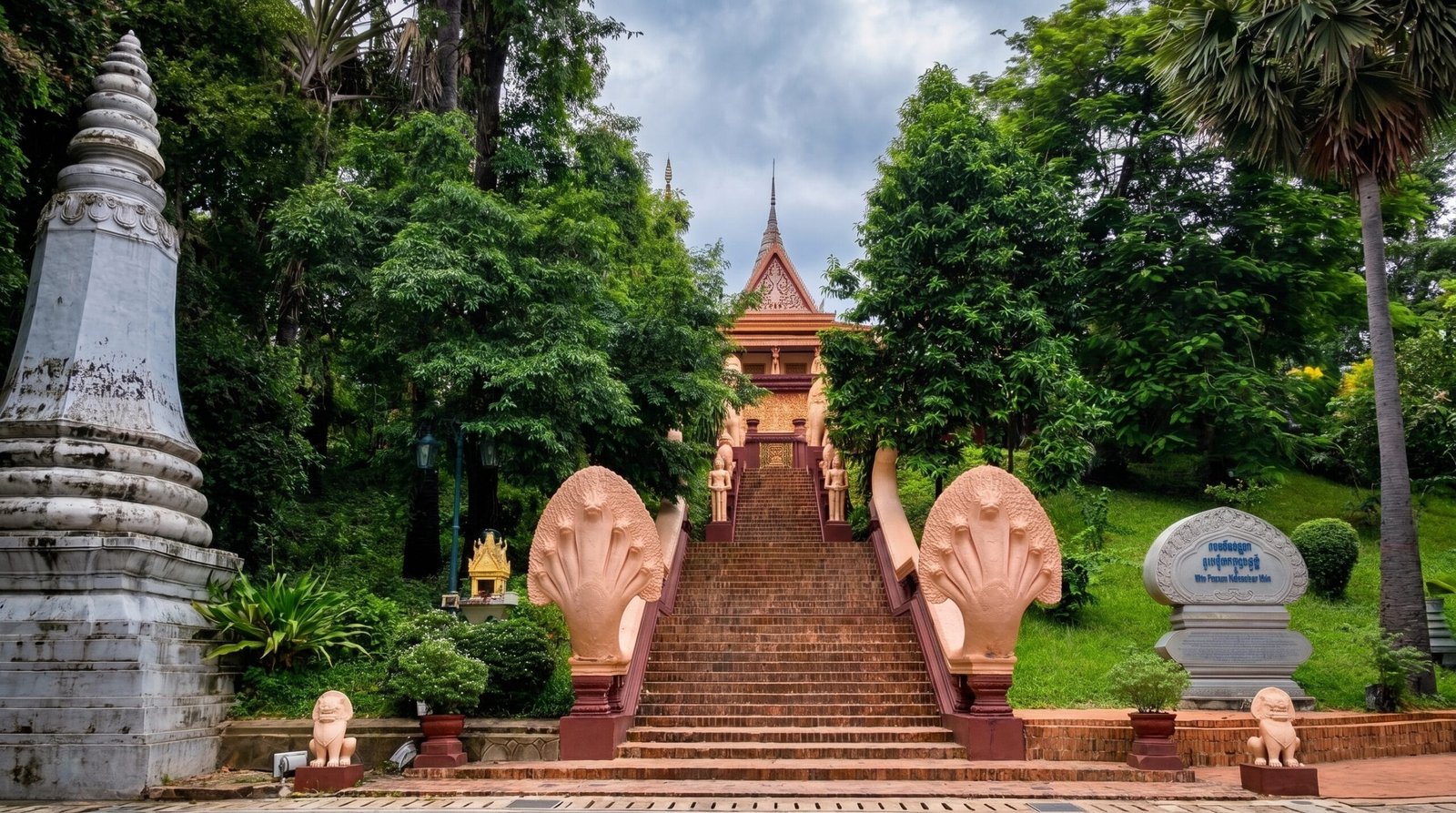
The hill is still there. It sits at the northern edge of central Phnom Penh, covered in trees and topped with a Buddhist temple that has been part of this city’s identity for more than 600 years. The temple is called Wat Phnom, and it is one of the most historically significant sites a visitor can see in Cambodia’s capital.
This guide explains what Wat Phnom is, what you can actually see and do there, and what to know before you go.
Quick Travel Information
Location: Northern end of central Phnom Penh, at the intersection of Norodom Boulevard and Street 96
Type of Destination: Active Buddhist temple on a historic hill
City: Phnom Penh
Known For: Being the founding site and namesake of Phnom Penh
Main Experience: Climbing a 27-meter hill to visit a living temple, seeing the founding legend represented in statues, and viewing Phnom Penh from a peaceful elevated spot
Recommended Visit Time: 30–45 minutes for the temple itself; longer if you relax in the surrounding park
Best Time to Visit: Morning (7:00–10:00 AM) for cooler temperatures and quieter conditions
Entrance Fee: $1 USD for foreign visitors (collected at the main eastern staircase); Cambodian nationals enter free
Opening Hours: Generally 7:00 AM – 6:00 PM daily. Hours can vary, so confirm before visiting.
Useful to Know: The surrounding park is free to access and popular with local joggers and families, especially in the early morning and evening
What Is Wat Phnom?
Wat Phnom is a Buddhist temple sitting on top of a 27-meter hill in Phnom Penh. The name says exactly what it is: wat means temple and phnom means hill in Khmer.
The hill is the only significant elevation in central Phnom Penh. That makes Wat Phnom both a landmark you can spot from nearby streets and a naturally cooler, breezier place compared to the surrounding city.
It is not a large temple complex like Angkor Wat. It is one compact sanctuary, a few stupas, and several smaller shrines arranged on a tree-covered mound. What it lacks in size, it makes up for in symbolic importance. This is the place that gave Cambodia’s capital city its name.
Why Visit Wat Phnom?
Wat Phnom matters for three specific reasons.
First, it is the founding site of Phnom Penh. According to local tradition, the city grew from the settlement that formed around this hill. Visiting Wat Phnom is, in a very literal sense, visiting the origin point of the city you are standing in.
Second, it is an active Buddhist temple, not a museum piece. Locals come here to pray, make offerings, and seek blessings. You will see Cambodian religious life happening around you, not just historical displays.
Third, it offers a manageable, accessible introduction to Cambodian temple culture. If you are new to Cambodia and feeling unsure about how to behave at a temple, Wat Phnom is a good first stop. It is small, walkable, and relaxed compared to larger religious sites.
What to See
The Main Temple Sanctuary (Vihara)
The main temple building at the summit houses a large bronze Buddha statue surrounded by smaller statues, flowers, candles, and items of devotion. The walls are covered in murals depicting Buddhist stories and scenes from the Reamker, the Cambodian version of the Ramayana.
The interior is active and fragrant with incense. Monks may be present. Visitors are welcome but should behave respectfully—speak quietly, do not point your feet toward the Buddha, and avoid interrupting anyone who is praying.
The Statue of Daun Penh
On the south side of the passage between the main temple and the large stupa, there is a statue of a plump, smiling woman. This is Daun Penh—Grandma Penh—the woman from the founding legend.
The statue is a popular spot for photos, but it is also a genuine object of local respect. Cambodians come here to make offerings and ask for good luck.
The Royal Stupa
West of the main temple stands a large stupa that contains the ashes of King Ponhea Yat and members of his royal family. This connects Wat Phnom directly to the period when the Khmer capital moved from Angkor to Phnom Penh in the 15th century.
The Shrine of Preah Chau
On the north side of the hill, below the main temple, there is a smaller and more eclectic shrine dedicated to a spirit called Preah Chau. This shrine includes guardian figures, drawings of Confucius, and an eight-armed statue of Vishnu. It is a good example of how Cambodian religious practice can blend Buddhist, Hindu, and Chinese influences.
The View from the Hill
From the top of the 27-meter hill, you can look out over parts of central Phnom Penh. It is not a panoramic observation deck, but it offers a different perspective on the city—tree canopy, rooftops, and the movement of the streets below.
What to Do
The main activity at Wat Phnom is walking up the hill and exploring the temple at the top. The climb is short—roughly 27 meters of elevation—and there are staircases on multiple sides.
Many visitors also sit in the park at the base of the hill. This is a free public space where you can rest, people-watch, or simply take a break from the heat. Local residents use it for jogging, stretching, and family time.
Photography is a natural part of the visit. The temple buildings, the naga (serpent) balustrades on the main staircase, and the surrounding trees offer good photo opportunities. Be respectful when photographing people, especially anyone who is praying.
Some visitors choose to make a small offering—incense, flowers, or fruit—as local worshippers do. This is not required, but if you do it, do so with quiet respect and not as a performance.
The Story and History of Wat Phnom
The Legend of Daun Penh
The most well-known origin story is a legend. It is not a documented historical event, and it should be understood as a traditional story that explains the city’s name.
According to the legend, in the late 14th century, a wealthy widow named Daun Penh found a large koki tree floating in the Mekong River near her home. Inside the hollow trunk, she discovered four bronze statues of the Buddha. She built a small shrine on an artificial hill to protect the statues, and the site became a place of prayer and blessing.
The hill became known as Phnom Daun Penh—the Hill of Lady Penh. Over time, the settlement that grew around it took the name Phnom Penh.
The Historical Record
A separate account suggests that King Ponhea Yat built a sanctuary on this site when he moved the Khmer capital from Angkor to Phnom Penh in the 15th century. The royal stupa on the western side of the hill contains his ashes, which supports this connection to the royal capital move.
The temple has been rebuilt several times over the centuries, including in 1434, 1806, 1894, and most recently in 1926. The current structure dates primarily from that 1926 reconstruction, though some older elements remain.
Culture and Local Meaning
Wat Phnom is not just a tourist site. It is a working temple where Cambodians come to pray for good luck, success in school exams, and success in business.
When a person’s wish is granted, they may return to make an offering they promised—often a garland of jasmine flowers or bananas. These offerings are part of an ongoing relationship between the worshipper and the spiritual power associated with the site.
The temple is also a center of celebration during Khmer New Year and Pchum Ben, two of the most important festivals in Cambodia. If you visit during these times, expect larger crowds and a more festive atmosphere.
What the Experience Is Like
Wat Phnom feels different from the larger, more famous temple sites in Cambodia. It is small, and the visit is short. The atmosphere is a mix of quiet devotion, casual local recreation, and light tourist activity.
The park at the base is usually livelier than the temple itself. You will likely see people exercising, children playing, and vendors selling drinks or small items.
At the temple level, things are calmer. The incense, the murals, and the presence of monks and worshippers create a reflective mood. It is not a silent or solemn place—it is a living religious space—but it is noticeably quieter than the streets below.
Crowds vary. Early mornings are generally calm. Midday can be hot and busier with tour groups. Late afternoon, when the light softens and the park fills with local families, is a pleasant time to be there.
How to Get There
Wat Phnom is located at the northern end of the central Phnom Penh grid, along Norodom Boulevard. It is within walking distance of the riverside area, the Royal Palace, and the National Museum for reasonably mobile travelers.
The easiest way to get there is by tuk-tuk or taxi. Tuk-tuk drivers in Phnom Penh know Wat Phnom by name, and a ride from most central hotels should take around 10–20 minutes depending on traffic.
For visitors who prefer to walk, Wat Phnom is connected to the riverside promenade via Norodom Boulevard. The walk is roughly 2–3 kilometers from the Royal Palace area.
There is no direct train or boat service to Wat Phnom. Public bus routes exist in Phnom Penh, but for most foreign visitors, tuk-tuk is the practical choice.
How to Visit
What to wear: Cover your shoulders and knees. Sleeveless tops, tank tops, and shorts above the knee are not appropriate for the temple area. A light scarf or sarong in your bag is a useful backup.
Shoes: You will need to remove your shoes before entering the main temple building. Wear shoes that are easy to slip on and off.
Etiquette: Speak quietly. Do not point your feet at Buddha images or monks. Do not touch monks. If you sit on the floor inside the temple, sit with your legs tucked to one side rather than stretched out in front of you.
Photography: Photography is generally allowed in the outdoor areas. Inside the temple, be discreet and avoid using flash. Do not photograph people praying without permission.
Time needed: 30–45 minutes is enough to climb the hill, visit the main temple, and look around. Add more time if you want to sit in the park.
Accessibility: The hill is climbed by staircases. There is no elevator or ramp to the summit. Visitors with limited mobility may find the climb difficult.
Best Time to Visit
The best time of day to visit Wat Phnom is early morning, shortly after opening. Temperatures are cooler, the light is softer for photography, and the site is less crowded.
November to February is the coolest and driest period in Phnom Penh, making it the most comfortable season for walking and climbing stairs. March to May is hot and humid. June to October is the rainy season, with short intense downpours that can make stairs slippery.
If you visit during Khmer New Year (usually mid-April) or Pchum Ben (usually September or October), expect larger crowds and a more celebratory atmosphere.
How Long to Spend
Plan for 30–45 minutes at Wat Phnom. This is enough time to climb the hill, visit the main temple, see the stupa and the statue of Daun Penh, and take a few photos.
If you want to sit in the park, rest, or people-watch, allow an hour. Wat Phnom does not require a half-day. It works well as a short stop combined with other nearby attractions.
Nearby Places to Combine With Your Visit
Wat Phnom is close to several other central Phnom Penh destinations that are relevant to foreign travelers.
The National Museum of Cambodia is south of Wat Phnom along Street 13. It houses one of the world’s largest collections of Khmer art and is a natural companion visit—Wat Phnom gives you the living religious context, and the museum gives you the historical and artistic depth.
The Royal Palace and the Silver Pagoda are further south along the riverside. These are major attractions and can be visited in the same half-day as Wat Phnom if you plan your route.
The riverside promenade (Sisowath Quay) is a pleasant walk from Wat Phnom and offers restaurants, cafes, and views of the Tonle Sap and Mekong rivers.
Travel Tips
Bring small change. The $1 entrance fee for foreigners is collected at the main eastern staircase. Having a dollar bill ready makes the entry smoother.
Go early for cooler weather. Phnom Penh is hot for much of the year. Climbing a hill in the middle of the afternoon is less pleasant than doing it in the morning.
Keep a scarf or light layer handy. It can be used for sun protection, for covering shoulders at the temple, and for the occasional cool breeze.
Do not rush the park. The park at the base of Wat Phnom is a genuine slice of local Phnom Penh life. Sitting there for ten minutes can be as memorable as the temple itself.
Check current hours. Opening hours can change, especially around holidays or for maintenance. Confirm locally or with your hotel before making a special trip.
Responsible Travel
Wat Phnom is a religious site, not a theme park. The most important thing you can do is treat it as a place of worship.
Dress modestly. Speak quietly. Remove your shoes where required. Do not climb on stupas or statues. Do not disturb anyone who is praying or making an offering.
If you take photos, do so respectfully. Ask before photographing people. Avoid photographing monks in ways that feel intrusive.
If you buy drinks or small items from vendors in the park, that is a legitimate way to support local livelihoods. If you choose to make a temple offering, do it with genuine respect rather than as a photo opportunity.
Leave no litter. Follow any posted rules or instructions from temple staff.
Frequently Asked Questions
Is Wat Phnom worth visiting?
It depends on what you are looking for. Wat Phnom is not a large or visually spectacular temple. It is a historically significant, small, active temple with a meaningful story behind it. If you are interested in the origin of Phnom Penh or want an easy introduction to Cambodian temple culture, it is worth 30–45 minutes. If you are only interested in grand ancient architecture, it may not be a priority compared to Angkor.
How much does it cost to enter Wat Phnom?
Foreign visitors pay $1 USD. Cambodian nationals enter free. The surrounding park is free for everyone
What should I wear to Wat Phnom?
Cover your shoulders and knees. Avoid sleeveless tops and shorts above the knee. Bring a scarf or sarong if you are unsure. You will need to remove your shoes before entering the main temple building
Can I take photos at Wat Phnom?
Photography is generally allowed in outdoor areas. Be discreet inside the temple and avoid flash. Do not photograph people praying without their permission.
How long does it take to visit Wat Phnom?
Is Wat Phnom accessible for people with mobility issues?
The temple sits on top of a hill reached by staircases. There is no elevator or ramp. Visitors who cannot climb stairs may find it inaccessible.
When is the best time to visit Wat Phnom?
Early morning, shortly after opening, is the best time. It is cooler, quieter, and better for photography. The coolest months are November to February.
Conclusion
Wat Phnom is a small temple with a large story. It is the place where, according to local tradition, a woman named Penh found four Buddha statues in a floating tree and built a shrine on a hill. That hill became Phnom Penh.
For a foreign traveler, Wat Phnom offers a compact, accessible, and meaningful experience. It does not require a full day. It does not demand expert knowledge of Cambodian history. What it asks is a little curiosity and a little respect.
If you are spending time in Phnom Penh, Wat Phnom fits naturally into a half-day of central city exploration. Combine it with the National Museum, the Royal Palace, or a walk along the riverside. Give it 30–45 minutes. Climb the stairs, see the temple, and take a moment to sit in the park below.
You will have visited the place that gave Cambodia’s capital its name. That is a small but real connection to the city you are standing in.