Preah Vihear Temple: A Visitor’s Guide to Cambodia’s Cliff Temple
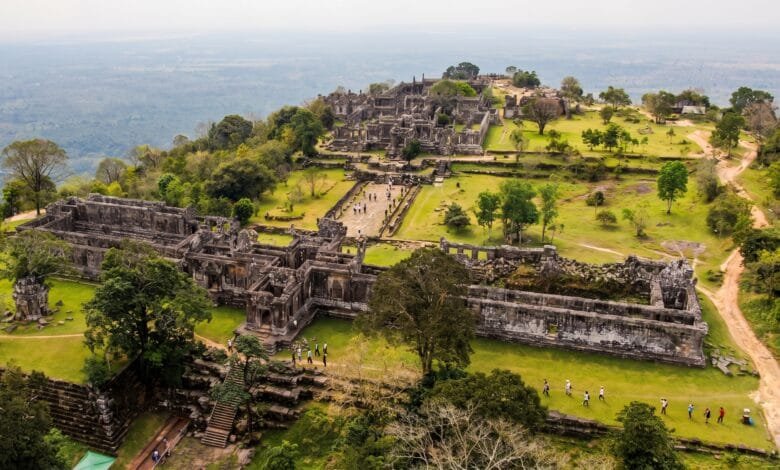
Most Khmer temples were built on flat land. Preah Vihear was built on the edge of a cliff.
The temple sits 625 meters above the Cambodian plain in the Dângrêk Mountains, in Preah Vihear Province, northern Cambodia. It is not a single compact temple like Angkor Wat. Instead, it is a long series of sanctuaries, walkways, and staircases stretching more than 800 meters along a north-south axis.
Construction began in the 9th century under King Yasovarman I and continued for over 300 years. Preah Vihear is a UNESCO World Heritage Site and one of the most important examples of Khmer architecture outside the Angkor region.
This guide explains what Preah Vihear is, why it matters, and what foreign travelers should know before visiting.
Quick Travel Information
- Location: Preah Vihear Province, northern Cambodia, near the Thailand border
- Province: Preah Vihear
- Site Type: Hindu temple (dedicated to Shiva)
- Historical Period: 9th–12th century CE
- Religious Tradition: Hinduism (Shaiva)
- Heritage Status: UNESCO World Heritage Site (inscribed 2008)
- Known For: Cliff-top setting, 800-meter linear layout, five gopuras
- How to Get There: 3–4 hours by car from Siem Reap; private vehicles stop at the ticket office, then transfer to a site shuttle or pickup truck
- Recommended Visit Time: 2–3 hours at the temple
- Opening Hours: Approximately 7:30 AM–5:30 PM (verify before travel)
- Entrance Fee: $10 USD for foreigners; shuttle to summit approximately $25 USD per vehicle (verify before travel)
Note: Travel information can change. Check current conditions with local authorities or a reputable tour operator before traveling.
What Is Preah Vihear?
Preah Vihear is a Hindu temple complex dedicated to Shiva. It was built on a cliff in the Dângrêk Mountains, overlooking the plains of northern Cambodia.
Unlike most Khmer temples, which were planned as concentric squares, Preah Vihear follows a linear plan. It climbs uphill from south to north, with each level built higher than the last. The temple has four main levels and four courtyards, connected by five gopuras (entrance pavilions).
The temple is also known as Prasat Preah Vihear in Khmer. It has been a place of pilgrimage for centuries.
Why Is Preah Vihear Important?
Preah Vihear is important for three main reasons.
First, it is an architectural masterpiece. The temple’s linear design responds directly to the natural topography of the cliff. This is unusual in Khmer architecture and shows the skill of the ancient builders.
Second, it has a long and continuous history. While many temples were abandoned when their patron king died, Preah Vihear received patronage for more than four centuries. Kings from Yasovarman I to Suryavarman II contributed to its construction.
Third, it is a UNESCO World Heritage Site. It was inscribed in 2008 under criterion (i), which recognizes it as a masterpiece of human creative genius.
The History of Preah Vihear
The story of Preah Vihear begins in the 9th century. King Yasovarman I (889–910) started work on the original temple, which was dedicated to Shiva.
According to a French epigraphist, a son of Jayavarman II may have founded a sanctuary at the site even earlier, in the early 9th century. An inscription says he brought a linga from Vat Phou to the site.
The temple was not completed in one generation. It grew over more than 300 years. Most of the stone structures visible today were built under King Suryavarman I (1002–1050) and his son Udayadityavarman II (1050–1068).
Later kings, including Jayavarman VI, Dharanindravarman I, and Suryavarman II, added more. The temple was only completed in the reign of Suryavarman II (1113–1150).
In modern times, the temple became a point of tension between Cambodia and Thailand. In 1962, the International Court of Justice ruled that Preah Vihear belongs to Cambodia. In 2008, it was inscribed as a UNESCO World Heritage Site by Cambodia.
Architecture and What to Look For
Preah Vihear is unlike other Khmer temples. Most temples in the Angkor region are built on flat ground with a compact layout. Preah Vihear stretches along the edge of a cliff for over 800 meters.
The temple is organized in a linear sequence of levels. Each level has its own gopura and courtyard. As you climb, the structures get smaller and more sacred.
The five gopuras are the main architectural features. Gopura I is at the bottom, near the ticket area. Gopura V is at the top, near the main sanctuary.
The temple’s design is meant to represent Mount Meru, the home of the Hindu gods. The ascent from the plain to the cliff-top sanctuary mirrors the spiritual journey from the earthly world to the divine realm.
Carvings, Sculptures and Stories
Preah Vihear has some of the finest in-situ carvings of any Khmer temple.
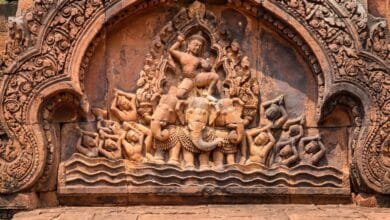
The carvings include scenes from Hindu mythology. One important relief shows the Churning of the Ocean of Milk, with devas and asuras pulling a snake around a pole. Another shows Vishnu reclining on the naga Ananta.
There are also many depictions of apsaras (celestial dancers) and dvarapalas (guardian figures) on the walls and pillars. Some lintels and pediments show scenes from the Ramayana and Mahabharata.
The carvings at Preah Vihear are notable for their quality and their state of preservation. Because the temple is remote, many of its decorative elements have survived better than those at more accessible sites.
Cultural and Religious Meaning
Preah Vihear was dedicated to Shiva, one of the three main gods of Hinduism. The temple was a center of Shaiva worship for centuries.
The temple was also a place of pilgrimage. Kings and commoners alike traveled to the site to pay homage. The main sanctuary may have housed a linga, the symbol of Shiva.
Today, Preah Vihear is still a sacred site for many Cambodians. Buddhist ceremonies are sometimes held at the temple, and visitors may see incense or offerings left among the ruins.
What Visitors Can See
When you visit Preah Vihear, you will start at the ticket office at the base of the mountain. From there, you will take a shuttle or pickup truck up the steep road to the temple entrance.
At the top, you will see the first gopura. A seven-headed naga carving welcomes visitors at the start of the causeway. From there, you will walk through a series of courtyards and gopuras, climbing gently toward the main sanctuary.
The main sanctuary is partially ruined. Stones from collapsed structures are scattered around, but the atmosphere is peaceful and uncrowded. At the far end of the temple, a viewing platform offers a wide view of the Cambodian plain below.
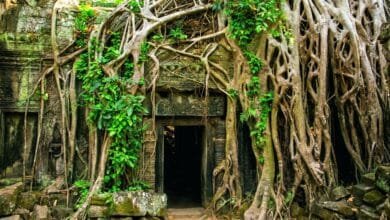
You may also see a small stupa covered in grass, with tree roots growing through its stone doorway. This is a reminder of the temple’s long history and the passage of time.
What the Visit Is Like
The visit to Preah Vihear involves walking and climbing. The path from the first gopura to the main sanctuary is about 800 meters long. The walk is mostly uphill, but the incline is gradual.
The temple is on a cliff, so there is little shade in some areas. The sun can be strong, especially in the middle of the day. Bring water, a hat, and sunscreen.
There are some stairs, but they are not as steep as those at some other Khmer temples. The main challenge is the heat and the distance.
Photography is allowed at the temple. The best light for photography is in the early morning or late afternoon. Sunrise and sunset can be particularly dramatic, with the temple silhouetted against the sky.
How to Get There
Preah Vihear is about 3–4 hours by car from Siem Reap. The road is paved for most of the way, but some sections are rough. Private vehicles can drive to the ticket office at the base of the mountain.
From the ticket office, you must transfer to a site shuttle or pickup truck. The road to the top is extremely steep, and private vehicles are not allowed. The shuttle costs approximately $25 per vehicle, and multiple passengers can share it.
It is also possible to reach Preah Vihear from Preah Vihear City (Tbeng Meanchey), which is about 1.5 hours away by car.
There are no direct flights to Preah Vihear. Most travelers visit as a day trip from Siem Reap or as part of a longer northern Cambodia itinerary.
How to Visit
- Tickets: Foreigners pay $10 USD. The shuttle to the summit costs approximately $25 per vehicle.
- Opening Hours: The temple is open daily, approximately 7:30 AM–5:30 PM. Verify current hours before traveling.
- Dress: Dress respectfully. Cover your shoulders and knees. Remove your hat when entering temple buildings.
- Etiquette: Do not touch carvings. Do not climb on ruins. Follow all posted signs and instructions from site staff.
- Photography: Photography is generally allowed. Be respectful when photographing religious activity.
- Accessibility: The site involves walking and some stairs. It may not be suitable for visitors with limited mobility.
Best Time to Visit
The best time to visit Preah Vihear is during the dry season, from November to April. During this period, the weather is cooler and the views are clearer.
The rainy season, from May to October, can bring heavy rain and fog. The road to the temple can be slippery, and the views are often obscured by clouds.
If you visit during the dry season, go early in the morning. The temple opens at 7:30 AM, and the early morning light is beautiful. There are also fewer visitors at this time.
How Long to Spend
Most visitors spend 2–3 hours at Preah Vihear. This includes the shuttle ride up and down the mountain, the walk through the temple, and time for photography.
If you are particularly interested in Khmer architecture or history, you may want to spend more time. The carvings and architectural details reward careful observation.
Nearby Places to Combine With the Visit
- Koh Ker: An ancient capital of the Khmer Empire, about 2 hours from Preah Vihear. It is known for its pyramid temple, Prasat Thom.
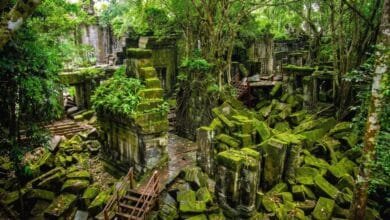
- Beng Mealea: A jungle-covered temple about 1.5 hours from Preah Vihear. It is less restored than Angkor Wat and has a wild, atmospheric feel.
- Preah Vihear Province: The surrounding province has other remote temples and natural areas. It is a good region for travelers who want to explore beyond the main tourist routes.
Travel Tips
- Bring cash. There may not be ATMs near the temple.
- Bring water and snacks. There are limited food options at the site.
- Wear comfortable shoes. You will be walking on uneven stone surfaces.
- Start early. The temple opens at 7:30 AM, and the morning light is best.
- Check the security situation before traveling. The Cambodia-Thailand border area has experienced tensions in the past. Check your government’s travel advisory before planning your trip.
Responsible Tourism
Preah Vihear is a sacred site and a protected heritage site. Visitors should treat it with respect.
Do not touch or climb on carvings. The oils from your hands can damage the stone.
Do not remove any stones or artifacts. This is illegal and harms the site.
Follow all conservation rules. Some areas may be closed for restoration.
Dress appropriately. Cover your shoulders and knees. Remove your shoes before entering certain sacred areas if asked.
Dispose of your waste properly. Take your trash with you.
Respect local communities. The temple is an important part of Cambodian cultural heritage. Be mindful of the people who live and work in the area.
Frequently Asked Questions
Is Preah Vihear worth visiting?
Yes, for travelers interested in Khmer history and architecture. The cliff-top setting is dramatic, and the temple is less crowded than Angkor Wat. However, it requires a long drive from Siem Reap, so it is best for travelers with extra time.
Can I visit Preah Vihear from Thailand?
Access from Thailand is currently restricted due to border tensions. Check current conditions before planning. Most foreign travelers access the temple from the Cambodian side.
How do I get to Preah Vihear?
The most common route is by private car or tour from Siem Reap, about 3–4 hours. You can also arrange transport from Preah Vihear City.
What is the entrance fee?
Foreigners pay $10 USD. The shuttle to the summit costs approximately $25 per vehicle.
What should I wear?
Dress respectfully. Cover your shoulders and knees. Wear comfortable walking shoes.
Is Preah Vihear accessible for people with limited mobility?
The site involves walking and some stairs. It may be difficult for visitors with limited mobility. Check with a tour operator about accessibility options.
When is the best time to visit?
November to April, during the dry season. Go early in the morning for cooler weather and better light.
Conclusion
Preah Vihear is one of Cambodia’s most remarkable temples. It was built over 300 years, from the 9th to the 12th century, and it sits on a cliff 625 meters above the plain.
The temple’s linear design, its fine carvings, and its dramatic setting make it unique among Khmer monuments. It is a UNESCO World Heritage Site and a place of continuing spiritual importance.
Visiting Preah Vihear requires more effort than visiting Angkor Wat. The drive from Siem Reap is long, and the final ascent is steep. But for travelers who make the journey, the reward is a temple experience unlike any other.
If you have time in your Cambodia itinerary, consider adding Preah Vihear. It offers a quiet, powerful encounter with Khmer heritage in a setting that few other temples can match.