Walking Through Beng Mealea’s Collapsed Ruins
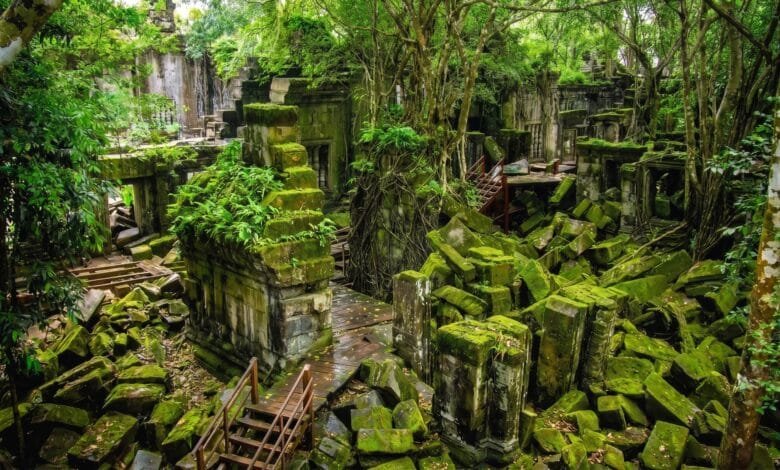
Most visitors to Siem Reap spend their days walking through temples that have been cleared, stabilized, and partly rebuilt. Galleries are supported. Towers are held together. Wooden walkways guide you through the main structures.
Beng Mealea is different.
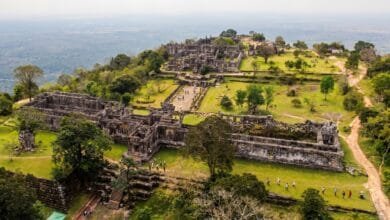
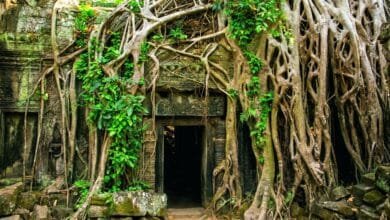
This 12th-century temple, about 40 kilometers east of the main Angkor group, is still lying where it fell. Stone blocks are scattered across the ground. Tree roots have pushed galleries apart. The central sanctuary is now a mound of loose sandstone. There is no attempt to hide the collapse.
That is exactly why people come here.
Quick Travel Information
| Information | Detail |
|---|---|
| Location | Svay Leu District, Siem Reap Province, about 40 km east of Angkor |
| Site Type | Hindu temple, later modified with Buddhist elements |
| Historical Period | Mid-12th century, Angkor Wat period |
| Religious Tradition | Originally Hindu (Shiva), later Buddhist additions |
| Heritage Status | On Cambodia’s UNESCO Tentative List since 2020 |
| Known For | Unrestored jungle ruins, collapsed galleries, tree roots |
| Main Visitor Experience | Walking through collapsed structures on wooden walkways |
| How to Get There | By car or tuk-tuk from Siem Reap, about 1–1.5 hours |
| Recommended Visit Time | 1–2 hours |
| Opening Hours | 7:00 AM – 5:30 PM (verify locally) |
| Entrance Fee | Covered by Angkor Pass; separate $10 ticket available if no pass |
Opening hours and ticket details can change. Check with Angkor Enterprise or your hotel before you go.
What Is Beng Mealea?
Beng Mealea is a large temple built in the middle of the 12th century. Its layout closely resembles Angkor Wat, the most famous temple in Cambodia. Both have a central sanctuary surrounded by galleries, and both are surrounded by a wide moat.
The difference is what happened after they were built. Angkor Wat became a major conservation project. Beng Mealea was left alone.
The temple sits in Svay Leu District, Siem Reap Province. It is not part of the Angkor Archaeological Park’s core zone. Cambodia submitted Beng Mealea to UNESCO’s Tentative List in 2020, but it is not yet a World Heritage Site in its own right.
Its builder is not known with certainty. No inscriptions have been found at the site. Scholars date it by architectural style — the same style as Angkor Wat — and assume it was built during the reign of King Suryavarman II in the early to mid-12th century.
Why Is Beng Mealea Important?
Beng Mealea matters for three reasons.
First, it is one of the largest temple complexes of the Angkor period. The temple compound covers about 14 hectares, surrounded by a moat roughly 1,200 meters by 900 meters. That scale tells us it was an important religious center, not a small provincial shrine.
Second, its architectural style connects it directly to Angkor Wat. The layout, the galleries, the use of sandstone — all point to the same building tradition. Some researchers suggest Beng Mealea may have served as a kind of practice or prototype for the larger temple.
Third, and most visibly for a visitor today, Beng Mealea shows what these temples look like when nature is left to take over. It is a rare chance to see an Angkor-period monument in a condition close to how French explorers found these sites in the 19th century.
The History of Beng Mealea
The temple was built in the mid-12th century, during the reign of Suryavarman II. The dating comes from architectural style, not from inscriptions. The king who ordered its construction is not recorded on site.
Beng Mealea sits along an ancient royal road that connected Angkor to Preah Khan Kampong Svay, further east. That road had well-built bridges, some of which survive. The temple’s position near a canal used for transporting sandstone also suggests it was planned as part of a wider network, not an isolated monument.
After the Angkor period, Beng Mealea was abandoned. The jungle grew over it. French researchers documented the site in the late 19th and early 20th centuries, but no major restoration was attempted. That decision — or lack of resources — shaped what visitors see today.
The temple is sometimes described as “unfinished,” but that is not quite accurate. It was built, used, and then left to decay. What looks unfinished is really the result of centuries of collapse.
Architecture and What to Look For
Beng Mealea has three enclosures connected by galleries, similar to Angkor Wat’s plan. But unlike Angkor Wat, where the galleries are restored and walkable, Beng Mealea’s galleries have largely collapsed.
The main architectural elements to notice:
The moat. A wide moat surrounds the temple, representing the cosmic ocean in Hindu cosmology. The moat is still visible, though overgrown in places.
The eastern causeway. This long entrance path has been restored in recent years. It originally had pillars and drainage channels.
The central sanctuary. This is now a pile of fallen sandstone blocks. You cannot enter it as a room. You look at it as a ruin.
The galleries. Sections of the galleries are still standing, but many have been pushed apart by tree roots. Wooden walkways now cross some of the collapsed areas.
The libraries. Four smaller structures, traditionally called libraries, were part of the complex — two in the inner enclosure and two in the outer enclosure. Like the rest of the temple, they are in ruins.
Carvings, Sculptures and Stories
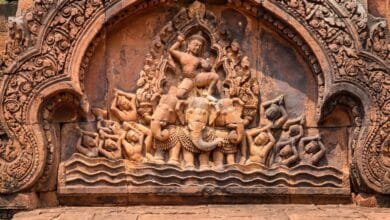
Beng Mealea does not have the large narrative bas-reliefs that make Angkor Wat famous. What survives are smaller decorative elements: lintels above doorways, carvings of apsaras (celestial dancers), and images of Vishnu, Shiva, and the Buddha.
Because the temple is in ruins, many carvings are partially buried or hidden. Some have been looted over the centuries. What remains is scattered — a pediment lying face-down in the grass, a lintel still in place above a collapsed doorway, a carving half-covered by roots.
The mix of Hindu and Buddhist imagery reflects the religious history of the Khmer Empire. The temple was originally Hindu, dedicated to Shiva, and later received Buddhist additions during the reign of Jayavarman VII, the king who built Bayon and Ta Prohm.
Do not expect to read a story in the carvings here. Expect to find fragments.
Cultural and Religious Meaning
Beng Mealea was built as a Hindu temple, most likely dedicated to Shiva. The moat, the enclosures, and the central sanctuary all follow Hindu temple cosmology, with the sanctuary representing Mount Meru, the home of the gods.
Later Buddhist modifications suggest the site continued to be used as the Khmer Empire’s religious landscape shifted from Hinduism to Buddhism. An Avalokiteshvara, a Buddhist bodhisattva of compassion, is believed to have stood at the central tower.
Today, Beng Mealea is not an active place of worship in the way that some smaller Cambodian temples are. It is primarily a heritage site and a tourist destination. But it remains a sacred landscape in Cambodian cultural memory.
What Visitors Can See
When you arrive at Beng Mealea, you will enter through the eastern gate. A wooden walkway now crosses part of the collapsed center. It was rebuilt and extended in recent years to make the site safer for visitors.
Along the walkway you will see:
- Collapsed galleries with tree roots growing through the stone
- Sandstone blocks scattered across the ground
- Standing sections of wall with carvings still visible
- The central mound where the sanctuary once stood
- Sections of the moat, partly overgrown
- Lintels and pediments that have fallen but remain on site
The walkway gives you a route through the ruins without climbing over unstable stone. But the temple is not fully accessible. Some areas are closed or blocked by collapse.
What the Visit Is Like
This is not a polished temple experience. The ground is uneven. The walkway helps, but you will still encounter steps, narrow sections, and areas where you need to watch your footing.
The site is shady. The jungle cover that surrounds and grows through the temple keeps the temperature lower than in the open areas of Angkor Wat. That makes Beng Mealea a more comfortable visit during the middle of the day than some other temples.
Crowds are usually smaller than at Angkor Wat or Ta Prohm. Beng Mealea is further from Siem Reap, and it is not on every tour itinerary. You are more likely to share the site with independent travelers and small groups than with large buses.
Photography is excellent, but not in the way it is at Angkor Wat. Here the subject is not a perfectly restored tower against the sky. It is the texture of collapse — roots, broken stone, shafts of light through the canopy.
How to Get There
Beng Mealea is about 40 km east of Angkor and roughly 55–70 km from Siem Reap, depending on where you start. The drive takes about one to one-and-a-half hours by car or tuk-tuk.
The road is paved for most of the way. During the rainy season, some sections can be slower, but the temple is accessible year-round.
Most visitors go by private car, tuk-tuk, or as part of a guided day tour. There is no public bus service directly to the temple. If you are staying in Siem Reap, your hotel or a local tour operator can arrange transport.
How to Visit
Tickets. Beng Mealea is covered by the Angkor Pass. If you have a valid 1-day, 3-day, or 7-day Angkor Pass, you do not need to pay extra. If you do not have an Angkor Pass, you can buy a separate $10 one-day ticket for Beng Mealea at the entrance. The Angkor Pass prices are $37 for one day, $62 for three days, and $72 for seven days. These prices can change; verify before you travel.
Opening hours. The temple is generally open from 7:00 AM to 5:30 PM. Some sources list 6:00 AM to 6:30 PM. Hours can vary by season, so check locally.
Dress. As with all Cambodian temples, dress respectfully. Cover your shoulders and knees. A scarf or light shirt is useful.
Etiquette. Do not climb on unstable ruins. Do not touch carvings. Follow the wooden walkway. Stay on marked paths. These rules protect both you and the site.
Guides. Local guides are available at the entrance. A guide can help you navigate the ruins safely and explain what you are seeing. Because the site is a maze of collapsed structures, a guide is genuinely useful here.
Best Time to Visit
The cool season, from November to February, is the most comfortable time for temple visits in general. The heat is less intense, and the ground is dry.
The rainy season, from May to October, makes the temple greener and the atmosphere more dramatic. But paths can be slippery, and some areas may be harder to access.
Early morning is a good time to arrive. The light is softer, the temperature is lower, and you will likely have fewer people around.
How Long to Spend
Most visitors spend about one hour at Beng Mealea. If you are interested in photography or want to explore the ruins slowly, you can easily spend two hours.
The temple is not large in terms of walking distance. The time goes into looking, climbing where allowed, and absorbing the atmosphere.
Nearby Places to Combine With the Visit
Beng Mealea pairs well with several other sites east of Siem Reap.
Koh Ker is a full-day pairing. It was the Khmer capital for a brief period in the 10th century under King Jayavarman IV. Its main temple, Prasat Thom, has a seven-tiered pyramid that rises above the jungle. Koh Ker was listed as a UNESCO World Heritage Site in 2023.
Banteay Srei is about 10 km from Beng Mealea. It is famous for its pink sandstone carvings, which are among the finest in Khmer art.
Kbal Spean is a riverbed site with carvings of Hindu deities. It is often combined with Banteay Srei and Beng Mealea on a day trip from Siem Reap.
The Rolous Group — Bakong, Preah Ko, and Lolei — is a lighter option if you want less driving. These are early Angkor-period temples, closer to Siem Reap.
Travel Tips
- Bring water. The temple area has limited facilities.
- Wear shoes with good grip. The walkway and surrounding ground can be uneven.
- Bring insect repellent. The jungle setting means mosquitoes, especially in the rainy season.
- Carry cash for the entrance if you do not have an Angkor Pass. Card payment may not be available at the ticket counter.
- Start early if you want to combine Beng Mealea with other sites. The drive from Siem Reap takes time.
- Ask your driver to wait. There is no regular transport back to Siem Reap from the temple.
Responsible Tourism
Beng Mealea is a fragile site. The collapse that makes it interesting also makes it vulnerable.
- Stay on the wooden walkway. Do not climb on unstable stone structures.
- Do not touch or lean on carvings. Oils from your skin can damage the sandstone.
- Do not remove anything from the site. Even a small stone is part of the heritage.
- Follow the instructions of local guides and site staff.
- Dispose of your waste properly. Take it with you if there is no bin.
- Be respectful of any religious activity you may encounter. Some Cambodians still visit these sites for prayer.
Frequently Asked Questions
Is Beng Mealea included in the Angkor Pass?
Yes. A valid Angkor Pass covers entry to Beng Mealea. If you do not have an Angkor Pass, you can buy a separate $10 ticket at the entrance.
Is Beng Mealea the same as Ta Prohm?
No. Both are jungle temples, but Ta Prohm has been partly restored and has wooden walkways through the main structures. Beng Mealea is much less restored and feels more like an active ruin.
How far is Beng Mealea from Siem Reap?
About 55–70 km, depending on your starting point. The drive takes roughly one to one-and-a-half hours.
Can I visit Beng Mealea without a guide?
Yes, you can walk the wooden walkway without a guide. But a local guide can help you understand the layout and navigate the ruins more safely.
Is Beng Mealea safe to explore?
The wooden walkway is safe. Do not climb on collapsed stone structures. Follow posted signs and guide instructions.
What is the best time of day to visit?
Early morning is best for light and temperature. The site is shady, but the heat can still be intense in the afternoon.
Was Beng Mealea ever finished?
The temple was built and used. What looks “unfinished” is actually the result of centuries of collapse and natural decay, not incomplete construction.
Conclusion
Beng Mealea is not the most famous temple in Cambodia, and it is not the easiest to reach. But it offers something the more famous sites cannot: the experience of walking through an Angkor-period temple that has been left largely as it was found.
Its scale connects it to Angkor Wat. Its collapse connects it to the jungle. Its location along an ancient royal road connects it to the wider Khmer world.
For travelers who want to understand what these temples were and what time has done to them, Beng Mealea is worth the drive. It fits naturally into a day trip that includes Banteay Srei or Koh Ker. And for photographers, it offers textures and compositions that the restored temples do not.
If you go, go with realistic expectations. This is not a polished monument. It is a ruin in a forest, and that is exactly the point.