Bayon Temple: A Visitor’s Guide to the Temple of Faces
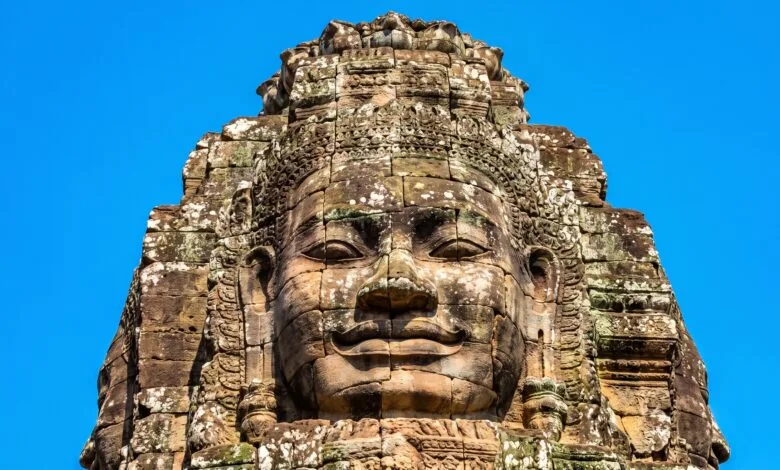
Bayon Temple is unlike any other temple in Angkor. From a distance, it looks like a pile of stone towers. Up close, you realize those towers are covered in faces — huge, calm faces with closed eyes and gentle smiles.
There are more than 200 of them. They face in every direction. No one knows for certain whose faces they are. That mystery is one reason Bayon Temple is one of the most memorable stops in the Angkor Archaeological Park.
This guide explains what Bayon Temple is, why it matters, what you will see, and what you should know before you visit.
Quick Travel Information
| Information | Details |
|---|---|
| Location | Center of Angkor Thom, Angkor Archaeological Park, Siem Reap Province |
| Site Type | State temple; mountain temple (symbolic representation of Mount Meru) |
| Historical Period | Late 12th to early 13th century |
| Religious Tradition | Originally Mahayana Buddhist; later modified by Hindu and Theravada Buddhist kings |
| Heritage Status | Part of the Angkor World Heritage property (UNESCO, 1992) |
| Known For | Stone face towers; extensive bas-reliefs |
| How to Get There | Tuk-tuk, car, or guided tour from Siem Reap town |
| Recommended Visit Time | About 1.5 to 2 hours |
| Opening Hours | 7:30 AM – 5:30 PM (verify before travel) |
| Entrance Fee | Included in Angkor Pass (1-day: $37; 3-day: $62; 7-day: $72; verify current prices) |
Note: Opening hours, pass prices, and access details can change. Always check with the official Angkor Enterprise or APSARA National Authority before your trip.
What Is Bayon Temple?
Bayon Temple is a richly decorated Khmer temple at the center of Angkor Thom, the ancient capital city built by King Jayavarman VII. It was constructed at the end of the 12th century or the beginning of the 13th century as the official state temple of the king.
According to a stone inscription, the temple was originally known as “Chey Kiri,” which means “Triumphant Mountain”. It was built as a mountain temple, representing Mount Meru, the center of the universe in Hindu and Buddhist cosmology.
Unlike Angkor Wat, Bayon is not surrounded by a large moat. It sits directly at the heart of the walled city of Angkor Thom.
Why Is Bayon Temple Important?
Bayon Temple is important for several reasons. First, it is the only major Angkorian temple built as a Mahayana Buddhist state temple. Angkor Wat was Hindu. Many other temples were dedicated to Hindu gods. Bayon stands apart.
Second, Bayon contains some of the most unusual architectural features in Khmer art: dozens of towers carved with colossal faces. The temple is described as the most striking expression of the “baroque style” of Khmer architecture, contrasting with the classical style of Angkor Wat.
Third, Bayon’s bas-reliefs are a remarkable historical record. They show not only battles and mythological scenes but also scenes of everyday life — markets, cooking, fishing, and construction work. Without these carvings, historians would know much less about daily life in the Khmer Empire.
Fourth, Bayon has been the focus of one of the longest-running international conservation projects in Cambodia, supported by UNESCO, Japan, and the APSARA National Authority.
The History of Bayon Temple
Bayon was erected under the reign of Jayavarman VII, towards the end of the 12th century. Jayavarman VII is often called the last great king of the Khmer Empire. He ruled from approximately 1181 to 1218.
The temple was built after a period of conflict. Angkor Thom was occupied by the Cham army for four years, from 1177 to 1181. After driving out the Cham forces, Jayavarman VII built a new capital and a new state temple at its center. Bayon represented a “new city immortal and unshakable” after the occupation.
Following Jayavarman’s death, the temple was modified and augmented by later Hindu and Theravada Buddhist kings. Some Buddhist images were removed or altered. The temple’s precise function and symbolism have puzzled scholars for decades.
Architecture and What to Look For
Bayon is a complex temple with multiple levels. Only 37 towers are still standing among the original 49 or 54. The towers are carved with faces — usually four faces per tower, each facing one of the cardinal directions.
The faces are about 2 meters high and are carved from sandstone. Each face wears a jeweled crown and earrings. The total number of faces is often given as 216, though estimates vary.
The temple has two sets of bas-relief galleries. The outer gallery is the most accessible. The inner gallery is more difficult to navigate in places.
The central tower of Bayon has been temporarily closed for conservation and restoration work since February 2020. Access to the third level may be limited. Check current conditions before you visit.
Carvings, Sculptures and Stories
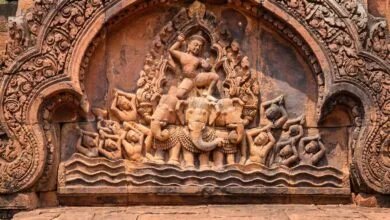
The bas-reliefs at Bayon are one of its greatest treasures. They cover the walls of the outer and inner galleries and depict an unusual combination of mythological, historical, and everyday scenes.
On the outer gallery, you will find scenes of naval battles between the Khmer and the Cham. Khmer soldiers are shown with short hair; Cham soldiers wear distinctive helmets and tunics. Elephants, cavalry, musicians, and infantry fill the panels.
Between the battle scenes, there are smaller scenes of ordinary life. You can see people cooking fish, selling goods at markets, building roads, and even playing music. These scenes give a rare glimpse into the daily life of the Khmer Empire.
The inner gallery includes scenes from Hindu mythology, including the famous story of the Churning of the Ocean of Milk. This scene also appears at the entrances to Angkor Thom.
Cultural and Religious Meaning
Bayon was originally a Mahayana Buddhist temple. The faces on the towers are often associated with Avalokiteshvara, the bodhisattva of compassion. Some scholars believe the faces are representations of King Jayavarman VII himself, in the guise of Avalokiteshvara. Others believe they represent Brahma, a Hindu god.
The Ministry of Tourism of Cambodia notes that the similarity of the faces to other statues of Jayavarman VII has led many scholars to hypothesize that they are portraits of the king. However, no single interpretation is accepted by all scholars.
What is clear is that the faces are a central part of the temple’s spiritual identity. They are described as gazing in all directions, symbolizing compassion and protection.
Today, Bayon is a site of both tourism and spiritual significance. It remains a place of respect for many Cambodians.
What Visitors Can See
When you enter Bayon, you will likely begin at the east or south entrance. The first thing you notice is the density of the towers and the faces looking down from above.
You can walk through the outer gallery and study the bas-reliefs. The scenes are detailed and reward slow looking. You can then move inward toward the central sanctuary.
The upper terrace offers close-up views of the face towers. The faces are carved at different heights, so you can often find one at eye level.
The temple is crowded during peak hours (usually mid-morning to early afternoon). Early morning and late afternoon are quieter and cooler.
What the Visit Is Like
Visiting Bayon involves walking on uneven stone floors and climbing some steep stairs. The temple is not fully accessible for visitors with limited mobility. There are no elevators or ramps inside the temple.
The stone can be slippery after rain. Wear sturdy shoes with good grip. The temple has some shaded areas, but much of it is open to the sun. Bring water and sun protection.
Flash photography is not allowed inside the temple premises. This rule helps protect the carvings and respects other visitors. Photography without flash is generally allowed.
You may see monks or local worshippers at the temple. Keep your voice low and be respectful. Do not touch the carvings.
How to Get There
Bayon is located inside Angkor Thom, about 10 kilometers from Siem Reap town. The most common way to get there is by tuk-tuk, private car, or guided tour.
Most visitors combine Bayon with other temples in Angkor Thom, such as Baphuon and the Terraces of the Elephants and the Leper King. The temple is also commonly included in a standard “small circuit” temple tour.
If you are staying in Siem Reap, your hotel or guesthouse can arrange transport. Tuk-tuk drivers often offer day rates for temple tours.
How to Visit
You need an Angkor Pass to enter the Angkor Archaeological Park. The pass covers Bayon and all other temples in the park. Passes are available for 1 day, 3 days, or 7 days. Prices are subject to change; verify current rates at the official ticket office or Angkor Enterprise website.
A dress code applies. Your shoulders and knees must be covered. This is a sacred site, so dress respectfully. Shoes are allowed inside the temple, but some upper areas may require removing shoes.
Guides are available for hire at the park entrance or through tour companies. A knowledgeable guide can explain the bas-reliefs and the history of the temple in detail.
Best Time to Visit
The best time to visit Bayon is early morning, right after the temple opens, or late afternoon, before it closes. These times are cooler and less crowded.
The dry season (November to April) offers clearer skies and easier walking. The wet season (May to October) brings rain, but also fewer crowds and greener surroundings. The stone can be slippery after rain.
Avoid the middle of the day if you are sensitive to heat. There is limited shade inside the temple.
How Long to Spend
Most visitors spend between 1.5 and 2 hours at Bayon Temple. This allows time to walk through the galleries, study the bas-reliefs, and climb to the upper terrace.
If you are very interested in the carvings, you may want more time. If you are on a tight schedule, you can see the main features in about one hour.
Bayon is often visited as part of a larger temple circuit that includes Angkor Wat, Ta Prohm, and other sites. Plan your day accordingly.
Nearby Places to Combine With the Visit
Bayon is located inside Angkor Thom, so it is easy to combine with other nearby sites.
- Baphuon Temple: A large, three-tiered temple just northwest of Bayon. It was built earlier, in the 11th century.
- Terrace of the Elephants: A long, carved terrace used by Angkorian kings for reviewing troops and ceremonies.
- Terrace of the Leper King: A small terrace with intricate carvings, located near the royal palace area.
- Phimeanakas: A small pyramid-shaped temple inside the royal palace enclosure.
- Angkor Wat: The most famous temple in the park, about 15 minutes away by vehicle.
Travel Tips
- Buy your Angkor Pass before entering the park. The ticket office is on the road from Siem Reap to Angkor.
- Start early. The temple opens at 7:30 AM. Early arrival means fewer people and cooler temperatures.
- Bring a refillable water bottle. There are limited places to buy water inside the park.
- Wear comfortable, sturdy shoes. The stone surfaces are uneven.
- Carry a small towel or cloth. The stone can be dusty.
- If you hire a guide, ask them to explain the bas-reliefs. This adds a lot to the experience.
- Keep your pass with you at all times. It may be checked at any temple.
- Respect the site. Do not climb on carvings or remove any stones.
Responsible Tourism
Bayon Temple is a sacred site and a World Heritage property. Your visit helps support its conservation, but it also puts pressure on the monument.
Here are some ways to visit responsibly:
- Dress modestly. Cover your shoulders and knees. This is required and respectful.
- Do not touch the carvings. Oils from your hands can damage the stone.
- Follow conservation rules. Stay on marked paths and respect barriers.
- Do not use flash photography inside the temple.
- Keep your voice low. Other visitors and worshippers may be present.
- Take your trash with you. Do not leave plastic or other waste at the site.
- Support local communities. Hire local guides and buy from local vendors where possible.
Frequently Asked Questions
What is Bayon Temple famous for?
Bayon Temple is famous for its many stone towers carved with gigantic, serene faces. It is also known for its extensive bas-reliefs showing historical battles and scenes of daily life.
Who built Bayon Temple?
Bayon was built under King Jayavarman VII, a Mahayana Buddhist king who ruled the Khmer Empire from approximately 1181 to 1218.
Are the faces on Bayon Temple Buddha?
The faces are often associated with Avalokiteshvara, the bodhisattva of compassion in Mahayana Buddhism. Some scholars believe they represent King Jayavarman VII himself. Others suggest they represent the Hindu god Brahma. There is no single agreed interpretation.
How many faces are there at Bayon Temple?
Estimates vary, but a commonly cited number is 216 faces. There are 37 standing towers, most with four faces.
Is Bayon Temple the same as Angkor Wat?
No. Bayon Temple and Angkor Wat are two different temples. Angkor Wat is a Hindu temple built in the 12th century by King Suryavarman II. Bayon is a Buddhist state temple built later by King Jayavarman VII. Both are part of the Angkor Archaeological Park and are covered by the same entrance pass.
Do I need a separate ticket for Bayon Temple?
No. Bayon is included in the Angkor Pass. You do not need a separate ticket.
How long does it take to visit Bayon Temple?
Most visitors spend about 1.5 to 2 hours at Bayon. You can see the main features in less time if needed, or spend longer if you are interested in the carvings.
Is Bayon Temple accessible for people with limited mobility?
Bayon has uneven stone floors and steep stairs. It is not fully accessible. Visitors with mobility challenges may find it difficult to explore the upper levels. The outer galleries are somewhat easier to navigate.
Conclusion
Bayon Temple is one of the most unusual and memorable temples in Angkor. Its face towers are unlike anything else in Khmer architecture, and its bas-reliefs offer a window into both the grand battles and the quiet daily life of the Khmer Empire.
The temple is not as large as Angkor Wat, and it does not have the same iconic silhouette. But it has something different: a sense of mystery and intimacy. Standing among the stone faces, you are looking at a 900-year-old puzzle that no one has fully solved.
Bayon fits naturally into any Angkor itinerary. It is located at the center of Angkor Thom, easy to combine with nearby temples, and covered by the standard Angkor Pass. If you have time for only a few temples beyond Angkor Wat, Bayon should be one of them.
Before you go, check current opening hours, pass prices, and any restoration closures. These details can change. But the faces are not going anywhere.