A Morning at a Kampot Durian Farm: Harvesting the King of Fruits
The smell hits you before you see the fruit.
It drifts across the orchard—sweet, rich, and unmistakable. Some travelers find it strange at first. Others breathe it in like perfume. Either way, the aroma of ripe durian is the first sign that you have arrived somewhere special.
Kampot province in southern Cambodia is famous for many things. Its pepper is world-renowned. Its riverside town draws travelers with French colonial charm. But from May to July each year, one fruit takes center stage: the durian.
Locals call it turèn. The rest of the world knows it as the “king of fruits.” And in Kampot, you can experience it at its very best—straight from the tree.
Quick Facts / At a Glance
| Detail | Information |
|---|---|
| Location | Kampot province, southwestern Cambodia |
| Province | Kampot |
| Experience Type | Farm visit / Orchard tour (self-guided or with a guide) |
| Best Time | May to July (peak harvest season) |
| Typical Duration | 1–3 hours at a farm |
| Main Food | Fresh durian (various varieties) |
| Main Activities | Orchard walk, tasting, learning about harvesting, buying fresh fruit |
| Travel Style | Day trip, countryside tour, slow travel |
Why This Food Experience Is Worth Having
Durian is one of those foods that people either love or hate. Some describe the smell as strong and unusual. Others find it irresistible. But here is the thing about Kampot durian: it is known for being sweeter and having a milder aroma than durians from some other countries.
That makes Kampot the perfect place to try it for the first time.
The province has about 1,300 hectares of durian cultivation, with roughly 940 hectares already producing fruit. Total annual production reaches around 12,280 tonnes. That is a lot of durian—and most of it stays in Cambodia.
What makes Kampot durian special is the combination of soil, climate, and farming knowledge passed down through generations. The fruit grown here has a thick, creamy flesh and a balanced sweetness that Cambodians prize above imported durians.
For travelers, visiting a durian farm is more than just tasting a fruit. It is a window into rural Cambodian life, agricultural traditions, and the pride a community takes in its most famous crop.
What the Experience Is Like
A morning at a Kampot durian farm begins early. Farmers start work before the heat of the day sets in, walking between the tall trees to check on the fruit.
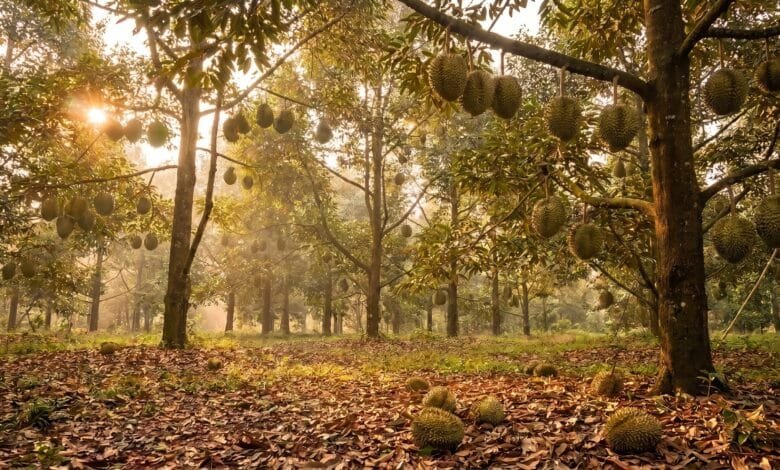
The trees themselves are impressive. Mature durian trees can reach 25 to 40 metres in height, their branches heavy with large, spiky fruits. Walking beneath them, you see durians hanging at various stages of ripeness—some still green, others turning golden-brown.
The sound of the orchard is peaceful. Birds call from the branches. The rustle of leaves in the breeze mixes with the distant sounds of village life.
Then there is the smell. As you approach trees with ripe fruit, the durian aroma grows stronger. It is sweet, almost like custard, with something deeper beneath it. For many travelers, this is the moment they understand why people travel across the world for this fruit.
Farmers use long poles with hooks or climb the trees to harvest the durians. The fruit falls into nets or is carefully lowered to the ground—durians can weigh several kilograms each, and a fall from that height would damage them.
Once harvested, the durians are gathered and sorted. The best ones are set aside for sale. Some are opened right there for tasting.
The Food Behind the Experience
Durian (turèn in Khmer) is the star of the experience.
Several varieties grow in Kampot:
- Ang Siam — Sweet and creamy, a local favourite
- Nungoy — Rich in sugar with a unique flavour
- Lychee — Delicate, almost like custard
- Au Khak — A variety gaining international attention, with golden, smooth flesh and a rich, slightly buttery sweetness
Kampot durian is known for its thick, creamy flesh and balanced sweetness. The flesh is golden-yellow, encased in a thick, brown, spiky skin.
When you taste fresh durian at a farm, the experience is completely different from buying it pre-packaged in a supermarket. The fruit has been tree-ripened—picked at the perfect moment. The texture is creamy, almost like custard. The flavour is sweet with hints of caramel and a slight savoury note.
Some travelers compare the smell to something unusual. Others find it inviting. But almost everyone agrees: fresh Kampot durian tastes better than any durian they have tried before.
Ingredients and Local Production
Kampot’s soil and climate are ideal for durian cultivation. The province sits near the Elephant Mountains, with a coastal climate that provides the right balance of rain and sun.
Durian trees need specific conditions to thrive. They prefer cooler weather and consistent moisture. Kampot’s rainy season—which coincides with durian season—provides exactly that.
The fruit is grown across the province, from small family orchards to larger commercial plantations. Most durian farms are family-run operations, with knowledge passed down from parents to children.
Farmers monitor their trees carefully throughout the year. The trees bear fruit starting around Khmer New Year in April, with the main harvest running from May through July.
The People Behind the Food
Behind every durian is a farmer who has spent years learning the craft.
Durian farming requires patience and skill. Trees take several years to begin producing fruit. Farmers must know when to water, when to prune, and—most importantly—when to harvest.
In Kampot, many durian farmers have been working the land for generations. They know their trees individually. They can tell by looking at a durian whether it is ready to pick.
During harvest season, families work together. Some climb the trees. Others sort and pack the fruit. Children help where they can. It is a community effort.
For travelers, meeting these farmers is often the most memorable part of the experience. They are proud of their fruit and happy to share their knowledge. Some farmers offer tastings on the spot. Others will open a durian and explain what makes a good one.
What Travelers Can Eat
At a durian farm, the main thing to eat is—of course—fresh durian.
Farmers usually open a fruit for visitors to taste. You can eat it right there, using your hands or a spoon. The flesh is soft and creamy, best enjoyed fresh.
Some farms also sell other tropical fruits that grow alongside durian, including:
- Mangosteen — A small purple fruit with sweet, white segments inside
- Rambutan — A hairy red fruit with sweet, translucent flesh
- Longan — A small brown fruit similar to lychee
Kampot town itself has plenty of places to eat durian and other local foods. During durian season, stalls appear along roadsides and at markets. The Central Market (Psar Kampot) has food stalls selling local dishes. The night market near the Durian Roundabout offers fresh fruit smoothies and local snacks.
What Travelers Can Learn
Visiting a Kampot durian farm teaches you several things about Cambodia:
Agricultural traditions — Durian farming in Kampot represents generations of knowledge about soil, climate, and fruit cultivation.
Local pride — Kampot durian is a source of regional pride. The giant durian statue in the centre of Kampot town symbolises this. The fruit is so important to the province that farmers and officials are working to protect its reputation.
Cambodia’s food culture — Durian is deeply embedded in Cambodian food culture. It is served fresh, used in desserts, and celebrated during the harvest season.
Rural life — A farm visit shows you how many Cambodians still live and work. It is a glimpse into a way of life that is slowly changing but remains central to the country’s identity.
How to Experience It
Visiting a Kampot durian farm is relatively straightforward, but requires some planning.
Self-guided visits — Some farms welcome visitors who arrive independently. You can hire a tuk-tuk in Kampot town and ask the driver to take you to a durian farm. Many drivers know which farms are open to visitors.
Organised tours — Several tour operators offer day trips from Kampot or Phnom Penh that include durian farm visits. These tours often combine a durian orchard with a pepper farm visit and a stop at the coast. Tours are available exclusively during the durian harvest season.
Countryside tours — Tuk-tuk countryside tours are a popular way to explore Kampot’s agricultural landscape. These tours typically include visits to farms, villages, and pepper plantations.
Important note: Not all durian farms are set up for tourists. Some are working farms that may not have facilities for visitors. If you are unsure, ask at your accommodation or use a tour operator.
Best Time to Go
Durian season in Kampot runs from May to July.
Some sources say the harvest begins as early as mid-April and continues through June. Others note the season can last until early August.
The exact timing varies each year depending on weather conditions. In general:
- May — The season begins. Early durians appear at markets and farms.
- June — Peak season. The widest variety and best availability.
- July — The season continues. Some farms may still have fruit.
The rainy season in Cambodia runs from May to October. This means you should expect some rain during your visit. Many travelers find this adds to the experience—the countryside is green and lush, and the rain brings out the richest flavours in the fruit.
The dry season (November to April) is better for general sightseeing, but you will miss the durian harvest.
How Long to Spend
A durian farm visit typically takes 1 to 3 hours.
If you are visiting a single farm, 1 to 2 hours is usually enough to walk through the orchard, see the harvesting process, and enjoy a tasting.
If you are combining the farm visit with a pepper plantation, a seafood lunch at the coast, or other activities, allow a full day.
How to Get There
From Phnom Penh — Kampot is about 150 kilometres southwest of the capital. The drive takes approximately 3 hours by car or bus. Buses run regularly from Phnom Penh to Kampot. Private taxis and tour operators also offer transport.
From Sihanoukville — Kampot is about 100 kilometres east of Sihanoukville. The drive takes around 2 hours.
From Kep — Kampot is only about 25 kilometres from Kep. The drive takes about 30 minutes.
Within Kampot — The best way to reach durian farms is by tuk-tuk. Tuk-tuks are widely available in Kampot town. You can hire one for a half-day or full-day countryside tour. Many drivers speak basic English and know the local farms.
What to Bring
- Water — It gets hot in Kampot, especially during the dry season.
- Comfortable shoes — Farms can be muddy, especially during the rainy season.
- Sun protection — Hat, sunglasses, and sunscreen.
- Cash — Small Cambodian riel or US dollars. Farms may not accept cards.
- Camera or phone — The scenery is beautiful and worth capturing.
- Insect repellent — Farms are outdoors and mosquitoes are present.
- An open mind — Durian is unlike any fruit you have tried before.
Practical Tips
Try it fresh — Durian is best eaten fresh, straight from the fruit. Do not judge it by the packaged versions you might find at home.
Ask questions — Farmers are usually happy to explain their work. Ask about the varieties, the harvest process, and how they know when a durian is ready.
Buy some to take with you — If you enjoy the fruit, buy a whole durian to take back to your accommodation. Just be aware that many hotels do not allow durian in rooms because of the smell.
Combine with other experiences — Kampot is also famous for its pepper. Many tours combine a durian farm with a pepper plantation visit. The salt fields, Bokor Mountain, and Kep’s crab market are other nearby attractions worth considering.
Check the season — If you are visiting outside May to July, you will not find fresh durian at the farms. Plan your trip accordingly if durian is your main goal.
Responsible Travel
Ask before taking photos — Always ask permission before photographing farmers or their families. Most are happy to oblige, but it is respectful to ask first.
Support local businesses — Buy durian directly from farmers rather than from middlemen when possible. This puts money directly into the hands of the people who grow the food.
Avoid waste — Durian is a precious crop. Do not waste it. If you buy a whole fruit, eat what you can and share the rest.
Respect the land — Farms are working agricultural sites. Stay on paths, do not damage trees, and take any rubbish with you.
Learn a few words of Khmer — A simple “suosdey” (hello) or “aw kun” (thank you) goes a long way.
Things to Do Nearby
Kampot Pepper Farms — Kampot pepper is world-famous. La Plantation and other farms offer tours where you can learn about pepper cultivation.
Kampot Durian Roundabout — The giant durian statue in the centre of town is a popular photo stop.
Bokor National Park — A mountain park with French colonial ruins, a waterfall, and views over the coast.
Kep Crab Market — The nearby coastal town of Kep is famous for its crab. You can buy fresh crab and have it cooked at nearby restaurants.
Salt Fields — Kampot produces sea salt in vast, shimmering fields.
Kampot Riverside — The riverside in Kampot town is pleasant for walking, especially in the late afternoon.
Frequently Asked Questions
When is durian season in Kampot?
Where can I try durian in Kampot?
You can try durian at farms during harvest season, at roadside stalls, and at markets in Kampot town. Some tour operators also include tastings in their itineraries
Is Kampot durian different from other durians?
Can I visit a durian farm without a tour?
Yes. You can hire a tuk-tuk in Kampot town and ask the driver to take you to a farm. However, not all farms are set up for visitors, so using a guide or tour operator can be easier
How much does durian cost in Kampot?
What does durian taste like?
Durian has a sweet, creamy flavour with hints of caramel and a slight savoury note. The texture is soft and custard-like. Many people find it tastes much better than it smells
Is durian allowed in hotels?
Many hotels in Cambodia do not allow durian in rooms because of the strong smell. Check with your accommodation before bringing a durian back.
What other fruits are in season at the same time?
Mangosteen, rambutan, and longan are also in season during the durian harvest
Final Thoughts
A morning at a Kampot durian farm is not just about tasting a fruit. It is about understanding a place through its food.
Kampot’s durian connects you to the land—the rich soil, the coastal climate, the rain that falls during the green season. It connects you to the people—the farmers who climb the trees, who know each fruit by sight, who have spent their lives perfecting their craft. It connects you to a tradition that stretches back through generations.
And yes, it connects you to a flavour that is unlike anything else in the world.
For some travelers, durian is an acquired taste. For others, it is love at first bite. Either way, experiencing it at its source—in a Kampot orchard during harvest season—is one of those travel moments you will not forget.
So if you find yourself in Cambodia between May and July, make time for Kampot. Follow the smell. Find a farm. Try the king of fruits.
You might just discover something unexpected.