Kuy Teav: A Traveler’s Guide to Cambodia’s Beloved Noodle Soup
Walk through almost any Cambodian neighborhood in the early morning, and you will notice the same scene. Small stalls with steaming pots line the streets. Vendors ladle clear broth over bowls of rice noodles. Customers sit on plastic stools, chopsticks in hand, starting their day with a hot bowl of kuy teav.
Kuy Teav (pronounced roughly “koy tee-uv”) is Cambodia’s most popular breakfast noodle soup. If you have traveled in Vietnam, it may look familiar to pho. But kuy teav has its own character — a clearer broth, thinner rice noodles, and a distinct set of toppings. For foreign travelers, it is one of the easiest and most rewarding Cambodian street foods to try.
What Is Kuy Teav?
Kuy Teav is a Cambodian rice noodle soup made with a clear pork-based broth. It is typically served for breakfast, though you will also find it at lunch in some markets and food stalls.
The Khmer name គុយទាវ (kŭytéav) refers both to the dish and to the flat rice noodles used to make it. In everyday speech, Cambodians often pronounce it “k’téav” or “kă-téav” because of the natural rhythm of the Khmer language. The word itself comes from the Teochew Chinese term 粿條 (guê2diao5), reflecting the dish’s origins among Chinese communities who settled in Cambodia generations ago.
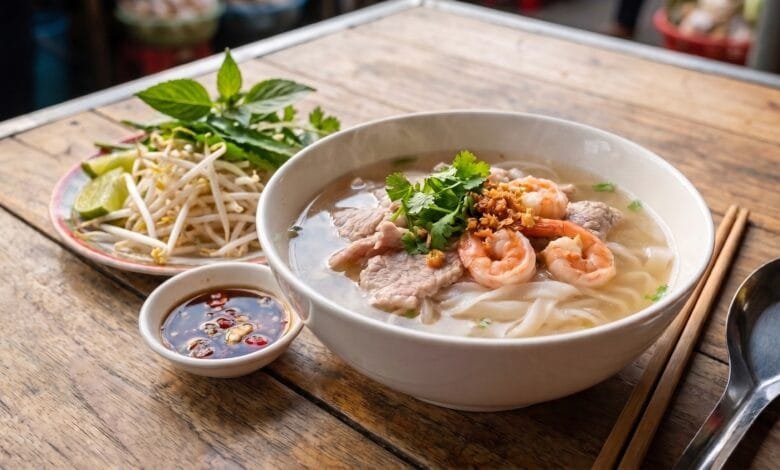
A bowl of kuy teav is easy to recognize. You will see a mound of thin, flat rice noodles in a clear broth, topped with slices of pork, sometimes shrimp, and a handful of fresh herbs. A plate of bean sprouts, lime wedges, and extra herbs usually sits on the side.
What Does Kuy Teav Taste Like?
The first thing you notice about kuy teav is the broth. It is light and clear, not heavy or creamy. The flavor comes from simmering pork bones, often with dried shrimp or dried squid, for several hours. The result is a savory, slightly sweet broth with a gentle depth.
The noodles are soft and slippery, with a mild rice flavor. They absorb the broth quickly, so the texture changes as you eat. Toppings add contrast: sliced pork is tender and mild, while shrimp brings a briny sweetness. Fried garlic and garlic oil add aroma. A squeeze of lime brightens everything.
Kuy teav is not a spicy dish by default. The heat comes from condiments you add yourself — usually sliced chilies, chili paste, or pickled chilies on the table. Fish sauce is commonly used in the broth and as a condiment, so the overall flavor profile leans savory and slightly salty rather than hot.
What Is in Kuy Teav?
The core ingredients of kuy teav are simple and consistent across most vendors.
The broth is made from pork bones, sometimes with chicken bones added. Dried shrimp and dried squid are common additions that deepen the flavor. Some vendors also add daikon, onion, or garlic during simmering.
The noodles are flat rice noodles, similar to the wide rice noodles used in Thai or Vietnamese cooking. They are briefly blanched in boiling water before serving.
The toppings vary by vendor and region. Common toppings include sliced pork, minced pork, pork liver, shrimp, fish balls, and sometimes quail eggs. Phnom Penh-style kuy teav tends to be richer, with more toppings and a slightly sweeter broth.
The garnishes are what make each bowl customizable. You will usually receive a plate of bean sprouts, lettuce or cabbage, fresh herbs (such as cilantro and Thai basil), lime wedges, and sometimes pickled vegetables. Condiments like fish sauce, soy sauce, sugar, and chili paste sit on the table.
How Is Kuy Teav Prepared by Street Vendors?
Watching a kuy teav vendor work is part of the experience. Most stalls operate with remarkable speed and efficiency.
The noodles are kept in bundles or baskets near the cooking station. When you order, the vendor grabs a portion of rice noodles and dips them into a pot of boiling water for just a few seconds. The noodles are then drained and placed into a bowl. A small amount of garlic oil and a splash of seasoned sauce — often a mix of oyster sauce, soy sauce, and a pinch of sugar — are added to the noodles.
Next comes the broth. The vendor ladles hot broth from a large simmering pot over the noodles. The broth has been simmering since early morning, sometimes since 4 a.m., developing its flavor slowly.
Finally, the toppings are added. Sliced pork, shrimp, or other meats are arranged on top. The bowl is handed to you with a side plate of fresh garnishes. You season the soup yourself at the table.
Some vendors also offer a “dry” version of kuy teav, where the noodles are tossed with sauce and toppings, and the broth is served on the side. This style is popular in Phnom Penh and worth trying if you want a different texture.
When and Where Do Cambodians Eat Kuy Teav?
Kuy teav is primarily a breakfast food. Most kuy teav stalls open early in the morning, often by 6 a.m., and close by late morning or early afternoon when the broth runs out. In some markets, you can find kuy teav at lunch as well.
The most common places to find kuy teav are:
- Local markets (phsar) — Almost every Cambodian market has at least one kuy teav stall, usually in the food section.
- Roadside stalls — Many vendors set up along busy streets in the early morning, serving commuters and workers.
- Neighborhood shops — Small family-run eateries in residential areas often serve kuy teav as their main breakfast dish.
- Night markets — Some night markets in tourist areas also have kuy teav vendors, though the breakfast tradition is stronger.
In Phnom Penh, the area around Central Market is known for morning kuy teav. In Siem Reap, you can find stalls near the Old Market. In Battambang and Kampot, local markets are your best bet.
Why Is Kuy Teav Popular as Street Food?
Kuy teav works well as street food for several practical reasons. The broth can be prepared in large batches and kept simmering for hours. The noodles cook in seconds, so service is fast. The ingredients are affordable and widely available. And the dish is filling without being heavy — perfect for a morning meal before a day of work or travel.
There is also a social dimension. Kuy teav stalls are gathering places. People sit together, customize their bowls, and start the day with a shared routine. For many Cambodians, a bowl of kuy teav is not just food — it is part of the rhythm of daily life.
The Story and History of Kuy Teav
Kuy teav is widely understood to have originated with Teochew Chinese communities who settled in Cambodia, particularly in Phnom Penh, during the late 19th and early 20th centuries. The word “kuy teav” comes directly from the Teochew Chinese term for flat rice noodles. Over time, the dish was adopted and adapted by Khmer cooks, becoming a distinctly Cambodian breakfast staple.
It is difficult to pinpoint exactly when kuy teav became a mainstream Cambodian dish. What is clear is that by the mid-20th century, it was already established as a common breakfast food in Phnom Penh and other urban areas. Today, it is one of the most widely eaten street foods in the country.
The dish also exists in neighboring countries under different names and forms. In Vietnam, hủ tiếu is closely related. In Malaysia and Singapore, kway teow refers to similar rice noodles. In Thailand, kuai tiao is a common noodle soup. These shared roots reflect the movement of Chinese communities across Southeast Asia.
Regional and Vendor Variations
Kuy teav varies from vendor to vendor, and regional styles have their own character.
Phnom Penh kuy teav is often described as the richest version. The broth may be slightly sweeter and more complex, with more toppings, including shrimp and pork liver. Some Phnom Penh vendors also serve a dry version, where the noodles are tossed in sauce and the broth comes on the side.
Provincial kuy teav tends to be simpler. In smaller towns and rural areas, you may find kuy teav with just pork slices and a lighter broth. Toppings depend on what is locally available.
Vendor style matters as much as region. Some vendors focus on the broth, simmering it longer for deeper flavor. Others emphasize the toppings, offering more variety. Some serve kuy teav with a side of fresh herbs from the market; others keep the garnish simple.
There is no single “authentic” kuy teav. The dish is defined by its basic structure — rice noodles, clear pork broth, fresh garnishes — but the details change from stall to stall.
Where Can Travelers Try Kuy Teav?
The easiest way to try kuy teav is to visit a local market in the morning. Markets in Phnom Penh, Siem Reap, Battambang, and Kampot all have food sections where you can find kuy teav stalls.
In Phnom Penh, Central Market (Psar Thmei) and Orussey Market are good starting points. The area around Olympic Stadium also has local kuy teav shops that are popular with residents. In Siem Reap, the Old Market area and nearby streets have morning vendors. In Battambang, the central market is a reliable spot.
For travelers who prefer a sit-down setting, some restaurants in Phnom Penh serve kuy teav alongside other Cambodian dishes. These are more comfortable but usually more expensive than street stalls.
A practical tip: go early. The best kuy teav is served in the morning, when the broth is freshest and the stalls are busy. If you see a stall with a crowd of local customers, that is usually a good sign.
How to Order Kuy Teav
Ordering kuy teav is straightforward, even if you do not speak Khmer.
Say “kuy teav” (pronounced “koy tee-uv” or “k’téav”) and hold up one finger for one bowl. Most vendors will understand. If you want to specify a type, you can try:
- Kuy teav sach moan — kuy teav with chicken
- Kuy teav sach chrouk — kuy teav with pork
- Kuy teav Phnom Penh — Phnom Penh-style kuy teav, usually with more toppings
If you want the dry version, you can say “kuy teav dry” or point to the noodles and make a separating gesture with your hands. Many vendors in tourist areas understand basic English.
The bowl usually comes with a side plate of garnishes. You add these yourself. There is no wrong way to eat it, but most people add bean sprouts, herbs, and a squeeze of lime, then season with fish sauce, sugar, or chili to taste.
How to Eat Kuy Teav
Kuy teav is eaten with chopsticks and a spoon. Hold the chopsticks in one hand and the spoon in the other. Use the chopsticks to pick up noodles and toppings, and the spoon to drink the broth.
It is normal to customize your bowl as you eat. Add bean sprouts early so they soften slightly in the hot broth. Squeeze lime over the noodles. Add chili paste if you want heat. Taste the broth first before adding fish sauce or sugar — it may already be well seasoned.
The garnishes are not just decoration. They add freshness and texture that balance the richness of the broth and pork. Do not skip them.
What Foreign Travelers Should Know
A few practical points can make your kuy teav experience smoother.
Spice level: Kuy teav is not spicy by default. Heat comes from condiments you add yourself. If you are sensitive to spice, simply skip the chili paste.
Fish sauce and dried shrimp: The broth commonly contains fish sauce and dried shrimp or dried squid. If you have a seafood allergy, ask before ordering. “Ot mien bpel” (no fish) is not a reliable phrase for allergies — it is better to use a translation app or ask a local to help explain.
Vegetarian options: Traditional kuy teav uses pork broth and often contains fish sauce and dried shrimp, so it is not vegetarian. Some restaurants in Phnom Penh and Siem Reap offer vegetarian versions with mushroom or vegetable broth. If you are vegetarian, look for restaurants rather than street stalls, or ask if a vegetable-based broth is available.
Portion size: A standard bowl of kuy teav is a moderate meal — enough for breakfast, but not overly heavy. If you are very hungry, you can order extra noodles or a side of bread.
Hygiene: Street food in Cambodia is generally safe when it is cooked fresh and served hot. Choose busy stalls with high turnover. Avoid raw garnishes if you have a sensitive stomach, as they may have been washed in tap water.
Seating: Most kuy teav stalls offer simple plastic stools and tables. Some are takeaway only. Do not expect air conditioning or comfortable seating.
Payment: Most street stalls operate on cash. Small riel notes and US dollar bills are both accepted. Prices are usually between $1 and $3, depending on the vendor and location.
How Much Does Kuy Teav Cost?
Prices for kuy teav vary by location, vendor, and portion size. At local markets and family-run stalls, a bowl typically costs between $1 and $2. In Phnom Penh, prices may be slightly higher, sometimes reaching $2.50 to $3 at busier or more tourist-oriented stalls. Restaurant versions usually cost more.
Prices can change over time, so treat these figures as a general guide rather than a fixed price. In most cases, kuy teav remains one of the most affordable meals you can buy in Cambodia.
Frequently Asked Questions
What is kuy teav?
Kuy teav is a Cambodian rice noodle soup with a clear pork-based broth. It is commonly eaten for breakfast and sold by street vendors, market stalls, and small restaurants across Cambodia.
Is kuy teav the same as pho?
No. Kuy teav and pho are both rice noodle soups, but they have different broths, noodles, and toppings. Kuy teav has a clearer, lighter broth and thinner flat rice noodles. Pho often has a richer, more aromatic broth with different herbs and spices.
Is kuy teav spicy?
Kuy teav is not spicy by default. The broth is savory and mild. Spice comes from chili paste or fresh chilies that you add yourself.
Is kuy teav vegetarian?
Traditional kuy teav is not vegetarian. The broth is made from pork bones and often contains fish sauce and dried shrimp. Some restaurants offer vegetarian versions, but street stalls rarely do.
Where can tourists try kuy teav?
You can find kuy teav at local markets, roadside stalls, and small neighborhood eateries throughout Cambodia. In Phnom Penh, Central Market and Orussey Market are good places to start. In Siem Reap, the Old Market area has morning vendors.
How do you pronounce kuy teav?
The Khmer pronunciation is roughly “koy tee-uv.” In casual speech, Cambodians often say “k’téav” or “kă-téav.” Saying “kuy teav” clearly is usually enough to be understood.
Conclusion
Kuy Teav is more than just a bowl of noodles. It is a window into how Cambodians start their day — simply, socially, and with food that is both comforting and practical. The clear broth, tender pork, and fresh garnishes make it a meal that is easy to enjoy, even for travelers who are new to Cambodian food.
For foreign visitors, kuy teav is one of the most accessible street foods in Cambodia. You do not need to be adventurous to appreciate it. The flavors are mild, the preparation is fast, and the price is low. What makes it memorable is not complexity, but balance — the way a simple broth, fresh herbs, and a squeeze of lime come together in a single bowl.
If you see a busy kuy teav stall in the morning, sit down, order a bowl, and take your time. You will be experiencing one of Cambodia’s most genuine daily rituals.