Cambodian Breakfast Street Food: What Locals Eat Before 9 AM
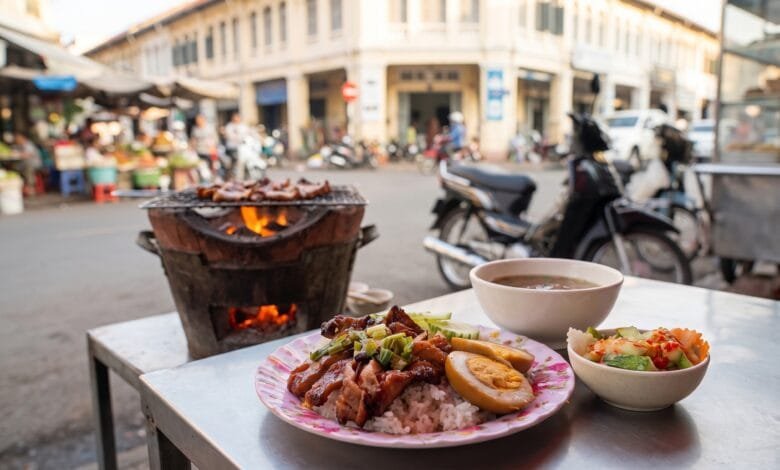
In Cambodia, breakfast happens early and it happens outside. By 6 AM, charcoal grills are already smoking, pots of pork broth are simmering, and vendors are arranging plastic stools along the sidewalk. Motorbike riders pull up, helmet still on, for a quick bowl before the day begins.
For a foreign traveler, this morning street food scene is one of the easiest and most rewarding ways to eat like a local. The food is affordable, the flavors are approachable, and the dishes are served fast. This guide explains what Cambodians actually eat before 9 AM, what each dish tastes like, and how you can order and enjoy it with confidence.
What Is Cambodian Breakfast Street Food?
Cambodian breakfast street food is the food sold by vendors from early morning until around 9 or 10 AM. It centers on a small number of dishes that locals eat almost every day.
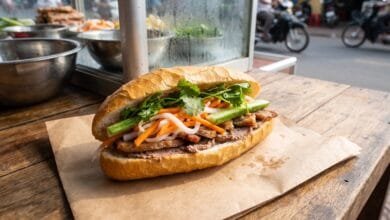
The three most common are Bai Sach Chrouk (grilled pork with rice), Num Banh Chok (rice noodles with fish curry), and Kuy Teav (pork noodle soup). Each one is prepared fresh at the stall, often by the same vendor every morning.
This is not a heavy, sit-down meal. It is quick, warm, and practical. You eat it on a small stool, pay a dollar or two, and move on. That rhythm is part of what makes Cambodian breakfast street food so special.
What Does Cambodian Breakfast Street Food Taste Like?
Each breakfast dish has its own flavor identity, but they share a few traits: they are savory, aromatic, and rarely spicy on their own.
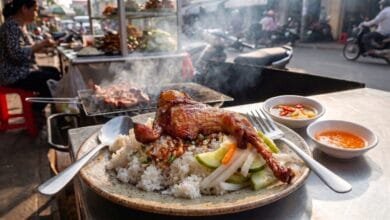
Bai Sach Chrouk tastes smoky and slightly sweet. The pork is thin, tender, and glazed with a marinade of coconut milk, garlic, and palm sugar. It comes with steamed rice, pickled cucumber or papaya, and sometimes a small bowl of clear broth. The overall flavor is mild and comforting.
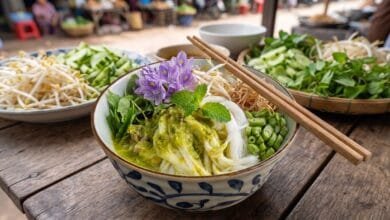
Num Banh Chok is fresh and herbal. The rice noodles are cool and soft, topped with a greenish-yellow fish curry that is fragrant with lemongrass, turmeric, and kaffir lime. The raw vegetables on the side — banana blossom, cucumber, long beans, and herbs like mint and basil — add crunch and a clean, grassy finish.
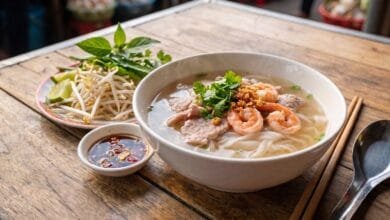
Kuy Teav is light but deeply savory. The broth is clear, usually made from pork bones, and has a subtle sweetness from daikon and dried seafood. The rice noodles are soft, and the toppings — sliced pork, fried garlic, scallions, and bean sprouts — give it layers of texture.
None of these dishes are inherently spicy. Heat comes from the condiment tray on the table: chili flakes, pickled chilies, and sometimes a chili paste. You add as much or as little as you like.
What Is in Cambodian Breakfast Street Food?
The ingredients are simple and locally sourced. This is everyday food, not restaurant cooking.
Bai Sach Chrouk uses thinly sliced pork, coconut milk, garlic, palm sugar, fish sauce, and sometimes soy sauce. The pork is marinated, then grilled over charcoal. It is served with jasmine rice, pickled vegetables, and a clear soup or broth on the side.
Num Banh Chok starts with fresh rice noodles. The curry sauce is made from freshwater fish, lemongrass, turmeric, galangal, kaffir lime leaves, and prahok (fermented fish paste). The vegetables served alongside include banana blossom, cucumber, long beans, bean sprouts, and fresh herbs.
Kuy Teav is built on rice noodles and a pork broth made with pork bones, dried squid, daikon radish, and sometimes rock sugar. Toppings include sliced pork, minced pork, fried garlic, scallions, and bean sprouts. A condiment tray with lime, chili, fish sauce, and pickled chilies lets you adjust the flavor.
How Is It Prepared by Street Vendors?
The preparation is simple and repetitive. Vendors do the same thing every morning, and that consistency is what makes the food good.
Bai Sach Chrouk vendors set up a small charcoal grill on the sidewalk. The pork is grilled in batches, sliced thin, and placed over rice that has been steamed earlier. Pickled vegetables and broth are prepared in advance. When you order, the vendor assembles the plate in under a minute.
Num Banh Chok is assembled cold. The noodles are pre-cooked and kept in a basket. The curry sauce is kept warm in a large pot. When you order, the vendor places noodles in a bowl, ladles the curry over them, and hands you a plate of raw vegetables and herbs on the side. You mix everything together yourself.
Kuy Teav is made to order. The vendor blanches a portion of rice noodles in hot water, places them in a bowl, adds sliced pork and other toppings, then ladles hot broth over everything. Fried garlic and scallions go on last. It takes about one minute.
When and Where Do Cambodians Eat It?
Cambodian breakfast street food is a morning food. Vendors start setting up around 5:30 or 6 AM. The busiest window is from 6:30 to 8:30 AM. By 9 AM, many stalls are packing up or already sold out.
You find it everywhere: on street corners, in front of markets, along busy roads, and near schools and offices. Some vendors have a fixed spot they return to every day. Others move around. The food is not tied to a specific neighborhood — if you see a crowd of motorbikes parked near a stall, that is a good sign.
Some dishes are also eaten at lunch, but breakfast is when they are most common. Kuy Teav, for example, is primarily a morning dish, though some shops serve it all day.
Why Is It Popular as Street Food?
These dishes work as street food for practical reasons. They are fast to prepare, made from affordable ingredients, and easy to eat on a stool or even standing up.
They also fit the rhythm of Cambodian mornings. People are on their way to work, school, or the market. They want something warm, filling, and quick. A bowl of noodles or a plate of pork and rice costs one or two dollars and takes ten minutes to eat.
There is also a social side to it. The same vendors serve the same customers every day. Breakfast is a small, familiar ritual — a moment of calm before the day gets busy.
The Story and History of Cambodian Breakfast Street Food
The origins of these dishes are not fully documented. What is clear is that they developed from a mix of local Khmer cooking, Chinese influence, and the practical needs of a tropical climate.
Rice noodles and pork-based broths are common across Southeast Asia. In Cambodia, they were adapted to local ingredients — freshwater fish, prahok, coconut milk, and palm sugar. Num Banh Chok, for example, is sometimes called Cambodia’s national dish and has been eaten for generations, though it is difficult to date its exact origin.
Bai Sach Chrouk and Kuy Teav are not ancient royal dishes. They are everyday foods that grew out of market culture and roadside cooking. Their history is less about a single moment of invention and more about the daily repetition that made them essential.
Regional and Vendor Variations
The same dish can taste different depending on where you are and who is cooking.
Num Banh Chok varies by region. In some places, the curry is made with coconut milk and is richer. In others, it is lighter and more herbal. The vegetables on the side change with the season. Some vendors add chicken or shrimp instead of fish.
Bai Sach Chrouk is fairly consistent, but the marinade and the cut of pork can vary. Some vendors grill the pork over charcoal, which gives it a smokier flavor. Others use a gas grill. The pickled vegetables on the side also change — cucumber, papaya, or green mango, depending on what is available.
Kuy Teav has the most variation. The broth can be pork-based, beef-based, or seafood-based. Some versions include shrimp, quail eggs, or offal. The condiments on the table change from vendor to vendor. This is part of the fun: no two bowls are exactly the same.
Where Can Travelers Try Cambodian Breakfast Street Food?
You do not need to search for a specific restaurant. The best approach is to walk or ride through a busy local area between 6:30 and 8:30 AM and look for stalls with customers.
Markets are a good starting point. Orussey Market and Central Market in Phnom Penh have breakfast vendors. In Siem Reap, the area around the Old Market gets busy in the morning. In Battambang, Phsar Nath is a local morning market with breakfast stalls.
Street corners near schools, offices, and transportation hubs are also reliable. If you see a vendor with a charcoal grill and a crowd of motorbikes, that is where you want to eat.
How to Order Cambodian Breakfast Street Food
Ordering is easier than it looks. Most vendors only sell one or two dishes, so you can simply point at what someone else is eating.
Here are the Khmer names to use:
- Bai Sach Chrouk — grilled pork with rice
- Num Banh Chok — rice noodles with fish curry
- Kuy Teav — pork noodle soup
If you want to say “one bowl” or “one plate,” you can say “m’ye bowl” (for soup) or “m’ye plate” (for rice dishes). Most vendors will understand simple pointing and holding up one finger.
If you do not want something, like chili or offal, you can say “ot” (no) and point to the ingredient. It is not a precise system, but it works. Vendors are used to foreign customers and are generally patient.
How to Eat It
There is no wrong way to eat Cambodian breakfast street food, but there are a few common habits.
For Kuy Teav, you use chopsticks and a spoon. Add condiments from the tray to taste — lime, chili, fish sauce. Mix everything together before eating.
For Bai Sach Chrouk, you use a fork and spoon. Cut the pork with the spoon, mix it with the rice, and eat. The pickled vegetables are eaten alongside, not mixed in.
For Num Banh Chok, you take a portion of noodles, add vegetables and herbs, and mix them in your bowl. The curry sauce is already on the noodles. You eat it with chopsticks or a fork and spoon.
What Foreign Travelers Should Know
A few practical points will make your breakfast experience smoother.
Spice level: The dishes themselves are not spicy. You control the heat with the condiment tray. If you are sensitive to spice, start with a small amount of chili and add more if you want.
Strong flavors: Prahok (fermented fish paste) is used in some dishes, especially Num Banh Chok. It has a strong, salty, umami flavor. If you are not used to fermented fish, you may want to start with Kuy Teav, which has a milder profile.
Vegetarian options: Most traditional breakfast dishes contain meat or fish. Kuy Teav can sometimes be made vegetarian if you ask for no meat and no fish sauce, but the broth is usually pork-based. Num Banh Chok almost always contains fish. If you are vegetarian, look for vendors selling fruit, rice porridge, or Chinese doughnuts.
Hygiene: Street food in Cambodia is generally safe for most travelers. Choose stalls with a high turnover of customers. Food that is cooked fresh in front of you is usually a good choice. Drink bottled water and use common sense.
Seating: Most stalls have small plastic stools. Some have tables. If you are tall, the stools can feel low, but they are part of the experience. You can also take your food to go.
How Much Does It Cost?
Prices vary by location, portion, and vendor. As a general guide, a breakfast dish from a street stall typically costs between 4,000 and 10,000 riel (roughly $1 to $2.50 USD). A bowl of Kuy Teav or Num Banh Chok is usually at the lower end of that range. Bai Sach Chrouk with rice and pickles is often around 6,000 to 10,000 riel.
Prices can change, and tourist areas may charge more than local neighborhoods. Exact prices cannot be verified without visiting the vendor directly, so treat these figures as a general reference rather than a fixed quote.
Frequently Asked Questions
What is the most popular breakfast in Cambodia?
Kuy Teav (pork noodle soup) is often considered the most popular breakfast dish. It is sold everywhere and eaten by people from all walks of life.
What time do Cambodians eat breakfast?
Most people eat breakfast between 6 and 9 AM. Street vendors start serving around 5:30 or 6 AM and often sell out by 9 or 10 AM.
Is Cambodian breakfast spicy?
The dishes themselves are not spicy. Heat comes from condiments like chili flakes, pickled chilies, and chili paste that you add yourself.
Can vegetarians eat Cambodian breakfast street food?
It is difficult but not impossible. Most traditional breakfast dishes contain meat or fish. Some vendors may be able to make Kuy Teav without meat, but the broth is usually pork-based. Fruit, rice porridge, and Chinese doughnuts are safer options.
Where can tourists try Cambodian breakfast street food?
Look for busy local markets, street corners near schools or offices, and areas with a high concentration of motorbikes parked near a stall. Markets like Orussey Market in Phnom Penh and the Old Market area in Siem Reap are good starting points.
How do you order Cambodian breakfast?
Point at what someone else is eating, or use the Khmer name of the dish. Hold up one finger for one portion. Most vendors understand simple gestures and are used to foreign customers.
Conclusion
Cambodian breakfast street food is one of the easiest and most rewarding parts of traveling in Cambodia. The dishes are simple, affordable, and full of flavor. Whether you start your morning with smoky grilled pork and rice, a cool bowl of fish curry noodles, or a warm bowl of pork broth, you are eating the same food that locals eat every day.
The key is to go early, look for busy stalls, and order with confidence. You do not need to speak Khmer or know the menu. Point, smile, and try. That is how breakfast works in Cambodia — and it is a morning ritual worth waking up for.