How Tonlé Sap’s Fishing Families Are Adapting to a Changing Lake
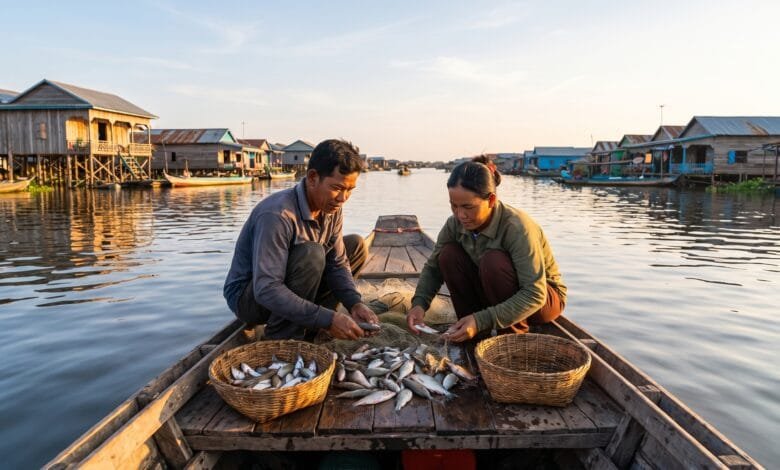
Along the shifting shoreline of Cambodia’s Tonlé Sap Lake, families have long lived by the rhythm of rising and receding water. When the monsoon arrives, the Mekong River swells and pushes water back into the lake. The lake expands into a vast inland sea, flooding forests and fields. Months later, the water retreats, leaving behind one of the most productive freshwater systems on Earth.
That rhythm once felt dependable. It no longer does.
Floods are arriving later. Water levels rise and fall in unfamiliar ways. Fish catches are less predictable. Along the lake, fishing families are adjusting. Some are changing how they fish. Others are finding new ways to earn a living. Some are leaving the water altogether.
For travelers who visit the floating villages around Siem Reap, Battambang, or Kampong Thom, understanding these families — not just the scenery — makes the experience more meaningful. This article explains who these families are, how they live, and how they are adapting to a lake that is no longer the one their grandparents knew.
Who Are Tonlé Sap’s Fishing Families?
The fishing families of Tonlé Sap are not a single group. They include Khmer families who have lived around the lake for generations, Cham Muslim fishing communities along the Tonlé Sap River, and Vietnamese-origin families who have lived on the water for decades, sometimes without formal citizenship or land rights.
Most fishing households are small and family-run. The men typically go out on the water, often at night or early morning, using nets, traps, and small motorized boats. Women manage the household, process and sell fish, and increasingly take on new roles in community projects and tourism. Children learn to handle boats and nets from a young age.
In communities like Kampong Khleang in Siem Reap province, more than 85 percent of the nearly 1,800 families depend on traditional fishing. In Phat Sanday in Kampong Thom, about 90 percent of over 1,000 families are engaged in fishing. These are not communities that fish as a hobby. Fishing is their identity, their income, and their food supply.
Where Do They Live?
Tonlé Sap is Southeast Asia’s largest freshwater lake. It sits in the northwest of Cambodia and connects to the Mekong River through the Tonlé Sap River. During the wet season, the lake can expand to several times its dry-season size, flooding forests and farmland around its edges.
Fishing families live in three main types of settlements. Some live in floating villages, where houses sit on rafts or boats that rise and fall with the water. Others live in stilted villages, where houses are built on tall wooden poles so they stay above the flood. And some live in water-land communities, spending part of the year on the water and part on land.
Each type of settlement shapes daily life differently. In floating villages, everything happens on the water: cooking, washing, going to school, buying food from floating markets. In stilted villages, families move between water level and land level depending on the season. Children in floating villages often paddle themselves to school by boat.
How Do They Make a Living?
Fishing is the foundation. Families catch a wide variety of freshwater fish, including species that are central to Cambodian cooking: mudfish, snakehead, climbing perch, and many others. Some fish is eaten at home. Some is sold fresh at local markets or to traders. And a great deal is processed into prahok, fermented fish paste, which is a staple of Cambodian cuisine and a key source of income for many families.
The work is hard and often happens at night. A fisher may leave in the late afternoon or evening and return the next morning. Fuel costs are a major expense. Some fishers report spending five to ten liters of diesel a day just to run their boats, while the catch has shrunk to the point where it barely covers the cost.
Fish processing is often done by women. In Kampong Khleang, families have maintained large-scale fish processing skills for generations, producing prahok, smoked fish, and dried fish. These activities are not just livelihoods — they are part of the community’s cultural identity and, increasingly, an attraction for visitors.
Family and Community Life
Family life on Tonlé Sap is closely tied to the water. In floating villages, children grow up on boats and rafts. They learn to swim early. They help with small tasks like sorting or descaling fish. In some communities, children crouch in front of a board, descaling the catch with a small knife while their parents work nearby.
Women play a central role in household management and community organization. In many fishing communities, women lead savings groups, manage fish processing, and participate in community fisheries committees. In Kaev Poar commune in Siem Reap, women have taken leading roles in a community-led flooded forest nursery, managing daily operations and guiding younger members. One woman, Mrs. Ri Sam, said the work gave her the chance to earn money, buy school supplies for her children, and feel like she has a real voice in community meetings.
Community institutions are important. Community Fisheries, or CFi, are local organizations that manage fishing areas, patrol for illegal fishing, and sometimes run livelihood projects. In Chong Khneas commune, patrol teams now use mobile data tools to record illegal fishing and share information with authorities in real time.
Knowledge Passed Between Generations
Fishing knowledge on Tonlé Sap is passed down through families. Children learn which nets to use in which season, how to read the water, where fish gather, and when to expect the flood. This knowledge was built over generations and adapted to the lake’s natural rhythm.
But that rhythm is changing, and some of the old knowledge no longer works the way it used to. Fishers who once knew exactly when the water would rise now say the timing is unpredictable. The skills that made their parents successful do not always produce the same results.
This is why some communities are actively documenting and sharing traditional coping strategies. The Mekong River Commission has worked with fishing communities to understand how they have dealt with environmental variability in the past, with the goal of using that knowledge to prepare for future changes.
How Life Is Changing
Several forces are combining to change life on Tonlé Sap.
Climate change is altering rainfall patterns and shifting the timing of the monsoon. Upstream hydropower dams on the Mekong are changing how and when water flows into the lake. Sand mining and sediment disruption are weakening the flood pulse that feeds the lake’s fisheries.
Inside Cambodia, land-use change, overfishing, and the loss of flooded forests add further strain. The flooded forests are critical habitat for fish spawning. When they disappear, fish populations decline.
Fishers describe the change in simple terms. Cheim Oeurn, a 40-year-old fisher in Siem Reap province, caught only about one kilogram of fish one July morning. In the past, he said, fishers could earn 50,000 to 100,000 riel (about $12.50 to $25) a day with a 50- to 60-kilogram catch. Now they often return with nothing of value.
“Less water means fewer fish,” he said.
Some families are adapting by diversifying. They are taking on farming, aquaculture, fish processing, or tourism work. Others are moving away. Some floating communities are no longer floating — they have become water-land communities, staying on land longer than on water throughout the year.
What Travelers Can Learn
For travelers, the fishing families of Tonlé Sap offer a lesson in resilience and adaptation. These are not passive victims of environmental change. They are active agents in their own lives, making decisions, forming organizations, and finding new ways to support their families.
Travelers who visit floating villages often see boats, stilt houses, and children paddling to school. What they may not see is the community meeting where families discuss how to manage fish stocks. They may not see the women’s group planning a new livelihood project. They may not see the patrol team heading out at dawn to check for illegal nets.
Understanding these layers makes a visit more than a photo opportunity. It becomes a chance to see real people navigating real change with dignity and determination.
Visiting Respectfully
If you plan to visit a floating village or fishing community around Tonlé Sap, here are a few things to keep in mind.
Ask before taking photos of people, especially children. Many families are comfortable with visitors, but not all want to be photographed.
Buy local where you can. Fish products like prahok and dried fish are made by families in these communities. Purchasing directly supports local livelihoods.
Consider community-based tourism options. Some villages, like Kampong Khleang and Phat Sanday, run their own ecotourism programs with boat tours, homestays, and local guides. These programs keep tourism revenue in the community.
Be mindful that you are visiting a working community, not a theme park. People are going about their daily lives. Respect their space and their routines.
Frequently Asked Questions
Can I visit Tonlé Sap’s floating villages?
What is the best time of year to visit?
The dry season, from November to April, is generally the easiest time to visit. Water levels are lower, and travel by road and boat is more predictable. During the wet season, some areas may be harder to reach, but the flooded forest is at its most dramatic.
Are the fishing families still able to make a living from fishing?
Many are, but it is getting harder. Fish catches have declined, and fuel costs have risen. Many families are diversifying into farming, aquaculture, fish processing, or tourism to supplement their income.
What is prahok?
Prahok is fermented fish paste, a staple of Cambodian cooking. It is made by salting and fermenting fish, often in large jars. Families around Tonlé Sap have produced prahok for generations. It is used as a flavoring in many Khmer dishes.
How can I help?
Support community-based tourism, buy local fish products, and treat the people you meet with respect. Community Fisheries organizations also welcome support for their conservation and livelihood projects.
Is it appropriate to give money or gifts to children?
It is generally better not to give money or sweets directly to children. If you want to support the community, consider purchasing from local businesses or donating to community organizations that work on education and conservation.
Conclusion
The fishing families of Tonlé Sap are living through a period of profound change. The lake that shaped their grandparents’ lives is not the same lake they know today. The water arrives at different times. The fish are fewer. The old knowledge does not always work.
But these families are not standing still. They are organizing. They are diversifying. They are teaching their children new skills while holding on to the old ones. They are, in their own quiet way, showing what adaptation looks like in real life.
For travelers, understanding this makes a visit to Tonlé Sap richer. The floating villages are not just a scenic stop on the way to Angkor Wat. They are home to people who are working hard to keep their families and communities together as the water changes around them.
That is the story behind the lake. And it is a story worth understanding.