Christianity in Cambodia: What Travelers Should Know About a Small but Resilient Faith
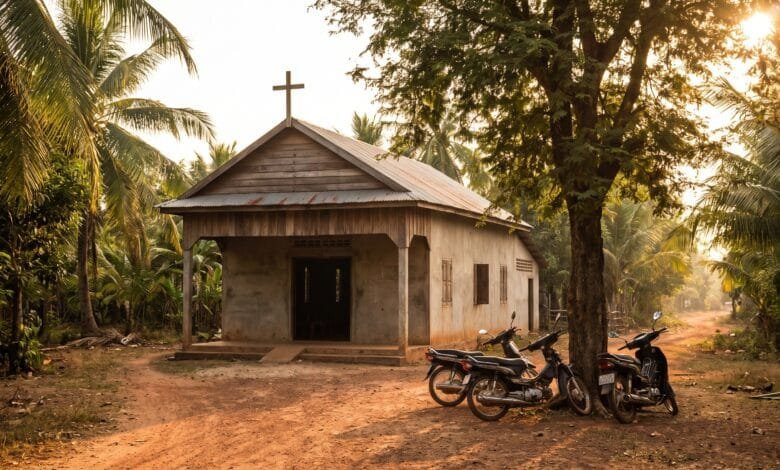
Walk through almost any Cambodian town and the most visible religious structures are Buddhist pagodas — golden roofs, orange-robed monks, and the sound of chanting in the early morning. But look a little closer in Phnom Penh, Siem Reap, or Battambang, and you might also spot something else: a church steeple, a modest storefront chapel, or a sign for a Sunday service in English.
Christianity is a small minority faith in Cambodia. Yet its story here is far older than most visitors realize, and its recent revival is one of the quieter but more remarkable chapters in the country’s modern religious life.
What Is Christianity’s History in Cambodia?
Christianity arrived in Cambodia long before French colonial rule. The first documented Christian mission came in 1555–1556, when a Portuguese Dominican friar named Gaspar da Cruz visited the royal court at Longvek. The effort did not produce lasting results, but it marked the beginning of a Christian presence that would persist, in fits and starts, for centuries.
In 1590, King Preah Borom Ricrea granted religious freedom to Christians in the kingdom — a notable act of tolerance for its time. Over the following centuries, small Catholic communities formed, often among Vietnamese refugees and other minority groups. The first Cambodian priest was ordained in 1957.
Protestant Christianity arrived much later. In 1923, missionaries with the Christian and Missionary Alliance (C&MA) began work in northwestern Cambodia. They translated the New Testament into Khmer in 1929 and the full Bible in 1954. By 1965, the Protestant church had grown to roughly 12,000 members.
What Happened During the Khmer Rouge Period?
The Khmer Rouge regime (1975–1979) devastated Cambodia’s Christian community. Religious practice was banned. Churches were destroyed, repurposed, or abandoned. Catholics were particularly targeted: of approximately 65,000 Catholics in Cambodia before 1975, two-thirds are estimated to have died in forced labor camps. Bishops, priests, nuns, and catechists were killed or driven into hiding. One of those who died was Bishop Joseph Chhmar Salas, Cambodia’s first native bishop, who perished in 1977.
After the fall of the Khmer Rouge, Catholics had to practice quietly for years. Many churches remained closed or were used for other purposes. It was not until the 1990s, when religious freedom returned, that the Christian community could begin rebuilding openly.
What Does Christianity in Cambodia Look Like Today?
Today, Christians make up a very small percentage of Cambodia’s population. Estimates vary, but Christianity in all its forms — Catholic and Protestant — likely represents around 1 percent of Cambodians, though some sources suggest slightly higher figures when accounting for unregistered congregations.
The Catholic Church is organized into three jurisdictions: the Apostolic Vicariate of Phnom Penh and the Apostolic Prefectures of Battambang and Kompong Cham. There are roughly 40 parishes and more than 130 pastoral centers across the country. The community remains small — some estimates put Catholics at around 25,000 to 75,000, with many being ethnic Vietnamese or members of indigenous highland communities.
Protestant and Evangelical churches have grown more rapidly in recent decades. The Christian and Missionary Alliance alone reports hundreds of churches and hundreds of thousands of adherents. Other denominations, including Baptists, Methodists, Seventh-day Adventists, and The Church of Jesus Christ of Latter-day Saints, also have a presence. In 2023, Cambodia marked 100 years of Protestant Christianity with a celebration attended by thousands, including government officials.
Where Might Travelers See Christianity in Cambodia?
You do not need to seek out Christian sites to encounter them. In Phnom Penh, several churches hold services in English, Khmer, or both. The Church of St. Joseph the Worker was consecrated in 2026 in Phnom Penh, a sign of the Catholic community’s continued growth.
The Phnom Penh Cambodia Temple of The Church of Jesus Christ of Latter-day Saints opened for public tours in 2026 ahead of its formal dedication — the first Latter-day Saint temple in the country.
Outside the capital, Cambodia’s oldest surviving Catholic church is St. Mary’s in Taom village, about 60 kilometers southwest of Siem Reap. Built in 1910, it survived the Khmer Rouge era because it was used as a food and livestock barn. Another survivor is the Church of Mount Bokor, a striking hilltop church in the southern Elephant Mountains, now being restored for its centenary.
In Siem Reap, St. John Catholic Church offers services and is known for incorporating Khmer cultural elements, including a Madonna and Child statue dressed in traditional Khmer clothing.
How Does Christianity Fit Into Cambodia’s Religious Landscape?
Buddhism is Cambodia’s state religion, and more than 90 percent of Cambodians are Buddhist. But the Cambodian Constitution guarantees freedom of religion for all. Government officials have repeatedly affirmed that Islam, Christianity, and other faiths are free to practice according to their own traditions.
This does not mean Christianity is always understood or welcomed by every individual. Some Cambodians may view Christianity as a foreign religion. In rural areas, conversion to Christianity can sometimes create tension within families or communities, particularly when it is seen as a rejection of traditional Buddhist or ancestral practices. However, at the official level, religious coexistence is promoted. In 2025, Phnom Penh hosted the Eighth Buddhist-Christian Colloquium, where leaders from both traditions discussed working together for peace and reconciliation.
What Should Foreign Travelers Understand?
If you are a Christian traveler, you may find a church community in Cambodia that welcomes visitors — especially in Phnom Penh and Siem Reap. English-language services exist, and international congregations are often happy to see new faces.
If you are not Christian, understanding that Christianity exists in Cambodia adds texture to your understanding of the country. It reminds us that Cambodia is not a monolith. Just as Buddhism in Cambodia incorporates spirit beliefs and ancestor traditions, Christianity here has its own local history and character.
Most importantly, travelers should understand that Cambodia’s Christian community is small, historically wounded, and currently rebuilding. It deserves the same respect and curiosity you would bring to any religious space in the country.
How to Visit a Church in Cambodia Respectfully
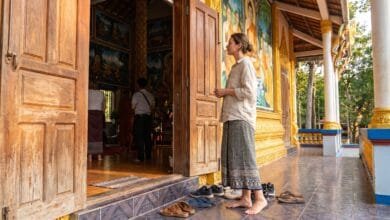
The same basic etiquette that applies to pagodas applies to churches. Dress modestly — cover your shoulders and knees. Remove your hat when entering. If a service is in progress, sit quietly at the back or wait until it finishes. Ask before taking photographs, especially of people praying or of religious leaders.
If you are not Christian and are simply curious, it is generally fine to attend a service as an observer. But be mindful that you are in a place of worship, not a tourist attraction. Keep your voice low, avoid moving around unnecessarily, and follow the lead of the congregation.
Frequently Asked Questions
Is Christianity growing in Cambodia?
Yes, particularly among Protestant and Evangelical denominations. Since the 1990s, when religious freedom was restored, the number of churches and Christians has increased significantly. The Catholic community has also grown, though more slowly.
Can tourists visit churches in Cambodia?
Yes. Most churches welcome respectful visitors. In Phnom Penh and Siem Reap, several churches hold services in English. If you plan to attend, arrive a few minutes early and dress modestly.
What is the oldest church in Cambodia?
How many Christians are there in Cambodia?
Estimates vary, but Christians likely make up around 1 percent of Cambodia’s population. The Catholic community is estimated at roughly 25,000 to 75,000, while Protestant churches report larger and growing numbers.
Do Cambodian Christians face persecution?
At the official level, no. The Constitution guarantees religious freedom, and the government has affirmed the right of Christians to practice. Social tensions can exist in some communities, particularly around conversion, but this is not the same as state persecution.
Why is Christianity so small in Cambodia?
Buddhism has been central to Cambodian identity for centuries. Christian missionaries found it difficult to gain converts, and the Khmer Rouge nearly destroyed the Christian community entirely. The community has been rebuilding only since the 1990s.
Conclusion
Christianity in Cambodia is easy to miss. It does not dominate the skyline the way Buddhist pagodas do. It does not shape the rhythm of daily life the way temple ceremonies and monk blessings do. But it is there — in a hilltop church in the south, in a village chapel near Siem Reap, in English-language services in Phnom Penh.
For travelers, understanding Cambodia’s Christian minority is a reminder that this country’s religious story is richer and more layered than a single glance can reveal. Whether you attend a service, pass a church on a quiet street, or simply learn the history, you are seeing a small community that has survived against remarkable odds — and that is still finding its place in modern Cambodia.