Phsar Leu Thom Tmey: Siem Reap’s Largest Local Market — What Travelers Can See, Eat and Buy
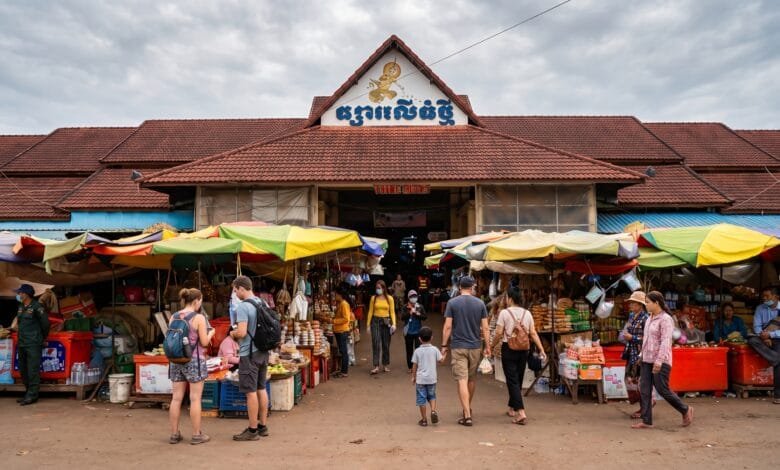
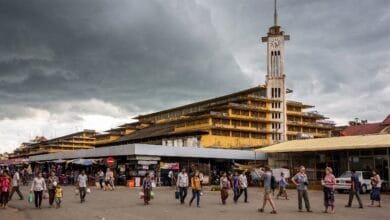
The road east from central Siem Reap leads past guesthouses, workshops and dusty intersections before something shifts in the air. The traffic thickens. Motorbikes weave between trucks. Women balance towering baskets on bicycle handlebars. And then you see it: a sprawling yellow-and-white complex rising from the roadside, surrounded by a sea of activity that spills far beyond its walls.
This is Phsar Leu Thom Tmey — Siem Reap’s largest and oldest market.
Unlike the Old Market near Pub Street, which has adapted to welcome tourists, Phsar Leu Thom Tmey remains a market built for Cambodians. It’s where locals buy their daily vegetables, find fabric for new clothes, eat breakfast before work, and bargain for motorbike parts. For travelers willing to step away from the temple crowds, it offers something increasingly rare: a glimpse into everyday life in Siem Reap.
Quick Facts / At a Glance
Why Visit Phsar Leu Thom Tmey?
Most visitors to Siem Reap spend their days among the temples of Angkor and their evenings along the restaurants and bars of Pub Street. Between these two worlds lies a third Cambodia — the one where people live, work, and shop.
Phsar Leu Thom Tmey offers exactly that.
Built along National Road 6 toward Phnom Penh, the market replaced an earlier wooden structure and has served as Siem Reap’s commercial heart for decades. It survived the Khmer Rouge years when urban markets were abolished, and it was among the first places to revive afterward — a symbol of everyday life returning to the city.
Today, the market is described by locals as “the market that never truly sleeps.” It opens as early as 3:00 or 4:00 AM and stays busy until nightfall.
For travelers, visiting Phsar Leu Thom Tmey means experiencing a side of Siem Reap that hasn’t been polished for tourism. Few vendors speak English. The prices are for locals, not tourists. The produce is for cooking, not display. And that’s exactly what makes it worth visiting.
What to See at the Market
Phsar Leu Thom Tmey doesn’t start at a formal entrance. It begins on the street itself.
The Outdoor Street Stalls
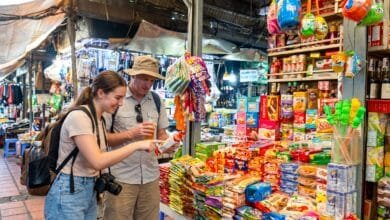
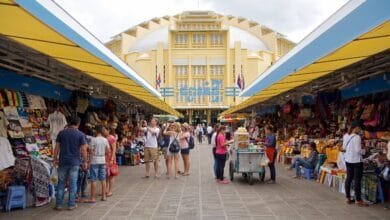
Before dawn, vendors arrive and claim their patches of sidewalk. They spread their goods on folding tables and woven baskets — roasted nuts, lotus flowers, ripe plums, snails — all displayed under yellow and orange umbrellas that glow in the morning heat.
These outdoor sellers are among the market’s most independent traders. No rent, no stall contract, no fixed address. Their entire business fits on a table or in two large baskets.
The Main Market Building
Step inside and you enter a labyrinth. The passageways branch and loop back on themselves without obvious logic. One aisle is groceries. The next is clothing. The one after opens onto a food hall.
The ceiling disappears under goods hung from every available hook. Fluorescent lights cast a cool white glow over the clutter. The air carries the smell of raw meat, dried fish, and synthetic fabric — a scent familiar across Southeast Asian markets.
Every square centimeter is claimed. Cardboard boxes serve as shelves and counter extensions. Nothing is wasted.
The Textile Section
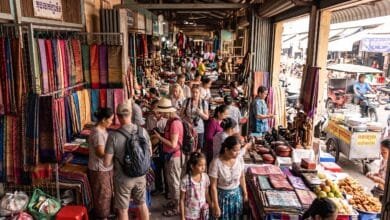
The fabric sector is one of the market’s largest sections. Rows of textiles, sewing supplies, and even mannequins fill the aisles. Travelers looking for traditional Khmer fabric or Krama scarves will find abundant options here.
The Food Hall
Tucked within the market’s interior is a food hall where vendors cook using ingredients sourced from the market itself. This is where you’ll find some of the most authentic Khmer street food in Siem Reap.
What to Eat
Phsar Leu Thom Tmey is a working market, not a food court. But for travelers willing to explore, the food is among the most authentic you’ll find in Siem Reap.
Nom Banh Chok (Khmer Noodles)
This traditional Cambodian breakfast dish features rice noodles topped with a fish-based green curry gravy, served with fresh vegetables. It’s a morning staple and one of the most popular dishes at the market.
Bai Set Chrouk (Grilled Pork with Rice)
Slices of grilled pork marinated with garlic, sugar, and fish sauce, served over rice. Simple, satisfying, and everywhere.
Fresh Spring Rolls
Unlike the fried versions, fresh spring rolls are packed with vegetables, herbs, and sometimes shrimp or pork, wrapped in translucent rice paper.
Khmer Desserts
The market offers a range of traditional sweets: roast banana in sticky rice, sugar-glazed rice donuts, and various coconut-based treats.
Fried Insects
For the adventurous eater, some stalls sell fried crickets, spiders, and other insects — a common snack in Cambodia.
Tropical Fruit
Mangosteen, rambutan, dragon fruit, and local citrus are available in season. The fruit sections are among the most photogenic parts of the market.
What to Buy
Phsar Leu Thom Tmey is a one-stop destination for everything from daily groceries to household goods.
Fresh Produce
The vegetable and fruit sections are vast, with vendors selling everything from morning glory (a popular local green) to exotic tropical fruits.
Meat and Seafood
Fresh meat and fish are sold in dedicated sections. The seafood comes from the Tonlé Sap lake and surrounding waters.
Fabrics and Clothing
The textile section offers traditional Khmer fabrics, Krama scarves, and clothing. Unlike the tourist markets, prices here are aimed at locals.
Jewelry and Gold
Several stalls sell gold and silver jewelry.
Household Goods
From kitchenware to electronics to motorbike parts, the market supplies everyday needs for Siem Reap’s residents.
Beauty Products
Hair and beauty products are available in dedicated sections.
The Local Food Story
Phsar Leu Thom Tmey isn’t just a place to buy food — it’s where Siem Reap’s culinary life begins.
The market supplies restaurants, street food vendors, and home cooks across the city. The ingredients sold here — fish from the Tonlé Sap, vegetables from nearby farms, spices from the eastern provinces — form the backbone of Khmer cuisine.
What makes this market special is its connection to daily life. The women who run the stalls have been here for decades, some since they were teenagers helping their mothers. They haggle, keep the books, manage children, cook meals, and maintain the social fabric that makes a market a community.
For travelers interested in Cambodian food culture, watching how locals shop — how they select fish, bargain for vegetables, and choose ingredients — offers more insight than any cooking class.
How to Experience the Market
Arrive early. The market comes alive between 5:00 and 7:00 AM, when vendors are setting up and locals are doing their morning shopping.
Start outside. Walk along the street stalls first, where vendors sell snacks and produce under colorful umbrellas.
Enter the main building. Explore the labyrinth of aisles. Don’t worry about getting lost — that’s part of the experience.
Find the food hall. Look for the section where vendors are cooking. Follow the smell of grilled meat and frying noodles.
Try something. Pick a dish that looks popular with locals. Point at what you want — communication doesn’t require language.
Shop if you like. Browse the textiles, jewelry, and household goods. Bargaining is expected, but keep it friendly.
Best Time to Visit
Early morning (5:00 – 9:00 AM) is the best time to experience Phsar Leu Thom Tmey at its most vibrant. This is when the market is busiest with local shoppers and when the outdoor stalls are fully set up.
Mid-morning to early afternoon is quieter but still active.
Late afternoon sees a second wave of activity as people shop for dinner ingredients.
The market is open daily from approximately 3:00 AM to 8:00 PM. Seasonal factors can affect what produce is available, but the market operates year-round.
Practical Tips
Bring cash. Small denominations are useful. Most vendors do not accept cards.
Wear comfortable shoes. The market floors can be wet and slippery.
Dress modestly. This is a working market, not a beach. Cover shoulders and knees out of respect.
Ask before taking photos. Many vendors are happy to be photographed, but it’s polite to ask first.
Be prepared to bargain. Bargaining is normal in Cambodian markets. Start at about half the asking price and negotiate from there. Keep it friendly.
Learn a few Khmer words. “Susaday” (hello) and “Awkun” (thank you) go a long way.
Watch your belongings. The market is crowded. Keep bags secure.
Expect limited English. Few vendors speak English, but pointing and using hand gestures works.
How to Get There
From central Siem Reap: Take a tuk-tuk east along National Road 6. The journey takes about 10–15 minutes depending on traffic. The market is on the right-hand side. The fare should be around $3–5 USD each way, depending on your starting point and bargaining skills.
From the bus station: The market is about 2 km from the main bus station — a short tuk-tuk ride or a walk if you’re traveling light.
Address: NR6, Krong Siem Reap 17252, Cambodia
Coordinates: 13.35984° N, 103.874842° E
How Long Should You Spend?
Plan for 1–2 hours at Phsar Leu Thom Tmey.
- 30–60 minutes: A quick walk through the main sections, some photos, and a snack.
- 1–2 hours: A thorough exploration of the building, outdoor stalls, and food hall, with time to browse and buy.
- 2+ hours: If you’re a serious food or photography enthusiast, you could easily spend half a day here.
Where to Stay
Most travelers base themselves in central Siem Reap, near Pub Street and the Old Market. From there, Phsar Leu Thom Tmey is a short tuk-tuk ride away. The market itself is surrounded by local neighborhoods rather than tourist accommodation, so staying in the city center is the most practical option.
Things to Do Nearby
Angkor Archaeological Park — The world-famous temple complex is about 15–20 minutes from the market by tuk-tuk.
Siem Reap Old Market (Phsar Chas) — The tourist-oriented market near Pub Street offers a different, more polished experience.
War Museum Cambodia — About 5 km from the market, this museum offers insight into Cambodia’s recent history.
Tonlé Sap Lake — About 20 km south, the lake and its floating villages are a popular excursion.
Wat Thmei (Killing Caves) — A Buddhist temple and memorial site about 20 km from the market.
Responsible Travel
Support local vendors. Buying from independent stallholders directly supports families and the local economy.
Reduce plastic. Bring your own bag and avoid single-use plastics where possible.
Respect the community. This is a working market for locals. Be mindful of blocking aisles or disrupting business.
Ask permission for photos. Not everyone wants to be photographed. Always ask first.
Bargain fairly. Bargaining is expected, but remember that small amounts of money mean more to vendors than they do to you.
Frequently Asked Questions
What are the opening hours?
Phsar Leu Thom Tmey is open daily from approximately 3:00 AM to 8:00 PM.
What is the best time to visit?
Early morning (5:00 – 9:00 AM) is the best time to experience the market at its busiest and most vibrant.
Is there an entrance fee?
No, entry to the market is free.
What food can I try?
Nom Banh Chok (Khmer noodles), Bai Set Chrouk (grilled pork with rice), fresh spring rolls, tropical fruit, Khmer desserts, and for the adventurous — fried insects.
Can tourists buy fresh ingredients?
Yes, you can buy fresh produce, meat, and seafood just like locals do.
Can I visit with children?
Yes, but keep in mind the market is crowded and the floors can be wet. It’s a very local experience that children may find overwhelming or fascinating.
How long should I spend there?
1–2 hours is enough for a good experience.
How do I get there?
Take a tuk-tuk from central Siem Reap east along National Road 6. The journey takes about 10–15 minutes.
Is bargaining expected?
Yes, bargaining is normal in Cambodian markets. Start at about half the asking price and negotiate from there.
What should I bring?
Cash (small denominations), comfortable shoes, modest clothing, and a camera (ask permission before taking photos of people).
Final Thoughts
Phsar Leu Thom Tmey isn’t designed for tourists. There are no souvenir shops selling miniature temples, no English menus, no air-conditioning. It’s hot, crowded, and smells of fish and fabric. And that’s exactly why it’s worth visiting.
For travelers who want to see beyond the temples and the tourist trail, this market offers something rare: a genuine glimpse into how people in Siem Reap live, work, and eat. It’s a place where Cambodia feels real — unpolished, lively, and human.
So before you head to Angkor Wat, or after a day among the temples, take a tuk-tuk east on National Road 6. Step into the yellow-and-white building. Get lost in the aisles. Eat something you can’t pronounce. And experience the market that Siem Reap’s locals have relied on for generations.
Planning a food-focused trip through Cambodia? Save this Market Trails guide and add Phsar Leu Thom Tmey to your Siem Reap itinerary.
Have you visited Phsar Leu Thom Tmey? What did you discover?