Ingredients Foreigners Should Try in Cambodia: A Traveler’s Guide to Khmer Flavors
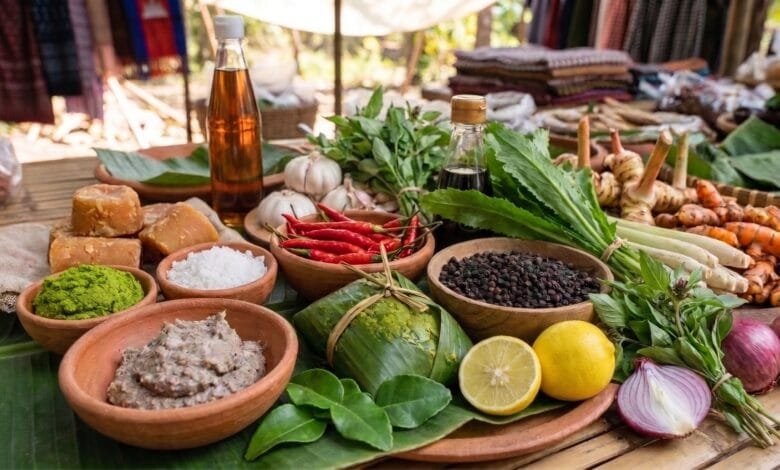
Cambodian cooking does not shout. It leans on herbs, fermented fish, and palm sugar rather than chili heat, and its flavors build slowly from ingredients that may be unfamiliar to a first-time visitor. If you are traveling to Cambodia for the first time, knowing a few key ingredients will change how you eat. You will recognize the fermented tang in a bowl of soup, understand why the pepper on your table tastes different from anything you have tried at home, and maybe even know what to ask for at a market stall. This guide introduces the ingredients that matter most in Khmer cooking — what they are, what they taste like, and how you will encounter them.
What Is Prahok?
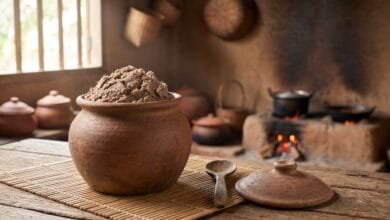
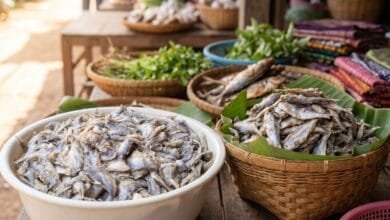
Prahok (ប្រហុក, prâhŏk) is Cambodia’s most distinctive ingredient: a salted, fermented fish paste that functions as a seasoning, a condiment, and sometimes a main source of protein in rural meals. It is made from small freshwater fish, most commonly a tiny mud carp called trey riel in Khmer, which is abundant in the Tonle Sap Lake and Mekong River during the dry season.
In Cambodian cooking, prahok is rarely eaten straight from the jar. It is cooked, fried, or mixed into dishes to add a deep, savory, umami-rich flavor that is difficult to replicate with anything else. Some travelers describe its aroma as similar to ripe Camembert or Limburger cheese, which is why food writers have nicknamed it “Cambodian cheese”.
What Does Prahok Taste and Smell Like?
Prahok has a powerful, pungent aroma that hits before the first bite. The smell is fermented, salty, and distinctly fishy, with a complexity that deepens when it is cooked. The taste is intensely savory and salty, with a lingering umami quality that resembles aged fish sauce concentrated into a paste. Its texture can range from lumpy to creamy, depending on how it has been processed and how long it has fermented.
When prahok is fried with pork or mixed into a curry, the raw pungency softens. It becomes a background flavor that gives depth to the entire dish. First-time travelers often find it challenging on its own but enjoyable once it is integrated into a cooked dish.
What Does Prahok Look Like?
Fresh prahok is a grayish-pink to gray-brown paste, sometimes with visible fragments of fish. It is typically sold in plastic tubs or wrapped in banana leaves at markets. Cooked prahok, which is what most travelers will encounter in restaurants, is darker and more uniform in texture.
How Is Prahok Used in Cambodian Cooking?
Prahok is used in several ways. It can be fried with minced pork, garlic, and shallots to make a rich, savory dip called prahok ktis. It can be mixed into soups and stews as a seasoning, where a small amount adds a deep savory note. It can also be wrapped in banana leaves and grilled, or mixed with coconut milk and spices to create a dipping sauce for fresh vegetables.
In many Cambodian homes, a small dish of cooked prahok sits on the table alongside a meal of rice and vegetables, much like a condiment. It is not meant to be eaten in large spoonfuls. A little goes a long way.
Which Cambodian Dishes Use Prahok?
Prahok appears in dozens of Khmer dishes. Prahok ktis is a fried dip of prahok with minced pork and coconut milk, served with fresh crunchy vegetables. Samlor machou prahok is a sour soup that uses prahok as its base seasoning. Green papaya salad (bok lahong) often includes a spoonful of cooked prahok in its dressing. The ingredient also appears in various dips and sauces that accompany grilled meats and freshwater fish.
What Is Kroeung?
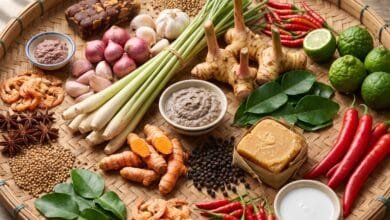
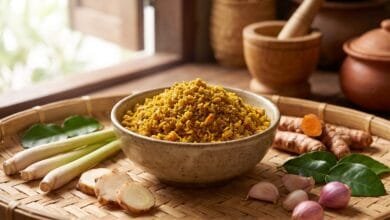
Kroeung (គ្រឿង, krœăng) is the aromatic paste that forms the backbone of many Cambodian curries, soups, and stir-fries. It is not a single ingredient but a pounded mixture of fresh aromatics, most commonly lemongrass, galangal, turmeric, kaffir lime leaves, garlic, and shallots. The word kroeung simply means “ingredients” or “spices” in Khmer, and Cambodian cooks prepare different versions depending on the dish.
A yellow kroeung, for example, is used as a marinade and in dishes like fish amok and samlor machu kroeung (a pork rib stew). A red kroeung includes dried red chilies and is used for richer curries. Unlike Thai curry pastes, Cambodian kroeung often contains no chili at all, relying instead on the fragrance of lemongrass, galangal, and kaffir lime.
What Does Kroeung Taste and Smell Like?
Kroeung is intensely aromatic. The smell is citrusy and herbal, with the sharp brightness of lemongrass and kaffir lime leaves balanced by the earthy warmth of galangal and turmeric. When it hits a hot pan, the aroma fills the kitchen immediately. The taste is complex: citrusy, slightly bitter from the kaffir lime, warm from the turmeric, and pungent from the garlic and shallots.
Travelers who are familiar with Thai green curry paste will find Cambodian kroeung milder and more herbal, with less upfront heat.
How Is Kroeung Used in Cambodian Cooking?
Kroeung is almost always cooked before it is eaten. It is fried in oil until fragrant, then combined with coconut milk, fish sauce, palm sugar, and the main ingredient of the dish — usually fish, chicken, or pork. It is also used as a marinade for grilled meats and as a base for dipping sauces.
If you are buying kroeung at a market, you will see it sold as a fresh, brightly colored paste, often wrapped in banana leaves or packed into small plastic containers. The color depends on the version: yellow kroeung is golden from turmeric, while red kroeung is a deeper orange-red from dried chilies.
Which Cambodian Dishes Use Kroeung?
Fish amok, often called Cambodia’s national dish, is perhaps the most famous dish built on kroeung. Freshwater fish is folded into a yellow kroeung with coconut cream and egg, then steamed in a banana-leaf cup until it sets like a soft custard. Other dishes include samlor machu kroeung, a sour pork rib soup; kari sach moan, a chicken curry; and various grilled meat marinades.
What Is Kampot Pepper?
Kampot pepper (ម្រេចកំពត, mrech Kampot) is Cambodia’s most internationally recognized spice. It is grown in Kampot Province in southern Cambodia and in the neighboring Kep Province, where the soil and coastal climate give the peppercorns a distinctive flavor. Kampot pepper was awarded Geographical Indication (GI) status by Cambodia in 2010 and by the European Union in 2016, making it the first Cambodian product to receive that protection.
Kampot pepper comes in four forms: green, black, red, and white. The difference is not the plant variety but the stage of harvest and processing. Green peppercorns are harvested early and sold fresh. Black pepper is harvested when the berries begin to ripen and then dried in the sun. Red pepper is harvested fully ripe, and white pepper is made from ripe berries with the outer skin removed.
What Does Kampot Pepper Taste and Smell Like?
Kampot pepper is known for its complex aroma and lingering taste, with a mildness of spice that sets it apart from mass-produced pepper. The flavor is floral and citrusy, with notes of eucalyptus and a slow-building warmth rather than sharp heat. Some cooks describe it as having a sweetness that emerges after the initial bite.
If you have only ever used pre-ground black pepper from a supermarket, Kampot pepper will be a revelation. The aroma alone is worth seeking out.
How Is Kampot Pepper Used in Cambodian Cooking?
In Cambodian cooking, Kampot pepper is used both as a cooking spice and as a finishing ingredient. It is added to marinades for grilled meats, stirred into stir-fries, and ground fresh at the table. One of the most iconic uses is in the dipping sauce for lok lak, a popular dish of seared beef served over salad and rice. The sauce is simply lime juice, salt, and a generous amount of cracked Kampot pepper.
Kampot pepper is also used in kampot pepper crab, a dish of fresh crab stir-fried with garlic, spring onions, and a generous dose of black pepper. The pepper is not just a seasoning in this dish; it is the defining flavor.
What Is Cambodian Palm Sugar?
Cambodian palm sugar (skor thnot) is made from the sap of the Palmyra palm tree (Borassus flabellifer), a tall palm that grows throughout Cambodia and is the country’s national tree. The sap is collected from the flower stalks of the palm, then gently evaporated over low heat to produce a raw, unrefined sugar.
Palm sugar is produced in several provinces, but Kampong Speu Province is the most famous for its distinctive version, which also holds GI status. The production process is largely community-based: men climb the tall palms twice daily to collect the sap, while women handle the cooking and crystallization.
What Does Cambodian Palm Sugar Taste and Smell Like?
Cambodian palm sugar has a rich, caramel-like sweetness with a distinct palm aroma. It is less sweet than refined white sugar and has a deeper, more complex flavor, with notes of toffee and a faint smokiness from the open-fire evaporation process. Depending on the form — granulated, paste, block, or syrup — the color ranges from light golden to deep amber.
Travelers who enjoy brown sugar or muscovado will find palm sugar familiar but more fragrant. It is worth trying on its own, perhaps in a cup of herbal tea, to appreciate the difference.
How Is Palm Sugar Used in Cambodian Cooking?
Palm sugar is used across Cambodian cooking, from savory soups and curries to desserts. In savory dishes, it balances the saltiness of fish sauce and prahok, adding a gentle sweetness that rounds out the flavor. In desserts, it is the primary sweetener for traditional Khmer sweets like num chak chan (sticky rice with palm sugar) and num ansom (sticky rice cakes filled with palm sugar and coconut).
It is also used in dipping sauces, where it is dissolved with lime juice and fish sauce to create the classic sweet-sour-salty balance that defines Cambodian flavor.
What Is Tuk Trey?
Tuk trey (ទឹកត្រី) is the Cambodian name for fish sauce, a thin, amber-brown liquid made by fermenting fish with salt. It is one of the most essential seasonings in Khmer cooking, used in everything from marinades and stir-fries to dipping sauces and soups. Cambodian fish sauce is similar to Thai nam pla and Vietnamese nuoc mam, though travelers may notice slight differences in aroma and saltiness depending on the producer.
Tuk trey is not the same as prahok. Prahok is a thick paste of fermented fish; tuk trey is the liquid that is extracted or produced separately. Both are used in Cambodian cooking, often in the same dish, with prahok providing depth and tuk trey providing salt and umami.
What Does Tuk Trey Taste and Smell Like?
Tuk trey is intensely salty and savory, with a strong fermented fish aroma. The smell is pungent straight from the bottle but dissipates somewhat when the sauce is mixed into a dish or combined with lime juice and sugar. The taste is deep umami with a saline finish.
For travelers unfamiliar with fish sauce, the first encounter can be intense. But once you taste it in a balanced dipping sauce, where lime juice and palm sugar soften the edges, the purpose becomes clear: it is the backbone of savory flavor in Cambodian cooking.
How Is Tuk Trey Used in Cambodian Cooking?
Tuk trey is used as a seasoning in nearly every savory Cambodian dish. It is added to soups, stir-fries, and curries, and it is the base for dipping sauces. A typical Cambodian table will have at least one small bowl of tuk trey–based dipping sauce, often mixed with lime juice, sugar, garlic, and chilies.
Travelers will encounter tuk trey in tuk trey piam (fish sauce dressing) and in the dipping sauces served with grilled meats, spring rolls, and fresh vegetables.
Fresh Aromatics: Lemongrass, Galangal, Kaffir Lime Leaves, and Turmeric
Beyond the fermented and processed ingredients, Cambodian cooking relies on a small group of fresh aromatics that give Khmer food its characteristic fragrance.
Lemongrass (slek krey sabou) is one of the most fundamental herbs in Cambodian cooking, used in soups, curries, and marinades. It has a bright, citrusy aroma and a subtle lemony flavor. Cambodian cooks use the inner core of the stalk, finely sliced or pounded into kroeung.
Galangal (romdeng) is a rhizome related to ginger but with a sharper, more citrusy and pine-like flavor. It is a key component of kroeung and is also used in soups and herbal remedies. Fresh galangal is pale yellow with a reddish-brown skin, and it is usually sliced or pounded rather than eaten in large pieces.
Kaffir lime leaves (kroch saech) come from the kaffir lime tree, a citrus variety with intensely fragrant, hourglass-shaped leaves. The leaves are used whole in soups and curries, or finely shredded and added to kroeung and salads. Their aroma is sharp and floral, with a bright lime character that is more perfume than juice.
Turmeric (rumdeng or khmer turmeric) is a bright orange rhizome that gives many Cambodian dishes their golden color. It has an earthy, slightly bitter flavor and is used fresh in kroeung and marinades. Fresh turmeric from Siem Reap Province is particularly valued for its high essential oil content.
Where Do These Ingredients Come From?
Most of these ingredients are produced within Cambodia, though some have broader regional origins. Prahok is made from freshwater fish caught in the Tonle Sap Lake and Mekong River system, particularly during the dry season when water levels recede and fish become concentrated in smaller bodies of water. Kampot pepper is grown only in Kampot and Kep provinces, where the soil and climate are considered essential to its character. Palm sugar is produced in several provinces, with Kampong Speu being the most famous. Fresh aromatics like lemongrass, galangal, and turmeric are grown throughout the country in home gardens and small farms.
Why These Ingredients Matter in Cambodian Food
Cambodian cooking is often described as being less spicy than Thai food, and that is true in the sense that chilies are used more sparingly. But Cambodian food is not mild in flavor. It is built on a different kind of intensity: the fermented depth of prahok, the aromatic complexity of kroeung, the floral warmth of Kampot pepper, and the caramel sweetness of palm sugar.
These ingredients work together to create a cuisine that is savory, aromatic, and balanced. The Cambodian approach to flavor is about layering: a little prahok for depth, a spoonful of kroeung for fragrance, a splash of tuk trey for salt, a pinch of palm sugar for balance. Understanding these ingredients is the key to understanding why Cambodian food tastes the way it does.
Can Foreign Travelers Try or Buy These Ingredients?
Yes, and most travelers will encounter them without trying. Prahok and kroeung appear in countless restaurant dishes. Kampot pepper is on nearly every table, often in a small grinder. Palm sugar is used in desserts and drinks. Tuk trey is in the dipping sauce that comes with almost every meal.
For travelers who want to buy these ingredients to take home, Cambodian markets and specialty food shops sell prahok in tubs, kroeung as fresh paste or dried spice packets, Kampot pepper in sealed bags or grinders, and palm sugar in blocks or jars. Kampot pepper and palm sugar are the easiest to pack and carry. Prahok is pungent and may not be allowed through customs in some countries, so check your home country’s regulations before buying.
What Should Travelers Know?
A few practical notes will make the experience smoother. Prahok has a strong smell, and if you are sensitive to fermented aromas, try it in a cooked dish first rather than on its own. Kroeung is generally mild, but some versions include chilies, so ask if you are unsure. Kampot pepper is not spicy in the chili sense; its heat is subtle and aromatic. Palm sugar is safe for most diets, but if you are managing blood sugar, treat it like any other sugar.
Cambodian food is not designed to be eaten in a hurry. It is meant to be shared, with rice as the center and several dishes around it. Take your time, ask questions, and let the flavors build.
Frequently Asked Questions
What is prahok called in English?
Prahok is usually translated as “fermented fish paste” or “Cambodian fish paste.” Food writers sometimes call it “Cambodian cheese” because of its pungent aroma.
Is Cambodian food spicy?
Cambodian food is generally less spicy than Thai or Lao food. Chilies are used, but often sparingly. The primary flavors come from fermented fish, aromatic herbs, and palm sugar rather than chili heat.
What is kroeung made of?
Kroeung is a paste made from fresh aromatics. The most common ingredients are lemongrass, galangal, turmeric, kaffir lime leaves, garlic, and shallots. Some versions add chilies.
Is Kampot pepper the same as regular black pepper?
Kampot pepper is a specific variety of pepper grown in Kampot Province, Cambodia. It is known for its complex, floral aroma and mild heat, and it holds Geographical Indication status. It is not the same as mass-produced black pepper.
Can I bring prahok home from Cambodia?
Prahok is a fermented fish product and may be restricted by customs regulations in some countries. Check your home country’s rules before purchasing. Kampot pepper and palm sugar are generally easier to bring home.
What should I try first if I am new to Cambodian food?
Start with fish amok, which uses kroeung and coconut milk and is mild and aromatic. Then try lok lak with its Kampot pepper dipping sauce. These dishes introduce the core flavors of Cambodian cooking without overwhelming intensity.
Conclusion
Cambodian cooking is built on ingredients that reward curiosity. Prahok, kroeung, Kampot pepper, palm sugar, tuk trey, and the fresh aromatics of lemongrass, galangal, kaffir lime, and turmeric are not just components of a recipe. They are the vocabulary of Khmer flavor. For a foreign traveler, learning to recognize these ingredients transforms every meal from a plate of food into a conversation with Cambodian culture. You do not need to love prahok on the first try, and you do not need to memorize every name. But if you pay attention to what you are tasting, you will leave Cambodia with a deeper understanding of why this cuisine tastes like nowhere else.