Angkor Wat: A Complete Guide to Cambodia’s Ancient Temple
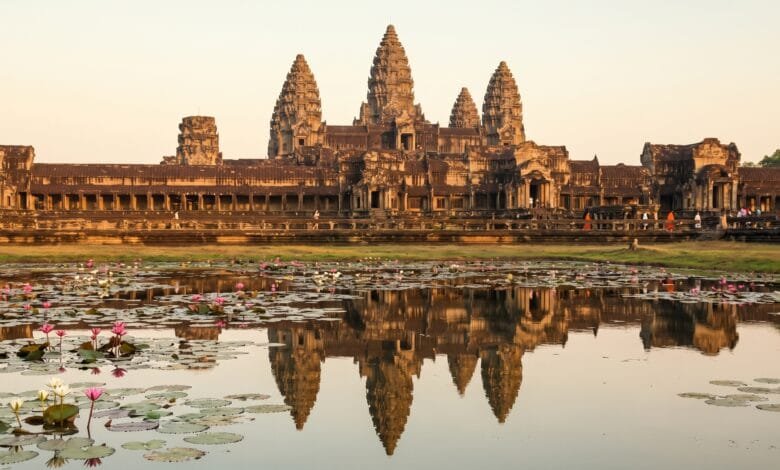
Most temples in the Angkor region face east, toward the rising sun. Angkor Wat faces west. This single architectural decision, made nearly 900 years ago, has puzzled scholars for generations and tells you something important: Angkor Wat was never an ordinary temple.
It was built to be extraordinary. Today, it stands as the largest religious monument in the world and the most recognizable symbol of Cambodia. For travelers visiting Southeast Asia, understanding what Angkor Wat is, why it was built, and what to look for can transform a visit from a photo opportunity into a genuine encounter with Khmer heritage.
This guide explains the temple’s history, architecture, and cultural meaning in simple English. It also covers what you need to know before you go, from tickets and dress rules to the best time to see the sunrise.
Quick Travel Information
| Information | Details |
|---|---|
| Location | Angkor Archaeological Park, Siem Reap Province, Cambodia |
| Site Type | Temple complex / State temple / Funerary temple |
| Historical Period | First half of the 12th century (early 1100s) |
| Religious Tradition | Originally Hindu (Vishnu); later Buddhist |
| Heritage Status | UNESCO World Heritage Site (inscribed 1992) |
| Known For | Largest religious monument in the world; five-tower silhouette; bas-relief galleries |
| Main Visitor Experience | Sunrise viewing, gallery bas-reliefs, upper-level Bakan tower |
| Opening Hours | 5:00 AM – 5:30 PM daily (verify current hours before travel) |
| Entrance Fee | 1-day pass: US$37; 3-day pass: US$62; 7-day pass: US$72 |
| How to Get There | About 6 km north of Siem Reap city; tuk-tuk, taxi, or bicycle |
What Is Angkor Wat?
Angkor Wat is a massive temple complex in northwestern Cambodia. It was built in the first half of the 12th century by King Suryavarman II, who ruled the Khmer Empire from about 1113 to around 1150.
The name “Angkor Wat” comes from Khmer and roughly means “City of Temples.” The temple was originally dedicated to Vishnu, one of the principal Hindu gods. It was later transformed into a Buddhist temple, probably toward the end of the 12th century.
The complex covers about 400 acres (162.6 hectares). It contains over a thousand buildings and is surrounded by a moat that is roughly 3.6 kilometers (2.2 miles) long.
Why Is Angkor Wat Important?
Angkor Wat matters for several reasons. It is the largest religious monument ever built. It represents the high point of classical Khmer architecture. It has remained a place of worship for nearly 900 years. And it appears on Cambodia’s national flag—the only building featured on a national flag anywhere in the world.
For travelers, Angkor Wat is important because it helps explain the Khmer Empire’s power, wealth, and spiritual vision. The temple is not just a ruin. It is a statement in stone about how the Khmer kings understood the universe and their place within it.
The History of Angkor Wat
Construction began in the first half of the 12th century under King Suryavarman II. Scholars believe the temple was intended as the king’s funerary temple—a place where his remains would rest for eternity. Some researchers also propose that the west-facing orientation supports this funerary purpose, since west is associated with death in Hindu tradition.
The Khmer Empire flourished from the 9th to the 15th centuries. Angkor was its capital. At its height, the empire controlled much of present-day Cambodia, Thailand, Laos, and southern Vietnam.
After the 15th century, most of Angkor was abandoned following Siamese attacks. But Angkor Wat remained in use as a Buddhist shrine. This continuous religious use helped preserve the temple when other monuments in the region fell into ruin.
The temple was inscribed on the UNESCO World Heritage List in 1992, along with the wider Angkor Archaeological Park.
Architecture and What to Look For
Angkor Wat’s design is deliberate and symbolic. The temple represents Mount Meru, the home of the gods in Hindu cosmology. The five towers at the center symbolize the five peaks of Mount Meru. The outer wall represents the mountains at the edge of the world. The moat represents the oceans beyond.
The temple has three rectangular galleries, each raised above the next. You enter from the west, crossing a long causeway over the moat. This 617-foot bridge leads to the main entrance.
The central tower rises 65 meters (about 213 feet) above the ground. The upper level, called the Bakan, is the highest and most sacred part of the temple. Access is limited and rules are strict.
Two library buildings stand in the courtyard between the first and second galleries. These are unique to the Angkor period and were likely used to store sacred texts.
Carvings, Sculptures and Stories
The inner walls of the galleries are covered with bas-reliefs—carvings that stand out slightly from the background. These carvings are one of the main reasons for Angkor Wat’s fame.
The most famous bas-relief is the Churning of the Ocean of Milk. It is a 49-meter-long panel that shows gods and demons working together to churn the cosmic ocean and produce the elixir of immortality. The scene includes 88 gods and 92 demons pulling a giant serpent.
Other galleries show scenes from the Hindu epics, the Mahabharata and the Ramayana, as well as historical events from the Khmer Empire.
The temple also contains over 1,800 carved images of devatas and apsaras—celestial female figures. One carving is especially famous: an apsara shown smiling with her teeth visible, a rare detail in Khmer art.
Cultural and Religious Meaning
Angkor Wat was originally a Hindu temple dedicated to Vishnu. Vishnu was one of the three principal gods in Hinduism, along with Shiva and Brahma.
In the late 12th century, the Khmer Empire shifted from Hinduism to Buddhism. Angkor Wat became a Buddhist shrine, and many of its Hindu carvings were adapted or replaced with Buddhist imagery.
Today, Angkor Wat remains a working religious site. Buddhist monks still use parts of the temple, and pilgrims come to pray. This living religious tradition is one reason the temple feels different from a purely archaeological ruin.
When you visit, you are entering a sacred space that has been in continuous use for nearly nine centuries.
What Visitors Can See
The main visitor route begins at the west entrance. You cross the causeway over the moat and pass through the outer gate. From there, you enter the first gallery and can walk around the bas-reliefs.
The bas-reliefs are best seen in the morning or late afternoon, when the light is softer and the crowds are thinner. You can walk the full circuit of the first gallery, which takes about 45 minutes to an hour if you stop to look carefully.
The second gallery leads to the courtyard with the libraries. From here, you can see the central towers rising above you.
The Bakan—the upper level—is accessed by steep wooden stairs. Only 100 visitors are allowed at a time, and visits are limited to about 15 minutes. Children under 12, pregnant women, and people with heart conditions are not allowed to climb.
What the Visit Is Like
Angkor Wat is hot. Even in the early morning, the temperature can reach the low 30s Celsius (high 80s Fahrenheit). By midday, it is often above 35°C (95°F) with high humidity.
There is very little shade inside the temple. Most of the walking is on stone surfaces that reflect heat. You should bring water and take breaks.
The walking itself is not difficult, but there are stairs and uneven surfaces. The Bakan stairs are very steep and have no handrails.
Sunrise is the most popular time to visit. Hundreds of people gather at the lotus pond outside the main entrance to watch the sun rise behind the towers. If you want a good spot, arrive by 4:30 AM.
How to Get There
Angkor Wat is located about 6 kilometers (3.7 miles) north of Siem Reap city. The easiest way to get there is by tuk-tuk. You can arrange a full-day tuk-tuk through your hotel for around US$15–$20.
Taxis are also available and cost more, usually US$20–$30 per day. Bicycles and electric bikes can be rented in Siem Reap for more flexibility.
The main ticket office is on Apsara Road, about 4 kilometers from the center of Siem Reap. You can also buy passes online at the official Angkor Enterprise website.
How to Visit
Tickets:
You must have an Angkor Pass to enter the park. Passes are sold at the official ticket office or online. Do not buy from other vendors—those tickets are not valid.
Current prices (verify before travel):
- 1-day pass: US$37
- 3-day pass: US$62 (valid for any 3 days within a 10-day window)
- 7-day pass: US$72 (valid for any 7 days within a 30-day window)
Children under 12 enter free with proof of age.
Dress Code:
Cover your shoulders and knees. This applies to men and women. Tank tops, short skirts, and shorts above the knee are not allowed, especially on the upper level. A scarf or sarong thrown over a sleeveless top is often not accepted for the Bakan tower—wear proper clothing.
Etiquette:
Speak softly. Do not touch the carvings. Do not climb on restricted ruins. Remove your hat before entering temple interiors. Do not feed the monkeys.
Photography:
Photography is allowed in most areas. Tripods may be restricted. Be respectful when photographing monks or people praying.
Best Time to Visit
The dry season, from November to February, offers the best weather. Mornings are cooler, skies are clearer, and the moat is full and reflective. This is also the busiest season.
The rainy season, from May to October, brings afternoon showers but fewer crowds. The temple is greener and the light can be dramatic. Sunrise viewing depends on luck during the rainy season.
For sunrise, the sun rises between approximately 5:30 and 6:30 AM, varying by season. In the dry season, the sun rises later. In the wet season, it rises earlier.
How Long to Spend
Most visitors spend 2 to 3 hours at Angkor Wat itself. This allows time for the bas-reliefs, the galleries, and the Bakan tower. If you want to see everything without rushing, allow 4 hours.
Many travelers combine Angkor Wat with nearby temples in a single day. A common small circuit includes Angkor Wat, Angkor Thom, Bayon, and Ta Prohm. This takes a full day and covers about 17 kilometers.
Nearby Places to Combine With the Visit
Angkor Wat sits inside the Angkor Archaeological Park, which contains dozens of other temples. The most popular to combine with a visit are:
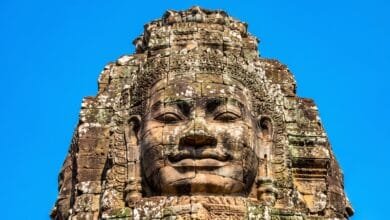
- Angkor Thom and Bayon: The ancient capital city with the famous face towers. About 1.5 km north of Angkor Wat.
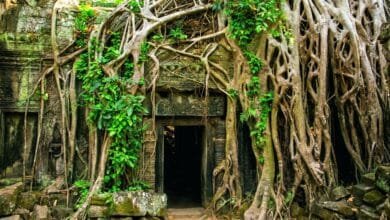
- Ta Prohm: The temple with tree roots growing through the ruins. About 4 km east of Angkor Thom.
- Banteay Kdei: A quieter temple with a similar atmosphere to Ta Prohm. Close to Ta Prohm.
- Phnom Bakheng: A hilltop temple with sunset views. About 2 km northwest of Angkor Wat.
Travel Tips
Buy your pass after 5 PM the day before. A pass purchased after 5 PM activates immediately and is valid through the entire following day. This lets you skip the early morning queue at the ticket office.
Bring small US dollar bills. The ticket office and many vendors prefer cash. Credit cards are accepted online but not always on-site.
Wear sturdy shoes. Temple stones can be slippery, especially during the rainy season. Flip-flops are not ideal for the steep stairs.
Bring a flashlight if you plan to arrive for sunrise. The path from the entrance to the viewing area is dark.
Carry a rain poncho in the wet season. Umbrellas with sharp ends are not allowed inside the temple because they can damage the carvings.
Stay hydrated. There are few water vendors inside the temple area. Bring more water than you think you need.
Responsible Tourism
Angkor Wat is a sacred site and a UNESCO World Heritage property. Your behavior affects both the preservation of the temple and the experience of other visitors.
Do not touch the bas-reliefs. The oils from your hands can damage the stone over time.
Follow the dress code. It is not just a rule—it is a sign of respect for a living religious site.
Stay on marked paths. Walking on the grass or climbing on ruins damages the site.
Do not buy from unofficial vendors inside the temple. These are not permitted and the money does not support conservation.
Do not feed the monkeys. Human food harms them and changes their natural behavior.
Frequently Asked Questions
Is Angkor Wat the same as Angkor Archaeological Park?
No. Angkor Wat is one temple within the larger Angkor Archaeological Park. The park contains dozens of temples and covers about 400 square kilometers.
Can I visit Angkor Wat without a guide?
Yes. Many visitors explore on their own. However, a guide can explain the history, architecture, and carvings in detail. Guides typically cost US$20–$25 per day.
What should I wear to Angkor Wat?
Clothing that covers your shoulders and knees. Light, loose, breathable fabrics are best for the heat. Avoid tank tops, short shorts, and very tight clothing.
Is sunrise at Angkor Wat worth it?
Sunrise is a popular experience, but it requires arriving before 5 AM and dealing with crowds. If you want a quieter visit, consider late afternoon instead. The temple is open until 5:30 PM.
Can I climb the upper level (Bakan)?
Yes, if you meet the requirements. Only 100 people are allowed at a time. Children under 12, pregnant women, and people with heart conditions are not permitted. The stairs are steep and there are no handrails.
How much time do I need at Angkor Wat?
Two to three hours is enough for most visitors. Four hours allows a more relaxed pace.
What is the best time of year to visit?
November to February offers the best weather. May to October is quieter and greener but can be very hot and humid.
Conclusion
Angkor Wat is more than a tourist attraction. It is a 900-year-old statement about power, faith, and the universe, carved in stone by a civilization that once dominated Southeast Asia.
For travelers, the temple offers a chance to see one of humanity’s greatest architectural achievements up close. The bas-reliefs tell stories that have survived centuries. The towers still rise above the jungle the way they did when they were built. And the temple remains a living place of worship, not just a monument to the past.
Angkor Wat fits naturally into any Cambodia itinerary. It is the centerpiece of the Angkor Archaeological Park, and most travelers combine it with nearby temples like Bayon, Ta Prohm, and Banteay Srei. Whether you come for the sunrise, the history, or the sheer scale of the place, Angkor Wat delivers something that few other sites in the world can match.
Before you go, check the current ticket prices, opening hours, and any restoration closures. These details change, and a little preparation makes the visit smoother. Bring water, dress respectfully, and give yourself time to look slowly. The temple rewards patience.