Ta Prohm Temple: A Visitor’s Guide to Cambodia’s Jungle Temple
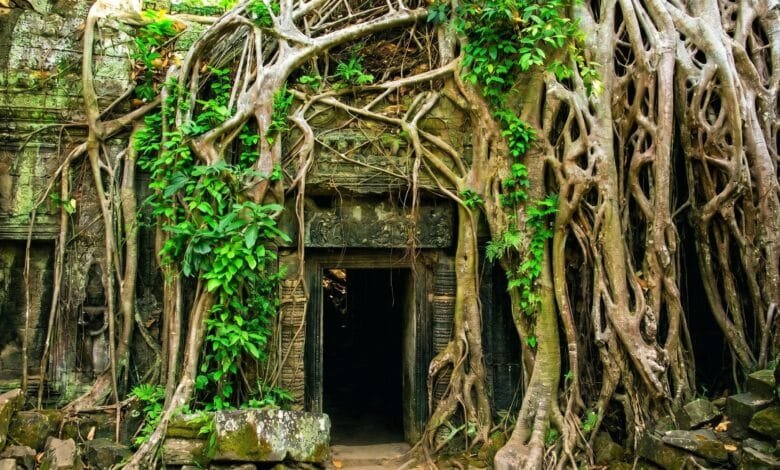
Ta Prohm temple was once a busy Buddhist monastery city. More than 12,500 people lived and worked here, including 18 high priests and 615 dancers. Today, giant tree roots wrap around its stone walls, and the jungle has become part of the architecture. It is one of the most photographed temples in Cambodia, but it is also one of the most historically interesting.
This guide explains what Ta Prohm is, why it matters, and what you should know before you visit. Whether you are planning your first trip to Angkor or returning to see it more slowly, understanding Ta Prohm’s history will change how you experience it.
Quick Travel Information
| Information | Details |
|---|---|
| Location | Angkor Archaeological Park, Siem Reap Province, Cambodia |
| Site Type | Buddhist temple monastery (ancient city complex) |
| Historical Period | Late 12th century, dedicated 1186 AD |
| Built By | King Jayavarman VII |
| Original Name | Rajavihara (Royal Monastery) |
| Religious Tradition | Mahayana Buddhism |
| Heritage Status | Part of the Angkor UNESCO World Heritage Site (inscribed 1992) |
| Known For | Giant tree roots growing over and through temple ruins; “Tomb Raider” filming location |
| Entrance | Included in Angkor Pass |
| Opening Hours | 7:30 AM – 5:30 PM daily (verify current hours before visiting) |
| Angkor Pass Prices | 1-day: $37 USD; 3-day: $62 USD; 7-day: $72 USD (verify current prices) |
| Recommended Visit Time | 1.5 to 2 hours |
| Dress Code | Shoulders and knees covered; respectful temple attire |
Prices and hours can change. Always check with the official Angkor Enterprise or APSARA National Authority before your visit.
What Is Ta Prohm?
Ta Prohm is an ancient Buddhist temple monastery inside the Angkor Archaeological Park in Siem Reap Province, Cambodia. It was built in the late 12th century under King Jayavarman VII and dedicated in 1186 AD . Its original name was Rajavihara, which means “royal monastery” .
Unlike many temples at Angkor that were cleared and restored, Ta Prohm was left largely in the condition in which French archaeologists found it in the early 20th century. They decided to leave it as a “concession to the general taste for the picturesque,” according to pioneering Angkor scholar Maurice Glaize .
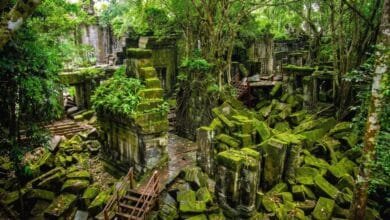
The result is a temple where nature and architecture are inseparable. Silk-cotton trees and strangler figs have grown over the walls, through doorways, and across galleries. Their roots have become part of the structure itself.
Why Is Ta Prohm Important?
Ta Prohm matters for several reasons.
First, it was one of the first major temples built by Jayavarman VII after he became king. It was part of a massive construction program that also included Preah Khan, Bayon, and other monuments .
Second, it was not just a temple. It was a functioning city. The temple’s stele — a stone inscription that records its founding — states that the site housed more than 12,500 people, including 18 high priests and 615 dancers. An additional 80,000 people lived in surrounding villages and worked to provide services and supplies .
Third, Ta Prohm was dedicated to the king’s mother. The temple’s main image represented Prajnaparamita, the Buddhist personification of wisdom, and was modeled on Jayavarman VII’s mother . This makes it a rare example of a major state temple built as a memorial to a woman.
Fourth, Ta Prohm’s conservation approach is unique. While other temples were restored to their original form, Ta Prohm was intentionally left to show how nature interacts with ancient architecture. This decision has made it one of the most atmospheric and popular temples in the park.
The History of Ta Prohm
King Jayavarman VII ruled the Khmer Empire from approximately 1181 to 1220 AD. After taking the throne, he began a large-scale building program that included temples, roads, rest houses, and hospitals across his kingdom.
Ta Prohm was consecrated in 1186 AD, just five years after Jayavarman VII became king. The stele inscription records this date and describes the temple’s purpose, its staff, and its wealth. According to the inscription, the temple owned gold, pearls, silks, and other valuable goods .
The temple continued to receive additions and modifications into the late 13th century, during the reign of King Srindravarman . After the fall of the Khmer Empire in the 15th century, Ta Prohm was abandoned. The jungle slowly took over. Trees grew from the loosened stones, and their roots spread across the walls and through the corridors.
In the early 20th century, when French archaeologists began conservation work at Angkor, they chose to leave Ta Prohm largely as they found it. They stabilized the ruins and cleared some vegetation, but they did not try to remove the trees or restore the temple to its original state.
Today, Ta Prohm is under the protection of the APSARA National Authority, which manages the Angkor Archaeological Park. Conservation work is ongoing, including a project to restore the South Gate, which began in early 2023 and is expected to be completed by the end of 2026 .
Architecture and What to Look For
Ta Prohm is a large, complex temple with multiple enclosures, galleries, towers, and satellite shrines. It was built mostly of sandstone and laterite.
The temple has four main enclosures. The outermost wall is about 1 kilometer by 650 meters. Inside, there are long galleries, small shrines, and a central sanctuary. The layout follows the standard Khmer temple plan, with the main sanctuary at the center and progressively smaller enclosures around it.
One of the most distinctive features of Ta Prohm is the “Hall of Dancers.” This is a rectangular hall with apsara carvings — celestial dancers — on the walls. The carvings are delicate, and many are partially covered by tree roots .
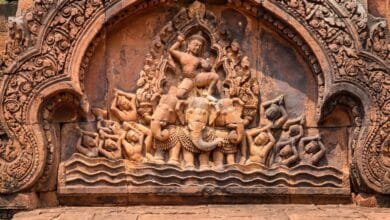
The temple’s towers and gopuras (entrance gateways) have carvings of Buddhist and Hindu figures. Lintels — horizontal stone beams above doorways — show scenes from mythology. Some of these carvings are well-preserved, while others have been worn by time and weather.
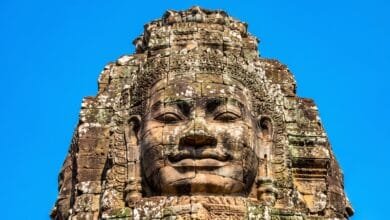
The western entrance is the main gate for visitors today. It has a large gopura with faces carved on it, similar to the gates at Bayon . The eastern entrance is also open and is currently under restoration.
Carvings, Sculptures and Stories
Ta Prohm’s carvings are less elaborate than those at some other temples, but they are still worth looking for. The apsara carvings in the Hall of Dancers are among the most notable. These celestial figures are shown in various poses, and some are still quite sharp despite centuries of exposure.
There are also carvings of Buddhist figures, including seated Buddhas and bodhisattvas. Some of these were defaced during later periods when the state religion changed from Buddhism to Hinduism, but many remain.
One unusual feature that visitors often look for is the “dinosaur” carving. There is a small relief on a stone pillar that some people say looks like a stegosaurus. Historians debate whether this is an ancient carving or a more recent addition, and some say it may simply be a decorative pattern that resembles a dinosaur . It is a fun detail to find, but it is not a major archaeological feature.
Cultural and Religious Meaning
Ta Prohm was built as a Mahayana Buddhist monastery. Its main purpose was to serve as a place of worship, study, and religious practice. The temple was also a memorial to the king’s mother, and it housed monks, teachers, and ritual specialists.
The stele inscription tells us that the temple was home to 18 high priests, 615 dancers, and more than 12,500 people in total . This shows that Ta Prohm was not just a temple but a community — a religious city with its own economy, staff, and daily life.
Today, Ta Prohm is no longer an active religious site in the same way. It is a protected heritage monument and a tourist destination. However, it remains an important symbol of Khmer civilization and Buddhist heritage. For Cambodians, it is a reminder of the country’s ancient past and the achievements of the Khmer Empire.
What Visitors Can See
When you visit Ta Prohm, you will see a complex of stone ruins with trees growing over and through the structures. The most famous features are the giant silk-cotton and strangler fig trees whose roots have wrapped around walls, doorways, and galleries.
The “Tomb Raider Tree” is one of the most photographed spots. It is located near the west gate, and its roots form a large arch over a doorway . Another popular spot is the “Crocodile Tree,” whose roots spread over a gallery roof in a shape that some say resembles a crocodile’s tail .
The Hall of Dancers is another highlight. It has a row of apsara carvings that are partially covered by roots. The light in this area is often soft and good for photography, especially in the morning.
You will also see the central sanctuary, which is mostly ruined, and several smaller shrines and galleries. Some of these have carvings and inscriptions that are still visible.
What the Visit Is Like
Walking through Ta Prohm is an experience of uneven surfaces, tree roots, and stone blocks. The paths are often narrow, and some areas require stepping over roots or through low doorways. The ground can be slippery when it is wet, so comfortable shoes with good grip are important.
The temple is mostly outdoors, and there is some shade from the trees. However, Cambodia is hot and humid for much of the year, so bring water and take breaks. The site can be crowded, especially in the morning and around midday. Early morning and late afternoon are usually quieter.
Photography is allowed, but there are restrictions in some areas. Flash photography is discouraged in dark chambers where bats live . You should also be careful not to touch the carvings or the tree roots, as the oils from your skin can damage them over time.
There are wooden walkways in some parts of the temple to protect the roots and the ruins. Stay on these paths and follow any signs or ropes that mark off restricted areas.
How to Get There
Ta Prohm is located inside the Angkor Archaeological Park, about 3 kilometers northeast of Angkor Wat and about 1 kilometer east of Angkor Thom . The western entrance is the main gate for visitors today, and it is reached by sealed roads.
Most visitors get to Ta Prohm by tuk-tuk, car, or organized tour from Siem Reap. The drive from Siem Reap city takes about 20 minutes by car . Ta Prohm is part of the “Small Circuit,” a popular route that also includes Angkor Wat, Bayon, and other major temples.
You can hire a tuk-tuk driver for the day to take you around the Small Circuit. Many drivers know the temples well and can suggest the best order to visit them. A licensed guide can also be hired for a more detailed explanation of the history and architecture.
How to Visit
Entry to Ta Prohm is included in the Angkor Pass. You do not need a separate ticket. The Angkor Pass can be purchased at the official Angkor Enterprise ticket office. As of 2026, prices are $37 USD for a 1-day pass, $62 USD for a 3-day pass, and $72 USD for a 7-day pass . These prices can change, so verify current rates before you travel.
Ta Prohm is open from 7:30 AM to 5:30 PM daily . However, opening hours can change, and some areas may be closed for restoration. Check the current hours with the APSARA National Authority or Angkor Enterprise before your visit.
Dress respectfully. Cover your shoulders and knees. This is a religious heritage site, and modest clothing is expected. Sarongs are sometimes available for rent near the entrance, but it is better to come prepared.
Follow all posted rules. Do not touch carvings or tree roots. Do not climb on the ruins. Stay on marked paths. Do not litter. These rules help protect the temple for future visitors.
Best Time to Visit
The best time to visit Ta Prohm depends on what you want to see. The dry season, from November to February, has clear skies and cooler temperatures. The roots are more visible because there is less vegetation. However, this is also the busiest time of year.
The wet season, from June to October, brings lush green vegetation and dramatic clouds. The temple is less crowded, but the paths can be muddy and slippery. Some areas may be more difficult to access.
If you want to avoid crowds, arrive early in the morning when the temple opens at 7:30 AM. The light is also good for photography at this time. Alternatively, visit after 3 PM when many tour groups have left .
How Long to Spend
Most visitors spend about 1.5 to 2 hours at Ta Prohm. This is enough time to walk through the main areas, see the famous trees, and take photographs. If you are interested in the carvings and history, you may want to spend more time.
If you are short on time, you can see the highlights in about an hour. But rushing through Ta Prohm misses the point. The temple is best experienced slowly, with time to sit and look.
Nearby Places to Combine With the Visit
Ta Prohm is part of the Small Circuit, so it is easy to combine with other nearby temples.
- Ta Keo: About 800 meters west of Ta Prohm, this is a large mountain temple that was never completed. It has a steep staircase and good views from the top .
- Banteay Kdei: About 1 kilometer south of Ta Prohm, this is a Buddhist monastery temple with a similar layout but fewer crowds.
- Srah Srang: About 1.2 kilometers south, this is a large reservoir with a landing platform. It is a good place to watch the sunset.
- Angkor Thom and Bayon: About 1 kilometer west, these are major sites with the famous face towers and the Terrace of the Leper King.
Travel Tips
- Bring water. The temple is hot, and there are no shops inside.
- Wear comfortable shoes with good grip. The paths are uneven and can be slippery.
- Bring a flashlight or use your phone light for dark chambers.
- Start early to avoid crowds and heat.
- Hire a guide if you want to understand the carvings and history. Guides are available at the entrance or can be arranged through your hotel.
- Respect the site. Do not touch carvings, do not climb on ruins, and do not remove any stones or objects.
- Be patient with crowds. Ta Prohm is popular, and some areas can get busy.
Responsible Tourism
Ta Prohm is a fragile heritage site. Your visit can help protect it if you follow a few simple guidelines.
Do not touch the carvings or the tree roots. The oils from your skin can accelerate erosion. Stay on the wooden walkways and marked paths. Do not climb on the ruins or enter roped-off areas. These rules are in place to protect both the temple and your safety.
Dispose of your waste properly. Do not leave plastic bottles or wrappers in the temple. Carry them out with you.
Be respectful of other visitors and of the site. Keep your voice low, and avoid blocking paths for long periods while taking photos.
If you hire a local guide or tuk-tuk driver, treat them with respect. They are part of the local community that helps protect and share this heritage.
Frequently Asked Questions
Is Ta Prohm the same as the Tomb Raider temple?
Yes. Ta Prohm was used as a filming location for the 2001 movie Lara Croft: Tomb Raider, starring Angelina Jolie. The temple’s jungle setting made it a natural fit for the film. It is often called the “Tomb Raider Temple” for this reason.
Do I need a separate ticket for Ta Prohm?
No. Entry to Ta Prohm is included in the Angkor Pass. You do not need a separate ticket.
How long does it take to visit Ta Prohm?
Most visitors spend 1.5 to 2 hours. You can see the highlights in about an hour, but a slower visit is more rewarding.
Is Ta Prohm accessible for people with mobility issues?
The temple has uneven paths, tree roots, and some narrow passages. It may be difficult for visitors with limited mobility. Some areas have wooden walkways, but the terrain is still challenging.
What should I wear to Ta Prohm?
Wear comfortable clothing that covers your shoulders and knees. This is a religious heritage site, and modest dress is expected. Comfortable shoes with good grip are also important.
Can I take photos at Ta Prohm?
Yes, photography is allowed. However, flash photography is discouraged in dark chambers where bats live. Be respectful of other visitors and do not block paths.
Is Ta Prohm still being restored?
Yes. Conservation work is ongoing. The South Gate restoration project began in early 2023 and is expected to be completed by the end of 2026. Other parts of the temple may also be under restoration at different times.
Conclusion
Ta Prohm is more than a temple. It is a place where history and nature meet in a way that is rare and powerful. It was built as a city of faith, home to thousands of people, and dedicated to a king’s mother. Today, it is a ruin, but a living one — its stones held together by the roots of ancient trees.
For a foreign traveler, Ta Prohm offers a different kind of experience from the grand scale of Angkor Wat or the carved faces of Bayon. It is quieter, more intimate, and more mysterious. It rewards slow walking and careful looking.
If you are planning a trip to Siem Reap, Ta Prohm should be on your list. It fits easily into the Small Circuit and pairs well with nearby temples. Give yourself time to sit, watch, and listen. The temple will stay with you long after you leave.
Before you go, check the current opening hours, ticket prices, and any restoration closures. Information can change, and a little preparation will make your visit smoother.