DOs and DON’Ts in Cambodia: What First-Time Visitors Should Know
Most Cambodians will smile and forgive a foreigner’s mistake. But some mistakes are harder to overlook than others — and a few can get you refused entry to a temple or leave someone quietly offended without you ever realizing it.
Knowing the basic DOs and DON’Ts of Cambodian culture is not about being perfect. It is about showing that you care enough to try. This guide covers the practical rules that matter most for foreign travelers, with clear explanations of why each one exists.
Cambodians are famously warm and patient with visitors. A little effort goes a long way. Here is what you actually need to know.
Quick Travel Information
| Information | Details |
|---|---|
| Topic | Cultural etiquette and social rules for foreign travelers |
| Best For | First-time visitors to Cambodia |
| Applies To | Temples, markets, streets, restaurants, transport, and private homes |
| Main Thing to Know | The two most important rules: don’t touch heads, don’t point feet. Cover shoulders and knees at temples. |
| What to Prepare | A light scarf or sarong for temple visits; small US dollar bills for tips and small purchases |
| Important Warning | Women must never touch monks or hand them items directly. This is strictly observed. |
| Official Source | Tourism Cambodia; Ministry of Cults and Religion |
The Cambodian Greeting: Do This, Not That
The Sampeah — A Simple Gesture That Goes a Long Way
Cambodians traditionally greet each other with a gesture called the sampeah: palms pressed together in front of the chest, with a slight bow of the head. You will also hear the phrase “Chum Reap Suor,” which means hello.
The height of your hands matters. Hands at chest level are appropriate for peers. Hands at chin or nose level show more respect to elders. Hands at forehead level are reserved for monks and royalty.
You do not need to master this perfectly. But if you offer a sampeah when greeting someone — especially someone older — it is noticed and appreciated.
DO: Offer a slight bow with your palms together when greeting someone older or in a formal setting.
DO NOT: Worry if you get the height wrong. A simple smile and nod is never offensive.
Handshakes: When They Are OK
Handshakes are increasingly common in Cambodia, especially between men or in business settings. If a Cambodian man offers his hand, it is fine to shake it. With women, it is best to wait and see if she offers her hand first. If she does not, use the sampeah instead.
Temple Etiquette: The Rules That Are Strictly Enforced
What to Wear (and What Not to Wear)
This is where foreign travelers most often get it wrong. Cambodian temples are sacred places, and the dress code is not a suggestion. The Ministry of Cults and Religion has issued clear guidelines.
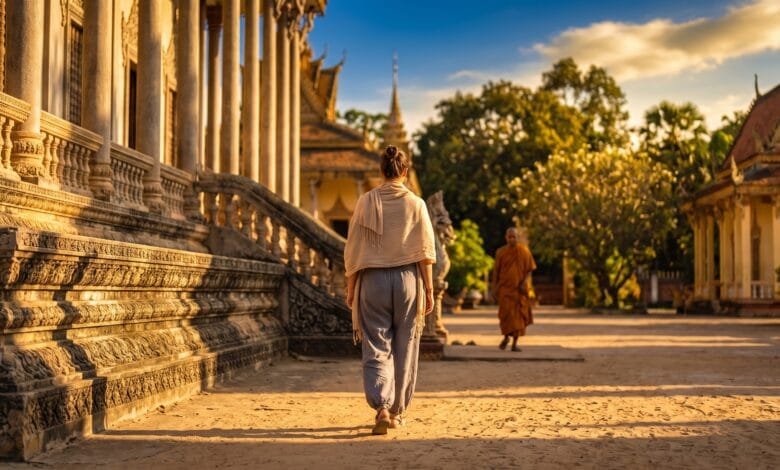
DO: Cover your shoulders and your knees. This applies to both men and women. A t-shirt and knee-length shorts or pants will usually be fine. For women, a skirt or trousers that cover the knees and a top that covers the shoulders are the safest choices.
DO NOT: Wear sheer tops, backless tops, spaghetti-strap tops, tank tops, or shorts or skirts above the knee. These are explicitly prohibited when paying respect to monks or Buddha statues, or when taking photographs inside temple grounds.
Many temple entrances sell or lend scarves and sarongs if you arrive unprepared. But it is easier to just pack a light scarf or sarong in your bag before you go.
Shoes, Hats, and Sacred Spaces
DO: Remove your shoes before entering any temple building, and remove your hat when you pass through the temple gate. This applies to pagodas, ordination halls, preaching halls, monks’ residences, and other sacred places.
The same rule applies when entering a Cambodian home. Your host may insist you keep your shoes on for comfort, but leaving them at the entrance is always appreciated.
Sitting and Pointing Inside Temples
If you sit on the floor inside a temple, do not sit cross-legged or with your legs stretched out. Sit on your heels, slightly to one side. If that becomes uncomfortable, shift to your other side.
Most importantly: never point your feet toward a Buddha image or a monk. This is considered deeply disrespectful.
How to Behave Around Monks
Women and Monks: The Touch Rule
This is one of the most important rules for female travelers. Buddhist monks in Cambodia are not allowed to touch women, and women are not allowed to touch them. This includes handing something directly to a monk.
DO: If you are a woman and want to offer something to a monk, place it within his reach on a table or surface. Or hand it to a male companion to pass along. You can also hold the object with a tissue or handkerchief.
DO NOT: Shake a monk’s hand, stand too close, or sit directly next to him on public transport.
This rule is strictly observed. It is not about you personally — it is about the monk’s vows.
Photography and Monks
DO: Ask permission before photographing a monk. Many monks are happy to chat and pose, especially if you show genuine respect.
DO NOT: Position yourself higher than a monk when taking a photo. Do not take photos during ceremonies without permission.
The Head and the Feet: Two Body Parts to Watch
Don’t Touch Anyone’s Head
In Cambodian and Buddhist culture, the head is considered the most sacred part of the body. Touching someone’s head — even a child’s — is offensive.
DO NOT: Pat a child on the head, ruffle someone’s hair, or touch anyone’s head for any reason.
Don’t Point Your Feet
The feet are considered the lowest and dirtiest part of the body. Pointing your feet at a person, a Buddha image, or a monk is a serious sign of disrespect.
DO NOT: Use your feet to point at someone or something, to get attention, or to push an object toward someone.
DO: When sitting on the floor, keep your feet tucked to the side or behind you.
Public Behavior: What Cambodians Consider Rude
Public Displays of Affection
Cambodian society is relatively conservative. Public displays of affection between men and women — such as kissing or hugging — are considered inappropriate and offensive. Holding hands is generally acceptable between friends of the same gender, but between men and women, it is frowned upon even for married couples.
DO NOT: Kiss, hug, or show physical affection with a partner in public.
Loud Voices and Anger
Cambodians value calm and composure. Raising your voice, shouting, or displaying anger in public is considered embarrassing and rude.
DO: Stay calm and patient, even when frustrated. A smile goes much further than a raised voice.
DO NOT: Shout, argue loudly, or lose your temper in public. This will not help you resolve anything and will make people uncomfortable.
The Monarchy and National Symbols
The King and the royal family are deeply respected in Cambodia. Criticizing or showing disrespect toward the monarchy is not acceptable and can have legal consequences.
DO: Stand when the national anthem plays — for example, in cinemas before a film. If you are in a public place and the anthem begins, follow what locals do.
DO NOT: Disrespect images of the King, the royal family, or national symbols. Do not climb on monuments or statues for photos.
Photography: Ask First, Always
DO: Ask permission before photographing anyone, especially monks, the elderly, and people at religious sites. A simple gesture — pointing to your camera and raising your eyebrows — works if you do not share a language.
DO NOT: Treat memorial sites like photo backdrops. At Tuol Sleng Genocide Museum and the Killing Fields, follow the signage and maintain a respectful demeanor. These are places of remembrance, not selfie spots.
Tipping and Money: What Is Expected
Tipping in Cambodia is not mandatory, but it is increasingly common in tourist areas and is appreciated as a supplement to income.
DO: Tip in US dollars. US dollars are widely accepted in Cambodia, and small bills are useful.
- Guides: $7–10 per day for a good job
- Drivers: About two-thirds of what you give the guide
- Tuk-tuk drivers: $1–2 or round up to the nearest dollar
- Restaurants: 10% of the bill if you were satisfied
- Hotel staff: $1–2 for porters or housekeeping
DO NOT: Tip at street food stalls. It can cause confusion and is not expected.
DO NOT: Feel obligated to tip if service was poor. Tipping is discretionary.
Safety DOs and DON’Ts for Foreign Travelers
DO Keep Your Belongings Secure
The most common crime targeting tourists in Cambodia is opportunistic theft — snatch-and-grab robberies from passing motorbikes, pickpocketing in markets, and theft from open-air vehicles like tuk-tuks.
DO: Keep your phone, camera, and bag out of sight when riding in a tuk-tuk. Hold your bag on the side furthest from the street when walking.
DO NOT: Wear expensive jewelry or carry large amounts of cash in visible pockets.
DO NOT Escalate a Robbery
If someone attempts to rob you, surrender your valuables immediately. Resisting can lead to violence. The U.S. Embassy has reported that robberies can escalate into fatalities when victims resist.
Common Tourist Scams to Know
DO: Be aware of the phone scam. A tuk-tuk driver may ask to use your phone for navigation, then pretend to drop it. When you get out to recover it, you find it is a fake phone and the driver has taken yours.
DO NOT: Accept unsolicited help with your bags at bus stations or airports unless you are prepared to pay for it.
DO NOT: Believe anyone who claims to be from your embassy and needs your financial information. The U.S. Embassy advises citizens to be wary of scams involving individuals claiming they are in Cambodia and need financial assistance from the United States.
Responsible Travel DOs and DON’Ts
DO: Support local businesses, use licensed guides where appropriate, and respect park rules at nature sites.
DO: Reduce single-use plastic where you can. Cambodia faces significant plastic waste challenges, and travelers can help by carrying a reusable water bottle and refusing unnecessary plastic bags.
DO NOT: Buy or export souvenirs made from endangered species. It is illegal and contributes to wildlife trafficking.
DO NOT: Photograph children without permission or give money to begging children, as this can discourage school attendance.
Frequently Asked Questions
Do I need to bow when greeting someone in Cambodia?
A slight bow with your palms pressed together (the sampeah) is the traditional greeting. It is not required of foreign travelers, but it is appreciated. A smile and a nod are never offensive.
Can women talk to monks in Cambodia?
Yes, women can talk to monks respectfully, but they should not touch a monk or hand something directly to him. Place items within reach or hand them to a male companion.
What happens if I wear shorts to Angkor Wat?
You may be refused entry to certain temples, especially the upper level of Angkor Wat. The dress code requires covered shoulders and knees. Many vendors near the entrance sell scarves and trousers, but it is better to dress appropriately from the start.
Is it rude to take photos of people in Cambodia?
Not if you ask first. Most Cambodians are happy to be photographed if you show respect. Do not take photos of monks or people at religious sites without permission.
How much should I tip a tuk-tuk driver in Cambodia?
$1–2 or round up to the nearest dollar is standard. If the driver waited for you or helped with luggage, $3–5 is generous.
Do I need to remove my shoes everywhere in Cambodia?
You remove your shoes before entering temples and private homes. It is not necessary in shops, restaurants, or hotels, unless the owner asks.
What is the biggest mistake tourists make in Cambodia?
The most common mistake is ignoring temple dress codes. The second most common is touching someone’s head or pointing feet at people without realizing it.
Conclusion
Cambodian culture is built on respect, calm, and modesty. The rules in this guide are not about restriction — they are about showing that you are a considerate guest.
The two rules that matter most are simple: never touch anyone’s head, and never point your feet at people or sacred images. If you remember nothing else, remember those.
For temple visits, cover your shoulders and knees, remove your shoes and hat, and behave quietly. For interactions with monks, especially if you are a woman, keep a respectful distance and never pass items directly to them.
Cambodians are forgiving of honest mistakes. A smile, a calm voice, and a genuine effort to show respect will carry you much further than getting every detail perfectly right. Travel with curiosity and courtesy, and you will find that Cambodia rewards you with warmth and openness in return.
Travel information can change. Check the latest information with the relevant official source before your trip, especially for visas, transportation, opening hours, prices, border crossings, and local regulations.