Why Respect for Elders Matters in Khmer Culture
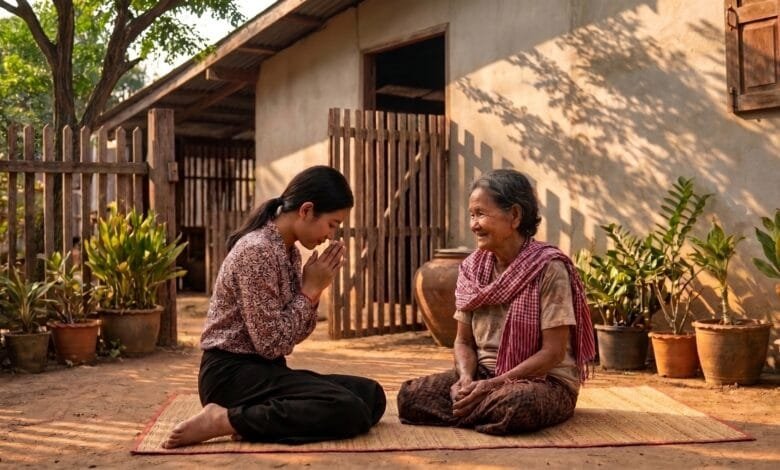
You might notice it the moment you sit down at a family-run restaurant in Siem Reap. A grandmother arrives, and the entire table shifts. Someone brings her the best chair. A younger family member pours her tea first. When she speaks, everyone listens.
Or you might see it on a quiet street in Battambang, where a teenager presses his hands together and bows his head slightly as an older neighbor passes by. The gesture takes less than two seconds. It says everything about how Khmer culture understands respect.
For a foreign visitor, these moments can feel unfamiliar. They may even seem formal or distant. But once you understand what is happening, you begin to see the quiet architecture of Khmer society — a set of values that shapes everyday life, family relationships, and even the way people speak.
What Is Respect for Elders in Khmer Culture?
Respect for elders in Khmer culture is more than a good habit. It is a core social value that determines how people relate to one another across age, status, and family.
In Khmer society, all relationships are organized hierarchically. Age is one of the most important markers of status — often more important than gender. People use kinship terms that reflect age: a sibling is either an “older sibling” or a “younger sibling.” Even strangers are addressed with age-appropriate family terms. A cyclo driver might be called “uncle.” A young waitress might be called “younger sister”.
This is not just about politeness. It is a way of seeing the world — one in which everyone has a place, and that place comes with obligations and expectations.
Why Does It Matter in Khmer Culture?
The roots of this tradition run deep into Buddhist belief. In Khmer society, a person’s status is understood as a reflection of merit accumulated in previous lives. A high-ranking person — including an elder — is seen as someone full of merit, and therefore someone who deserves respect and care.
Across Buddhist-majority countries in Asia, this view is widely held. In Cambodia, at least eight-in-ten Buddhists say that you cannot be truly Buddhist if you do not respect elders — one of the highest proportions in the region.
But the tradition is not only religious. It is also deeply practical. Before the country was torn apart by war in the 1970s, older people held a secure and respected place in village life. Old age was expected to be a time of relative leisure, with elders taking on lighter tasks and devoting more time to the temple and to making merit. Parents could count on their children to care for them in their later years.
That social contract was shattered during the Khmer Rouge period, when traditional hierarchies were dismantled and older people were targeted. After the regime fell, many older Cambodians observed that respect and good behaviour among the young had been severely undermined. The effort to restore these traditions is, for many Cambodians, part of rebuilding their culture.
How Is the Tradition Practiced?
You can see respect for elders in almost every aspect of Khmer daily life.
The Sampeah: The most visible expression is the sampeah, a gesture in which a person presses their palms together in a prayer-like position and bows slightly. The height of the hands and the depth of the bow communicate different levels of respect. For peers, the hands are held at chest level. When greeting elders, the hands are raised to the mouth or nose. For monks and the King, the hands reach the eyebrows.
The sampeah is used for greeting, saying goodbye, thanking, and apologizing. Returning the gesture is expected. Not doing so is considered very impolite.
Language: The Khmer language itself encodes hierarchy. Pronouns change depending on who is speaking to whom, and even common verbs like “to eat” have different forms for different social relationships. Younger people speak softly to elders and avoid disagreeing with them openly.
Body Language: When walking in front of an elder, a person bows slightly from the waist. When sitting, younger people avoid crossing their legs in the company of elders. When talking to an elder, they remove their hat and keep their hands out of their pockets. Direct eye contact with elders is often avoided as a sign of respect — which can be confusing for Westerners who may misread this as dishonesty.
Care Obligations: Respect extends beyond gestures. Adult children are expected to care for their aging parents. This is seen as repaying the moral debt owed to parents for giving life and raising them. In rural Cambodia, multigenerational households are common, with grandparents playing an active role in raising grandchildren.
What Does a Visitor See in Cambodia?
As a traveler, you will likely encounter this tradition in several ways.
At a family-run guesthouse or restaurant, you might notice that the oldest person is served first. In a temple, you might see younger people making way for elders or bowing as they pass. In a market, you might hear a vendor call a customer “older sister” or “uncle” — even if they have never met before.
If you are introduced to a Cambodian family, you may be offered a seat near the eldest person, or you may see younger family members deferring to you more than you expect. This is not because they see you as a superior. It is because age is automatically associated with status and respect.
You may also notice that younger Cambodians are often reluctant to correct or contradict older people, including visitors. They may smile and nod even when they disagree. This is a form of politeness, not dishonesty.
What Should Foreign Visitors Know?
You do not need to master Khmer etiquette to travel respectfully in Cambodia. But a few simple understandings can go a long way.
Learn the sampeah. If someone greets you with a sampeah, returning the gesture — palms together at chest level, with a slight bow — is a respectful response. You do not need to raise your hands as high as a Cambodian would to an elder; the gesture itself shows that you are trying.
Show patience and deference. If you are in a situation where an older person is present, let them speak first, let them sit first, and let them be served first. These small actions signal that you understand what matters in Khmer culture.
Avoid physical contact with elders of the opposite sex. In traditional Khmer culture, physical affection between men and women in public — especially involving elders — is not common. A warm smile and a respectful sampeah are more appropriate.
Be mindful of body language. When sitting in the company of elders, avoid crossing your legs. If you are walking in front of an older person, a slight bow is a thoughtful gesture. Remove your hat when entering a temple or speaking with an elder.
Ask before photographing. Elders are often the most respected members of a community. If you want to take a photograph, asking permission first is both polite and culturally aware.
How Has the Tradition Changed?
Respect for elders in Cambodia remains strong, but it is adapting to modern life.
Migration and urbanization are changing family structures. As younger Cambodians move to cities or abroad for work, the traditional expectation that children will live near their aging parents is harder to maintain. Many older people now care for grandchildren while their adult children work elsewhere.
The Cambodian government has responded by codifying elder care obligations into law and promoting awareness through International Day of Older Persons each October. In 2025, Prime Minister Hun Manet called on the private sector and NGOs to establish care centres for senior citizens, recognizing that traditional family structures cannot always provide all the support that is needed.
For Cambodians living abroad, including in the United States, elder reverence remains an essential cultural value. Research on Cambodian refugee families in the U.S. shows that they have retained what they consider essential aspects of their culture — including filial piety and respect for elders — while adapting to new circumstances.
For travelers, this means that the tradition you observe in Cambodia today is not a relic of the past. It is a living value that continues to shape how people relate to one another, even as the country changes.
Frequently Asked Questions
Should I bow when I meet an older Cambodian person?
If someone greets you with a sampeah — palms pressed together with a slight bow — you can respond with the same gesture. Your hands do not need to be as high as theirs. A simple sampeah at chest level with a small bow is respectful and appreciated. If you are unsure, watch how others respond and follow their lead.
What should I do if an elder offers me something, like food or a seat?
Accept it graciously. In Khmer culture, offering something to a guest or a younger person is a gesture of care. Refusing can be seen as impolite. If you truly cannot accept, do so gently and with thanks.
Can I take photos of elderly Cambodians?
Yes, but ask first. A simple gesture — pointing to your camera and then to them, with a questioning look — is usually enough. Many people are happy to be photographed, but asking shows respect and allows them to decline if they prefer.
What if I accidentally do something disrespectful?
Cambodians are generally understanding with foreign visitors who make cultural mistakes. If you realize you have done something inappropriate, a simple apology and a respectful attitude will usually smooth things over. The effort to understand and respect the culture matters more than perfect execution.
Do young Cambodians still follow these traditions?
Yes, but in varied ways. In rural areas and within families, traditional practices are often more strictly observed. In urban settings, some practices have adapted — handshakes are more common between men, for example — but respect for elders remains a strong cultural value across generations.
Is respect for elders the same in all parts of Cambodia?
The value is consistent throughout Cambodia, but the ways it is expressed can vary. Rural communities tend to maintain more traditional practices, while urban areas may show more flexibility in daily interactions. However, even in cities like Phnom Penh, the underlying respect for elders remains evident.
Conclusion
Respect for elders in Khmer culture is not a rule you learn from a guidebook. It is a way of being in the world — a recognition that age carries wisdom, that family carries obligation, and that society works best when everyone knows their place within it.
For foreign travelers, understanding this tradition opens a door. It helps you interpret the gestures and words you see around you. It gives you a way to respond that feels natural and respectful. And it deepens your appreciation for a culture that has endured enormous upheaval yet holds fast to the values that bind generations together.
The next time you see a young Cambodian press their hands together and bow to an elder, you will know what it means. And perhaps you will offer a sampeah of your own.