What Happened to Tourism in Cambodia? A 2026 Update for Travelers
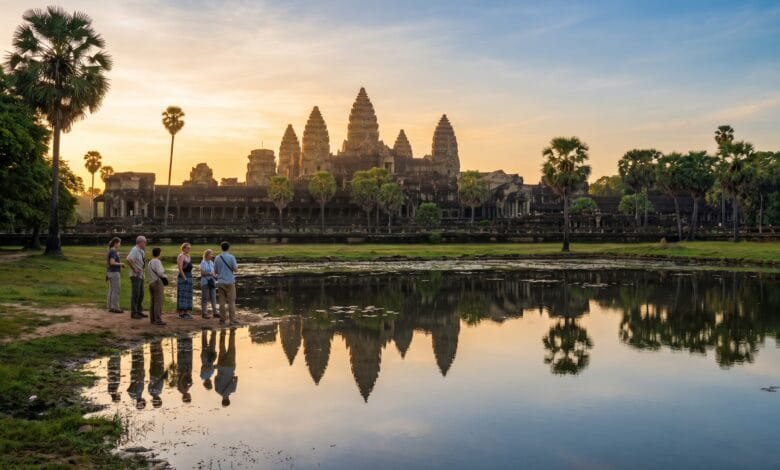
If you’ve searched for Cambodia travel advice lately, you’ve probably noticed something unusual: fewer people are talking about going. That’s not just a feeling. Cambodia welcomed 2.25 million international tourists in the first eight months of 2026 — a 44.4% drop from the 4.05 million during the same period in 2025.
For a country whose tourism industry depends heavily on international visitors, that’s a significant shift. But what does it actually mean if you’re thinking about visiting? And what does it look like on the ground?
Here’s what happened, what’s changing, and what it means for your trip.
What Is Changing in Cambodia’s Tourism?
The short answer: a lot, and quickly.
International arrivals aren’t just slightly down — they’ve fallen by nearly half in a single year. The Ministry of Tourism recorded 2,252,698 foreign visitors from January to August 2026. In the same period in 2025, that number was over 4 million.
The decline is spread across nearly every major source market. Chinese arrivals dropped 25%, Vietnamese visitors fell 28%, and American arrivals — travelers from the US — declined 7.3%.
But the most dramatic change involves Thailand. Thai tourists have almost completely disappeared from the equation. In the first eight months of 2025, 962,400 Thai nationals visited Cambodia. In the same period in 2026, that number collapsed to 47,800 — a 95% drop.
The reason? The land border between Cambodia and Thailand has been closed, cutting off the traditional overland route that once brought nearly a million visitors a year.
Why Is This Happening?
Several factors have combined to create this downturn.
Border closures with Thailand. Thailand has historically been a key gateway to Cambodia. Many travelers would fly into Bangkok, spend time in Thailand, then cross by land into Cambodia. With all land border crossings closed, that flow has essentially stopped.
Regional tensions and security concerns. Two rounds of armed clashes along the Cambodia-Thailand border in late 2025 affected traveler confidence, particularly in Siem Reap and Battambang — provinces closest to the border. News coverage of these events, combined with international media attention on online scam operations in the region, created what tourism officials describe as a “perception gap” between what headlines suggest and what visitors actually experience.
Global economic pressures. The Ministry of Tourism has cited the global economic crisis and rising fuel prices as additional factors discouraging international travel to the region.
Reduced flight connectivity. The return of Chinese tourists — Cambodia’s largest source market — has been slower than expected. Industry analysts point to reduced flight connectivity and high travel costs, along with limited Chinese-language support and inconsistent service quality in some tourism businesses, as ongoing constraints.
What Does It Look Like in Everyday Cambodia?
For travelers who do visit, the effects are visible.
In Siem Reap, the gateway to Angkor Wat, tour guides who once worked 20 days a month are now struggling to find even four or five days of work. The Angkor Archaeological Park sold 474,993 tickets in the first eight months of 2026, down 29% from the previous year.
Phnom Penh received about 1.14 million international visitors in the same period, a 15.3% decline. Siem Reap saw a 29% drop. Sihanoukville was the only major destination to grow — international arrivals there rose 9% to 301,000.
But there’s another side to the story. Domestic tourism has surged. Cambodians themselves took 25.65 million domestic trips in the first eight months of 2026 — a 48.5% increase. At Angkor, at beaches in Kampot and Kep, and at ecotourism sites across the country, you’re now more likely to encounter Cambodian families on holiday than foreign tour groups.
That changes the atmosphere. Quieter temples. Less crowded viewpoints. And a tourism sector increasingly focused on serving the domestic market while it waits for international visitors to return.
What Might Travelers Notice?
If you visit Cambodia in 2026 or early 2027, here are a few things you may observe:
- Fewer people at major sites. Angkor Wat at sunrise is still busy, but the crowds are noticeably thinner than pre-pandemic years. Bayon, Ta Prohm, and Banteay Srei may feel almost intimate.
- Land border crossings with Thailand remain restricted. If your trip plan involves traveling overland between Thailand and Cambodia, you’ll need to check current conditions. The border closure has affected both direct arrivals and transit traffic.
- New airport infrastructure. Techo International Airport officially opened in September 2025, replacing Phnom Penh’s old airport. With a Phase 1 capacity of 15 million passengers per year and 29 airlines operating flights, it’s a significant upgrade for arrivals into the capital.
- Green Season promotions. Cambodia’s tourism authorities are actively promoting the rainy season (May–October) as the “Green Season,” with lower prices, discounted hotel rates, and special events designed to attract visitors during traditionally quieter months.
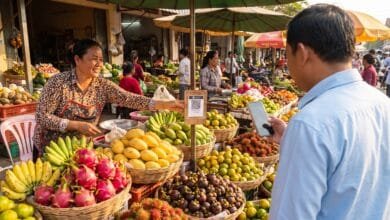
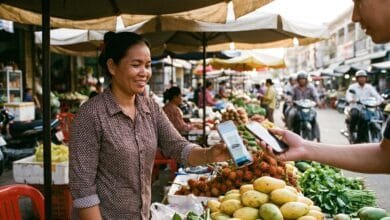
- A more domestic feel. Local travelers are filling the spaces that international tourists once occupied. Markets, restaurants, and attractions may feel more locally oriented — which can be a richer experience for travelers who want to see everyday Cambodia.
Why Does This Matter for Understanding Cambodia?
Cambodia’s tourism sector isn’t just about visitor numbers. It employs tour guides, drivers, hotel staff, restaurant workers, and small-scale vendors across the country. When arrivals drop by nearly half, those livelihoods are directly affected.
The government has responded by restructuring its approach. Tourism Minister Huot Hak has said the sector is diversifying beyond traditional heritage destinations like Angkor, expanding into ecotourism, community-based tourism, and wellness tourism. The Ministry of Tourism is working with the Ministry of Environment to develop nature-based tourism models that give local communities a greater share of tourism revenue.
The Asian Development Bank projects Cambodia’s economy will grow 3.9% in 2026, revised down from 4.1% because of weaker tourism. But the ADB also noted that manufacturing exports and investment inflows are helping offset the tourism slowdown.
For travelers, this context matters. Cambodia is not a country in crisis — it’s a country in transition. The tourism industry that emerges may look different from the one that existed before 2020.
What Makes This Interesting for Visitors?
Here’s the counterintuitive part: a tourism slowdown can actually make for a better trip.
Fewer crowds at Angkor mean more space to absorb the scale of the temples. Lower demand for hotel rooms in Siem Reap and Phnom Penh means better rates and more attentive service. And with the sector eager to attract visitors, you may find that tourism businesses are more flexible, more welcoming, and more willing to offer personalized experiences.
Beyond Angkor, Cambodia’s tourism offerings are expanding. Community-based ecotourism sites — like the Lèng Kao Waterfall in Mondulkiri, where the indigenous Phnong community welcomes visitors with homestays, traditional dance performances, and forest treks — offer a side of Cambodia that most travelers never see. The Cardamom Tented Camp in the Cardamom Mountains has reported measurable progress in rainforest protection and wildlife monitoring through its tourism-led conservation model.
The coastline in the southwest — Sihanoukville, Kampot, Kep, and Koh Kong — remains an underrated region, with 450 kilometers of coast offering beaches, islands, and seafood that rival better-known Southeast Asian destinations.
What Could Change Next?
Cambodia’s Ministry of Tourism has set a target of 5.6 to 5.8 million international visitors for 2026 — close to the 5.57 million recorded in 2025, though the first eight months of 2026 suggest that target may be difficult to reach.
Several developments could shift the trajectory:
- Visa policy experiments. The government tested a 14-day visa exemption for Chinese passport holders from June to October 2026. If successful, it could be extended or expanded to other markets.
- New air routes. Officials and airport investors have discussed adding direct flights from China, India, South Korea, the Middle East, and ASEAN markets, and offering airport service fee incentives for new routes.
- International events. Cambodia is scheduled to host the Equinox Festival, River Festival, Sea Festival, International Yoga Day, and the Francophone Summit in 2026 — all designed to showcase the country to international audiences.
- Ongoing scam crackdowns. The government deported more than 13,000 foreigners from 66 nationalities in 2025 for legal violations, many associated with online scam operations. Officials say these efforts are intended to rebuild international confidence in Cambodia as a destination.
These are plans and proposals, not guarantees. Travelers should verify current conditions before booking, especially if their itinerary involves land border crossings.
Frequently Asked Questions
Is Cambodia still worth visiting in 2026?
Yes. The temples, culture, food, and landscapes that make Cambodia special haven’t changed. If anything, fewer crowds make it an excellent time to visit. The main practical consideration is border access with Thailand.
Is it safe to travel to Cambodia right now?
Travel advisories vary by country. The incidents that affected tourism in 2025 were concentrated along the Cambodia-Thailand border. Major tourist destinations — Siem Reap, Phnom Penh, Sihanoukville, Kampot — have not been directly affected. As always, check your government’s current travel advice before booking.
Can I cross the border from Thailand to Cambodia by land?
As of September 2026, land border crossings between Cambodia and Thailand remain closed. Travelers should plan to fly into Cambodia from Bangkok or another regional hub.
Are hotels and tours cheaper because of the tourism decline?
In many cases, yes. Lower international demand has led to more competitive pricing in Siem Reap and Phnom Penh. The “Green Season” promotion (May–October) offers additional discounts and special events.
What is the Green Season in Cambodia?
The Green Season is Cambodia’s rainy season, roughly May through October. Tourism authorities are promoting it as an attractive travel period with lush landscapes, lower prices, and fewer visitors. Rain typically falls in short, intense bursts rather than all-day downpours.
Do I need a visa to visit Cambodia?
Most foreign visitors can obtain an e-visa online or a visa on arrival. As of January 2025, the e-visa fee for tourists was reduced to $30. The government has also experimented with visa exemptions for specific markets, including a 14-day exemption for Chinese passport holders from June to October 2026.
Conclusion
Cambodia’s tourism industry is navigating one of its most challenging periods in recent memory. International arrivals have dropped sharply, land borders with Thailand are closed, and the sector is working to rebuild confidence after a difficult 2025.
But here’s what the numbers don’t capture: Cambodia itself hasn’t changed. The temples are still standing. The food is still extraordinary. The coastline is still quiet and beautiful. And the people who work in tourism — the guides, the drivers, the guesthouse owners — are still welcoming visitors with the same warmth they always have.
If anything, this moment offers something rare. A chance to see Angkor without the crush of crowds. A chance to stay in a hotel that treats every guest like they matter. A chance to experience a country that is rediscovering what it has to offer beyond the postcard images.
Cambodia is not a destination in decline. It’s a destination in transition — and for travelers willing to look past the headlines, it may be more rewarding than ever.