What Does Cambodian Mangosteen Taste Like? A Traveler’s Guide
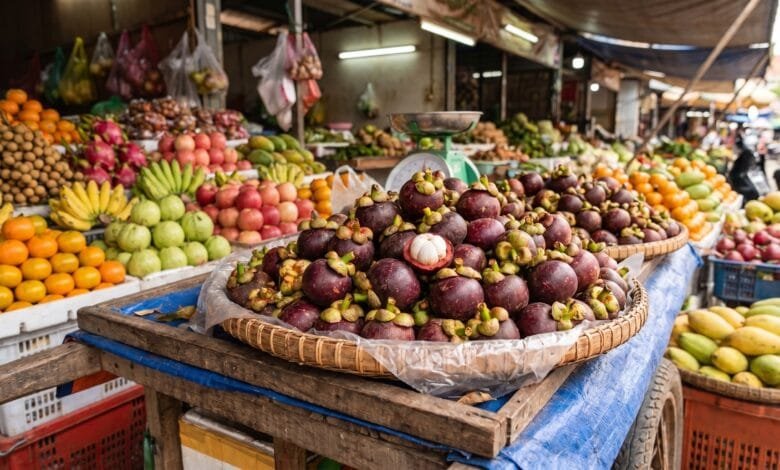
Mangosteen is one of the most talked-about fruits in Southeast Asia, yet many first-time visitors to Cambodia have never seen one. The fruit looks almost unreal — a smooth, dark purple sphere about the size of a small plum, with a thick shell that hides something completely different inside. Locals call it the “queen of fruits,” a title it earned for its delicate, sweet flavor and soft, creamy flesh. This guide explains what mangosteen tastes like, when you can find it in Cambodia, how to choose a good one, and how to eat it without making a mess.
What Is Mangosteen?
Mangosteen (Garcinia mangostana) is a tropical fruit native to Southeast Asia. In Khmer, it is called មង្ឃុត — pronounced “mong-khout.” It is sometimes written as “Meangkhout” in romanized Khmer.
Despite the name, mangosteen has nothing to do with mango. They are completely unrelated fruits. Mangosteen belongs to the Clusiaceae family, while mango belongs to the cashew family. The two fruits look nothing alike and taste nothing alike.
In Cambodia, mangosteen grows on a slow-growing evergreen tree that can reach 10 to 20 meters in height. The tree takes several years to produce fruit, which is one reason mangosteens are more expensive and seasonal than many other tropical fruits.
What Does Mangosteen Look Like?
From the outside, a mangosteen looks like a dark purple ball with a small, green leafy crown at the top. The outer shell — called the rind or pericarp — is thick, smooth, and leathery. A ripe mangosteen typically shows a deep reddish-purple to almost black color.
The rind is not edible. It is firm to the touch and may feel slightly soft when the fruit is perfectly ripe.
Inside, the fruit is a complete surprise. The white flesh is divided into four to seven segments, similar to how a tangerine is segmented. The largest segments may contain an almond-shaped seed. The flesh is pearly white, soft, and juicy — closer in texture to a ripe plum than a mango or banana.
The contrast between the tough purple shell and the delicate white interior is one of the most striking things about the fruit.
What Does Mangosteen Taste Like?
Mangosteen has a sweet, slightly tangy flavor that many people describe as a mix of lychee, peach, and strawberry. Some also detect a hint of citrus or pineapple.
The sweetness is mild and natural, not sharp or syrupy. There is a gentle tartness underneath that keeps the flavor from becoming too heavy. The aroma is light and floral.
The texture is what sets mangosteen apart. The flesh is soft, juicy, and delicate. It almost melts in your mouth — some describe it as similar to a well-ripened plum or even a light custard. It is not crunchy, fibrous, or stringy like some tropical fruits.
If you have never tried mangosteen before, the closest familiar comparison for many Western travelers would be a very soft lychee crossed with a mild peach. But mangosteen has its own distinct character — it does not taste exactly like anything else.
Ripe vs. Overripe Mangosteen
A perfectly ripe mangosteen is sweet and balanced. An overripe one can become slightly sour or fermented in flavor, and the flesh may turn yellowish or translucent. The rind of an overripe fruit may also ooze a yellow sap, which stains and is difficult to remove. Look for fruit that feels heavy and yields slightly when pressed — not hard, not mushy.
When Is Mangosteen in Season in Cambodia?
Mangosteen season in Cambodia generally runs from May to August, during the early months of the rainy season. The first heavy rains after the dry season trigger fruit development, and by June, local markets across the country are full of mangosteens.
Some sources note that mangosteen and rambutan seasons begin after Khmer New Year celebrations in April, with fruit appearing in provinces like Kampot, Kampong Cham, Tbong Khmum, Mondulkiri, and Ratanakkiri. The exact timing depends on when the rains arrive and the trees bloom.
Between May and July, mangosteens are at their best — thick-skinned, juicy, and well-balanced between sweet and tart.
The season is relatively short. By August, supplies start to thin out in many areas, and by September, fresh mangosteens become harder to find. If you are visiting Cambodia during the dry season (November to April), you are unlikely to find fresh mangosteens at local markets.
Where Does Mangosteen Grow in Cambodia?
Mangosteen thrives in Cambodia’s tropical climate, particularly in provinces with rich, well-drained soil and abundant rainfall. The main growing provinces include Kampot, Kampong Cham, and Pursat.
Kampot province, in southern Cambodia, is especially well known for its fruit production. While durian is the province’s most famous fruit, mangosteens also grow well there. Koh Kong province, along the coast, is another area where mangosteens are cultivated.
In many parts of Cambodia, mangosteens are grown by small-scale farmers who have cultivated them for generations. For these families, the fruit is not just a seasonal snack — it is part of their agricultural heritage and household income.
How Do Cambodians Eat Mangosteen?
The most common way to eat mangosteen in Cambodia is fresh and raw. It is typically enjoyed as a cool, refreshing snack during the hot and humid months. You will often see Cambodians eating mangosteens in the afternoon, sitting with a small pile of purple shells and a bowl of white flesh segments.
To open a mangosteen, most people simply press the fruit gently between their palms until the thick rind cracks. The rind splits along its natural lines, revealing the white segments inside. You can also use a small knife to cut around the circumference if the fruit is especially firm.
The white flesh is eaten directly. The seed inside the larger segments is usually discarded — it is bitter and not meant to be eaten. The rind is never eaten.
Some Cambodians eat mangosteen with a small dip of salt or chili-salt, which adds a savory contrast to the sweetness. This is similar to how other tropical fruits like green mango or guava are eaten in Cambodia. But mangosteen is also commonly eaten plain, without any accompaniment.
How Is Mangosteen Used in Cambodian Food?
Mangosteen is primarily eaten as a fresh fruit in Cambodia rather than used as a cooking ingredient. Unlike green mango or green papaya, which appear in salads and savory dishes, mangosteen is almost always enjoyed on its own.
That said, mangosteen does appear in some Cambodian desserts and fruit platters. It may be included in mixed fruit bowls, fruit salads, or served alongside other seasonal fruits at gatherings. In some cases, the fruit is blended into juices or smoothies.
The rind, while not eaten, has traditional uses in Cambodian medicine. It is sometimes used to treat digestive problems and skin ailments, though these uses are traditional rather than clinically proven for most applications.
For most travelers, the most important thing to know is that mangosteen is a fresh-eating fruit. You will not typically find it in curries, stir-fries, or soups in the way that unripe mango or papaya might be used.
How to Choose a Good Mangosteen
Choosing a good mangosteen is easier than it looks once you know what to check.
- Color: Look for a deep purple or reddish-purple rind. Avoid fruit that is very pale or greenish (unripe) or blue-black (overripe).
- Feel: Press gently. A ripe mangosteen should yield slightly — like a soft tennis ball. If it is rock-hard, it is not ready. If it feels mushy, it may be overripe.
- Stem: A fresh, green stem is a good sign of quality. A dry or shriveled stem suggests the fruit has been sitting for a while.
- Weight: A good mangosteen feels heavy for its size, which means the flesh inside is juicy.
- Avoid: Fruit with cracks, yellow sap oozing from the rind, or a very hard shell. These are signs of over-ripeness or damage.
At Cambodian markets, mangosteens are usually sold by the kilogram. You may also find vendors selling them in small pre-bagged portions. Feel free to ask the vendor to help you pick — they usually know which fruits are ready to eat.
Where Can Travelers Find Mangosteen in Cambodia?
During mangosteen season, you will find this fruit almost everywhere in Cambodia that sells fresh produce:
- Local markets (phsar): Most mid-size and large markets across the country carry mangosteens during May to August. Orussey Market in Phnom Penh is one example where vendors sell them regularly during the season.
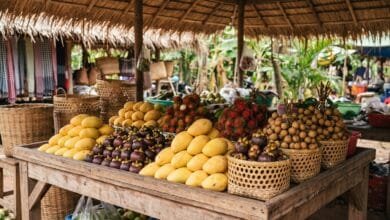
- Street fruit stalls: Roadside vendors and mobile fruit carts often sell mangosteens alongside rambutan, longan, and other seasonal fruits.
- Fruit shops: Dedicated fruit shops in cities and towns stock mangosteens during peak season.
- Restaurants and hotels: Some restaurants and hotels include mangosteen in fruit platters or desserts during the season.
- Rural areas: If you are traveling through provinces like Kampot or Kampong Cham during the season, you may see mangosteens sold directly by growers along the road.
Prices vary by location and season. In general, mangosteens are more expensive than rambutan or longan but less expensive than durian. Prices tend to be lower in growing provinces and higher in tourist areas.
How Should a First-Time Traveler Try Mangosteen?
If you have never eaten mangosteen before, here is the simplest approach:
- Buy two or three fruits from a market or fruit stall. They are small, so a few will give you a proper taste.
- Look for fruit with a deep purple color and a slightly soft feel.
- Open it by pressing gently between your palms. If the rind does not crack easily, use a small knife to score around the middle.
- Pull the halves apart and eat the white segments inside. Do not eat the rind or the seed.
- Try it plain first. Mangosteen is sweet enough on its own. If you want to try the local style, dip a segment in a little salt or chili-salt.
The flavor is mild and approachable. Most first-time tasters find mangosteen easy to enjoy — it is not as polarizing as durian or as sour as tamarind. The texture is soft and juicy, so it is best eaten fresh rather than stored for long.
One practical note: the purple rind can stain your fingers and clothing. If you are worried about stains, you can hold the fruit with a napkin or open it with a small knife. The stain is not permanent on skin but can be difficult to wash out of light-colored fabric.
How Is Mangosteen Different From Similar Fruits?
Travelers sometimes confuse mangosteen with other tropical fruits. Here is how it compares:
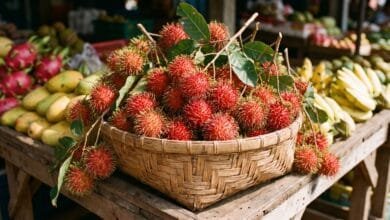
Mangosteen vs. Rambutan: Rambutan has a red, hairy exterior and translucent white flesh. Mangosteen has a smooth purple rind and opaque white flesh. Rambutan tastes sweeter and juicier, while mangosteen is more delicate and slightly tart.
Mangosteen vs. Lychee: Lychee has a bumpy red skin and a strong floral fragrance. Mangosteen’s flavor is milder and creamier. Both have white flesh, but they are unrelated fruits.
Mangosteen vs. Mango: These are completely different fruits. Mango is large, yellow or green, and has a single flat seed. Mangosteen is small, purple, and segmented. The only thing they share is part of a name.
Cultural and Regional Importance
In Cambodian fruit culture, mangosteen holds a special place. It is traditionally called the “queen of fruits,” paired with durian as the “king.” This pairing is not just poetic — in traditional Chinese and Southeast Asian medicine, durian is considered a “heating” fruit, while mangosteen is considered “cooling.” Eating mangosteen after durian is a common practice, believed to balance the body.
For Cambodian farming families in provinces like Kampot and Kampong Cham, mangosteen is more than a seasonal treat. It is a source of income and a connection to generations of agricultural tradition. Some farmers describe the fruit as part of their family heritage, passed down through grandparents and parents.
Mangosteen also appears in Cambodian fruit offerings during festivals and family gatherings, though it is not as ritually significant as bananas or coconuts.
What Should Foreign Travelers Know?
- The rind is not edible. Only the white segments inside are eaten.
- The seed is not edible raw. It is bitter and hard. Spit it out or remove it before eating.
- The rind stains. Purple mangosteen juice can stain fingers and fabric. Bring napkins or wet wipes if you plan to eat them on the go.
- Mangosteen is seasonal. If you are visiting Cambodia outside May–August, fresh mangosteens may be hard to find.
- It is not related to mango. Despite the similar name, they are completely different fruits.
- Hygiene matters with pre-cut fruit. If you buy pre-opened mangosteen from a street vendor, make sure it looks fresh and has been handled cleanly.
- Start with a small amount. Mangosteen is generally well-tolerated, but as with any unfamiliar fruit, try one or two first to see how your body responds.
Mangosteen is one of the easier tropical fruits for first-time visitors to enjoy. Its flavor is mild, its texture is pleasant, and it does not have the strong smell or acquired taste of durian. If you are in Cambodia during the season, it is well worth trying.
Frequently Asked Questions
What is mangosteen called in Khmer?
Mangosteen is called មង្ឃុត in Khmer, pronounced “mong-khout.”
What does mangosteen taste like?
Mangosteen has a sweet, slightly tangy flavor often described as a mix of lychee, peach, and strawberry. The flesh is soft, juicy, and creamy.
When is mangosteen in season in Cambodia?
Mangosteen season in Cambodia typically runs from May to August, with peak availability in June and July.
How do Cambodians eat mangosteen?
Cambodians usually eat mangosteen fresh as a snack. The rind is cracked open by hand, and the white segments inside are eaten plain or with a small dip of salt or chili-salt.
Where can travelers find mangosteen in Cambodia?
During the season, mangosteens are sold at local markets, street fruit stalls, and fruit shops across Cambodia. Orussey Market in Phnom Penh is one well-known location.
Is mangosteen the same as mango?
No. Mangosteen and mango are completely unrelated fruits. They differ in appearance, taste, texture, and botanical family.
Conclusion
Mangosteen is one of Cambodia’s most rewarding seasonal fruits. Its thick purple shell opens to reveal soft white segments with a sweet, delicate flavor that is easy to enjoy — even for travelers who have never tried tropical fruit before. The fruit is in season from May to August, sold at markets and fruit stalls across the country, and eaten fresh as a simple snack. For a first-time visitor, mangosteen offers a gentle introduction to Cambodian fruit culture: no strong smell, no complicated preparation, just a small purple fruit that tastes like nothing else. If you are in Cambodia during the season, buy a few from a local vendor, crack one open, and see for yourself why it is called the queen of fruits.