Islam in Cambodia: What Travelers Should Know About the Cham Muslim Community
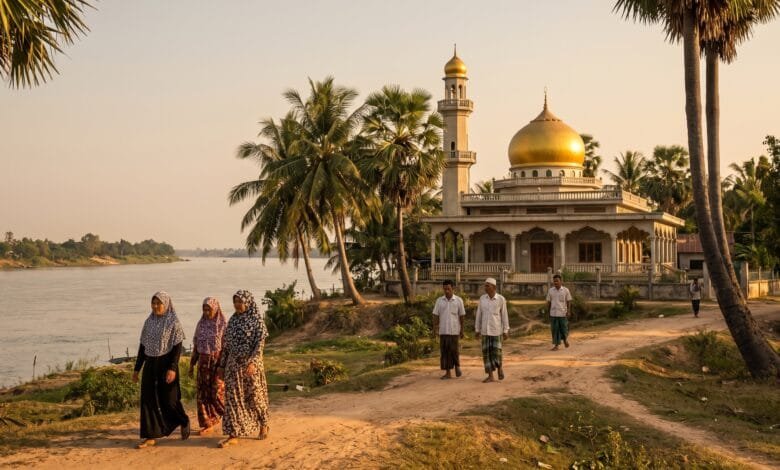
Most travelers arrive in Cambodia expecting temples, monks, and Buddhist culture. And they find plenty of all three. But if you travel along the Mekong River through Kampong Cham province, or walk through certain neighborhoods in Phnom Penh, you may notice something else: women wearing headscarves, men in skullcaps, and mosques with slender minarets rising above the palm trees.
This is the Cham Muslim community — a part of Cambodia that many visitors never learn about before their trip.
Who Are the Cham Muslims?
The Cham are an ethnic group with their own language, history, and cultural identity. Their ancestors lived in the kingdom of Champa, which was located along the coast of what is now central and southern Vietnam. As Islam spread across Southeast Asia, many Cham converted to the faith. When their kingdom was gradually conquered by the Vietnamese, large numbers of Cham migrated into Cambodia, settling along the Mekong River and around the Tonle Sap lake.
Today, Cham Muslims make up the largest Muslim community in Cambodia. Estimates vary, but they are generally understood to number in the hundreds of thousands — a small minority in a country where the vast majority of people are Buddhist. The Cham live in their own villages, often right next to Khmer Buddhist communities, and maintain a distinct style of dress and religious life.
What Makes Islam in Cambodia Different?
If you have traveled in Indonesia, Malaysia, or the Middle East, you may notice some differences in how Islam is practiced among Cambodia’s Cham communities. That is because Islam arrived here through trade and cultural exchange across Southeast Asia, not through direct conquest or colonization from the Arab world.
The majority of Cham Muslims in Cambodia follow the Shafi’i school of Sunni Islam, which is common across Southeast Asia. But there is also an important distinction within the community that travelers rarely hear about: a smaller group known as the Jahed (sometimes called the Imam San community).
The Jahed practice a form of Islam that incorporates elements of older Cham traditions. They pray once a week on Fridays rather than five times a day, use the Cham language rather than Arabic in their religious practice, and preserve Cham script in their texts. This does not make their practice any less Muslim — it reflects the long history of Islam in this region and the way faith adapts to local cultures over centuries. The Jahed number just over 20,000 and are concentrated around Udong and parts of Kampong Cham province.
What Does Daily Religious Life Look Like?
For most Cham Muslims in Cambodia, daily life includes the five daily prayers, fasting during Ramadan, and gathering at the mosque for Friday prayers. Women often wear headscarves and long clothing; men may wear skullcaps and grow beards.
Cham communities build their own mosques, often with funds raised collectively by the community or with support from Muslim organizations abroad. Some of these mosques are wooden structures over a century old; others are newer buildings with tiled domes and minarets.
Religious education is important in many Cham communities. Children learn to read the Quran, often in Arabic for the mainstream Sunni community and in Cham script for the Jahed. Many Cham families maintain connections with Muslim communities in Malaysia and the Middle East, and some young people travel abroad for religious study.
What About the Khmer Rouge Period?
You cannot tell the story of the Cham in Cambodia without mentioning the Khmer Rouge. Between 1975 and 1979, the Khmer Rouge regime targeted religious practice across the country, but the Cham were singled out for particularly harsh treatment. Their mosques were destroyed or desecrated, their religious texts were burned, and they were forced to abandon their dress, diet, and religious practices. Historians estimate that a very large proportion of the Cham population died during this period.
For travelers, this history matters because it explains why the Cham community places such strong emphasis on preserving its religious identity today. The mosques, schools, and community institutions you see are not just places of worship — they are also a statement of survival.
Where Might Travelers Encounter Cham Muslim Communities?
The most accessible places to encounter Cham Muslim life are in Kampong Cham province, particularly along the Mekong River, and in Phnom Penh. In Phnom Penh, the Al-Serkal Mosque is the largest and most prominent mosque in the country, located in the Boeng Kak neighborhood. It was funded by an Emirati businessman and opened in 2015. Non-Muslim visitors may be able to visit outside of prayer times, but it is always best to ask first and dress modestly.
In Kampong Cham and other provinces, you may see wooden mosques that have served communities for generations. The Cambodian government has recently begun promoting some of these as cultural tourism sites, recognizing that travelers are interested in understanding the country’s full religious landscape.
You may also notice halal restaurants and food stalls near mosques and in Cham neighborhoods. These serve communities where pork is not eaten, and they are a good reminder that religious practice and daily life are closely connected.
How Should Travelers Approach a Visit?
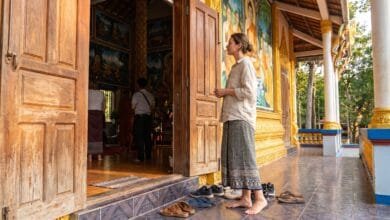
If you are interested in visiting a mosque or a Cham community, the basic principles are similar to visiting a Buddhist pagoda or any other religious space: be respectful, dress modestly, remove your shoes if asked, and do not photograph people without permission. Women may be asked to cover their hair before entering a mosque; carrying a light scarf is a good idea.
If you are not Muslim, it is generally fine to observe from a respectful distance, but do not enter the prayer hall during prayers. Friday midday prayers are the busiest time, so plan your visit outside those hours. If you want to learn more, a polite question to a community member or imam is usually welcomed — many Cham are proud of their heritage and happy to explain it.
It is also worth remembering that the Cham are not a tourist attraction. They are a living community with their own religious life. A respectful attitude goes a long way.
Frequently Asked Questions
What religion are the Cham people?
Most Cham in Cambodia are Muslim. The majority follow Sunni Islam of the Shafi’i school, while a smaller group known as the Jahed practice a distinct form of Islam that incorporates older Cham traditions.
How many Muslims are there in Cambodia?
Estimates generally range from several hundred thousand to around 850,000, making Islam the second-largest religion in Cambodia after Buddhism.
Can I visit a mosque in Cambodia?
Yes, many mosques welcome respectful non-Muslim visitors outside of prayer times. Always ask before entering, dress modestly, and follow any instructions from community members.
What is the difference between Cham and Khmer?
The Cham are a distinct ethnic group with their own language and history. The Khmer are the majority ethnic group in Cambodia and are primarily Buddhist. Cham communities often live alongside Khmer villages but maintain their own religious and cultural traditions.
Why do some Cham women wear headscarves?
Wearing the hijab is a practice of modesty in Islam. In Cambodia, it is one of the most visible ways Cham Muslim identity is expressed in daily life.
Conclusion
Cambodia is often described as a Buddhist country, and that is true. But it is also a country where Islam has deep roots and a living presence. The Cham Muslim community has been part of Cambodian life for centuries, surviving war, persecution, and displacement — and continuing to practice its faith with quiet determination.
For travelers, understanding the Cham means understanding a fuller picture of Cambodia. It means noticing the mosque as well as the pagoda, the headscarf as well as the saffron robe, and recognizing that this country’s cultural richness comes from more than one tradition.
If you find yourself near a Cham village or a mosque during your travels, take a moment to look. You may be seeing a part of Cambodia that most visitors never notice.