What Travelers Should Know Before Visiting a Cambodian Pagoda
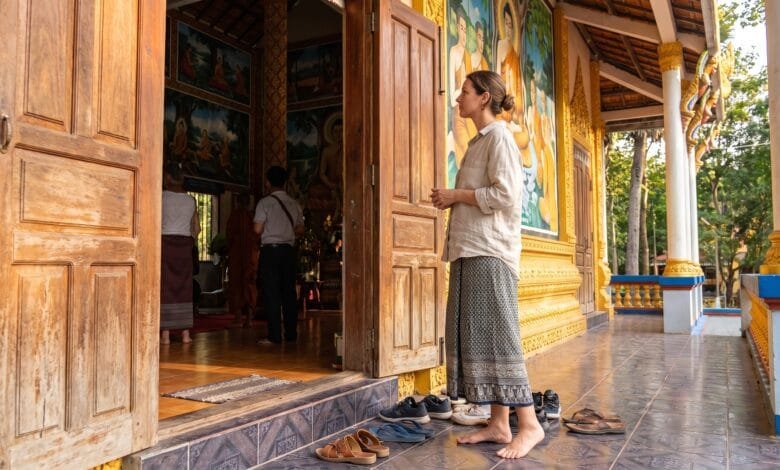
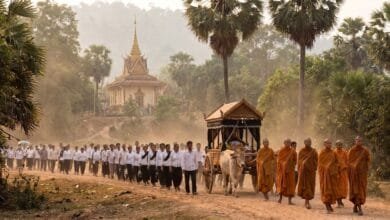
You see them everywhere in Cambodia. Behind low walls, past golden gateposts, under the shade of broad-leafed trees. The roof curves upward at the corners, often with a naga—a serpent—sliding along the ridge. A monk in saffron robes walks slowly across the courtyard. A woman kneels on a mat, hands pressed together, forehead nearly touching the ground.
A Cambodian pagoda is not a museum. It is not a monument you tick off a list. It is a living place where people pray, make offerings, ask for help, give thanks, and remember their dead. Travelers are welcome, but the welcome comes with an unspoken expectation: that you understand where you are and act accordingly.
This guide is not about strict rules. It is about understanding what a pagoda is, what you will see inside, and how to move through that space in a way that feels natural—for you and for the people around you.
What Is a Cambodian Pagoda, Exactly?
The English word “pagoda” is a traveler’s shorthand. Cambodians usually say wat (វត្ត), which means temple or monastery compound. A wat is more than one building. It is a whole space: the main hall, the monks’ quarters, a dining area, often a school or community shelter, and open ground where people gather.
The most important building is the vihara (វិហារ), sometimes called the vihear or simply the main hall. This is where the Buddha statues sit, where monks chant, and where laypeople come to pray and make offerings. It is also where you will be asked to remove your shoes.
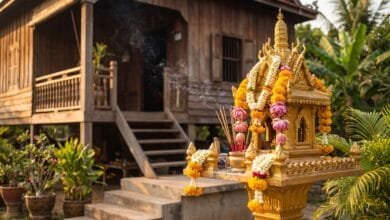
Cambodia is a Theravada Buddhist country, and the pagoda sits at the center of religious life for most Khmer people. But you will also notice things that do not come from Buddhism at all—spirit houses, neak ta shrines, strings tied around wrists, offerings of fruit and incense. In Cambodia, Buddhism and older spirit beliefs have lived alongside each other for centuries. A pagoda is a Buddhist space, but it is embedded in a culture where the spiritual world is layered and complex.
What You Will See Inside the Main Hall
When you step into the vihara, the first thing many travelers notice is the quiet. Not silence—there is often chanting, or the murmur of people praying, or the click of a donation box—but a deliberate softness. Voices drop. Movement slows.
At the far end of the hall sits the Buddha. Not one Buddha, usually, but several. A large central figure, seated, eyes downcast or half-closed. Smaller statues around it, some gilded, some simple stone or bronze. The Buddha’s hands are often in a specific gesture—one hand touching the earth, or both resting in the lap. These gestures are called mudras, and they tell a story. The earth-touching gesture, for example, recalls the moment the Buddha called the earth to witness his enlightenment.
In front of the Buddha there is an altar. You will see incense sticks burning, their smoke rising in thin lines. Fruit, flowers, small packets of food, sometimes a folded scarf or a bottle of water. These are offerings. People bring them not to “give” the Buddha something he needs, but as an act of generosity and respect. In Buddhist practice, giving is a way of making merit—of creating good conditions for this life and the next.
You will also see people kneeling. Not sitting on chairs, but on mats or the floor. Their hands are pressed together in front of their chest or face. This gesture is called sampeah, and it is used for greeting, for showing respect, and for prayer. When you see someone bowing deeply with sampeah raised to their forehead, they are showing the highest respect—usually to the Buddha, sometimes to a monk, sometimes to an elder.
Monks: What They Do and How to Interact
Monks are not priests in the Western sense. They do not perform sacraments or mediate between people and a divine being. In Theravada Buddhism, the Buddha is not a god. He was a human being who woke up to the nature of reality, and monks are people who have chosen to devote their lives to following his path.
A monk’s day begins early—often before 5 a.m.—with chanting and meditation. They eat one main meal before noon and do not eat after that. They study, clean the temple grounds, teach, and participate in ceremonies for the community: funerals, weddings, blessings, and festivals. In many villages, the wat is also a school, a community center, and a place where people come for advice.
When you see a monk, you do not need to do anything special. A slight bow of the head and a sampeah at chest level is polite and appreciated. What you should not do is touch a monk, especially if you are a woman. In Theravada tradition, monks avoid physical contact with the opposite sex as part of their discipline. Women should also avoid handing objects directly to a monk; place the item on a cloth or table, or let a man pass it. This is not about you being unclean. It is about the monk’s vows.
If you want to take a photo of a monk, ask first. A simple gesture—pointing to your camera and raising your eyebrows—usually works. Many monks are used to visitors and will nod or smile. Some will not, and that is fine. Respect the answer.
The Donation Box, the Incense, and the Unspoken Rhythm
Most pagodas in Cambodia are free to enter. There is no ticket counter. But you will almost always see a donation box—often a wooden box with a slit in the top, sitting near the altar or by the entrance. These donations support the temple: repairs, electricity, food for the monks, and community projects. Giving is optional. A small amount—a thousand riel, a dollar—is perfectly normal. The act matters more than the amount.
You do not have to light incense. You do not have to kneel. You do not have to make an offering. Travelers are welcome to simply observe. But if you want to participate, do so quietly and without drawing attention. Watch how others do it. Follow the rhythm.
One thing to notice: people usually move clockwise around the altar or the Buddha, keeping their right side toward the sacred object. This is a subtle gesture of respect that you will see across Buddhist Asia. You do not have to copy it, but knowing what it means helps you understand what you are watching.
What to Wear and How to Move
Cambodia is hot. Shorts and tank tops feel natural. But inside a pagoda, they are not appropriate. The Ministry of Cults and Religion has issued official guidelines asking visitors to cover their shoulders and knees when entering temple grounds. This applies to both men and women. A light scarf or sarong in your bag solves the problem instantly.
Before entering the vihara or any other sacred building, remove your shoes and your hat. You will see a jumble of sandals by the door. Leave yours there. Socks are fine, bare feet are fine.
When you sit, do not point your feet toward the Buddha or toward a monk. Feet are considered the lowest part of the body in Cambodian culture, and pointing them at something sacred is disrespectful. Sit with your legs tucked to one side, or cross-legged if you can do so comfortably. If you are not sure how to sit, just watch how the Cambodian women around you are sitting. They will show you.
Avoid loud conversation, laughter that carries, or any kind of physical affection—holding hands, hugging, kissing—inside the temple compound. These behaviors are not forbidden because they are “bad,” but because the pagoda is a place of restraint and calm. The guidelines also prohibit alcohol and gambling on temple grounds.
Why This Matters for Your Trip
You do not need to become an expert in Buddhism to visit a Cambodian pagoda respectfully. You do not need to memorize Pali terms or understand the finer points of monastic discipline. What you need is a willingness to slow down, observe, and adjust.
The pagoda is one of the few places in Cambodia where you can see the country’s religious life as it actually is—not staged for tourists, not explained on a placard, but happening in real time. A grandmother teaching her grandson how to hold incense. A young monk scrolling through a phone between chanting sessions. A woman crying quietly as she kneels before the Buddha, asking for something she cannot say out loud.
If you enter with curiosity and leave with your voice a little softer than when you arrived, you will have done it right.
Frequently Asked Questions
Can tourists enter Cambodian pagodas?
Yes. Most active pagodas welcome visitors, and there is usually no entrance fee. A few major sites, like the Silver Pagoda in Phnom Penh, have specific rules and may charge admission. Local neighborhood wats are generally open to anyone who enters respectfully.
What should I wear to a Cambodian pagoda?
Cover your shoulders and knees. Both men and women should follow this guideline. A scarf or light sarong is useful to carry. Remove your shoes and hat before entering any sacred building.
Can I take photos inside a pagoda?
Usually yes, but be discreet. Do not use flash. Do not photograph people praying without permission. Some temples, especially the Silver Pagoda, prohibit photography inside the main hall entirely. If you see a sign or someone gestures for you to stop, stop.
Can women touch monks?
No. In Theravada tradition, monks do not have physical contact with women. Women should also avoid handing items directly to a monk. Place the item on a table or cloth, or ask a man to pass it.
Do I have to make a donation?
No. Donations are optional. If you choose to give, a small amount is fine. The donation box supports the temple and the monks.
What is the sampeah?
Sampeah is the Cambodian gesture of respect—palms pressed together in front of the chest or face, with a slight bow. You will see it used as a greeting, as a prayer posture, and as a way of showing respect to monks and elders. You do not have to use it, but a slight bow and a smile go a long way.
Conclusion
A Cambodian pagoda is not a puzzle to be solved. It is a place where people live their faith in ordinary, human ways. They come to give, to ask, to remember, to sit quietly, to be part of something larger than themselves.
Travelers are welcome in that space, but the welcome is not passive. It asks something of you: attention, patience, and a willingness to let the place set the tone. You do not need to know the chants or understand the Pali. You only need to notice where you are—and act like someone who understands that a pagoda is not just a building, but a home for the heart of a community.
If you remember that, you will be fine.