Kampong Speu Palm Sugar: The Sweet Tradition of Cambodia’s Tree-Climbing Farmers
Kampong Speu Palm Sugar: The Sweet Tradition of Cambodia’s Tree-Climbing Farmers
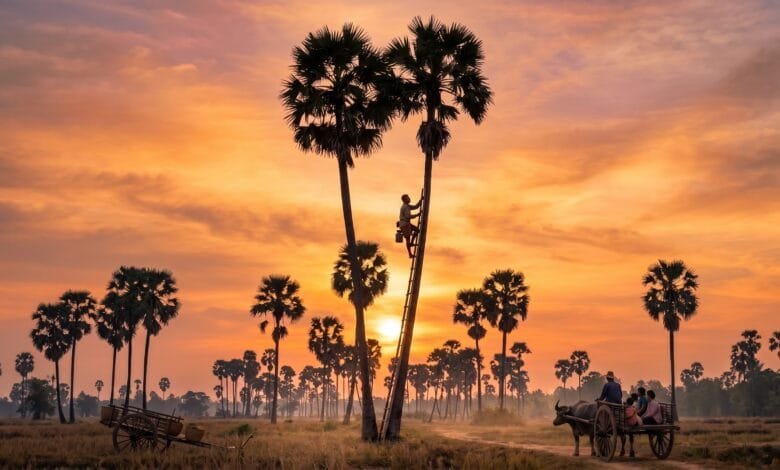
In Kampong Speu, some of Cambodia’s most prized sugar comes not from fields of cane, but from the tops of trees that soar 30 meters into the sky. Twice a day, farmers climb these giants to collect a nectar that has earned European Union protection—and a place at the heart of Cambodian cuisine.
This is the story of Kampong Speu palm sugar—a product that connects land, people, tradition, and food in a single sweet drop.
Quick Facts
Where This Story Begins
Kampong Speu Province lies between Phnom Penh and the Cardamom Mountains, an easy day-trip destination from the capital. Known as the “Sugar Palm Province,” its landscape is dotted with thousands of sugar palms—Borassus flabellifer, the national tree of Cambodia—towering over rice fields and villages.
What makes this place special is the soil. For a palm tree to produce sugar that can be called Kampong Speu palm sugar, it must grow in sandy soil at least 80 centimeters deep, followed by another 80 centimeters of red gravel beneath it. This specific soil composition, combined with the province’s low rainfall and dry climate, produces sap with exceptionally high sugar concentration.
The production area spans three districts in Kampong Speu—Oudong, Samaki Monichey, and Samrong Torng—and extends into Ang Snuol District in neighboring Kandal Province. Within this zone, the Kampong Speu Palm Sugar Promotion Association (KSPSPA) oversees quality and certification, ensuring every batch meets the strict standards required for its Geographical Indication status.
Meet the Farmers
The people behind Kampong Speu palm sugar are small-scale farmers who have been cultivating this tradition for generations. Many families follow a seasonal rhythm: growing rice during the rainy season and making sugar during the dry season.
“Between growing rice in the rainy season and making sugar in the dry season, we now have a stable income year-round.”
— Sem Ven, Kampong Speu palm sugar farmer
The work is deeply gendered and intergenerational. Traditionally, men are responsible for climbing the trees and collecting sap, while women handle the cooking, crystallization, and packaging. Children grow up watching their parents perform these tasks, and knowledge passes from one generation to the next—though today, that chain is under threat.
The Kampong Speu Palm Sugar Promotion Association currently has approximately 150–168 farmer members. These families collectively own about 300,000 palm trees, though only around 3,000 are actively used for sap extraction due to a shortage of skilled climbers. Each family earns between $1,700 and $3,800 per season, with some earning up to $4,000–$6,000 annually from palm sugar production.
For farmers like Kong Nap, a 48-year-old mother of three from Samaki Monichey district, palm sugar production has transformed her family’s livelihood:
“My husband and I find this profession simple, and it contributes greatly to our livelihood. I am no longer worried. No matter how much sugar I produce, the association will purchase it all.”
— Kong Nap, Kampong Speu palm sugar farmer
How Kampong Speu Palm Sugar Is Made: From Tree to Table
The production of Kampong Speu palm sugar is a precise, labor-intensive process that has changed little over centuries.
Step 1: Climbing and Tapping
Skilled farmers climb sugar palms that reach 20 to 30 meters in height. This is dangerous work—a single slip can be fatal. The climber ascends twice daily: once to cut into the flower stalk and attach a collection container, and again to collect the accumulated sap.
The sap is collected in traditional bamboo containers called Bampong. The use of plastic containers is strictly prohibited under GI regulations. To slow natural fermentation and preserve the sap, a small piece of Popel or Koki wood is placed in each container.
Step 2: Collection and Processing
Sap must be processed within 15 hours of extraction. Farmers bring the filled bamboo containers down and filter the sap before transferring it to large cooking pans.
Step 3: Boiling and Evaporation
The sap is gently evaporated in large pans over low heat using traditional tools like the Antok and Khnos. No chemical additives are used at any stage. The boiling process requires constant attention—the sap must be stirred continuously to prevent burning and to achieve the right consistency.
Step 4: Forming the Sugar
Depending on the desired final product, the cooked sap is shaped into different forms:
The sugar is then stored temporarily for up to three months before packaging. Depending on the type, shelf life ranges from one to three years.
The Season Behind the Product
The palm sugar season in Kampong Speu runs from December to May.
The best quality sugar is produced from December to March, when the weather is driest and the trees yield the most abundant sap. As rains begin in mid-March, the quality gradually declines. By the end of May, when the rainy season arrives in earnest, farmers stop climbing—thunder and wet conditions make it too dangerous.
“It can be called Kampong Speu palm sugar only when it’s harvested from December to May.”
— Vy Veasna, Kampong Speu Palm Sugar Promotion Association
The Ingredient: What Makes Kampong Speu Palm Sugar Special
Kampong Speu palm sugar is not just any sweetener. It has a distinctive flavor profile—strong, sweet, with very low bitterness and acidity. Its aroma is unmistakably palm-like, and its color ranges from light golden to deep amber depending on the form.
Health-conscious consumers value it for its naturally low glycemic index and higher polyphenol content compared to coconut or refined sugars.
What truly sets it apart, however, is its Geographical Indication (GI) status. Kampong Speu palm sugar was registered as a GI product at Cambodia’s Ministry of Commerce on April 2, 2010. In 2019, it became only the second Cambodian product to receive Protected Geographical Indication (PGI) status from the European Union, following Kampot pepper.
This certification protects the product’s authenticity and ensures that only sugar produced within the designated area, using traditional methods and bamboo containers, can carry the name Skor Thnot Kampong Speu.
From Farm to Cambodian Table
Kampong Speu palm sugar is a cornerstone of Cambodian cuisine. It appears in:
- Curries — adding depth and balancing heat
- Sauces and marinades — providing sweetness and caramelization
- Desserts — from sticky rice cakes to sweet soups
- Herbal teas — dissolved in warm water as a traditional remedy for fatigue and coughs
Traditional Khmer sweets like Num Chak Chan and Num Ansom—sticky rice cakes filled with palm sugar paste, coconut, and banana—highlight its importance. Another beloved dessert is Glutinous Rice Balls (នំផ្លែអាយ), made with glutinous rice flour, palm sugar, and coconut.
Beyond food, the sugar palm tree itself is deeply integrated into Cambodian rural life. Its leaves are used for roofing, hats, mats, and baskets; its trunks become boats, furniture, and houses; its fruit appears in desserts. In 2005, the Palmyra palm was officially declared a national emblem of Cambodia.
Why This Product Matters
Kampong Speu palm sugar matters on multiple levels:
Culturally: Palm sugar production has been part of Cambodian life for centuries, with evidence dating back to the Angkor era. Inscriptions from that period record palm groves being donated to temples, and sugar produced was used to support priests and temple supplies.
Economically: The GI certification has significantly improved farmers’ livelihoods. Before joining the association, farmers could only sell sugar for 4,000–5,000 riel ($1.00–$1.25) per kilogram. Today, prices have increased, and the association guarantees a market for all production. The product is now exported to over 20 countries, including France, the US, Japan, Thailand, and China.
Nationally: The sugar palm is a symbol of Cambodian national identity. Prime Minister Hun Sen has called for the conservation of palm trees, noting that the GI registration has “contributed to an increase in its price, created jobs, enhanced livelihoods and encouraged people to participate in conserving palm trees”.
What a Farm or Producer Visit Is Like
Visitors to Kampong Speu can experience palm sugar production firsthand. Some villages offer tastings and demonstrations of the process.
A typical visit might include:
- Watching farmers climb the towering sugar palms (from a safe distance)
- Observing the sap collection from bamboo containers
- Seeing the boiling and evaporation process over open fires
- Tasting different grades of sugar—from light golden to deep amber
- Purchasing sugar directly from producers
The experience is informal and community-based. Visits are usually arranged through local guides or by contacting the Kampong Speu Palm Sugar Promotion Association.
Note: Availability and arrangements vary. It is recommended to inquire locally or through a reputable tour operator before visiting.
Best Time to Visit
The best time to visit Kampong Speu for palm sugar experiences is December to April.
- Best for farming activity: December–March, when sap quality is highest
- Best for comfortable travel: November–April, when conditions are dry
During this period, the weather is favorable for both production and travel, and visitors have the best chance of seeing the full production process in action.
How to Get There
Kampong Speu Province is located approximately 60–70 kilometers west of Phnom Penh.
By Car/Taxi: The journey takes about 1.5 to 2 hours from Phnom Penh via National Road 4.
By Bus: Several bus companies operate services from Phnom Penh to Kampong Speu town.
Once in the province, palm sugar production sites are scattered throughout the countryside, particularly in the Oudong, Samaki Monichey, and Samrong Torng districts. Local guides or the KSPSPA can help direct visitors to specific producers.
What to Bring
- Water (it can be hot and dry during the harvest season)
- Sun protection (hat, sunscreen)
- Comfortable shoes for walking on uneven ground
- Insect repellent
- Camera (ask permission before photographing people)
- Cash for purchasing sugar directly from producers
Responsible Farm Tourism
When visiting palm sugar producers, please:
- Ask before entering private areas or farmyards
- Ask before photographing people—respect their privacy
- Do not damage crops, trees, or equipment
- Do not pick produce or fruit without permission
- Buy directly from producers when possible to support local livelihoods
- Respect working spaces—this is someone’s workplace, not a theme park
- Follow local instructions from farmers and guides
- Do not treat farmers as attractions—they are skilled workers and business owners
Nearby Food or Travel Experiences
Kampong Speu offers several other attractions worth exploring:
- Kirirom National Park — Cambodia’s first national park, with pine forests, hiking trails, and waterfalls
- Oudong Mountain — Former royal capital with stupas and panoramic views
- Silk Weaving Villages — Traditional weaving communities producing Khmer silk
- Phnom Aural — Cambodia’s highest peak (1,813m), for adventurous trekkers
Suggested Internal Article: A Guide to Kampong Speu Province: Beyond Palm Sugar
Frequently Asked Questions
Where can I visit Kampong Speu palm sugar producers?
Production sites are scattered across Kampong Speu Province, particularly in Oudong, Samaki Monichey, and Samrong Torng districts. Local guides or the KSPSPA can help arrange visits.
What season is best for visiting?
December to April offers the best combination of farming activity and comfortable travel weather
Can travelers join the harvest?
Generally, no—climbing is dangerous and requires specialized skill. However, visitors can observe from a safe distance and participate in other activities like tasting and purchasing.
What does Kampong Speu palm sugar taste like?
How is it used in Cambodian food?
It’s used in curries, sauces, marinades, desserts, and traditional sweets like Num Chak Chan and Num Ansom
Is the farm open to visitors?
Some producers welcome visitors, but arrangements should be made in advance. Not all farms are set up for tourism.
How long does a visit take?
A typical visit to see the production process and taste the sugar might take 1–2 hours.
What should I bring?
Water, sun protection, comfortable shoes, insect repellent, a camera (with permission), and cash for purchases.
Final Thoughts
Kampong Speu palm sugar is more than a sweetener—it is a story of land and people, of 30-meter climbs and generations of knowledge, of a product that has earned global recognition while remaining deeply rooted in Cambodian rural life.
From the sandy soils of Kampong Speu to the kitchens where it sweetens curries and desserts, from the hands of farmers who climb before dawn to the tables of families across Cambodia and beyond—this is a tradition worth understanding, tasting, and protecting.
The next time you taste the rich, caramel sweetness of Kampong Speu palm sugar, remember the climb. Remember the farmer. Remember the story behind every grain.