Kampot-Kep Salt Farmers: Battling Rain and Climate Change
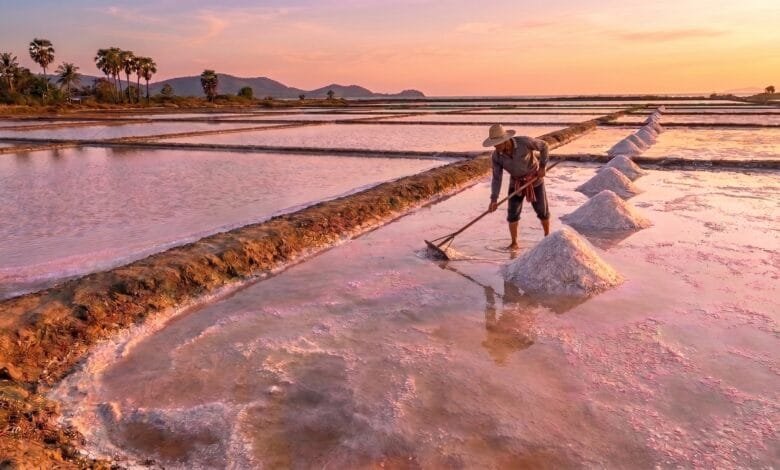
The salt crunches underfoot like fresh snow, but the air is tropical and heavy. Before sunrise, farmers wade into shallow ponds, their hands moving across the water’s surface, gathering crystals that have taken weeks to form under the Cambodian sun. This is the sound of salt — and it’s a sound that’s getting harder to hear.
Just outside Kampot town, the landscape transforms into something unexpected: a vast grid of shallow pink-and-white ponds stretching toward the Gulf of Thailand. This is where Cambodia’s sea salt comes from — and where 200 families are watching the sky with growing anxiety.
Kampot-Kep salt farmers climate change is not just an abstract concern. It is a daily reality. Changing monsoon patterns linked to climate change are putting pressure on Cambodia’s sea salt industry, which relies on prolonged dry and sunny conditions for production. In recent years, unusually heavy rainfall during the dry season has disrupted production in Kampot and Kep provinces, Cambodia’s main salt-producing region.
Quick Facts
| Detail | Information |
|---|---|
| Province | Kampot and Kep, Cambodia |
| Product | Kampot-Kep Sea Salt (Geographical Indication) |
| Producer Type | 200+ families, 141 producers (GI Association members) |
| Main Season | December to May (dry season) |
| Total Production Area | Approximately 4,748 hectares |
| Annual Production | Varies: 168,882 tonnes (2024), ~30,000 tonnes (2025) |
| Experience | Visit salt fields (seasonal), photography, learn traditional methods |
| Best Time to Visit | January to April (harvest season), early morning |
| Typical Visit Length | 1–2 hours |
| Food Connection | Essential seasoning in Cambodian cooking; used with Kampot pepper |
Where This Story Begins
Kampot and neighbouring Kep province, located about 150 kilometres southwest of Phnom Penh, form the heart of Cambodia’s traditional salt industry. Salt production has been practised here for decades — and in fact, for centuries. Historical records by Zhou Daguan, a Chinese diplomat who visited the Khmer Empire in the 13th century, mention salt production along the coast. Some techniques used today have probably changed little in a thousand years.
The provinces sit on the edge of the Gulf of Thailand, an area that has produced sea salt for several centuries. The coastline provides the perfect combination of factors: flat coastal land, access to seawater, intense tropical sun, and a reliable dry season. Or at least, it used to be reliable.
Today, the salt fields cover around 4,748 hectares across both provinces. In Kampot province, the salt production area spans 3,489 hectares, while Kep contributes 497 hectares. These are not industrial operations. They are traditional, family-run enterprises using methods passed down through generations.
Meet the Farmers and Producers
A total of 141 producers harvest sea salt using traditional, labour-intensive solar evaporation techniques across the coastal areas of the two provinces. But behind that number are families — around 200 families who own salt farms.
The Association of Geographical Indication Kampot-Kep Salt Producers (AGIKSP) brings together these families. As of recent records, 11 families are actively producing GI-certified Kampot-Kep Salt, with each family exploiting around 12 hectares per season. In total, about 133.5 hectares of salt fields are currently exploited for GI salt production.
Producers have learned salt production techniques from their parents. The know-how is transmitted from generation to generation. Most often, three or four family members participate in the production, each with an important role to play. Traditionally, men managed the salt field and carried salt from the ponds to the warehouse, while women were responsible for collecting the salt and selling it.
One family produces around 200 tonnes of salt per year, which can generate an income of approximately 10,000 to 13,000 US dollars per season. But this income is far from guaranteed.
The seasonal rhythm of salt farming is intimately tied to Cambodia’s agricultural calendar. Whereas sea salt is produced in the dry season, from December to May, most of these same families grow rice in the wet season. This dual livelihood — salt in the dry months, rice when the rains come — has sustained coastal communities for generations.
How Kampot-Kep Salt Farmers Face Climate Change
Climate change is a big challenge for salt production because our production depends entirely on weather conditions, said Bun Narin, President of the Association of Geographical Indication Kampot-Kep Salt Producers.
Over the last five years, production patterns have changed due to heavy rain and high tides that flood salt ponds.
The production process is simple in principle but delicate in practice. Seawater is channelled into shallow evaporation ponds. Under the intense tropical sun, the water gradually evaporates, leaving layers of salt crystals that are collected by hand. But this process requires weeks of uninterrupted sun. A single day of rain can set production back by a week or more.
If it rains twice a month, salt producers lose half a month, Narin explained. In March 2025, a sudden rain in a single day disrupted production for a week and ten days before farmers could resume. In April of the same year, it rained continuously, forcing the association to finish the harvest early.
The impact is stark. In 2024, favourable weather conditions allowed Cambodia to produce 168,882 tonnes of salt — a record high that meant the country did not need to import salt from abroad. But in 2025, persistent rainfall disrupted production dramatically. Producers expected to harvest only about 30,000 tonnes. Some reports suggested production could fall as low as 18,000 to 20,000 tonnes — a drop of more than 90% compared to the previous year.
The Season Behind the Salt
The salt harvest season in Kampot and Kep typically runs from January to April each year. In years with hotter and drier weather, it can extend until June. The season begins when farmers open sluice gates to let seawater flow into a series of evaporation ponds. As the water moves from pond to pond, it becomes increasingly salty. When the brine reaches the right concentration, salt crystals begin to form on the surface.
The best time to see active harvesting is from January through April. Farmers start working long before sunrise and are usually done by 10 or 11am, so morning is the best time to visit. The salt fields are at their most photogenic during these months, with workers moving across shallow pans before dawn, raking salt into white piles while the water reflects the sky.
However, climate change is making the season increasingly unpredictable. March to April is the full time for salt harvesting, but in March, there was a sudden rain in a day that disrupted our production for a week and 10 days before we could do it, Narin said. This year in April, it rained continuously, so the association decided to finish the harvest by the end of April.
The Ingredient: Kampot-Kep Sea Salt
Kampot-Kep sea salt is not ordinary table salt. It is a type of sea salt extracted from seawater through evaporation ponds in the coastal regions of Kampot and Kep provinces. The production is artisanal and organic, relying on handcrafting by local farmers using simple, mostly wooden tools like hoes, spades, rakes, and baskets.
The sodium level varies based on production and harvesting conditions, but it usually sits between 31 and 34% — much lower than many other salts. This lower sodium content, combined with the natural minerals from the Gulf of Thailand, gives Kampot-Kep salt a distinctive flavour profile that chefs and home cooks prize.
Kampot-Kep salt received Geographical Indication (GI) certification in April 2023, giving the region’s distinctive sea salt greater recognition for its quality and origin. This GI status — similar to that given to Champagne in France or Parma Ham in Italy — recognizes the unique qualities of the salt that are specifically attributable to its geographical origin within Kampot and Kep provinces. The certification was a milestone, offering protection and potential for higher prices for producers.
From Salt Field to Cambodian Table
Salt is the most fundamental seasoning in Cambodian cooking. It appears in almost every dish, from the simplest bowl of rice to complex curries and fermented foods.
Kampot-Kep salt is used in local markets and exported to countries including Japan and several European Union member states. However, the war between Russia and Ukraine caused a decline in exports to Europe, and the association is negotiating with Japan to increase exports.
In Cambodian kitchens, salt is used not just for seasoning but also for preservation. It is essential in making prahok (fermented fish paste), mam (fermented fish), and dried fish — staples of the Cambodian diet. The salt’s mineral content and lower sodium level make it particularly suited to these traditional preservation methods.
Perhaps the most celebrated pairing is with Kampot pepper. The two GI products from the same region are natural partners. Salted Kampot pepper — fresh peppercorns fermented with Kampot sea salt — is a specialty that showcases both products. The mineral-rich salt enhances the pepper’s complex flavour, creating a condiment that is uniquely Cambodian.
Why This Product Matters
Kampot-Kep salt is more than a commodity. It is a cultural and economic asset for Cambodia. The salt industry supports the livelihoods of around 200 families and their communities. It preserves traditional knowledge that has been passed down through generations.
The economic stakes are significant. A reasonable salt price is around 10,000 riels (approximately 2.50 USD) per 50-kilogram sack — enough to support farmers’ livelihoods and their children’s education. But during the harvest, prices can drop to 5,000 riels per sack, only rising to 8,000–9,000 riels afterward.
I have been in the salt sector for many years. I know that farmers can survive when the price is at least 8,000 riels, so that they have enough money to buy rice to eat, Narin said. Between 10,000 and 12,000 riels is reasonable. Farmers have money for their children to go to high school. If the price is below 8,000 riels, most salt farmers will be unable to meet their needs. And some may even have to go into debt.
Climate change threatens not just production volumes but the viability of the entire industry. When production falls, prices rise — but only after the harvest. Farmers caught between unpredictable weather and volatile prices face an increasingly uncertain future.
What a Salt Field Visit Is Like
The Kampot salt fields are one of the most photogenic and accessible agricultural sights in Cambodia. Located about 15 minutes from Kampot city, they are the biggest salt fields in the country.
Visitors can wander around the fields at their own pace, though there are no official tours specifically for the salt fields. Many visitors combine a salt field visit with a trip to a Kampot pepper farm, creating a half-day exploration of the region’s two GI products.
What will you see? During the dry season (January to April), you’ll see workers in the ponds, raking salt into piles, carrying baskets of crystals, and maintaining the intricate system of evaporation ponds. The fields themselves are stunning — a grid of shallow pools in shades of pink, white, and pale blue, reflecting the sky like a giant mirror.
What will you learn? If you’re lucky enough to visit during active harvesting, you can observe the traditional methods that have been used for generations. Some local guides can explain the process, showing how seawater moves from pond to pond and how crystals form.
What will you taste? You may have the chance to taste fresh salt crystals — a revelation for anyone who has only experienced processed table salt. The flavour is clean, briny, and surprisingly delicate.
Important note: The salt fields are seasonal. Outside the dry season (roughly December to April), there may be little to see. If it has rained recently, the ponds may be flooded, and production may have stopped.
Best Time to Visit
The best time to visit the salt fields is during the Cambodian dry season, from January to April. This is when salt is being actively harvested and the dirt roads will be less muddy.
For the best experience, go early in the morning. Farmers start before sunrise and are usually finished by 10 or 11am. The light is also at its most beautiful in the early morning and late afternoon, when the sun is low and the salt pans glow.
If you’re visiting for photography, sunset can be spectacular — the salt pans reflect the colours of the sky, and the workers’ silhouettes against the shimmering water create unforgettable images.
How to Get There
The salt fields are located approximately 15 minutes from Kampot city. Kampot is about 150 kilometres southwest of Phnom Penh.
From Phnom Penh: Take a bus or private taxi to Kampot (approximately 3–4 hours). From Kampot, hire a tuk-tuk or motorbike to the salt fields. Many tuk-tuk drivers in Kampot offer countryside tours that include the salt fields.
From Kampot: The salt fields are on the road toward Kep, east of Kampot city. A tuk-tuk ride should take about 15–20 minutes. Most drivers know the location.
Tours: Various tour operators offer half-day or full-day trips combining salt fields, pepper farms, caves, and the Secret Lake. Prices vary, but expect to pay around $15–$25 per person for a half-day tour.
What to Bring
- Water — It gets hot, and there is little shade
- Sun protection — Hat, sunscreen, sunglasses
- Comfortable shoes — You may walk on uneven, salty ground
- Camera — The salt fields are incredibly photogenic
- Insect protection — Mosquitoes can be present near water
Responsible Farm Tourism
When visiting the salt fields, please remember:
- Ask before entering private areas — The fields are working farms, not theme parks
- Ask before photographing people — Always seek permission before taking photos of farmers
- Do not walk on the salt crystals — This damages the product and the ponds
- Do not pick or take salt without permission
- Buy directly when possible — Purchasing salt from farmers supports their livelihood
- Respect working spaces — Farmers are working; observe without interfering
- Follow local instructions — If a farmer asks you to move or not enter an area, comply
- Do not treat farmers as attractions — They are skilled workers, not exhibits
Nearby Food and Travel Experiences
Kampot Pepper Farms: The region’s most famous product. La Plantation and other farms offer tours and tastings.
Kep Crab Market: Just 30 minutes away, this seaside market is famous for fresh crab and Kampot pepper crab — a must-try dish.
Secret Lake (Brateak Krola Lake): A popular stop on countryside tours, this lake was created during the Khmer Rouge era.
Phnom Chhngok Cave Temple: A limestone cave with a small temple inside, often combined with salt field tours.
Frequently Asked Questions
Where can I visit Kampot salt fields?
The salt fields are located about 15 minutes east of Kampot city, on the road toward Kep. Most tuk-tuk drivers know the location.
What season is best for visiting the salt fields?
The best time is during the dry season, from January to April, when salt is being actively harvested
Can travelers join the harvest?
Generally, no — the harvest is skilled work requiring experience. However, visitors can observe and learn about the process from respectful distance.
What does Kampot-Kep salt taste like?
It has a clean, briny flavour with lower sodium content than many commercial salts (31–34%). The mineral content from the Gulf of Thailand gives it a distinctive character.
How is Kampot-Kep salt used in Cambodian food?
It is used as a basic seasoning in almost all Cambodian cooking, as well as in preservation of fish products like prahok and dried fish. It is also paired with Kampot pepper.
Is the salt field open to visitors?
The fields are open and accessible, though there is no formal visitor centre. Visitors can walk around the edges and observe.
How long does a visit take?
Most visits last 1–2 hours, though photographers may want longer.
What should I bring to the salt fields?
Water, sun protection, comfortable shoes, a camera, and insect repellent.
Final Thoughts
The story of Kampot-Kep salt is the story of Cambodia’s coastal people — their resilience, their traditions, and their connection to the land and sea. For over a thousand years, families have harvested salt from these waters, using techniques passed from parent to child. The salt has seasoned Cambodian food, preserved its fish, and sustained its communities.
But today, Kampot-Kep salt farmers climate change is not a distant threat. It is a daily battle against unpredictable rain, flooding tides, and shifting seasons. Each harvest is a gamble. Each dry spell is watched with hope and anxiety.
When you visit the salt fields — and you should — you will see more than a photogenic landscape. You will see a way of life hanging in the balance. You will see skilled workers practising a craft that has survived empires and wars, now facing its greatest challenge.
Buy Kampot-Kep salt when you can. Visit during the harvest season. Ask questions. Take photos with permission. And remember that every grain of salt on your table carries the story of the people who harvested it — and the climate that made it possible.