What Happens at a Cambodian Pagoda? A Traveler’s Introduction to Theravada Buddhism
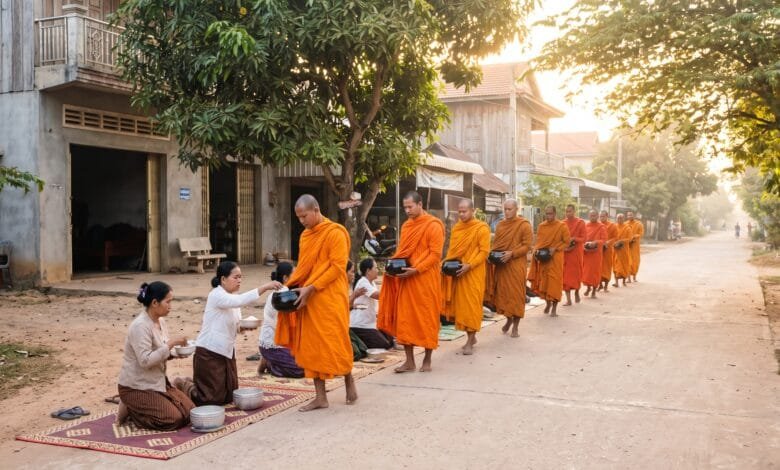
It is just after six in the morning in Siem Reap, and the streets are already busy. A line of monks in bright saffron robes walks slowly along the roadside, each carrying a large bowl. Women kneel on mats at the edge of the pavement, lifting handfuls of rice into the bowls as the monks pass. No one speaks. The only sounds are morning traffic and the soft shuffle of feet.
Most foreign travelers in Cambodia see something like this within their first few days. And most of them have the same question: What exactly is going on?
This article answers that question. It is a traveler’s introduction to Theravada Buddhism — the dominant religion in Cambodia — explained through what you will actually see, hear, and experience on your trip.
What Is Theravada Buddhism?
Theravada is one of the major branches of Buddhism. The name means “the way of the elders” in Pali, an ancient language used in Buddhist scriptures. It is the oldest surviving school of Buddhism and is practiced in Cambodia, Thailand, Laos, Myanmar, and Sri Lanka.
It is different from other forms of Buddhism you may have heard of, such as Zen (common in Japan and Korea) or Tibetan Buddhism (associated with the Dalai Lama). Theravada emphasizes the original teachings of the Buddha and a structured monastic tradition.
In very simple terms: Theravada Buddhism teaches that life involves suffering, that suffering has causes, and that it is possible to reduce suffering by living ethically, training the mind, and understanding the nature of reality. Monks dedicate themselves to this path full-time. Laypeople support them and try to follow the same principles in daily life.
For a traveler, the most important thing to know is that Theravada Buddhism is not just a set of private beliefs. It is woven into the social fabric. The pagoda (called a wat in Khmer) is a community center. Monks are visible in public. Religious practice happens in the open, not behind closed doors.
Why Does Buddhism Matter So Much in Cambodia?
Theravada Buddhism has been part of Cambodian life for centuries. It took firm root in the country in the late 13th century and gradually became the dominant religion of the Khmer people. Even today, it remains central to Cambodian identity.
But its importance is not about numbers or official status. It is about rhythm. Buddhism gives Cambodian life a daily rhythm — dawn almsgiving, monthly observance days, annual festivals, and life-cycle ceremonies. It shapes how people understand good and bad behavior, how they treat elders, how they mark birth, marriage, and death.
This rhythm is visible everywhere. In cities and villages alike, you will see monks walking, pagoda gates open, families making offerings, and small shrines in front of homes and businesses. Even many younger Cambodians who may not actively practice still participate in family religious ceremonies and respect the traditions.
For a traveler, understanding this rhythm helps make sense of Cambodia. It explains why certain days feel quieter, why streets fill with people carrying food to pagodas, and why monks are treated with such deep respect.
What Do Cambodian Buddhists Believe?
Before going further, a careful distinction is important. This section describes what Theravada Buddhists generally believe. It is not a statement of scientific or historical fact. It is a description of religious belief.
The core beliefs of Theravada Buddhism include:
The Four Noble Truths. Life involves dissatisfaction or suffering. This suffering has causes. It can end. And there is a path to end it.
Karma. Actions have consequences. Good actions bring good results; harmful actions bring harmful results. This is understood as a natural law, not a punishment from a god.
Rebirth. Most Theravada Buddhists believe that beings are reborn after death, and the quality of that rebirth is shaped by karma.
Merit. Making offerings, supporting monks, and doing good deeds generate merit, which improves one’s spiritual condition and can be shared with others, including deceased relatives.
The Three Refuges. Buddhists take refuge in the Buddha (the teacher), the Dhamma (the teachings), and the Sangha (the monastic community).
It is also important to remember that not all Cambodians believe or practice exactly the same way. Some are deeply devout. Some participate mainly on festival days. Some combine Buddhist practice with beliefs in local spirits and ancestors. The religious landscape is not uniform.
How Is Buddhism Practiced in Cambodia?
Theravada Buddhism in Cambodia is practiced in several interconnected ways.
Almsgiving (Tak Bat). Early each morning, monks walk through their communities with bowls to receive food from laypeople. This is not begging. It is a deliberate exchange: laypeople give material support, and monks provide spiritual guidance and the opportunity to make merit. The practice varies by location and community, but it is one of the most visible forms of religious life.
Pagoda life. The wat is not just a place of worship. It is a living community. Monks live there, study there, and often teach local children. Many young men and boys spend time as monks or novices — sometimes for a few weeks, sometimes longer. Temporary ordination is a traditional rite of passage for Cambodian men, often undertaken before marriage or after a family death.
Daily monk schedule. Monks rise before dawn to chant. They eat their main meal before noon and do not eat solid food after that. Their day includes study, prayer, cleaning the pagoda grounds, and sometimes teaching. They follow a large set of monastic rules — traditionally 227 — which guide everything from what they eat to how they interact with others.
Offerings and ceremonies. Laypeople bring food, flowers, incense, and sometimes robes to the pagoda. They may ask monks to chant blessings at weddings, funerals, and housewarmings. On observance days, especially full moon and new moon days, more people visit the pagoda to make merit.
Festivals. Major Buddhist festivals — such as Pchum Ben (the Festival of the Dead) and Visak Bochea (Buddha’s birthday) — bring religious life into public view on a larger scale. These are times when families gather, offerings are made, and the connection between Buddhism and community is especially visible.
What Will a Traveler Actually See?
Here are some of the most common Buddhist sights in Cambodia, and what they mean:
Monks in saffron robes. The bright orange-yellow robes are a uniform of sorts. They signal that the wearer has committed to the monastic path and the rules of the Sangha.
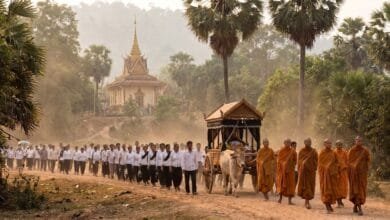
Bowl-carrying processions at dawn. As described at the start, this is almsgiving. Travelers may observe respectfully from a distance. Do not interfere with the line or try to join unless invited.
Pagoda gates and grounds. Wats are usually open to visitors during daylight hours. You will see buildings for worship, living quarters for monks, and often a school or community space.
Chanting. Pali chanting is a regular part of monastic life. It may sound unfamiliar, but it is a form of prayer, teaching, and meditation.
Offering trays with bananas, incense, and lotus buds. These are merit-making offerings. The specific items vary, but the intention is consistent: to give, to show respect, and to generate good karma.
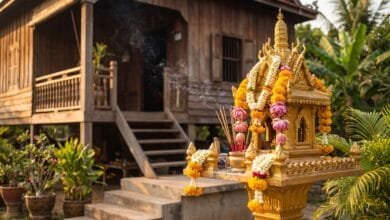
Spirit houses and small shrines. Not everything at a pagoda is strictly Buddhist. Many Cambodians also maintain beliefs in local spirits and guardian figures. These exist alongside Buddhism and are part of the broader spiritual landscape.
What Should Foreign Travelers Understand?
A few key points will make your experience richer and more respectful.
Buddhism is not a performance for tourists. The religious life you see is not staged. It is ordinary, daily practice. Observe with quiet respect.
The wat is a living space. People come to pray, mourn, celebrate, and rest. It is not a museum. Be mindful that your presence may be noticed, especially during ceremonies.
Monks are not guides or entertainers. They may or may not speak English. They may be busy with study or prayer. Do not expect them to stop and explain things. If a conversation happens naturally, that is a gift, not a service.
There is diversity. Rural and urban practice differs. Older and younger Cambodians may relate to religion differently. Some people are deeply devout; others are less so. Avoid assuming that everyone shares the same beliefs or practices in the same way.
Local beliefs coexist with Buddhism. Many Cambodians also honor ancestors, respect Neak Ta (local spirit guardians), and observe other traditional practices. These are not contradictions. They are part of a layered spiritual world.
How to Observe Respectfully
You do not need to be an expert to behave well at a Cambodian pagoda. A few simple habits go a long way.
Dress modestly. Cover your shoulders and knees. A light scarf or sarong in your bag is useful. This applies to men and women.
Remove your shoes and hat before entering temple buildings. This is a sign of respect, similar to removing your shoes before entering a home.
Do not touch monks. This is especially important for women. In Theravada tradition, monks do not have physical contact with women. If you wish to offer something, place it down for the monk to take, or hand it to a male companion. Do not hand items directly to a monk.
Sit lower than monks if you are in a seating area. Tuck your legs to the side rather than pointing your feet toward a Buddha image or a monk.
Ask before photographing people, especially monks and worshippers. Some pagodas allow photography; others do not. If in doubt, don’t.
Keep your voice low. Pagodas are places of calm. Loud conversations and laughter stand out.
Do not touch Buddha images or religious objects unless you are invited to.
For a broader overview of visitor etiquette in Cambodia, see CambodiaRecipe’s Travel Tips section.
Frequently Asked Questions
What religion is most common in Cambodia?
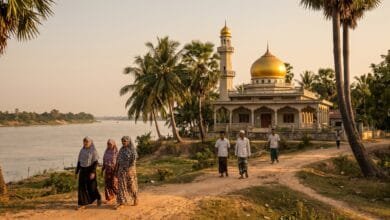
Theravada Buddhism is the dominant religion, practiced by the large majority of Cambodians. There are also Muslim, Christian, and other communities, as well as many people who hold traditional spirit and ancestor beliefs alongside Buddhist practice.
Can tourists enter Cambodian pagodas?
Yes, most wats welcome respectful visitors during daylight hours. Dress modestly, remove your shoes before entering buildings, and avoid disturbing anyone who is praying or making offerings.
Why do monks walk in the morning with bowls?
This is almsgiving (tak bat). Laypeople offer food to monks as a way of making merit. Monks do not cook for themselves; they rely on the community for their daily meal.
What is the difference between Theravada and other types of Buddhism?
Theravada is the oldest surviving Buddhist school and is common in Cambodia, Thailand, Laos, Myanmar, and Sri Lanka. It emphasizes the original teachings and a strong monastic tradition. Other forms, like Zen or Tibetan Buddhism, developed later and have different emphases.
Do all Cambodians practice Buddhism the same way?
No. Religious life varies by community, generation, and individual. Some people are deeply involved in daily practice; others participate mainly on festivals. Many also hold local spirit and ancestor beliefs alongside Buddhism.
Can women interact with monks?
Yes, but with some boundaries. Women should not touch monks or hand items directly to them. It is fine to speak respectfully from a distance or to place offerings down for a monk to receive.
Conclusion
Theravada Buddhism is not a separate part of Cambodian life that you visit and then leave behind. It is the background rhythm — the dawn almsgiving, the open pagoda gates, the saffron robes in the street, the offerings on a family altar. You do not need to understand every belief or follow every rule to appreciate it.
What matters most is attention. Notice what you see. Ask simple questions. Be quiet when quiet is needed. Be respectful of a tradition that has shaped this country for centuries.
If you leave Cambodia with a better sense of why that monk was walking at dawn and why that woman was kneeling with a bowl of rice, you have understood something real. That is more valuable than memorizing doctrine.
For more on Cambodian beliefs and traditions, explore CambodiaRecipe’s Religion & Beliefs section.