Kep Crab Market Guide: Fresh Seafood & Kampot Pepper in Cambodia
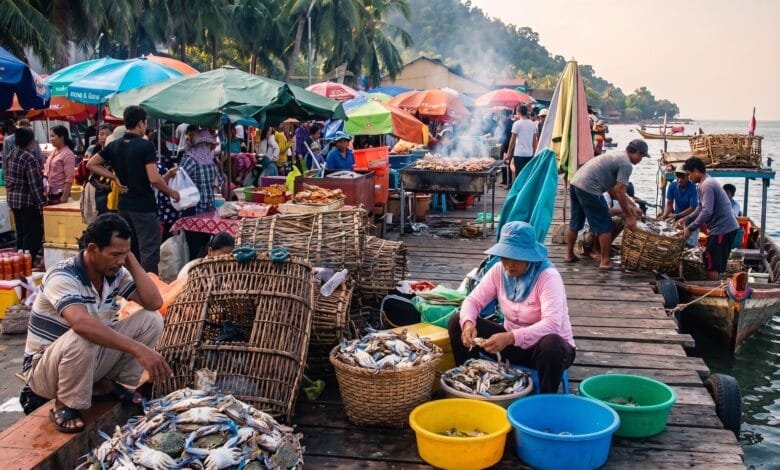
A Scent You Will Never Forget
The first thing that hits you is the smoke.
Not the clean smoke of a fancy restaurant grill. This is thick, fragrant smoke rising from small wooden shacks right on the water. It mixes with the salty sea breeze and the sharp smell of Kampot pepper sizzling in hot oil.
Then you hear the noise. Women in conical hats shout prices in Khmer. Fishermen pull baskets of live blue crabs onto the wooden docks. The crabs are so fresh they are still fighting to escape.
This is the Kep Crab Market. And it is one of the most unforgettable food experiences in Southeast Asia.
A Market with a Century of History
The Kep Crab Market – called Phsar Kdam in Khmer – sits right on the oceanfront in the small seaside town of Kep, in southern Cambodia.
The market covers about 1,600 square metres. It is separated from the sea by a long wooden pier where fishermen unload their catch directly.
The market’s story begins in the interwar years (1920s–1930s) , when the first seafood sellers set up to feed wealthy French colonial officials and Cambodian elites who came to Kep as a seaside escape.
Kep was founded in 1908 under the French protectorate. It became known as the “Saint-Tropez of Asia,” a glamorous resort town. Modernist villas rose on the hills in the 1950s and 1960s.
Then came the Khmer Rouge. From 1975 onward, the town was emptied. Its villas were looted, dynamited, or left to the weeds. For nearly three decades, Kep was a town of ruins.
But one thing never stopped: the fishing. And the small market where the catch was sold kept going.
The market came back to life around the turn of the 2000s, carried by the return of visitors and the growing reputation of Kep crab. Today, a giant blue crab statue welcomes visitors at the entrance to the bay.
Two Treasures, One Plate
The Kep Crab Market brings together two of Cambodia’s greatest gifts: the blue swimmer crab from the Gulf of Thailand and Kampot pepper.
Kampot pepper is not just any pepper. It is the first Cambodian product to receive Protected Geographical Indication (PGI) status from the European Union.
It was officially registered as a PGI on February 18, 2016. Kampot pepper had already received Geographical Indication status from Cambodia in 2010.
When you eat Kdam Chaa – crab fried with Kampot pepper – you are tasting something you cannot find anywhere else on earth.
What Makes Kampot Pepper So Special?
Kampot pepper is famous worldwide for its delicate aroma and strong, spicy taste.
In 2025, Cambodia exported 112 tonnes of Kampot pepper. About 85% goes to foreign markets. The remaining 15% is for local Cambodians.
The Kampot Pepper Promotion Association (KPPA) reported 2025 prices:
- · Black pepper: $17 per kilogram
- · Red pepper: $27 per kilogram
- · White pepper: $30 per kilogram
- · Green pepper: $10 per kilogram
The Kep Crab Market: The Main Event
Between 5:00 AM and 8:00 AM, the fishermen return with their daily catch. The blue swimmer crabs are still dripping with seawater. The women sort them right on the shore. The market is alive with energy.
By mid-morning, the best crabs are often sold out as supplies gradually sell out.
Best time to visit: The dry season from November to April offers the best weather. Weekdays are generally less crowded than weekends.