Cambodian Fermented Fish: The Women Producers Behind Prahok
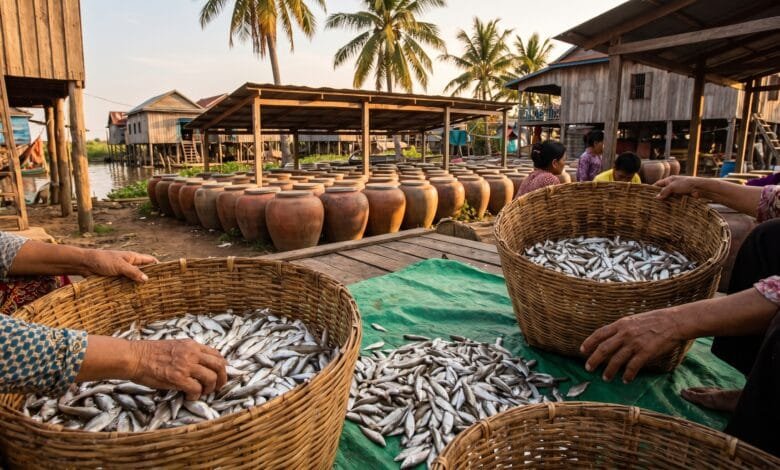
In a small village outside Kampong Cham, Touch Pov remembers the day a customer told her fish paste was “as salty as pure salt.” Instead of giving up, she spent years perfecting her recipe. Today, her fermented fish business earns over $10,000 a month.
Touch Pov is one of thousands of Cambodian fermented fish women producers who form the backbone of one of the country’s most important food traditions. From the shores of Tonle Sap to small family kitchens across the country, women are the primary makers of prahok — Cambodia’s iconic fermented fish paste.
This is the story of the women behind Cambodia’s fermented fish: who they are, how they make it, why it matters, and how travelers can experience this living tradition.
Quick Facts
Where This Story Begins
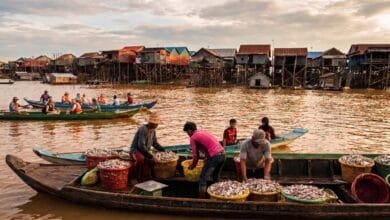
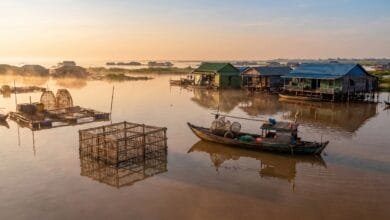
The story of Cambodian fermented fish begins in the water. Tonle Sap, Southeast Asia’s largest freshwater lake, provides the fish that becomes prahok. During the dry season — roughly November to February — millions of small fish migrate through the lake’s waterways. This is when the women who make prahok go to work.
The provinces surrounding Tonle Sap — Siem Reap, Battambang, Kampong Chhnang, and Pursat — are the heartland of prahok production. In 2013, official records showed more than 15,000 tons of prahok produced across eight Cambodian provinces, with Siem Reap leading at 3,825 tons. But the true scale is likely much larger, since most production happens at the household level.
The landscape here is defined by water and season. During the wet season, the lake expands dramatically, flooding surrounding forests and fields. When the waters recede, the fish are trapped in the shallows — and the women are ready.
Meet the Cambodian Fermented Fish Women Producers
Prahok is primarily produced by Cambodian women in fishing communities. This isn’t a new development — it’s a tradition that has shaped family life and local economies for generations.
Research has found that women’s decisions about prahok production are shaped by climate, economics, gender norms, and family responsibilities. For many women, making prahok is tied to their identity as caregivers and as entrepreneurs. As one study noted, prahok is “a marker of identity and pride for Cambodian women”.
In fishing communities around Tonle Sap, women process fish for both home consumption and sale. The work is often done at home, allowing women to balance household duties with income generation. Many small-scale producers make between 15 and 20 kilograms of prahok per day during peak season.
Some women have transformed family traditions into successful businesses. Touch Pov, now 63, started her fish processing business about 30 years ago. She began by selling dried fish at Kampong Cham market but struggled to make a profit. When customers complained her fermented fish was too salty, she didn’t give up — she experimented until she found the right balance.
“I sat down, looking at the fish — why is it too salty? Why can’t we make it right? We have our hands and feet, so let’s try.” — Touch Pov
Today, her enterprise — EPov Drief Fish Processing Handicraft — earns more than 50 million riel (over $12,000) per month from online and market sales. She now employs local workers and sells to Cambodians living abroad.
Women-owned enterprises account for 54 percent of fermented product businesses in Cambodia. This isn’t just about tradition — it’s about livelihoods, family income, and women’s economic empowerment.
How Prahok Is Made
Making prahok is labour-intensive work, and women are at every step of the process.
Step 1: Catching the Fish
The fish used for prahok are small freshwater species — typically mud carp (called trey riel in Khmer), along with other small fish. During the peak season, fishermen use giant nets called dai to collect the fish in large quantities.
Step 2: Cleaning and Preparing
The fish are beheaded, scaled, and cleaned. Traditionally, women would place the fish in flat baskets at the river’s edge and step on them to remove scales in the current. Today, some producers use machines for this step, but many still work by hand.
Step 3: First Salting
The cleaned fish are mixed with salt. The amount varies by producer and recipe — some use as little as 4-5% salt for the initial fermentation, while others use up to 30%. The fish are soaked in baskets overnight.
Step 4: Fermentation
The fish are packed into large earthenware jars, plastic containers, or concrete vats. More salt is added — typically 15-20% for bony prahok (prahok ch’oeung) or 25-30% for boneless prahok (prahok sach). Weights are placed on top to keep the fish submerged.
The mixture ferments for 3 to 12 months, depending on the fish species and the producer’s preference. Most producers use a 6-month fermentation. The container is kept sealed to prevent oxygen exposure, which would ruin the quality.
Step 5: Testing and Finishing
Experienced producers test the prahok by opening the container and checking the smell and texture. Some remove a small portion and steam it to evaluate the aroma and consistency.
The final yield from 100 kilograms of fresh fish is about 60 kilograms for bony prahok and 40 kilograms for boneless prahok.
The Season Behind the Product
Prahok production follows the rhythms of the lake. The peak season runs from November to February, during the dry season when fish are most abundant.
The Fisheries Administration of Cambodia announces the best times for prahok making each year, based on weather conditions. For example, in December 2025, the peak window was announced for December 25-31. These windows are carefully chosen — clear skies and no rain are essential for sun-drying the fish.
During these weeks, fishing villages come alive with activity. Women work from early morning to late evening, processing the catch before it spoils. The air fills with the distinctive smell of fish being cleaned, salted, and prepared for fermentation.
Outside the peak season, production slows but doesn’t stop entirely. Some women make smaller batches year-round, using fish from aquaculture or preserved supplies.
The Ingredient: What Makes Prahok Special?
Prahok is often called “Cambodian cheese” because of its strong aroma — reminiscent of ripe Camembert or Limburger. But its flavour is uniquely Cambodian.
There are two main types of prahok:
- Prahok Ch’oeung (ប្រហុកឈើង) — made with whole small fish, bones included, which soften during fermentation
- Prahok Sach (ប្រហុកសាច់) — boneless, made from larger fish like snakehead, with the bones removed
Siem Reap prahok is particularly famous, and in 2025 it was granted Geographical Indication (GI) status, recognising its unique quality and connection to the region.
The texture can range from lumpy to creamy, depending on the production method. The taste is intensely salty and umami-rich, with a depth of flavour that comes from months of fermentation.
“Prahok is the spirit of Khmer cuisine.” — Cambodian saying
From Farm to Cambodian Table
Prahok is everywhere in Cambodian cooking. It’s used as a seasoning, a condiment, and a central ingredient in countless dishes.
Common uses include:
- Soups — prahok adds depth to fish and vegetable soups
- Stir-fries — a small amount transforms vegetables and meat
- Dipping sauces — mixed with chilli, garlic, and lime juice
- Fish amok — the national dish often includes prahok
- Plain rice accompaniment — mixed with rice as a simple meal
The journey from women’s hands to the family table is direct. Much of Cambodia’s prahok never passes through a factory — it’s made at home, sold at local markets, and consumed within the community.
For Cambodians, prahok is more than food. It’s memory, identity, and home. As one study noted, “without its smell and flavour, food is not delicious”.
Why This Product Matters
Prahok matters on multiple levels.
Culturally, it is the cornerstone of Khmer cuisine. For centuries, it has been the flavour that defines Cambodian cooking. During the dry season, prahok — rich in protein and iron — has played a vital role in providing nutrition and food security.
Economically, it supports thousands of families. Most of the country’s prahok is made by small, family-scale producers. For women in fishing communities, it provides income, independence, and a way to contribute to their households.
Socially, it connects generations. Women learn the craft from their mothers and grandmothers. Each family has its own recipe and its own taste. This knowledge is passed down, keeping traditions alive in a rapidly changing world.
Yet challenges remain. Declining fish resources due to climate change and overfishing threaten production. Despite this, women continue making prahok — not just for profit, but to maintain their identity and cultural heritage.
What a Producer Visit Is Like
Visiting a Cambodian fermented fish producer offers a window into a world few travelers see.
In villages around Tonle Sap and in provinces like Kampong Cham, visitors may be able to observe women at work — cleaning fish, packing jars, testing the fermentation. The experience is sensory: the smell of fish and salt, the sight of rows of fermentation jars, the sound of women working and talking.
Some producers, like Touch Pov’s enterprise in Kampong Cham’s Boeung Snay Village, have become more organised and may be open to visitors with advance arrangements.
What you may see:
- Women cleaning and preparing fish
- Large jars or vats of fermenting fish
- Sun-drying areas
- The final product being packaged
What you may learn:
- The traditional process step by step
- The role of women in the community
- The importance of prahok in Khmer cuisine
- The challenges producers face
What you may taste:
- Fresh prahok (be warned — the flavour is intense!)
- Prahok-based dishes
- Other fermented fish products like mam or paork
Best Time to Visit
The best time to see prahok production is during the peak season from November to February. This is when the fish are most abundant and production is at its height.
Within this period, the Fisheries Administration announces specific windows for prahok making — typically a week or two around December to January. These are the most active times, when entire communities are involved in production.
For comfortable travel, Cambodia’s dry season (November to March) is also the most pleasant, with cooler temperatures and less rain.
How to Get There
The main prahok-producing regions are accessible from Phnom Penh or Siem Reap:
Kampong Cham — About 2 hours by road from Phnom Penh. Touch Pov’s enterprise is in Boeung Snay Village, Sambo Meas commune.
Siem Reap — The most famous prahok-producing province. Many producers are in villages around the Tonle Sap lake, particularly in Kompong Plouk commune.
Battambang — About 3-4 hours from Phnom Penh, with production along the river.
Note: Producer visits typically require advance arrangements. Not all producers are set up for tourism. It’s best to inquire locally or through a responsible tour operator.
What to Bring
- Sun protection — hat, sunglasses, sunscreen
- Comfortable shoes — you may be walking on uneven ground
- Water — it gets hot
- Camera — ask permission before photographing people
- Open mind — the smell can be strong!
Responsible Farm Tourism
When visiting producers:
- Ask before entering private or working areas
- Ask before photographing people — always get permission
- Don’t touch the product or equipment without permission
- Don’t treat producers as attractions — they are skilled workers
- Buy directly when possible — it supports the local economy
- Respect working spaces — production is serious work
- Follow local instructions — producers know best
Nearby Food or Travel Experiences
- Kampong Cham — Visit the local market to see fresh fish and prahok for sale
- Tonle Sap floating villages — Experience the lake that provides the fish
- Siem Reap — Try prahok in local restaurants and at the Old Market
- Phsar Prahok (Prahok Market) in Battambang — A market dedicated to fermented fish
Frequently Asked Questions
Where can I visit a prahok producer in Cambodia?
The main producing regions are around Tonle Sap (Siem Reap, Battambang, Kampong Chhnang) and Kampong Cham. Visits typically require advance arrangements through local contacts or tour operators.
What season is best for visiting?
November to February is the peak production season. Specific production windows are announced by the Fisheries Administration around December to January
Can travelers join the harvest or production?
Some producers may allow observation or participation with advance permission. This is not a standard tourist activity — arrangements should be made respectfully.
What does prahok taste like?
It’s intensely salty and umami-rich with a pungent aroma. The flavour is deeply savoury, often compared to strong cheese
How is prahok used in Cambodian food?
It’s used in soups, stir-fries, dipping sauces, and the national dish fish amok. It can also be eaten with plain rice
Is the producer open to visitors?
This varies. Some larger enterprises may be open with advance notice; most small-scale producers are not set up for tourism. Always ask respectfully.
How long does a visit take?
A typical producer visit might take 1-2 hours, depending on what’s being shown.
What should I bring?
Sun protection, comfortable shoes, water, and a camera (with permission). An open mind for the strong smell!
Final Thoughts
Behind every jar of prahok is a woman’s story. The Cambodian fermented fish women producers are the keepers of a tradition that has nourished the nation for centuries. From the shores of Tonle Sap to the markets of Phnom Penh, their hands transform humble fish into the flavour that defines Khmer cuisine.
These women are not just producers — they are entrepreneurs, caregivers, and cultural custodians. They face challenges from declining fish stocks and changing markets, yet they continue because prahok is part of who they are.
For travelers, visiting a producer offers more than a glimpse of food production. It’s a chance to understand Cambodia through its people — to see the land, the work, the tradition, and the table as one connected story.
The next time you taste prahok in a Cambodian dish, remember the women who made it. Their hands, their knowledge, and their dedication are the true ingredients.