Cambodian Fruit Calendar: What’s in Season Every Month
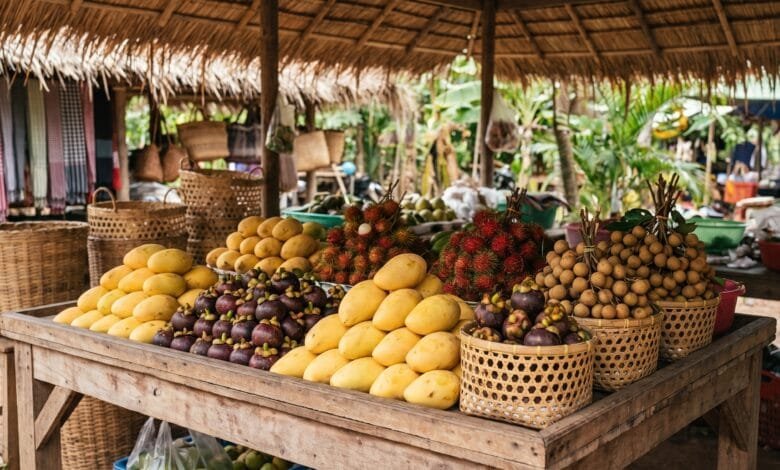
Cambodia’s tropical climate produces an astonishing variety of fruit throughout the year. If you’re planning a trip, the fruit you’ll see at markets, roadside stalls, and hotel breakfast buffets depends heavily on the month you visit. Some fruits, like mango and coconut, appear almost year-round. Others, like durian and mangosteen, have short, intense seasons that locals eagerly await.
This guide walks you through the Cambodian fruit calendar month by month, explains what each fruit tastes like, and gives you practical advice for trying them as a traveler. Whether you’re visiting during the dry-season mango peak or the rainy-season rambutan harvest, you’ll know exactly what to look for.
How Cambodia’s Seasons Shape Fruit Availability
Cambodia has two main seasons: the dry season from November to April and the rainy season from May to October. Fruit production follows this rhythm closely. Many trees flower during the dry months and bear fruit as the rains arrive. Others, like the sugar palm, are tapped for juice during the coolest part of the year.
That said, Cambodia’s fruit calendar isn’t rigid. Climate variation, irrigation, and modern farming practices mean some fruits are available outside their traditional seasons. But for the freshest, most flavorful, and most affordable produce, timing your visit around peak season makes a real difference.
The Cambodian Fruit Calendar at a Glance
| Month | Fruits at Their Best |
|---|---|
| January | Milk fruit (star apple), sugar palm fruit, early mangoes, watermelon, pomelo, guava, banana, coconut |
| February | Mango (peak begins), milk fruit, sugar palm fruit, watermelon, pomelo, jackfruit |
| March | Mango (peak), watermelon, jackfruit, pomelo, banana, coconut, papaya |
| April | Mango (peak), jackfruit, watermelon, lychee, santol, java plum |
| May | Durian (early), mangosteen (early), rambutan (early), mango, jackfruit, java plum |
| June | Durian (peak), mangosteen (peak), rambutan (peak), santol, java plum |
| July | Durian (late), mangosteen (late), rambutan, longan (early), santol |
| August | Rambutan (late), longan (peak), mangosteen (late), jackfruit, banana, coconut |
| September | Longan (peak), sapodilla, jackfruit, papaya, banana, coconut |
| October | Longan (late), sapodilla, pomelo (first harvest), jackfruit, coconut |
| November | Pomelo (harvest), sapodilla, sugar palm juice (begins), longan (late) |
| December | Sugar palm juice (peak), milk fruit (early), early mangoes, pomelo, watermelon, longan |
Now let’s look at the key fruits more closely, season by season.
Dry Season Fruits (November to April)
The dry season is mango time in Cambodia. It’s also when you’ll find watermelon, pomelo, and early sugar palm products.
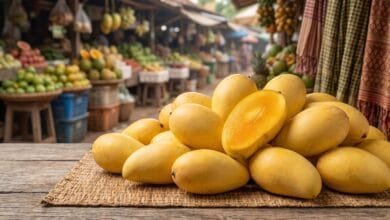
Mango (Svay) — Peak: February to April
Mango is arguably Cambodia’s most beloved fruit. The Khmer word is svay, and you’ll hear vendors call out different varieties: Svay Keo Chin, Svay Keo Lameat, Svay Phum Sen, and others. Each has its own character.
- Svay Keo Chin is the most prized variety. It’s sweet, aromatic, and expensive compared to others.
- Svay Keo Lameat is widely planted and commonly eaten green or half-ripe with chili and salt.
- Svay Phum Sen is very sour when green but becomes sweet and rich when ripe.
Mango season starts around December when trees begin flowering, and peaks from February to April. By May, the best fruit is mostly gone. If you visit during Khmer New Year in mid-April, you’ll hit the tail end of peak mango season — still excellent, but prices may be rising.
What it tastes like: Ripe Cambodian mangoes are intensely sweet with a floral, honey-like aroma. The flesh is soft, juicy, and golden-orange. Green mangoes are crunchy, tart, and refreshing — often served with a dip of chili, salt, and sometimes sugar.
Watermelon (Ovloek) — Peak: November to April
Watermelon is grown widely in Cambodia and is especially popular during the hot dry months. Farmers typically plant it after the rice harvest, from November onward. The fruit is refreshing and sweet, and you’ll find it sliced and sold at markets and roadside stalls throughout the cool season.
Pomelo (Kroch Thlong) — Harvest: October–November and March–April
Cambodia’s most famous pomelo comes from Koh Trong, a small island in the Mekong River near Kratie. The fruit is harvested twice a year. Koh Trong pomelos are known for their sweet, crunchy segments and relatively thin skin. You’ll also find pomelos grown in Kampong Cham and Battambang.
Pomelo is not a grapefruit. It’s larger, sweeter, and much less bitter. The thick pith is usually peeled away, and the segments are eaten fresh or used in salads.
Sugar Palm Fruit and Juice (Tnot) — Juice: December to May
The sugar palm tree — deum tnot in Khmer — is a symbol of Cambodia itself. You’ll see it towering over rice fields across the country. From December through May, tappers climb these trees to collect the sweet sap from the male flower stalks. The juice is drunk fresh, fermented into palm wine, or boiled into palm sugar.
The palm fruit itself, which grows in clusters of black-skinned, jelly-like seeds, ripens later in the season. It’s eaten fresh or made into desserts.
Hot Season Transition (April to May)
As the dry season ends and the rains begin, Cambodia’s most dramatic fruit season kicks off. This is when durian, mangosteen, and rambutan start appearing — the “royal trio” of Southeast Asian fruit.
Jackfruit (Khnol) — Peak: March to May
Jackfruit is the largest tree-borne fruit in the world, and it’s abundant in Cambodia. The season runs from March to May, though you’ll find it year-round. Ripe jackfruit has bright yellow, sweet, banana-like flesh that’s eaten fresh as a snack. Unripe jackfruit is used in savory dishes, curries, and soups.
What it tastes like: Ripe jackfruit is intensely sweet and tropical, with a flavor reminiscent of a mix of banana, pineapple, and mango. The texture is chewy and slightly fibrous. The seeds can be boiled or roasted and eaten like chestnuts.
Java Plum (Pring) — Peak: April to June
Java plum, known as pring in Khmer, is a small, purple-black fruit with a mix of bitter, sour, and sweet flavors. It grows on trees that often line rice fields and village roads. During its short season, you’ll see piles of it at markets. It’s eaten fresh with salt or sugar, and some people make it into juice or wine.
Santol (Kompong Reach) — Peak: April to June
Santol is a round, brownish fruit with a thick rind and cotton-like white flesh surrounding large seeds. It tastes sweet and sour. Most commonly it’s eaten with salt, and some people enjoy it with chili. It’s widely grown in provincial areas and often sold by roadside vendors.
Rainy Season Fruits (May to October)
The rainy season brings Cambodia’s most famous — and most divisive — fruits. This is durian and mangosteen season.
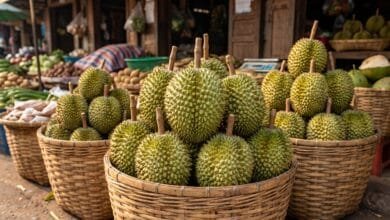
Durian (Thouren) — Peak: May to July
Durian is called the “king of fruits” for good reason. It’s large, spiky, and famous for its powerful smell, which has led to bans in some hotels and public transport. But those who love it describe the flesh as creamy, rich, and complexly sweet.
Cambodia’s most famous durian comes from Kampot province. Kampot durian is known for its particularly sweet, smooth flesh. Other durian-growing provinces include Battambang, Pursat, Kampong Cham, and Tboung Khmum.
What it tastes like: The flavor is hard to describe — somewhere between almond custard, sweet onion, and tropical fruit. The texture is soft and creamy, like a rich pudding. The smell is strong and sulfury, which is either intoxicating or overwhelming depending on who you ask.
Traveler tip: If you’re durian-curious, start with a small piece at a market. Vendors often sell individual segments. Don’t buy a whole fruit unless you’re committed. And check your hotel’s policy — many prohibit durian in rooms.
Mangosteen (Meangkhout) — Peak: May to July
Mangosteen is called the “queen of fruits,” and its season overlaps perfectly with durian. The fruit has a thick, dark purple rind that you break or cut open to reveal snow-white segments of flesh. The taste is sweet, slightly tangy, and incredibly refreshing.
What it tastes like: Mangosteen has a delicate, sweet-tart flavor that’s often described as a cross between lychee and peach, with a hint of citrus. The flesh is soft and juicy, with a texture similar to a ripe plum. Each fruit contains a few segments, and some have a small seed you spit out.
How to eat it: Score the rind around the middle with a knife, then twist the two halves apart. The white segments inside are the edible part. Don’t eat the purple rind — it stains and tastes bitter.
Rambutan (Sav Mav) — Peak: June to August
Rambutan is a small, round fruit covered in soft, fleshy spines that range from red to yellow-green. It’s related to lychee and longan. Inside the spiky shell is a translucent white fruit with a sweet, slightly acidic flavor.
What it tastes like: Rambutan is sweet and juicy, with a flavor similar to lychee but slightly more tart. The texture is firm and grape-like. It’s very refreshing, especially when chilled.
How to eat it: Use your thumbnail or a small knife to cut around the shell, then peel it away. Pop the fruit in your mouth and spit out the single seed. Don’t bite the seed — it’s bitter.
Longan (Mien) — Peak: July to September
Longan means “dragon eye” in Chinese, and the name fits. The fruit is small, round, and tan-colored, with a translucent white flesh and a single dark seed that shows through — like an eye. Cambodian longan is especially associated with Pailin province on the Thai border. The Pailin longan variety is famous for its sweetness and large size.
What it tastes like: Longan is very sweet and musky, with a flavor similar to lychee but milder and more honeyed. The texture is firm and slightly crunchy. It’s often eaten fresh, but you’ll also find it in desserts and drinks.
Late Year Fruits (September to November)
As the rains taper off, the fruit calendar shifts to sapodilla, early pomelo, and the return of sugar palm juice.
Sapodilla (Lmut) — Peak: September to November
Sapodilla is a small, brown, oval fruit with rough skin. Inside, the flesh is soft, sweet, and grainy, with a flavor that’s often compared to brown sugar or molasses. It’s sometimes called “chikoo” or “sapota.”
What it tastes like: Sapodilla is very sweet, with a flavor reminiscent of brown sugar, pear, and a hint of caramel. The texture is soft and slightly gritty, like a ripe pear. The seeds are black and shiny — don’t eat them.
Sapodilla is grown in warm regions like Kep, Kampot, and Siem Reap. It’s a quiet, underappreciated fruit that many travelers have never tried.
Milk Fruit / Star Apple (Phlai Teuk Doh Ko) — Peak: January to February (and Late Season)
Milk fruit, also called star apple or caimito, is a round fruit with smooth, purple or green skin. Inside, the flesh is white, soft, and sweet with a milky texture — hence the name. It’s considered the “princess” of Cambodian fruits, alongside durian (king), mangosteen (queen), and sapodilla (prince).
What it tastes like: Milk fruit is moderately sweet with a mild, creamy flavor. The texture is soft and jelly-like. It’s usually eaten fresh, and the flesh is scraped from the skin with a spoon or eaten in segments.
Fruits Available Year-Round
Some Cambodian fruits don’t follow a strict season. You’ll find them at markets any month of the year.
Banana (Chek) — Year-Round
Cambodia grows many varieties of banana, from small, sweet finger bananas to larger, starchier cooking bananas. They’re eaten fresh, grilled, fried, or used in desserts like num chek (banana cake).
Coconut (Dong) — Year-Round
Coconut is everywhere in Cambodia. Young coconuts are sold for their refreshing water, which is drunk straight from the shell. The flesh of mature coconuts is used in curries, desserts, and cooking. You’ll see coconut vendors with carts full of fresh coconuts on almost every street corner.
Papaya (Lhong) — Year-Round
Green papaya is a staple in Cambodian cooking, especially in salads like bok lahong. Ripe papaya is eaten fresh as a sweet, soft fruit. The tree produces fruit continuously, so it’s always available.
Guava (Traw Baek) — Year-Round
Guava is a small, round or pear-shaped fruit with green skin and pink or white flesh. It’s crunchy, sweet, and slightly tart. Cambodians often eat it with a dip of salt, sugar, and chili.
How to Try Cambodian Fruit Like a Local
At the market: Look for fruit stalls with the widest variety. Vendors often sell pre-cut fruit in bags or on plates, usually with a small packet of chili-salt dip. This is the easiest way to try several fruits at once.
The chili-salt dip: A mix of salt, sugar, and chili powder (sometimes with MSG) is the classic Cambodian fruit dip. It sounds unusual if you’re used to eating fruit plain, but it brings out the sweetness and adds a savory kick. Try it at least once.
Street vendors: Mobile fruit carts sell pre-cut fruit on sticks or in bags. This is convenient but slightly more expensive than buying whole fruit at a market. For the best value, buy whole fruits and peel them yourself.
Food safety: Fruit sold in Cambodia is generally safe to eat. Pre-cut fruit from reputable vendors is usually fine. If you’re concerned, stick to fruits you peel yourself — bananas, mangosteen, rambutan, longan, and durian all come in their own natural packaging.
What Travelers Should Know
- Strong smells: Durian is banned in many hotels, buses, and airplanes. Check before you buy.
- Seeds and skins: Most tropical fruits have inedible seeds or skins. Ask a vendor or watch how locals eat if you’re unsure.
- Seasonal scarcity: If a fruit is out of season, it may be imported from Thailand or Vietnam — often more expensive and less flavorful than local fruit.
- Price: Fruit prices vary by season and location. In peak season, local fruit is cheap. Out of season, expect to pay more.
- Unfamiliar flavors: Some Cambodian fruits taste unlike anything in a US supermarket. That’s part of the adventure. Start with sweeter fruits like mango, longan, and rambutan if you’re cautious, then work your way up to durian.
Frequently Asked Questions
What is the most popular fruit in Cambodia?
Mango is probably the most beloved fruit in Cambodia. It’s eaten ripe, green, and in salads. Coconut, banana, and jackfruit are also staples.
When is mango season in Cambodia?
Mango season runs roughly from December to May, with peak availability from February to April.
When is durian season in Cambodia?
Durian season is short, typically from May to July. Kampot durian is the most famous variety.
What does mangosteen taste like?
Mangosteen is sweet and slightly tangy, with a flavor often compared to a mix of lychee and peach. The flesh is soft and white.
Can I find these fruits outside Cambodia?
Some fruits like mango, coconut, and banana are widely available internationally. Others like durian, mangosteen, and rambutan are sold frozen or fresh in Asian grocery stores in the US and other countries. Sapodilla and milk fruit are harder to find outside Southeast Asia.
Is it safe to eat fruit from Cambodian street vendors?
Generally, yes. Pre-cut fruit from busy stalls is usually fresh. If you have a sensitive stomach, stick to fruits you peel yourself, like banana, mangosteen, or rambutan.
Conclusion
Cambodia’s fruit calendar is one of the best reasons to visit at any time of year. From the mango-heavy dry season to the durian-and-mangosteen peak of the early rains, each month offers something new to taste. For travelers, the key is knowing what to look for and being willing to try something unfamiliar. A plate of pre-cut fruit with chili-salt dip at a market stall can be one of the most memorable food experiences of a Cambodia trip. Use this calendar to plan your visit, but stay flexible — fruit seasons shift slightly from year to year, and the best discoveries often happen by chance.