Cambodia Flag History: Why Angkor Wat Appears on a National Flag
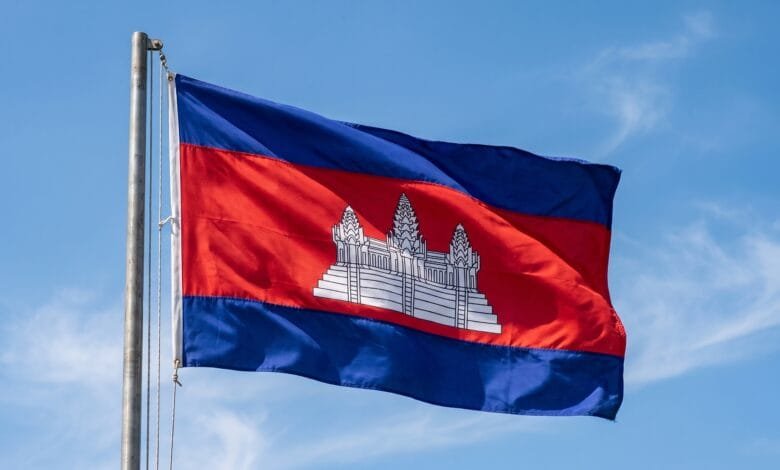
When you look at Cambodia’s national flag, you are looking at more than a piece of cloth. You are looking at a 900-year-old temple. You are looking at a symbol that survived colonialism, war, revolution, and genocide. And you are looking at one of the only national flags in the world that features an actual, identifiable building — the legendary Angkor Wat.
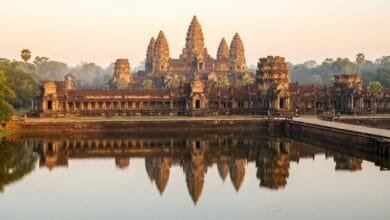
Most national flags use simple shapes, stars, or stripes. Cambodia’s flag is different. In the center of its red-and-blue stripes stands a white temple with three towers. That temple is Angkor Wat, the largest religious monument in the world and a UNESCO World Heritage Site since 1992.
But why is a building on a flag? And how did this design survive through decades of dramatic change? To understand Cambodia’s flag, you need to understand Cambodia’s history.
Quick History Information
| Information | Details |
|---|---|
| Historical Period | c. 1863 – present |
| Approximate Dates | First flag: c. 1863; Current design readopted: 1993 |
| Main Location | Cambodia (Kingdom of Cambodia) |
| Key Figures | King Norodom, Lon Nol, Norodom Sihanouk |
| What Happened | The flag evolved through colonial rule, independence, republic, Khmer Rouge rule, Vietnamese-backed government, and restored monarchy |
| Why It Matters | The flag reflects Cambodia’s national identity and its connection to the Angkorian past |
| What Remains Today | The 1948 design, restored in 1993, is the current national flag |
The Meaning Behind Cambodia’s Flag
Before exploring the flag’s history, it helps to understand what the current flag represents.
The Cambodian flag has three horizontal stripes. The top and bottom stripes are blue. The middle stripe is red and twice as wide as each blue stripe. In the center of the red stripe, there is a white depiction of Angkor Wat outlined in black. The stripes follow a 1:2:1 ratio — blue, red (double width), blue.
The flag reflects the trilogy of Nation, Religion, and King — the motto of the Khmer monarchy.
What Do the Colors Mean?
The colors carry specific meanings. According to widely cited interpretations:
- Blue represents the monarchy, as well as liberty, cooperation, and brotherhood.
- Red represents the nation and the bravery of the Cambodian people.
- White represents purity and religion (Buddhism).
These meanings are commonly described in sources such as the CIA World Factbook, which notes that “red and blue are traditional Cambodian colors”. Wikipedia’s summary of flag symbolism links Angkor Wat to integrity, justice, and heritage; blue to liberty, cooperation, and brotherhood; and red to bravery.
Some sources slightly vary in their explanations. For example, one Cambodian consulate source describes blue as representing “the Royalty of Cambodia, or freedom and co-operation” and red as “the Cambodia nation and bravery and loyalty of its people”. The core meanings remain consistent across sources.
Why Angkor Wat?
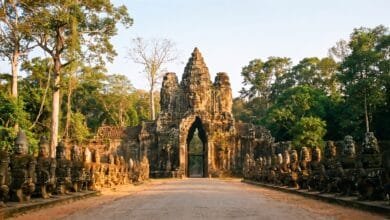
Angkor Wat is not just a temple. It is the most recognizable symbol of Cambodia’s golden age — the Khmer Empire, which flourished from the 9th to the 15th centuries. UNESCO describes the Angkor archaeological park as containing “the magnificent remains of the different capitals of the Khmer Empire”.
By placing Angkor Wat on the flag, Cambodia connects its modern identity to its ancient heritage. According to the CIA World Factbook, Cambodia’s flag is the only national flag to prominently incorporate an actual identifiable building into its design. A few other flags — Afghanistan, San Marino, Portugal, and Spain — show small generic buildings as part of their coats of arms, but none feature a specific, recognizable structure the way Cambodia does.
The First Cambodian Flags (1863–1948)
The story of Cambodia’s flag begins during a difficult period. In 1863, Cambodia became a French protectorate. The kingdom lost much of its independence, but it did not lose its sense of identity.
The first Cambodian flag probably came into existence around 1863. It was used, with only minor variations, until 1948. This early flag featured a red field with a blue border and a white representation of Angkor Wat in the center.
Interestingly, the use of Angkor Wat on a Cambodian flag dates back even further. According to Britannica, “the central building of Angkor Wat has appeared on Khmer national flags since the 19th century, in the early days of the French protectorate over Cambodia”.
This flag was not just a symbol of national pride. It was also a quiet statement of identity under colonial rule. Even as France controlled Cambodia’s government and foreign affairs, the flag reminded Cambodians of their own remarkable history.
The 1948 Flag: A New Design for a New Era
After World War II, Cambodia moved toward independence. In 1948, a new flag was adopted. According to Britannica, the flag was “modernized” in 1948 by adopting “unequal horizontal stripes of dark blue, red, and dark blue, and the temple was altered to correspond more closely to the original”.
According to Flags of the World, on 20 October 1948, a new flag was adopted: a horizontal triband with blue, red, and blue stripes (in a 1:2:1 ratio), with Angkor Wat depicted in white in the center.
This flag accompanied Cambodia into independence in 1953 and became a powerful symbol of national sovereignty. It was used until 9 October 1970, when political upheaval brought a new flag — and a new era.
A Flag for a New Republic: The Khmer Republic (1970–1975)
In March 1970, while Prince Norodom Sihanouk was traveling abroad, he was overthrown by Lon Nol, a military general who had served in the Cambodian government. The monarchy was abolished, and the Khmer Republic was proclaimed.
On 9 October 1970, a new flag was introduced. Britannica describes it clearly: “The ‘core flag’ became the canton, while the field was blue with three white stars”. In other words, the new flag had a blue background, with a red rectangle in the upper-left corner containing the white Angkor Wat, and three white stars in the upper-right area.
The three stars were sometimes interpreted as representing the three branches of government or the military. Some Cambodians assumed they stood for the stars on Lon Nol’s military uniform.
This flag was used until April 1975, when the Khmer Rouge captured Phnom Penh. It represents a brief, turbulent chapter in Cambodian history — one that coincided with the intensification of the Cambodian Civil War and heavy US bombing campaigns in the region.
The Khmer Rouge Flag (1975–1979)
When the Khmer Rouge took control of Cambodia on 17 April 1975, the country’s flag changed again — dramatically. The new rulers of what they called “Democratic Kampuchea” rejected the old flag entirely.
For a brief period after April 1975, the 1948–1970 flag was still used at the United Nations, while inside Cambodia plain red flags were reported. But on 5 January 1976, the Khmer Rouge adopted an official flag: a red field with a three-towered Angkor Wat silhouette in yellow.
This flag was unusual among communist state flags because it had no red or gold star, hammer and sickle, or other standard socialist symbols. Instead, it used the Angkor Wat silhouette, which was heavily stylized.
The Khmer Rouge period, from 17 April 1975 to 7 January 1979, was one of the darkest chapters in Cambodian history. The Extraordinary Chambers in the Courts of Cambodia (ECCC) documents mass crimes during this period, including forced displacement, forced labor, torture, executions, forced marriage, and persecution. The ECCC cites estimates of approximately 1.5 to 2 million deaths.
The Khmer Rouge flag remains a painful symbol for many Cambodians. It is a reminder of a time when the country’s own government turned against its people.
The People’s Republic of Kampuchea (1979–1989)
In January 1979, Vietnamese forces entered Cambodia and drove the Khmer Rouge from power. A new government was established: the People’s Republic of Kampuchea.
According to Britannica, this government “revived the flag adopted by the Khmer Issarak in the days of anti-French resistance” — a red flag with a five-towered yellow Angkor Wat silhouette. The five-towered design was a change from the three-towered version used by the Khmer Rouge, and it more closely resembled the actual towers of Angkor Wat.
When the People’s Republic of Kampuchea renamed itself the “State of Cambodia” in 1989, the flag was modified again. According to Wikipedia, the flag’s lower half was changed, and the design moved closer to the current flag.
During this period, Cambodia remained isolated internationally. The United Nations still recognized the Khmer Rouge coalition as Cambodia’s legitimate government for many years. Multiple flags representing different factions were used simultaneously — a reflection of the country’s fractured political situation.
Returning to the 1948 Design (1993–Present)
The long period of conflict began to end in the late 1980s and early 1990s. The Paris Peace Agreements of 1991 paved the way for a United Nations-administered transition. The UN flew its own light blue flag with a silhouette map of Cambodia during this period.
In 1993, Cambodia held elections under UN supervision. The monarchy was restored, and Norodom Sihanouk returned as King. On 30 June 1993, the 1948 flag — the blue-red-blue triband with the white three-towered Angkor Wat — was hoisted once again.
The 1993 Constitution of the Kingdom of Cambodia formalized this decision. Article 6 states that “the national flag, anthem and coat-of-arms shall be defined in Annexes I, II and III”. Annex I contains the official description of the flag.
According to Wikipedia, the flag was “readopted on 24 September 1993 following the 1993 Cambodian Constituent Assembly election and the restoration of the Cambodian monarchy”. Some sources also note the flag was initially adopted in its current form in 1989 during the State of Cambodia period before being formally readopted in 1993.
The flag that Cambodians fly today is essentially the same design that accompanied their country into independence in 1953. Its return in 1993 symbolized a return to stability, national identity, and hope.
What the Flag Means to Cambodians Today
For Cambodians, the flag is more than a national symbol. It is a statement of survival.
The flag connects modern Cambodia to the glory of the Khmer Empire. When Cambodians see Angkor Wat on the flag, they see proof that their ancestors built something extraordinary — something that still stands today. UNESCO recognized the Angkor archaeological park as a World Heritage Site on 14 December 1992, and it has become a powerful source of national pride.
The flag also reflects the country’s Buddhist identity. According to the Pew Research Center, Buddhist or Hindu religious symbols appear on only five national flags, and Cambodia’s is one of them. The temple of Angkor Wat is historically associated with both Hinduism and Buddhism.
And the flag represents resilience. The fact that the same design was used in 1948, discarded in 1970, and restored in 1993 tells a story of a country that lost and found itself again.
Why This History Matters to Travelers
If you are traveling to Cambodia, knowing the flag’s history can deepen your experience. When you visit Angkor Wat in Siem Reap, you will be standing before the temple that appears on every Cambodian flag. Understanding why that symbol matters can transform your visit from sightseeing into a meaningful connection with Cambodia’s past.
You will also notice the flag everywhere — on buildings, in schools, at government offices, and during national celebrations. Knowing its story helps you see it not as decoration, but as a living symbol of a country that has endured and rebuilt.
For American travelers in particular, the flag’s history connects to a period of US involvement in Southeast Asia. The Khmer Republic flag was in use during the Cambodian Civil War, a conflict that became entangled with the Vietnam War. Understanding the flag’s evolution offers a window into how Cambodia experienced one of the most turbulent periods in modern Southeast Asian history.
Frequently Asked Questions
Why does Cambodia’s flag have a temple on it?
Cambodia’s flag features Angkor Wat because it is the most recognizable symbol of the Khmer Empire, which flourished from the 9th to the 15th centuries. UNESCO describes the Angkor archaeological park as containing “the magnificent remains of the different capitals of the Khmer Empire”. The temple represents Cambodia’s cultural heritage and national identity.
What do the colors of the Cambodian flag mean?
When was the current Cambodian flag adopted?
What did the Cambodian flag look like during the Khmer Rouge period?
Is Cambodia the only country with a building on its flag?
Cambodia’s flag is one of only a few national flags to feature an identifiable building. The CIA World Factbook notes that Afghanistan, San Marino, Portugal, and Spain show small generic buildings as part of their coats of arms, but Cambodia’s flag is the only one to prominently feature an actual identifiable building — Angkor Wat.
What happened to the Cambodian flag after the Khmer Rouge was removed from power?
Can travelers visit Angkor Wat today?
Yes. Angkor Wat is located in the Angkor Archaeological Park in Siem Reap province, about 315 kilometers northwest of Phnom Penh. The site was inscribed on the UNESCO World Heritage List in 1992 and is Cambodia’s largest cultural tourism destination.
Why does the Cambodian flag matter?
For Cambodians, the flag is a symbol of national identity, resilience, and pride. It connects the modern nation to its ancient heritage and represents the country’s survival through decades of conflict. For travelers, understanding the flag adds depth to every visit to Cambodia’s historical sites.
Conclusion
The history of Cambodia’s flag is a history of Cambodia itself. From the French protectorate to the Khmer Republic, from the Khmer Rouge to the restored monarchy, the flag has changed with the country’s fortunes.
But one thing has remained constant: Angkor Wat. For more than 150 years, the temple has stood at the center of Cambodia’s national symbol. It is a reminder that even when Cambodia’s government changed, its identity did not. The temples of the Khmer Empire still stand. The Khmer people still carry their heritage forward.
When you see the Cambodian flag during your travels, take a moment to look at it closely. The blue and red stripes, the white temple in the center — they tell a story. It is a story of a country that has been through everything and is still standing. And now you know that story.