Why Suryavarman II Built Angkor Wat: The King, the God, and the Tomb
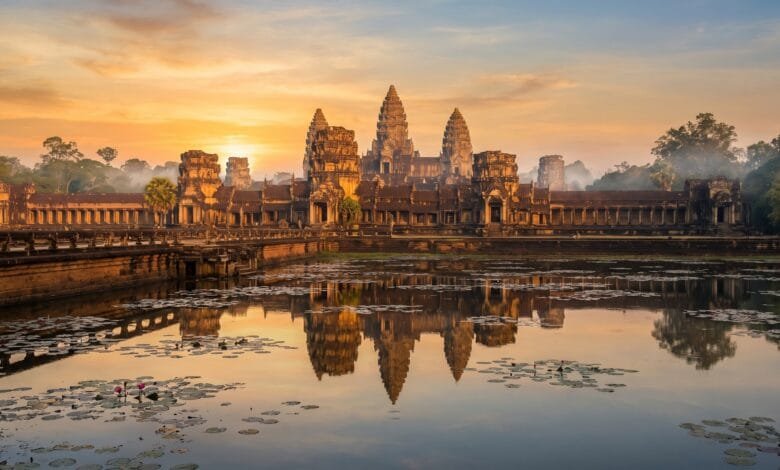
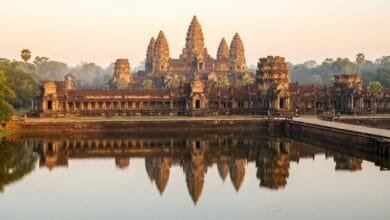
When travelers stand on the long sandstone causeway leading to Angkor Wat, they are walking toward the largest religious monument ever built. The five towers rise ahead like stone lotus buds, mirrored in the still water of the moat. It is a breathtaking sight. But the question that often lingers after the photographs are taken is simpler: Why? Why did a Khmer king nearly 900 years ago decide to build something this vast, this precise, and this beautiful? The answer lies in the ambitions of one man, Suryavarman II, and in a moment when Khmer religion, politics, and architecture converged in a way that had never happened before.
Quick History Information
| Information | Details |
|---|---|
| Historical Period | Khmer Empire, 12th century CE |
| Approximate Dates | 1113–1150 CE |
| Main Location | Angkor, near present-day Siem Reap, Cambodia |
| Key Figure | King Suryavarman II |
| What Happened | Suryavarman II commissioned Angkor Wat as his state temple and funerary monument |
| Why It Matters | Angkor Wat became the largest religious monument in the world and the defining symbol of Khmer civilization |
| What Remains Today | Angkor Wat is a UNESCO World Heritage Site and Cambodia’s most visited monument |
Who Was Suryavarman II?
Suryavarman II was not born to rule without a struggle. He came to the Khmer throne in 1113 CE after defeating a rival prince in a battle that Khmer inscriptions describe in vivid detail. One inscription states that he “killed him, as Garuda on the edge of a mountain would kill a serpent,” referring to his rival. This was a time when central control over the Khmer Empire had weakened, and different claimants competed for power.
Once he secured the throne, Suryavarman II proved to be an ambitious and warlike ruler. He expanded the empire to include much of present-day Thailand and parts of Laos, reaching the borders of the Burmese kingdom of Pagan to the west and the Gulf of Thailand to the south. He also launched campaigns against Champa, in what is now southern Vietnam, though not all of these were successful.
But Suryavarman II is remembered less for his military campaigns than for what he built. Britannica describes him as a “religious reformer and temple builder”. His reign marked a shift in Khmer royal religion: unlike most of his predecessors, who focused on the Hindu god Shiva, Suryavarman II placed Vishnu at the center of court religious life. It was this devotion to Vishnu that shaped his greatest monument.
The Religious World of the Khmer Empire
To understand why Angkor Wat was built, it helps to understand how religion and kingship worked in the Khmer Empire. Khmer kings were not just political leaders. They were seen as links between the human world and the world of the gods. Building temples was one of the most important ways a king could demonstrate his devotion, legitimize his rule, and secure his place in history.
Hinduism had been present in Cambodia for centuries, carried by traders and priests from India. The Khmer Empire’s culture, language, and political ideas were deeply influenced by Indian models. Most Khmer kings before Suryavarman II had dedicated their state temples to Shiva. Suryavarman II changed this pattern.
Why Vishnu? Vishnu was associated with preservation, order, and kingship. By dedicating his great temple to Vishnu, Suryavarman II was making a statement: his rule was not just political but divine. Britannica notes that he “blended the mystical cults of Vishnu and Shiva” and made Vaishnavism the official religion, replacing the Buddhism that had briefly gained popularity under his predecessors.
Why Build Angkor Wat?
There is no surviving inscription that directly states Suryavarman II’s personal motivation for building Angkor Wat. But the temple itself—its design, its dedication, and its location—tells a clear story.
A State Temple for a New Capital
Angkor Wat was built as Suryavarman II’s state temple and part of his capital city. In the Khmer Empire, the state temple was the spiritual heart of the kingdom. It housed the image of the deity to whom the king was most devoted, and it served as a place where the king could perform rituals that connected him to the gods.
Suryavarman II built Angkor Wat in the southeast corner of the existing capital, Yasodharapura, which had been founded by earlier kings. By placing his great temple there, he was both honoring the past and making his own mark on the sacred landscape. The temple’s scale—covering about 200 hectares—was unlike anything that had come before.
A Temple That Was Also a Tomb
One of the most important functions of Angkor Wat was funerary. National Geographic states that the temple was “probably intended to serve as his vast funerary temple where his remains would rest for eternity”. The National Library of Australia similarly describes Angkor Wat as Suryavarman II’s “state temple and personal mausoleum”.
This was not unusual for a Khmer king. Khmer rulers often built their state temples to serve as their tombs. But Angkor Wat was different in scale and in execution. It was designed from the beginning as a monument that would outlast its builder and keep his memory alive for centuries.
The Westward Orientation and Its Meaning
Most Hindu temples in the Khmer Empire faced east, toward the rising sun. Angkor Wat faces west. This detail has fascinated scholars for generations.
The westward orientation has several possible meanings. In Hindu tradition, west is the direction associated with Vishnu. But west is also the direction of the setting sun—and therefore of death. The APSARA National Authority explains that in Brahmanic funerary rituals, rites are performed in reverse order, with the procession moving in the opposite direction from normal. The bas-reliefs at Angkor Wat are designed to be viewed in an anti-clockwise direction, consistent with funerary practice.
Scholars once debated whether Angkor Wat was primarily a Vishnu temple or a mausoleum. Today, the consensus is that it was both. One study describes the scholarly agreement that Angkor Wat was a “Vaisnavite mausoleum for Suryavarman II”. The temple was a dwelling place for Vishnu and a resting place for the king who built it.
The Temple as a Model of the Universe
Angkor Wat is not just a building. It is a three-dimensional model of the Hindu universe. National Geographic describes the temple as “an earthly model of the cosmos—a miniature replica of the universe in stone”.
Mount Meru in Stone
The temple’s five towers represent Mount Meru, the sacred mountain at the center of the Hindu universe and the dwelling place of the gods. The central tower rises nearly 200 feet in the air. The outer wall of the temple corresponds to the mountains at the edge of the world, and the surrounding moat—three miles long—symbolizes the cosmic ocean.
This design was not simply decorative. It was theological. By building Angkor Wat as a model of the universe, Suryavarman II was creating a place where the human and divine worlds could meet. The king, as the intermediary between heaven and earth, could enter the temple and symbolically ascend Mount Meru to commune with Vishnu.
The Bas-Reliefs as a Historical Record
The walls of Angkor Wat’s galleries are covered with more than 1,000 square meters of bas-relief carvings. These carvings depict scenes from the Hindu epics—the Mahabharata and the Ramayana—as well as historical events from Suryavarman II’s reign.
One of the most famous panels shows Suryavarman II himself, seated in royal audience and reviewing his troops. Britannica notes that the temple is “decorated with sculptures portraying Suryavarman as Vishnu”. In these carvings, the king is not simply a historical figure. He is presented as an embodiment of the god to whom the temple is dedicated.
What Happened After Suryavarman II?
Suryavarman II died around 1150 CE, possibly during a military campaign against Champa. It is not clear whether he lived to see Angkor Wat completed. Britannica states that construction “was not finished until after his death”.
After his death, Angkor Wat continued to be used as a Hindu temple for more than a century. But by the late 12th century, a major religious shift was underway. King Jayavarman VII, who came to the throne in 1181, established Buddhism as the state religion. Angkor Wat continued to be a Hindu temple until the 1300s, when it was formally rededicated as a Buddhist site.
In the 15th century, the Khmer court abandoned Angkor and moved south toward Phnom Penh. The jungle gradually reclaimed much of the ancient city. But Angkor Wat was never fully abandoned. Buddhist monks continued to care for the temple, and it became a pilgrimage site.
What Remains Today
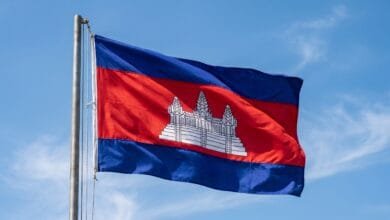
Angkor Wat is the best-preserved temple in the Angkor archaeological complex. In 1992, UNESCO designated the Angkor site as a World Heritage Site. Today, it is Cambodia’s most visited monument and appears on the national flag.
The temple’s survival is remarkable. Its moat helped protect it from the jungle, and its solid sandstone construction has endured for nearly nine centuries. Visitors today can still walk the same causeway that Khmer pilgrims walked, see the same bas-reliefs that Suryavarman II commissioned, and climb the same towers that were designed to reach toward the gods.
Why This History Matters to Travelers
When you visit Angkor Wat, you are not just seeing a beautiful ruin. You are standing inside a king’s vision of the universe. You are walking through a monument that was built to be a temple, a tomb, and a model of the cosmos all at once.
Knowing why Suryavarman II built Angkor Wat changes the experience. The westward orientation is no longer just a fact—it is a clue to the temple’s funerary purpose. The towers are no longer just architectural features—they are Mount Meru. The bas-reliefs are no longer just decoration—they are a royal statement of divine kingship.
For travelers from the United States, Europe, or anywhere else, this context makes the visit more than a photo opportunity. It becomes an encounter with a civilization that built for eternity.
Frequently Asked Questions
Why did Suryavarman II build Angkor Wat?
Suryavarman II built Angkor Wat as his state temple and funerary monument. It was dedicated to the Hindu god Vishnu, whom Suryavarman II elevated above other deities in the Khmer court. The temple served both as a dwelling place for Vishnu and as a mausoleum for the king.
Was Angkor Wat a temple or a tomb?
It was both. Scholars today generally agree that Angkor Wat functioned as a Vaisnavite temple and as a mausoleum for Suryavarman II. The temple’s westward orientation and anti-clockwise bas-reliefs support the funerary interpretation.
Why does Angkor Wat face west?
West is the direction associated with Vishnu, the god to whom the temple was dedicated. West is also the direction of the setting sun and death, which supports the interpretation that Angkor Wat was designed as a funerary temple.
Why was Angkor Wat dedicated to Vishnu and not Shiva?
Suryavarman II was unusual among Khmer kings in his devotion to Vishnu. While most earlier kings focused on Shiva, Suryavarman II made Vaishnavism the official religion and dedicated his greatest temple to Vishnu.
Did Suryavarman II ever see Angkor Wat completed?
It is uncertain. Construction of Angkor Wat began early in his reign and continued for decades. Britannica states that the temple was not finished until after his death around 1150 CE.
What happened to Angkor Wat after Suryavarman II died?
Angkor Wat remained a Hindu temple until the 1300s, when it was rededicated as a Buddhist site. It was never fully abandoned, even after the Khmer court moved away from Angkor in the 15th century. Buddhist monks continued to care for it.
Is Angkor Wat still a religious site today?
Yes. Angkor Wat is an active Buddhist temple. It is also a UNESCO World Heritage Site and Cambodia’s most visited monument.
Conclusion
Suryavarman II built Angkor Wat to be many things at once: a temple for Vishnu, a tomb for himself, and a model of the Hindu universe. No single inscription tells us his personal motivation, but the temple itself—its scale, its orientation, its carvings, and its dedication—speaks clearly. He wanted to create something that would connect him to the gods and preserve his memory forever. He succeeded. Nearly 900 years later, Angkor Wat still stands, still draws millions of visitors, and still tells the story of a king who tried to build heaven on earth. For travelers, knowing that story makes the temple more than a wonder. It makes it a window into a lost world.