Khmer Culture: A Complete Overview for First-Time Visitors to Cambodia
Imagine stepping off a plane in Phnom Penh. The air is warm and heavy. A driver greets you with palms pressed together at the chest and a gentle bow of the head. You notice a woman selling noodles on the street wearing a checkered scarf around her neck. In the distance, you hear the slow, resonant tones of a gong. Everything feels unfamiliar, and yet there is a calm rhythm to it all.
That rhythm is Khmer culture. It has been shaped by centuries of Buddhist practice, the rise and fall of the Angkorian empire, and the resilience of a people who rebuilt their society after unimaginable loss. For a foreign traveler, understanding even the basics can turn a trip into something far more meaningful than a checklist of temples.
This overview will walk you through what Khmer culture is, why it matters, and what you should know before you visit. There will be no jargon, no assumptions, and no tourist clichés—just the essential context that helps you see Cambodia through a clearer, more respectful lens.
What Is Khmer Culture?
Khmer culture is the living cultural identity of the Khmer people, the ethnic majority of Cambodia. The terms “Khmer” and “Cambodian” are often used interchangeably, though “Khmer” specifically refers to the ethnic group, its language, and its cultural traditions.
This culture is not a museum piece. It is practiced every day—in the way people greet each other, in the food they share, in the music played at ceremonies, and in the quiet respect shown to elders. It is a culture shaped by Theravada Buddhism, which is practiced by nearly 97% of the population, as well as by older animist beliefs that predate Buddhism and still coexist with it.
Khmer culture has also been influenced by Indian traditions, particularly through Hinduism and Buddhism, and by French colonialism. But its core—the values, the social rules, the artistic forms—remains distinctly Khmer.
Why Does It Matter in Khmer Culture?
Understanding Khmer culture matters because it explains the “why” behind so many things a visitor will observe.
Why do people press their palms together instead of shaking hands? Why do younger people show such deference to elders? Why does a simple scarf carry so much meaning? Why do people smile in situations where an American might expect anger or frustration?
The answer to all of these questions lies in a set of core values that run through Cambodian society. Harmony is one of them. In Khmer culture, maintaining social harmony and avoiding conflict are often more important than being right or expressing individual frustration. This is sometimes called “saving face”—protecting both your own dignity and the dignity of others.
Tolerance and calmness are also deeply valued, rooted in Buddhist teachings. Many Cambodians believe in taking responsibility for one’s own actions and approaching difficulties with patience and a peaceful mind.
Respect for hierarchy is another cornerstone. Age, status, and spiritual merit all determine social standing. A monk, a teacher, an elder, or a government official all command a level of respect that is expressed through language, body language, and gestures.
How Is the Tradition Practiced?
Khmer culture is not practiced in one single way. It is woven through daily life, special occasions, and the arts.
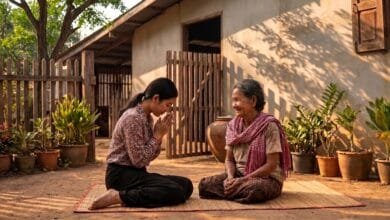
Social etiquette is one of the most visible aspects. The sampeah—pressing the palms together in a prayer-like gesture—is the traditional greeting. The higher the hands are held, the more respect is shown. Holding them at chest level is appropriate for peers; raising them to the mouth is for elders and superiors; nose level is for parents, grandparents, and teachers; and eyebrow level is reserved for the king and monks.
Body language carries cultural meaning, too. The head is considered the most sacred part of the body, so touching someone’s head—even a child’s—is considered disrespectful. The feet are considered the lowest, so pointing them at people or using them to move objects is avoided.
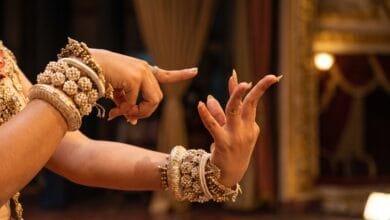
Traditional arts are another expression of Khmer culture. The Apsara dance, with its slow, deliberate movements and curved hand gestures, is a classical form that depicts celestial nymphs from Hindu and Buddhist mythology. It was inscribed by UNESCO as part of the Royal Ballet of Cambodia. The pinpeat ensemble, with its xylophones, gongs, and oboe-like sralai, provides the music for these dances and for religious ceremonies.
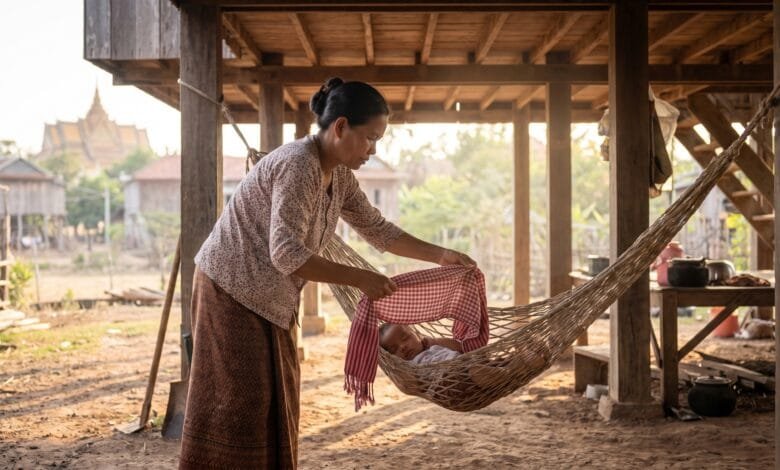
The krama is perhaps the most recognizable symbol of Khmer culture. This woven cotton or silk scarf, with its distinctive grid pattern, is used for dozens of purposes: as a head covering, a baby carrier, a hammock, a towel, a belt, or a decorative cloth. In 2024, UNESCO inscribed the cultural practices and expressions linked to the krama on its Representative List of the Intangible Cultural Heritage of Humanity. It is believed to hold spiritual power and bring good fortune to its bearer.
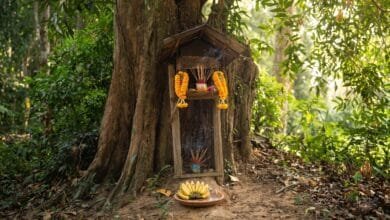
Buddhism and merit-making shape the rhythm of daily life. The Buddhist wat (temple) is a center of community life. Laypeople support monks through almsgiving and offerings, believing that these acts generate merit that can be shared with deceased ancestors. Alongside Buddhism, many Cambodians honor neak ta, or guardian spirits, who are believed to inhabit specific places and protect communities.
Traditional crafts such as silk weaving are passed down through generations, traditionally by women. Khmer kasuri, a type of ikat silk, is known for its fine design and twilled weaving techniques.
What Does a Visitor See in Cambodia?
A visitor to Cambodia will encounter Khmer culture in countless small moments.
You may see a grandmother teaching her granddaughter how to tie a krama around her head. You may hear the pinpeat ensemble playing at a temple ceremony and feel the deep, vibrating gongs in your chest. You may be offered a seat by someone younger than you, simply because you are perceived as an elder in that moment. You may notice that people smile and nod even when they disagree—an expression of harmony rather than agreement.
At a traditional wedding, you might witness rituals that stretch over multiple days. In Khmer tradition, weddings often include ceremonies symbolizing the cleansing of impurities and the blessing of the couple by elders. The groom may hold the bride’s sbai (shawl) as they enter her room, and parents of both families eat areca nuts and betel leaves to symbolize the bond between the two families.
At a Buddhist temple, you might see lines of monks receiving alms at dawn, or laypeople kneeling with incense and lotus buds. If you visit during a festival, you might see tug-of-war games (teanh prot) or the throwing of a ball (chol chhoung), traditional games that are played during Khmer New Year and other community gatherings.
What Should Foreign Visitors Know?
You do not need to master Khmer etiquette to visit Cambodia. But a few simple understandings will go a long way.
Greetings: You can greet people with a sampeah if you wish, but do not feel obligated. A smile and a polite nod are also appreciated. If you shake hands, wait to see if the other person offers their hand first—especially with women, as the sampeah is still the preferred greeting in many contexts.
Respect for elders: If you are introduced to someone older, it is respectful to use the sampeah gesture with hands at mouth or nose level. When speaking, avoid arguing or talking back to elders, even in casual conversation. In Khmer culture, disagreement is often expressed indirectly.
The head and feet: Do not touch anyone’s head. Do not point your feet at people or at images of the Buddha. If you are sitting on the floor, tuck your feet behind you or to the side.
Monks: If you are a woman, do not touch a monk or hand something directly to him. Place the item on a cloth or table, or give it to a male companion to pass. If you are a man, you may hand items directly to a monk, but do so respectfully.
The krama: If you receive a krama as a gift or buy one, treat it with respect. Do not use it to wipe your feet or wrap it around your shoes. It is more than a piece of cloth.
Temples: Dress modestly when visiting temples. Cover your shoulders and knees. Remove your shoes before entering temple buildings or private homes. Speak quietly and avoid pointing at Buddha images.
Saving face: If a situation feels frustrating—a delayed bus, a miscommunication, a disagreement—raising your voice or showing anger is unlikely to help. In Khmer culture, preserving harmony is often more important than winning an argument. A calm, patient approach is far more effective.
How Has the Tradition Changed?
Khmer culture has not remained static. It has survived colonialism, war, and profound social upheaval.
The Khmer Rouge regime (1975–1979) attempted to erase much of Cambodia’s cultural heritage. Intellectuals, artists, and monks were targeted. Temples, books, and works of art were destroyed. An estimated 1.5 to 3 million Cambodians died from execution, hardship, disease, and starvation.
After the regime fell, Cambodia began the long process of cultural rebuilding. Buddhist temples were restored. Dance and music traditions were revived, often by survivors who had memorized the movements and melodies. The Apsara dance, nearly lost, was inscribed by UNESCO and continues to be performed today.
Today, Khmer culture is changing again—this time through technology and globalization. Young Cambodians are using social media to share traditional music with hip-hop rhythms, live-streaming festivals, and creating digital content that blends old and new. At the same time, the Cambodian government and cultural institutions have emphasized the importance of safeguarding Khmer heritage amid rapid modernization.
The tension between tradition and change is real, but it is not unique to Cambodia. What is remarkable is how deeply many Cambodians—especially younger generations—still value their cultural roots.
Frequently Asked Questions
What is the most important thing to know about Khmer culture?
The most important thing to understand is that harmony and respect are central. How you say something often matters more than what you say. A calm, respectful approach will always serve you better than confrontation.
Is it offensive to shake hands in Cambodia?
No, but it is not the traditional greeting. If you offer your hand and the other person seems hesitant, you can switch to a sampeah or a nod. The sampeah is especially appreciated when greeting elders.
Can I take photos of people?
Ask first. A smile and a gesture toward your camera is usually enough. In temples, be mindful of signs prohibiting photography, especially in sacred areas. Never photograph monks without permission.
What does the krama symbolize?
The krama is a symbol of Khmer identity. It is used in daily life, in ceremonies, and in traditional games. It represents both practicality and spiritual protection. Treating it with respect is a small but meaningful gesture.
Why do Cambodians smile so much?
A smile in Cambodia can mean many things: happiness, politeness, embarrassment, or a desire to maintain harmony. It is not always an expression of joy. Understanding this helps avoid misunderstandings.
What should I do if I accidentally do something culturally insensitive?
Apologize simply and sincerely. A smile and a respectful attitude go a long way. Most Cambodians are understanding of foreign visitors who are trying to be respectful.
Conclusion
Khmer culture is not something you can learn from a book or a single article. It is a living, breathing tradition that you will encounter in the way people greet you, the music you hear, the food you share, and the quiet moments of kindness that often define travel in Cambodia.
Understanding the basics—the importance of harmony, the respect for elders, the meaning of the krama, the role of Buddhism—will not make you an expert. But it will make you a better traveler. You will notice more. You will connect more easily. And you will carry home a deeper appreciation for a country that has endured so much and still greets the world with a smile.
Cambodia rewards curiosity and respect. Learn a few words of Khmer. Accept the sampeah with grace. Treat the krama as the meaningful object it is. And remember that the most important thing you can bring to Cambodia is not a camera or a guidebook—it is an open mind.