Why the Krama Is More Than a Cambodian Scarf
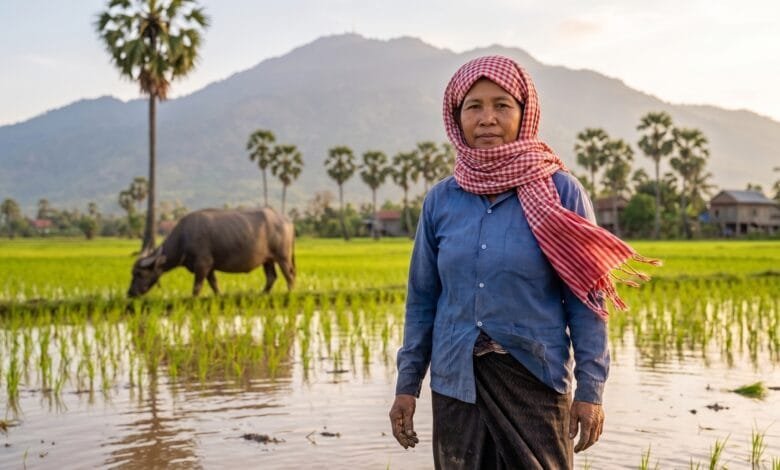
Walk through almost any village in Cambodia, and you will see it. A farmer bent over a rice paddy, a red-and-white checkered cloth wrapped around his head to block the sun. A woman at a market stall, the same pattern tied around her waist as a makeshift apron. A baby sleeping peacefully in a hammock made from a single piece of fabric strung between two palm trees.
That fabric is the krama. And if you are visiting Cambodia, you will see it everywhere. But the krama is not just a scarf. It is one of the most recognizable symbols of Khmer identity, a practical tool with countless uses, and a living tradition that has been part of Cambodian life for centuries.
Understanding the krama can transform how you see Cambodia. It can turn a simple piece of cloth into a window into the country’s values, craftsmanship, and resilience.
What Is the Krama?
The krama (pronounced krah-MAH) is a traditional Cambodian woven textile. It is a rectangular cloth, usually made of cotton or silk, and it almost always features a checkered or grid-like pattern. The most common colors are red and white, blue and white, or black and white, though silk kramas can be multicolored and interwoven with gold thread.
In the Khmer language, krama simply means “scarf.” But that simple word does not capture how much this piece of cloth does. The krama is worn by men, women, and children. It is used by people of all social classes. And it is found in every corner of the country.
Why Does It Matter in Khmer Culture?
The krama is far more than a practical item. It is a symbol of what it means to be Khmer.
According to UNESCO, which inscribed the krama on its Representative List of the Intangible Cultural Heritage of Humanity in December 2024, the krama “represents an emblematic expression of Khmer culture, and a ubiquitous feature in the lives of Cambodian people, accompanying them ever since birth”.
There is also a spiritual dimension. As a garment, each krama is believed by some to be unique to one individual, holding particular spiritual power that brings good fortune and protection to its bearer. Some people believe that using a silk krama brings good fortune and wards off bad luck.
Because of this, the krama is present at nearly every important moment in a Cambodian person’s life. It is used in wedding ceremonies, religious rituals, and funerary rites. It is there at birth, when a mother uses a krama to carry her baby. And it is there in death, as part of the final rites.
How Is the Tradition Practiced?
The krama’s versatility is remarkable. A single piece of cloth can serve dozens of purposes in a single day.
On the body:
- Wrapped around the head, it protects against the blistering sun, wind, rain, and dust
- Draped around the neck or shoulders, it is a scarf
- Tied around the hips, it becomes a sampot, a simple lower garment
- Worn diagonally across the upper body, it is called a peanea
- Draped across a woman’s chest, it is a chorn pong
As a tool:
- A mother ties one between two trees or palm trunks to make a hammock for her baby while she works in the fields
- A market vendor uses one to carry fruit, vegetables, or even live chickens
- A farmer uses one as a towel to wipe sweat from his brow
- A traveler uses one as a pillow, a shopping bag, or a blanket
In cultural and ritual life:
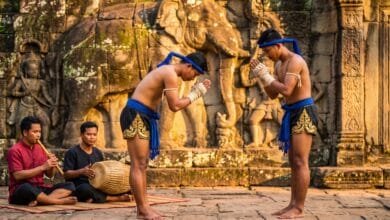
- During traditional games, kramas are bundled into a ball for Chol Chhuong, tied around the waists and foreheads of Bokator fighters, or twisted into a blindfold for games during Khmer New Year celebrations
- They are used to prepare food and in health care, including as bandages
The krama is predominantly produced by women, who traditionally learned the skill from their mothers and grandmothers. Men participate by planting and harvesting cotton, collecting materials for natural dyes, and maintaining the handlooms. The cloth is woven manually on traditional wooden handlooms, and the dyes — white, yellow, red, and blue — are extracted from natural vegetation and insects.
What Does a Visitor See in Cambodia?
As a traveler in Cambodia, you will encounter the krama constantly. Here are a few places where you are almost certain to see it:
In the countryside: Farmers wear kramas around their heads and necks as they work in the rice fields. You will see them used as shade, as sweat rags, and as carriers for tools or harvested crops.
At markets: Vendors use kramas as aprons, head coverings, and bags. You will also see stacks of kramas for sale — cotton ones are inexpensive and practical, while silk ones are more decorative and can be quite beautiful.
At temples: When you visit a pagoda or temple, you may see kramas draped over shoulders or wrapped around waists as a sign of modesty and respect. You may also see them used in ceremonies.
On the road: Tuk-tuk drivers, motorbike riders, and passersby often wear kramas to protect against dust and sun.
During festivals: Brightly colored silk kramas are worn to pagoda festivals and other celebrations.
If you visit Cambodia during Khmer New Year, you might even see kramas used in traditional games.
What Should Foreign Visitors Know?
The krama is widely available for purchase, and buying one is a wonderful way to support local weavers and take home a meaningful souvenir. Cotton kramas are affordable and practical; silk kramas are more elegant and often handwoven.
Wearing a krama is generally acceptable for visitors. It can be a respectful way to protect yourself from the sun and show appreciation for Cambodian culture. However, a few points of cultural sensitivity are worth keeping in mind.
First, the krama is not a costume. Wear it naturally and respectfully, not as a novelty. Second, be mindful of context. A krama worn around the neck while sightseeing is fine. But if you are visiting a temple, follow the same dress code rules as everyone else — cover your shoulders and knees. A krama alone is usually not enough to meet temple dress requirements; you should still wear appropriate clothing.
Third, understand that the krama has deep historical and emotional significance for many Cambodians. The red-and-white checkered pattern, in particular, is sometimes associated with the Khmer Rouge era, though the krama itself long predates that period. This is not a reason to avoid wearing one, but it is a reason to be thoughtful about it.
Finally, if you buy a krama, consider learning a little about how it was made. Many kramas are still woven by hand in villages, and the craft is passed down through generations. Buying directly from weavers or from fair-trade sources helps keep this tradition alive.
How Has the Tradition Changed?
The krama has adapted with the times. In the past, nearly every woman knew how to weave krama, and the skill was passed from mother to daughter. Today, professional weaving groups and producers have taken on much of the production, while educational organizations run training courses and workshops to keep the knowledge alive.
The UNESCO inscription in 2024 was a major moment for Cambodia. It brought international recognition to the krama and highlighted the importance of safeguarding the traditional techniques, knowledge, and practices surrounding its production. The inscription also drew attention to the role of Cambodian women, who have been the primary bearers of weaving knowledge, preserving classic patterns and using wooden handlooms passed down through generations.
Today, the krama remains a daily necessity for millions of Cambodians. But it is also evolving. Some designers are experimenting with new patterns and materials. Some young Cambodians are finding new ways to wear it. But the core meaning — a symbol of Khmer identity, practicality, and resilience — remains unchanged.
Frequently Asked Questions
Is the krama only worn in Cambodia?
Can tourists wear a krama?
Yes, and many do. Wearing a krama is a respectful way to protect yourself from the sun and engage with Cambodian culture. Just be mindful of context — especially at temples, where you should also wear appropriate clothing.
What is the difference between a cotton krama and a silk krama?
Cotton kramas are sturdy, affordable, and used for everyday tasks. Silk kramas are more decorative, often worn to festivals and ceremonies, and can be quite expensive. Some people believe silk kramas bring good fortune.
Why is the krama always checkered?
Is the red-and-white krama associated with the Khmer Rouge?
The red-and-white checkered pattern was used by the Khmer Rouge for identification, but the krama itself long predates that period. The association is a historical one, not a defining feature of the krama.
Where can I buy a krama?
Kramas are sold in markets throughout Cambodia. Cotton ones are very affordable. For silk kramas, you may find them in specialty shops or directly from weaving communities. Buying directly from weavers or fair-trade sources helps support traditional craftsmanship.
Conclusion
The krama is not just a scarf. It is a baby carrier and a market bag. It is a sun shield and a ceremonial cloth. It is a symbol of protection, identity, and resilience. It is present from birth to death, in the rice field and in the temple, on the farmer and on the bride.
For a traveler, learning about the krama is a small but meaningful way to understand Cambodia. It shows how deeply practical wisdom and cultural meaning can be woven into a single piece of cloth. It reveals a country where tradition is not frozen in a museum but lived every day.
When you see a krama in Cambodia — and you will — take a moment to notice it. You are looking at a piece of living history. And if you take one home, you are carrying a piece of Khmer culture with you.