The Grandmothers Raising Cambodia’s Next Generation
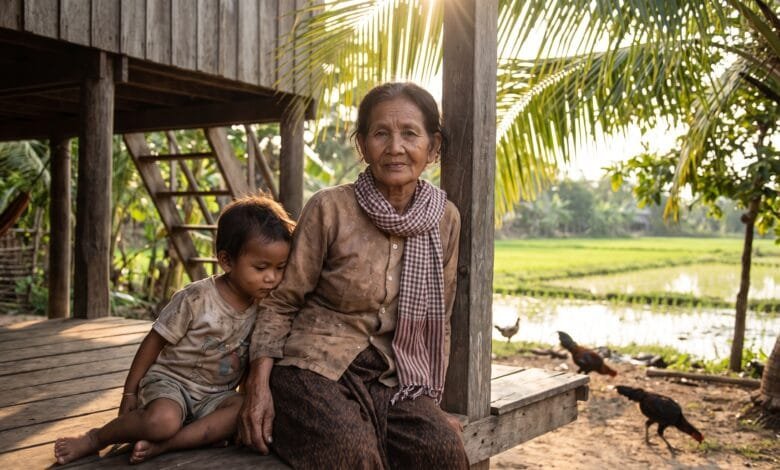
In a village outside Phnom Penh, a 68-year-old woman wakes before sunrise. She boils water for rice, wakes four grandchildren, and checks on the youngest, who has a heart condition. Her daughters are gone—one in prison, one working far away, one with a new life elsewhere. She is the only adult in the house. This is not an unusual story in Cambodia. It is how millions of families now function.
Travelers in Cambodia often notice elderly women caring for young children—at markets, on village lanes, in the shade of stilted houses. What they may not realize is that many of these women are not just grandmothers helping out. They are the primary parents.
Who Are These Grandmothers?
They are women in their sixties, seventies, and sometimes eighties. Most live in rural areas. Almost all of them are caring for grandchildren because the children’s parents have migrated for work.
In nearly two-thirds of Cambodian households, grandparents serve as primary caregivers. Of those caregivers, 99 percent are women. A 2019 study by the International Organization for Migration found that 75 percent of children left behind by migrant parents have their grandparents as their main caregiver.
These are not women who planned to raise a second family. They are women who stepped in when their own children had to leave.
Why Are Parents Leaving?
The answer is almost always work.
Cambodia’s economy has changed rapidly. Factories, construction sites, and service jobs draw young adults to Phnom Penh, Thailand, and beyond. Rural families often cannot survive on farming alone. Debt, rising costs, and limited local opportunities push parents to migrate.
Most parents who leave do so to support their families. They send money home when they can. But they cannot take young children with them. So the children stay—with their grandmothers.
This arrangement is sometimes called a “skip-generation household.” It means the middle generation—the parents—is absent, and the oldest and youngest generations live together. In rural Cambodia, skip-generation households are among the poorest.
What Does a Grandmother’s Day Look Like?
It starts early and rarely stops.
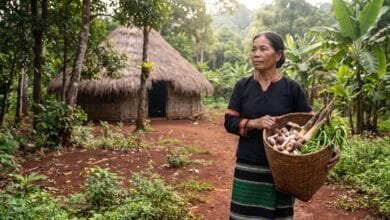
A grandmother in a skip-generation household cooks, cleans, washes clothes, and gets children ready for school—if they attend school. She may also work. Many grandmothers tend small rice fields, raise chickens, grow vegetables, or sell food at local markets. Some run tiny stalls selling sugarcane juice, snacks, or household goods.
One 61-year-old grandmother in Phnom Penh described her fear: “I would like some assistance with my health because I’m worried about what might happen to my grandson in the event that I become unwell.” She has high blood pressure and a history of heart problems, but she keeps going because there is no one else.
Many grandmothers in this situation deal with their own health issues while caring for children. Research from Oxford University describes how age, gender, and poverty combine to make these women especially vulnerable—yet their caregiving work often goes unseen.
The Knowledge They Pass On
Grandmothers are not just providing care. They are passing on knowledge that would otherwise be lost.
In Cambodia, recipes and cooking techniques are traditionally handed down orally, from one generation to the next. A grandmother teaches her granddaughter how to make samlor korko, a traditional soup. She shows her how to choose the right fish at the market, how to pound lemongrass paste, how to balance sweet, sour, and salty flavors.
This knowledge extends beyond food. Grandmothers teach children about rice planting, about which wild vegetables are safe to eat, about how to behave respectfully at the pagoda. In a country where elders are traditionally respected for their wisdom, grandmothers are living libraries.
But there is a tension. Many grandmothers grew up during or shortly after the Khmer Rouge era. They carry memories and habits shaped by scarcity. Some are wary of new foods or new ways of feeding children. Organizations working in Cambodia have found that involving grandmothers directly in nutrition education makes a real difference—because in these households, grandmothers make the decisions.
How Life Is Changing
The skip-generation household is a relatively recent phenomenon in Cambodia. It is not a historical norm. As poverty, debt, and economic pressure push more parents to migrate, family roles are shifting.
Some things are improving. Remittances from migrant parents—when they come—can help. Research suggests that children in skip-generation households who receive remittances do better in school than children left behind without that support.
But the burden on grandmothers is heavy. Many are caring for multiple grandchildren on very little money. Some are in debt. Many lack access to healthcare for themselves. And they are aging. As Cambodia’s population grows older—by 2050, nearly a quarter of Cambodians will be 60 or older—the number of grandmothers in this role will only increase.
Community organizations and NGOs are beginning to respond. Some programs now work directly with grandmothers, providing training, support groups, and small business assistance. The goal is not to replace grandmothers but to support them in the role they are already filling.
What Travelers Can Learn
If you travel through rural Cambodia, you will see grandmothers everywhere. Selling noodles at a roadside stall. Walking a grandchild to school. Sitting on a wooden platform, watching the rice fields.
It is easy to see them as background figures—part of the scenery. But they are the center of gravity for millions of Cambodian families.
Understanding this changes how you see Cambodia. The country’s future is not only being shaped in cities and factories. It is being shaped in village homes, by women in their seventies who are raising children for the second time.
Visiting Respectfully
If you visit a village, a homestay, or a community-based tourism project, you may meet grandmothers. Here are a few things to keep in mind:
Ask before photographing. A grandmother caring for her grandchildren is not a photo opportunity. Ask permission, and respect a “no.”
Buy from local stalls. If a grandmother is selling food or crafts, buying something is a small but meaningful way to support her household.
Be curious, not pitying. Grandmothers in this role are resilient and capable. Treat them with respect, not sympathy.
Learn a few Khmer words. A simple sok sabai (hello, how are you) or aw kohn (thank you) goes a long way.
Support community-based tourism. Homestays and village tours that keep money in the community help families stay together.
Frequently Asked Questions
Why do Cambodian parents leave their children with grandparents?
Most parents migrate for work—to factories in Phnom Penh, to construction sites in Thailand, or to other cities. They cannot afford to bring young children, so the children stay with grandparents, usually the grandmother.
Is this arrangement unique to Cambodia?
Skip-generation caregiving happens in many countries with high labor migration. But in Cambodia it has become especially common in rural areas. It is a coping strategy, not a tradition.
Do these grandmothers receive any support?
Support varies. Some receive remittances from their children. Some receive help from NGOs or community programs. But many rely on small farming, selling goods, or informal work. Government pensions are limited.
What happens to the children when the grandmother can no longer care for them?
This is a real concern. As grandmothers age and face health problems, the stability of these households is at risk. Some children end up in the care of other relatives or, in difficult cases, residential care facilities.
Can travelers help?
Yes—by supporting community-based tourism, buying from local vendors, and choosing homestays or social enterprises that reinvest in rural communities. Direct donations to reputable NGOs working with skip-generation households are also an option.
Is it rude to ask about the children’s parents?
It depends. Some families are open about their situation. Others may find it painful. Let the conversation develop naturally. If a grandmother volunteers information, listen with respect. Do not press for details.
Conclusion
The grandmothers raising Cambodia’s next generation are not a side story. They are central to how the country works right now.
They cook, clean, farm, sell, teach, and worry. They do it while aging, often while unwell, and often with very little money. They are raising children whose parents are somewhere else, working to keep the family afloat.
For travelers, understanding these women makes Cambodia clearer. The grandmother sitting quietly at a market stall, the one walking a child to school, the one tending a small garden—she may be holding an entire family together. When you see her, you are seeing one of the most important people in Cambodia today.
That is worth noticing. And it is worth respecting.