Is Cambodia More Digital Than You Think?
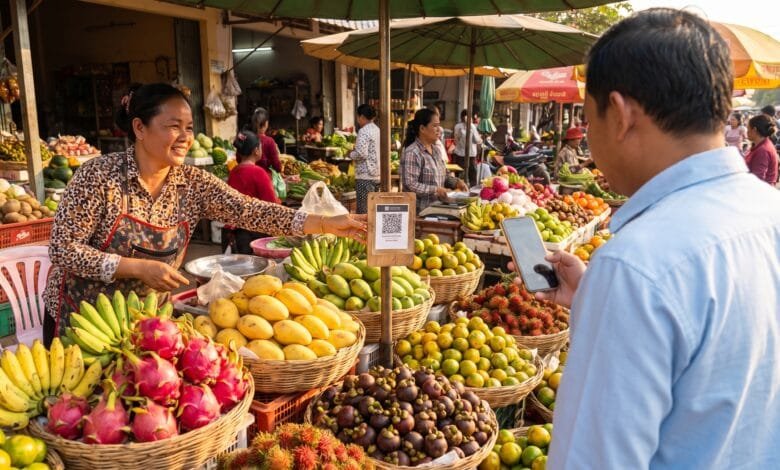
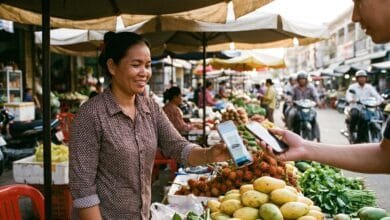
You step up to a fruit stall at a market in Siem Reap. The vendor hands you a bag of mangoes. You reach for your wallet, but she taps a small plastic stand on the counter — a QR code. Behind you, a teenager buys an iced coffee the same way, phone in hand. The transaction takes seconds.
If you arrived in Cambodia expecting a cash-only economy, the reality on the ground may surprise you.
Over the past several years, Cambodia has quietly built one of the more widely used digital payment systems in Southeast Asia. For travelers, this is not an abstract policy story. It is something you will see, and may use, throughout your trip — from airport taxis to night-market stalls to the guesthouse where you’re staying.
What Is Changing in Cambodia?
The most visible change is the rise of QR code payments.
Cambodia’s central bank, the National Bank of Cambodia, launched a system called Bakong in October 2020. It connects banks and payment providers across the country into a single network. Today, Bakong has approximately 39 million accounts — a figure that is 2.2 times Cambodia’s total population — and over 4.5 million merchants accept Bakong payments nationwide, according to the National Bank of Cambodia.
Those numbers do not mean every Cambodian has multiple bank accounts. They reflect a system where phone numbers and payment apps are linked in ways that make digital transactions accessible even without a traditional bank account.
For visitors, the bank introduced a separate app called Bakong Tourists. It allows foreign travelers to link a Visa or Mastercard, load funds, and pay by scanning KHQR codes at participating merchants. As of 2026, the app had approximately 37,000 registered accounts.
The KHQR code is the key to understanding what you’ll see. It is Cambodia’s standardized QR format — a single code that any participating bank or payment app can read. When you see a KHQR placard at a shop, it means that business accepts digital payments from multiple sources, not just one bank’s app.
Why Is This Happening?
Several factors have converged.
First, mobile phone adoption in Cambodia is exceptionally high. DataReportal’s Digital 2026 report found 21.7 million cellular mobile connections in late 2025 — equivalent to 121 percent of the total population. Internet penetration reached 67.3 percent, with 12.0 million internet users. Smartphone penetration specifically has surpassed 94 percent, driven in part by entry-level 4G handsets priced between USD 50 and USD 100.
In other words, the hardware was already in people’s hands. The payment infrastructure followed.
Second, the National Bank of Cambodia made a deliberate choice to build a shared system rather than leaving each bank to develop its own. This interoperability is why a single QR code works across different apps and banks. It lowered the barrier for small merchants — a market vendor does not need a card reader or a contract with a specific bank. A printed QR code is enough.
Third, cross-border connections have expanded the system’s reach. In June 2026, Cambodia and India launched a cross-border QR payment link allowing Indian visitors to scan KHQR codes using their UPI apps. In August 2026, a similar initiative with China’s Weixin Pay went live, enabling Chinese visitors to pay at Cambodian merchants by scanning KHQR codes. Cambodia welcomed more than 1.2 million Chinese visitors in 2025, about 20 percent of total international arrivals, so the practical impact is significant.
What Does It Look Like in Everyday Cambodia?
Walk through Phnom Penh or Siem Reap and the signs are easy to spot.
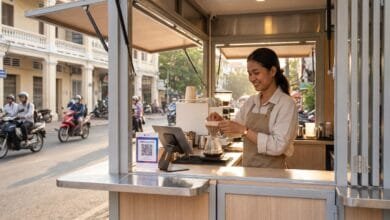
Convenience stores like Circle K and Aeon-affiliated shops display KHQR codes at the register. Independent cafés often have a small acrylic stand next to the till. Tuk-tuk drivers, especially those who work with ride-hailing apps, frequently carry a laminated QR code. Even some street food vendors have adapted.
The system is not universal. Many smaller businesses — particularly in rural areas or family-run stalls — still operate primarily in cash. US dollars remain widely accepted alongside Cambodian riel. But in urban centers and tourist areas, the QR code has become a normal part of the payment landscape.
For travelers, the practical question is whether to use it.
The Bakong Tourists app is one option. It requires a passport for registration and a linked international card for top-ups. Daily transaction limits apply — the standard limit is 200,000 riel (about USD 50), with higher limits available for larger purchases after additional verification, according to the National Bank of Cambodia.
Another option is to use a Cambodian bank app. ABA Bank, for example, allows tourists on T-class visas to open accounts and use ABA Mobile for KHQR payments. Wing Bank offers similar services. This is more practical for longer stays than for a short visit.
Many travelers, however, will find that cash still works perfectly well. Digital payments are an option in Cambodia, not a requirement. The significance is less about whether you must use them and more about what their presence tells you about the country.
What Might Travelers Notice?
Connectivity is another area where Cambodia may exceed expectations.
In January 2026, Cambodia officially launched 5G mobile services nationwide. Within the first six months, three major operators — Smart Axiata, CamGSM (Cellcard), and Viettel (Metfone) — deployed a combined 2,091 5G base stations, according to the Telecommunication Regulator of Cambodia.
In practice, this means faster mobile data in Phnom Penh, Siem Reap, and other provincial capitals. Travelers who buy a local SIM card or use an eSIM will likely find 4G coverage reliable in cities and tourist areas, with 5G available in key urban zones. Rural and temple areas generally have good 4G, though speeds vary.
This matters for the visitor experience in small but real ways. You can check maps at a temple complex. You can video-call home from a guesthouse in Battambang. You can use a translation app at a market without waiting for a signal. The infrastructure that supports digital payments also supports the broader connectivity that travelers have come to expect.
Why Does This Matter for Understanding Cambodia?
Cambodia is often described in terms of its past — the temples of Angkor, the Khmer Rouge era, the long recovery. All of that is real and important. But the country’s present is also worth paying attention to.
The Bakong system is a useful example of how Cambodia has approached modernization in a way that fits its context. Rather than waiting for every citizen to have a traditional bank account, the system was designed around what people already had: mobile phones. Rather than building separate, competing payment networks, the central bank created a shared standard.
The result is a country where a market vendor in a provincial town can accept digital payments using nothing more than a printed code and a smartphone. That is not a common outcome in the region.
For travelers, this is worth noticing because it changes the texture of daily interactions. Paying for a coffee in Siem Reap or a tuk-tuk ride in Phnom Penh is a small moment, but it reflects a larger reality: Cambodia is not standing still.
What Makes This Interesting for Visitors?
There is a tendency to think of travel in Cambodia as a choice between “traditional” experiences and “modern” conveniences. The reality on the ground is more interesting than that binary.
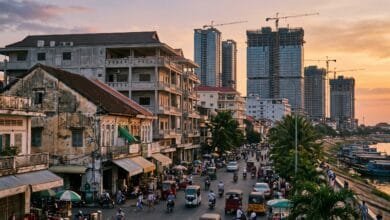
The same market where you buy handmade souvenirs may also accept QR payments. The same temple town where you wake up for sunrise may have 5G coverage by the afternoon. Tradition and modernization coexist, often in the same space.
Understanding the digital side of Cambodia helps you see the country more completely. It is not a museum. It is a place where people are building things, adapting technology, and finding practical solutions to everyday problems.
For a visitor, that is worth paying attention to — even if all you do is scan a QR code for a bottle of water.
Frequently Asked Questions
Can tourists use QR codes to pay in Cambodia?
Yes. The Bakong Tourists app allows foreign visitors to register with a passport, link an international card, and pay by scanning KHQR codes at participating merchants. Daily limits apply.
What is KHQR?
KHQR is Cambodia’s standardized QR code format. It allows a single code to work across multiple banks and payment apps, rather than requiring a specific provider’s app.
Do I need cash in Cambodia?
Cash remains widely used and accepted, especially at smaller businesses and in rural areas. US dollars and Cambodian riel are both common. Digital payments are increasingly available but not universally required.
Is the internet fast in Cambodia?
In cities and tourist areas, 4G coverage is generally reliable, and 5G is available in key urban zones as of 2026. Speeds vary in rural areas, but basic connectivity is widespread.
Can I use Apple Pay or Google Pay in Cambodia?
Not directly. Cambodia’s payment ecosystem is built around KHQR codes rather than NFC tap-to-pay systems. The Bakong Tourists app or a Cambodian bank app is the practical route for digital payments.
Is Cambodia becoming a cashless society?
Not entirely. Digital payments are growing rapidly in urban and tourist areas, but cash remains important, particularly outside major cities. The trend is toward wider digital adoption, not the elimination of cash.
Conclusion
Cambodia’s digital transformation is not a headline-grabbing story. It is happening in small, practical ways — a QR code at a market stall, a 5G signal in Siem Reap, a payment app that links a visitor’s card to a local merchant’s phone.
For travelers, understanding this side of Cambodia adds a layer to the experience. It helps explain what you’re seeing when you pay for lunch. It gives context to the infrastructure around you. And it offers a glimpse of a country that is actively shaping its own modern identity.
The next time you see a QR code at a Cambodian coffee shop, you’ll know what it represents: not just a payment method, but a system built to connect people, banks, and businesses across the country. It is a quiet kind of progress — and it is worth noticing.