Exploring Bokor National Park: Colonial Ruins, Cloud Forest & Wildlife in Cambodia
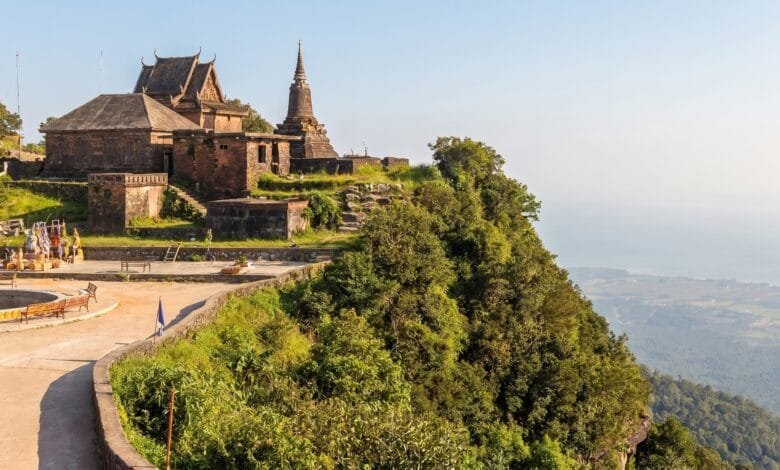
Bokor National Park sits high above the Cambodian coast, a misty plateau where abandoned French colonial buildings emerge from the fog and the air feels dramatically cooler than the lowlands below. Officially known as Preah Monivong Bokor National Park, this protected area in Kampot Province offers something that is genuinely rare in Cambodia: a mountain landscape where you can explore dense cloud forest, stand at the edge of sweeping coastal viewpoints, and walk through the eerie remains of a 1920s hill station that was abandoned decades ago.
Most travelers visit Bokor as a day trip from Kampot, the quiet riverside town that serves as the main gateway. The winding road to the summit takes you from sea-level heat into a different climate zone entirely, passing waterfalls, jungle, and several viewpoints along the way. Whether you are interested in history, hiking, birdwatching, or simply experiencing a side of Cambodia that few visitors see, Bokor rewards the journey.
QUICK TRAVEL INFORMATION
- Location: Kampot Province, southern Cambodia, in the Dâmrei Mountains (Elephant Mountains), forming the southeastern part of the Cardamom Mountains
- Type: National park and ASEAN Heritage Park
- Protected Area Status: Established in 1993; designated an ASEAN Heritage Park in 2003
- Area: Approximately 1,544–1,581 km²
- Highest Point: Phnom Bokor at approximately 1,080 meters above sea level
- Main Access Point: Kampot town, about 8 km from the park turnoff on Highway 3
- How to Get There: Motorbike, tuk-tuk, private car, or guided tour from Kampot; the paved road to the summit takes approximately 45 minutes to 1.5 hours depending on transport
- Best Time to Visit: November through March for clearer skies and cooler, drier conditions; the rainy season (May–October) brings mist and fuller waterfalls
- Recommended Stay: Half-day to one full day for the main highlights; longer if you plan to hike
- Main Activities: Sightseeing, photography, hiking, birdwatching, visiting waterfalls and historical ruins
- Accommodation: Limited accommodation on the plateau; most visitors stay in Kampot town
- Entrance Fee: Reports vary; some sources indicate a small fee for foreigners, while others suggest free entry. Check the latest information with the park authority or your tour operator before traveling.
- Useful to Know: Temperatures at the summit can be 10–15°C cooler than Kampot. Bring warm layers. Mobile signal is limited on parts of the mountain.
Where Is Bokor National Park?
Bokor National Park is located in Kampot Province in southern Cambodia. The park spans three provinces — Kampot, Kampong Spue, and Preah Sihanouk — though the main visitor area and summit are most easily accessed from Kampot town. The park forms part of the Dâmrei Mountains, also called the Elephant Mountains, which in turn are the southeastern extension of the larger Cardamom Mountains.
The nearest town is Kampot, a relaxed riverside destination about 8 km from the park turnoff on Highway 3. From Kampot, the road to the summit climbs through thick jungle with steep switchbacks, gaining roughly 1,000 meters of elevation over approximately 32 km. Sihanoukville is another possible starting point, roughly 95 km away.
What Makes Bokor National Park Special?
Bokor is unusual among Cambodian national parks because it combines a dramatic natural setting with a very visible layer of human history. The plateau at the top was developed by French colonial authorities in the early 1920s as a hill station — a cool retreat from the heat and humidity of Phnom Penh. The centerpiece was the Bokor Palace Hotel and Casino, surrounded by shops, a post office, a church, and royal apartments.
The French abandoned the station in the late 1940s during the First Indochina War, and later the site was used by various military forces, including the Khmer Rouge. Today the abandoned buildings — the palace hotel, the Catholic church, and other structures — stand empty, slowly being reclaimed by the forest and often wrapped in fog. This combination of architectural ruin and dense natural environment gives Bokor an atmosphere that is hard to find elsewhere in Cambodia.
The natural side is just as compelling. The park protects a range of habitats, from lowland forest and dry dipterocarp to moist evergreen and dwarf montane forest on the plateau. The park is recognized as a BirdLife International Important Bird Area, with over 300 bird species recorded, including hornbills, the chestnut-headed partridge, and the green peafowl.
What to See
Bokor Hill Station
The abandoned French hill station is the most visited part of the park. The Bokor Palace Hotel is the centerpiece — a large, empty building whose shattered floors and mouldy walls once hosted champagne-fueled evenings for colonial officers. The Old Catholic Church, Wat Sampov Pram (a Buddhist temple), and the remains of the royal apartments are also on the plateau. Note that some ruins have unstable structures, so do not enter collapsed buildings.
Popokvil Waterfall
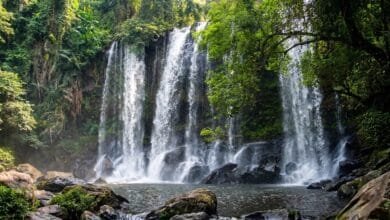
Popokvil Waterfall is a two-tiered cascade located about 8 km northeast of Kampot, inside the park. The upper tier drops roughly 15 meters and the lower tier about 18 meters, with a shallow pool between the levels. The name means “swirling clouds,” a reference to the mist that often hangs over the area. Water flow is strongest during the rainy season (May–October); in the dry season, the falls may be low or dry. A small entry fee has been reported for the waterfall area, but this should be confirmed locally.
Viewpoints
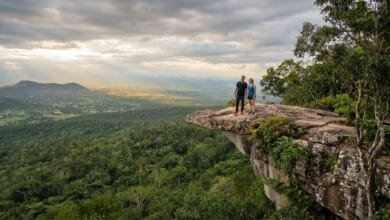
The plateau offers several places to take in the view. The Five Boats Viewpoint is known for its cliffside panorama, and the summit area provides views across the Gulf of Thailand toward the coast. On clear days, the contrast between the cool highlands and the tropical coastline below is striking.
Lok Yeay Mao Monument
The Lok Yeay Mao shrine is a sacred site at the park, featuring a large statue of the “Black Lady,” a figure in Cambodian folk belief. It is a cultural landmark as well as a scenic stop.
Things to Do
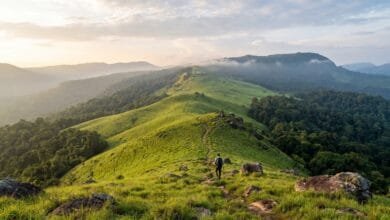
Hiking and Walking. The park has several walking routes. A short trail leads from the road to Popokvil Waterfall, taking about 30 minutes. A loop through the old hill station area takes 1–2 hours and passes the abandoned colonial buildings. A longer ridge trail through cloud forest takes 3–4 hours and offers views of the coast and interior highlands. Trail conditions can be slippery in the wet season, so sturdy footwear is important.
Birdwatching. With over 300 recorded species, Bokor is a significant birding destination. Hornbills, broadbills, and partridges are among the species that have been documented. BirdLife International recognizes the park as an Important Bird Area. Wildlife sightings are never guaranteed, and many birds are more active in the early morning.
Photography. The combination of misty ruins, jungle, and coastal views makes Bokor a strong destination for travel photography. The old church and palace hotel are particularly atmospheric when fog rolls in.
Scenic Driving. The road up to the plateau is an experience in itself, winding through jungle with occasional views. Many visitors do this by motorbike or tuk-tuk.
Wildlife and Nature
The park’s forests shelter a range of wildlife. Species documented in the park include the pileated gibbon, pig-tailed macaque, slow loris, Asiatic black bear, Malayan sun bear, and clouded leopard. In 2024, researchers announced the discovery of a new species of slender gecko, Hemiphyllodactylus bokor sp. nov., found in the park at higher elevations.
Birdlife is particularly rich. Over 300 species have been recorded, including several types of hornbill, the chestnut-headed partridge, and the green peafowl. However, most terrestrial wildlife is nocturnal and stays in more remote parts of the park. Sightings of large mammals are rare.
The park’s plant life includes valuable timber species, ferns, insectivorous sundew plants, and dipterocarp trees.
How to Get There
The most common starting point is Kampot town. From there, the park turnoff is about 8 km away on Highway 3, and the road to the summit is paved but winding.
By Motorbike. Renting a motorbike in Kampot is a popular option. Rental costs have been reported in the range of $5–8 per day for a standard bike, with larger bikes available for more. The ride takes about an hour. The road has steep switchbacks and can be foggy, so ride carefully, especially in the wet season.
By Tuk-Tuk or Private Car. Tuk-tuks and private taxis can be arranged in Kampot. A tuk-tuk day trip has been reported at around $30, though prices are negotiable and can change. The drive takes roughly 1.5 hours each way.
By Guided Tour. Many guesthouses and hotels in Kampot can arrange guided tours. Some tours include stops at a pepper farm or other nearby attractions.
Transportation prices and schedules can change. Confirm current rates with your hotel or a local operator before booking.
When to Visit
The dry season, particularly November through March, is generally the most comfortable time to visit. Skies tend to be clearer, making the coastal views more reliable, and temperatures at the summit are cool but pleasant.
The rainy season, from May to October, brings mist, fog, and fuller waterfalls. If you want to see Popokvil at its strongest, this is the time to go. However, trails can be slippery and road conditions may be more challenging. The early morning hours during the rainy season are often the most atmospheric for photography, with fog wrapping around the ruins.
The park can be busier on Cambodian holidays and weekends. Visiting on a weekday, especially in the morning, gives you a better chance of having the ruins to yourself.
How Long to Stay
A half-day trip of about 4–5 hours from Kampot is enough to see the main highlights: the old hill station, Popokvil Waterfall, and the viewpoints. A full day allows more time for hiking and exploring at a relaxed pace. If you want to do the longer ridge trail or spend time birdwatching, plan for a full day or consider staying overnight on the plateau.
Where to Stay
Accommodation on the plateau is limited. The Thansur Bokor Highland Resort is the main option at the summit, offering modern rooms with mountain views. Rates have been reported in the $80–200 per night range, though prices can vary. Le Bokor Palace, a separate property associated with the resort group, also operates on the mountain.
Most travelers stay in Kampot town and visit Bokor as a day trip. Kampot has a wide range of guesthouses and hotels, with budget options and mid-range properties available. Reported rates for guesthouses in Kampot have been in the $8–30 per night range.
Accommodation availability and prices change. Check current listings before your trip.
What to Pack
- Warm layers: temperatures at the summit can be 10–15°C cooler than Kampot, and it can feel cold in the fog or early morning.
- Comfortable walking shoes with good grip: trails to waterfalls and through the ruins can be uneven and slippery.
- Rain protection: even in the dry season, the plateau can be misty or drizzly.
- Sun protection: when the sun is out, the UV can be strong at elevation.
- Insect protection: the forest environment means mosquitoes and other insects are present.
- Plenty of water and snacks: food options on the mountain are limited and can be expensive.
- A camera: the ruins and views are highly photogenic.
Travel Tips
- Check current road conditions before you go. The road to the summit is paved, but fog can reduce visibility significantly.
- Bring cash. Credit cards may not be accepted everywhere on the mountain.
- Fill up your motorbike in Kampot before heading up. Fuel on the mountain may be limited or more expensive.
- Start early. Morning visits often mean fewer people and better chances of clear views before the clouds build.
- Mobile signal can be weak or unavailable on parts of the mountain. Download offline maps before you go.
- Some ruins have unstable structures. Do not enter collapsed buildings.
Responsible Travel
Bokor National Park is a protected area, and visitors can help keep it that way. Stay on permitted trails and do not cut through vegetation. Do not litter — carry out everything you bring in. Do not feed or disturb wildlife. Do not remove plants, rocks, or other natural objects. Respect local communities and cultural sites, including the Lok Yeay Mao shrine and Wat Sampov Pram. Follow any rules or instructions posted by park authorities.
The park faces pressures from poaching, illegal logging, and development. Responsible visitor behavior supports conservation efforts.
Is This Place Right for You?
Bokor suits travelers who enjoy a mix of nature and history. If you are interested in colonial ruins, cloud forest, mountain views, and a break from Cambodia’s heat, this is a strong choice. Hikers will find enough trails to fill a day. Photographers will appreciate the atmospheric fog and the contrast between decaying architecture and jungle.
Families with young children may find the long, winding drive and the uneven terrain at the ruins challenging, though the main viewpoints and waterfall are accessible. Travelers looking for a pure wildlife experience may be disappointed, as most animals are nocturnal and elusive. But for those who value atmosphere, landscape, and a genuinely unusual destination, Bokor is memorable.
Frequently Asked Questions
Where is Bokor National Park?
It is in Kampot Province, southern Cambodia, in the Dâmrei Mountains. The main access point is Kampot town, about 8 km from the park turnoff.
How do I get to Bokor National Park?
From Kampot, you can go by motorbike, tuk-tuk, private car, or guided tour. The drive to the summit takes roughly 45 minutes to 1.5 hours depending on your transport.
Is Bokor National Park worth visiting?
Yes, if you are interested in colonial history, mountain scenery, or a cool escape from the lowlands. The combination of abandoned ruins and cloud forest is unique in Cambodia.
How much time do I need?
A half-day covers the main highlights. A full day allows for hiking and a more relaxed pace. If you want to do longer trails or birdwatch, plan for a full day or stay overnight.
What can I do at Bokor National Park?
You can explore the abandoned French hill station, visit Popokvil Waterfall, enjoy viewpoints, hike on several trails, birdwatch, and photograph the misty ruins and landscape.
What should I bring?
Warm layers, comfortable walking shoes, rain protection, sun protection, insect protection, water, snacks, and a camera.
Is there an entrance fee?
Reports on entrance fees vary. Some sources indicate a small fee for foreigners, while others suggest entry is free. Check the latest information with the park authority or your tour operator before traveling.
Conclusion
Bokor National Park offers a version of Cambodia that surprises many visitors: cool mountain air, fog-draped ruins, and cloud forest instead of temples and beaches. The abandoned French hill station gives the park a human story that sits alongside its natural value, and the combination makes it one of the more distinctive day trips from Kampot.
This destination suits travelers who appreciate atmosphere, history, and landscapes over polished tourist infrastructure. The main practical consideration is transportation — you will need to arrange a motorbike, tuk-tuk, or tour from Kampot, and the road is winding. But for those willing to make the climb, Bokor delivers a side of Cambodia that stays with you.