Kampot Pepper: The World’s Best Pepper and Its Comeback Story
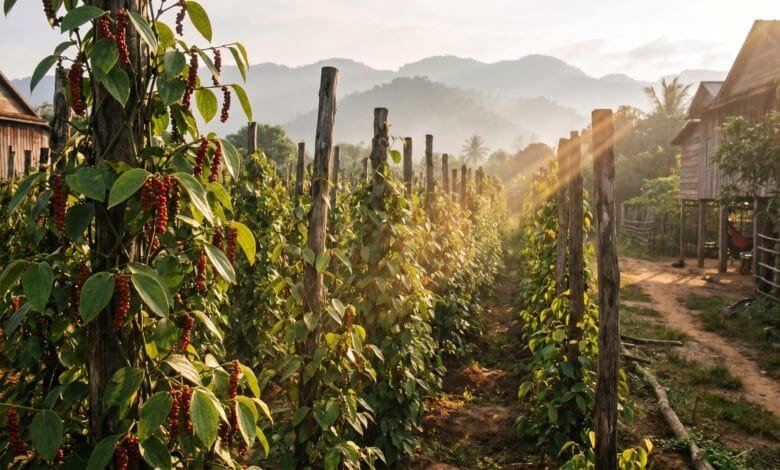
Kampot pepper is more than just a spice — it is a symbol of Cambodian resilience, a culinary treasure, and a story of revival. Grown in the coastal province of Kampot, this legendary peppercorn has been praised by chefs like the late Anthony Bourdain and Michelin-starred French chef Olivier Roellinger. It has been called the “best pepper in the world”, compared to fine wine, and awarded Protected Geographical Indication (PGI) status — putting it in the same league as Champagne and Darjeeling tea.
But this story is not just about flavor. It is about how Kampot pepper nearly disappeared forever — and how it came back.
Quick Regional Food Facts
| Detail | Information |
|---|---|
| Region | Kampot Province, southwestern Cambodia |
| Province | Kampot |
| Main Food Identity | Kampot pepper (PGI-status spice) |
| Key Ingredients | Black, white, red, and green Kampot peppercorns |
| Signature Foods | Kampot pepper in Lok Lak, pepper prawns, stuffed calamari, and Cambodian curries |
| Main Food Season | January–July (peak: May–early July) |
| Best Travel Season | November–February (dry season, cooler weather) |
| Food Experiences | Pepper farm tours, tastings, farm-to-table dining |
What Makes Kampot Pepper the World’s Best Pepper?
The question every food lover asks is simple: what makes Kampot pepper so special?
The answer lies in the land. Kampot pepper is grown in the foothills of the Elephant Mountains, where the soil is rich in quartz and minerals. The combination of sea breeze, tropical climate, and mineral-rich earth creates what farmers call a unique terroir — a sense of place that you can taste.
Kampot pepper is not aggressively spicy. Instead, it delivers complex layers of flavor: notes of eucalyptus, mint, citrus, and even cocoa. As Nathalie Chaboche of La Plantation explains: “It should not be too spicy, because if it’s too spicy, it just burns your mouth. Kampot pepper is not too spicy. It’s mild-spicy”. “It’s like a wine,” she says. “You can taste it like a wine, and then you can keep the taste in your mouth for a very long time”.
In 2010, the World Trade Organization granted Kampot pepper PGI status. In 2016, the European Union followed. This means only pepper grown in Kampot and Kep provinces using traditional methods can be called Kampot pepper — just as only sparkling wine from Champagne can be called Champagne.
The Landscape Behind the Food
Kampot Province sits in southwestern Cambodia, bordering the Gulf of Thailand. The landscape is a mix of coastal plains and rolling hills, with the Elephant Mountains rising inland. The province experiences a tropical monsoon climate with high temperatures year-round. The wet season runs from May to October, while the dry season lasts from November to February.
This climate — with about 220 days of rain per year — is ideal for pepper cultivation. The combination of abundant rainfall, high humidity (75–85%), and mineral-rich soil creates the perfect conditions for the pepper vine, Piper nigrum, to thrive.
The Ingredients That Define the Region
Kampot pepper comes in four distinct varieties, each with its own character:
| Type | Harvest | Flavor Profile |
|---|---|---|
| Green | Picked early, when berries are green | Fresh, bright, slightly grassy — used fresh or brined |
| Black | Picked when berries are almost ripe | Strong, aromatic, with eucalyptus and mint notes |
| Red | Picked fully ripe on the vine | Fruity, subtler spiciness, prized and rare |
| White | Red berries soaked and skin removed | Milder, delicate, with citrus and floral notes |
Red and white pepper command the highest prices — up to $28–$30 per kilogram — compared to $15–$17 for black pepper.
Regional Foods and Dishes to Know
Kampot pepper is the soul of Cambodian cooking. It appears in:
- Beef Lok Lak — stir-fried beef with cracked Kampot black pepper, served with a pepper-lime dipping sauce
- Pepper Prawns — fresh prawns wok-fried with Kampot pepper and kaffir lime leaves
- Stuffed Calamari — calamari stuffed with pork and fresh green Kampot pepper
- Kampot Pepper Beef — tender beef stir-fried with cracked Kampot pepper and holy basil
As one chef put it: “Kampot pepper itself is mostly produced in Kep… the whole coast of Cambodia is ideal for the cultivation of pepper”. The pepper’s unique aroma — “smellier, spicier and tastier than other peppers” — elevates every dish it touches.
The People Behind the Food
The story of Kampot pepper is ultimately a story of people.
Cambodians have been growing the Kamchay and Lampong varieties of pepper — the kind known now as Kampot pepper — for centuries. But it didn’t become a major cash crop until French colonialists started exporting it in bulk in the early 1900s, when yearly production reached 8,000 tons. “During the French protectorate at the beginning of the 20th century, all the pepper used in France was completely Kampot at that time,” says Chaboche.
Then came the Khmer Rouge. In the 1970s, the regime viewed peppercorns as a symbol of colonialism and forced farmers to grow rice instead. The pepper industry nearly died. “My parents and my grandparents were forced to fight for the Khmer Rouge,” says farmer Hon Thon.
After the regime fell, revival came slowly. Only in the late 1990s did local farmers — many with generations of peppercorn farming in their blood — return to their roots. Today, farmers like Chang Deang, a third-generation grower, tend their plants with traditional organic methods. He uses only cow dung and guano as fertilizer. “Try some, they’re really hot,” he says with a smile, offering fresh green peppercorns.
How Local Food Traditions Developed
The history of Kampot pepper spans at least eight centuries. The earliest known mention comes from the 13th century, when Chinese explorers noted pepper cultivation in Cambodia.
The French colonial period transformed pepper from a local crop into a global commodity. At the turn of the 20th century, Parisian chefs considered it the best in the world for its uniquely strong yet delicate aroma. The pepper was shipped through Kampot’s deep-water harbor, which is how it got its name.
The Khmer Rouge era nearly erased this heritage. But the knowledge survived — passed down through families, preserved in memory, and revived when peace returned. Today, Kampot pepper is protected by PGI status, which ensures that traditional methods are maintained. Organic farming is mandatory: chemical fertilizers and pesticides are forbidden. Farmers use traditional fertilizers like cow dung, bat guano, and crab shells.
Food Through the Seasons
The harvest of Kampot pepper is a year-round cycle:
The harvest is done entirely by hand. After picking, peppercorns are washed, sun-dried for 2–3 days, and sorted. The entire process is labor-intensive, which is one reason Kampot pepper commands premium prices.
Where Travelers Can Experience the Food
Visitors can experience Kampot pepper firsthand at several farms:
- La Plantation — the largest pepper plantation in Kampot, offering guided tours, tastings, and a café. During high season, they receive around 300 visitors daily. Tours explain the history, varieties, and production process. The farm employs 300 Cambodian workers during peak season.
- BoTree Pepper Farm — a family-run farm offering guided tours in Khmer, English, or French.
Most farm tours include a formal tasting where visitors sample different peppercorns alongside local salt blends and infused oils.
What to Eat and Look For
| Food | Taste | Where to Find | Best Season |
|---|---|---|---|
| Fresh green Kampot pepper | Soft, juicy, spicy | Pepper farms, local markets | January–June |
| Black Kampot pepper | Aromatic, eucalyptus, mint | Farms, shops, restaurants | Year-round |
| Red Kampot pepper | Fruity, subtle spice | Farms, specialty shops | May–July |
| Lok Lak with Kampot pepper | Bold, citrusy, peppery | Cambodian restaurants | Year-round |
A Food-Focused Way to Explore the Region
Morning: Visit the local market in Kampot town to see fresh green peppercorns and local produce.
Late morning: Head to a pepper farm like La Plantation for a guided tour. Learn how Kampot pepper is grown, harvested, and processed.
Lunch: Enjoy a farm-to-table meal featuring Kampot pepper at the farm’s café.
Afternoon: Explore the Kampot countryside — rice fields, salt farms, and the foothills of the Elephant Mountains.
Evening: Dine at a local restaurant and try dishes like Beef Lok Lak or pepper prawns.
Best Time to Visit
| Season | Experience |
|---|---|
| Best Food Season | January–July (harvest season; fresh green and red pepper available) |
| Best Travel Season | November–February (dry season, cooler temperatures, easier travel) |
If you want to see the harvest in action, visit between March and June. If you prefer comfortable travel weather, visit in the dry season.
How to Get There
Kampot is approximately 150 kilometers southwest of Phnom Penh. Travel options include:
- By road: 3–4 hours by car or bus from Phnom Penh via National Highway 3
- By train: Limited services; check current schedules
- Local transport: Tuk-tuks and motorbikes are available for exploring the countryside
Responsible Food Travel
- Ask before photographing farmers, families, or workers
- Do not enter private areas without permission
- Support local producers by buying genuine Kampot pepper
- Respect traditional farming methods — do not disturb crops
- Avoid wasting food — appreciate the labor behind every peppercorn
Frequently Asked Questions
What is Kampot pepper?
Kampot pepper is a PGI-certified peppercorn grown in Cambodia’s Kampot and Kep provinces, prized for its complex flavor and aromatic qualities
Why is Kampot pepper the best in the world?
The unique combination of quartz-rich soil, coastal climate, and traditional organic farming methods produces a pepper with exceptional flavor — notes of eucalyptus, mint, citrus, and cocoa
Where is Kampot pepper grown?
It is grown exclusively in Kampot and Kep provinces in southern Cambodia
What does Kampot pepper taste like?
It has a complex flavor with notes of eucalyptus, mint, citrus, and cocoa — not too spicy, with a long finish
What happened to Kampot pepper during the Khmer Rouge?
The Khmer Rouge forced farmers to grow rice instead of pepper, nearly wiping out the industry
Where can I visit Kampot pepper farms?
La Plantation and BoTree Farm offer guided tours and tastings
When is Kampot pepper harvested?
Harvest runs from January to July, with peak production from March to June
How much does Kampot pepper cost?
Prices vary: black pepper ~$15–17/kg, red ~$25–27/kg, white ~$28/kg
Final Thoughts
Kampot pepper is more than a spice. It is a taste of Cambodia’s history, a symbol of resilience, and a testament to the skill and dedication of the farmers who refused to let it disappear. From the tables of Parisian chefs to the hills of Kampot, this peppercorn has traveled a remarkable journey.
When you taste Kampot pepper — whether in a bowl of Lok Lak, sprinkled over fresh prawns, or simply ground over a meal — you are tasting more than flavor. You are tasting a story of survival, revival, and the enduring spirit of a place and its people.