Kampong Speu Palm Sugar: Cambodia’s GI-Certified Sweet Treasure
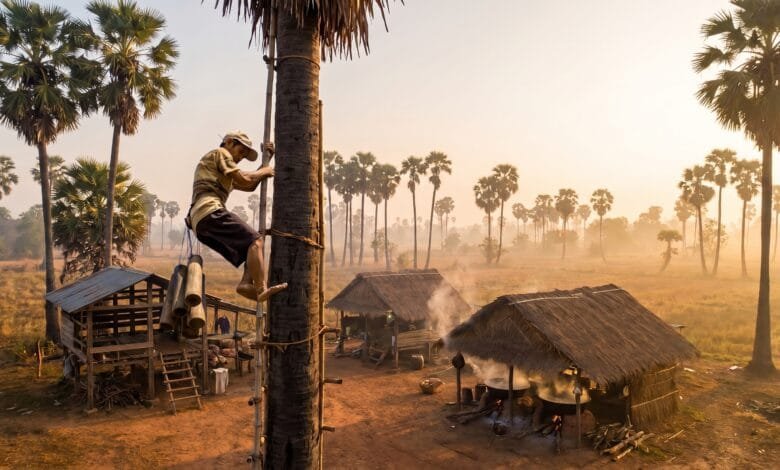
Before it reaches your morning coffee or sweetens a traditional Khmer dessert, Kampong Speu palm sugar travels from the crown of a towering palm tree, through the hands of a skilled climber, into a bubbling iron wok, and across oceans to tables around the world. This is not just any sugar. This is Cambodia’s first EU-protected Geographical Indication product—a sweet treasure that tells the story of a province, its people, and a tradition that spans centuries.
Kampong Speu palm sugar is made from the sap of the Palmyra palm tree (Borassus flabellifer L.), known in Khmer as doeum thnot. In 2010, the Ministry of Commerce granted domestic GI status to Kampong Speu palm sugar, and on April 3, 2019, it became the second Cambodian product to receive EU Protected Geographical Indication status—following Kampot pepper.
But what makes this sugar so special? The answer lies in the land, the climate, the trees, and the people who have perfected this craft over generations.
Quick Regional Food Facts
| Detail | Information |
|---|---|
| Region | Kampong Speu Province, Cambodia |
| Province | Kampong Speu (capital: Chbar Mon) |
| Main Food Identity | Palm sugar production—the “Sugar Palm Province” |
| Key Ingredients | Palmyra palm sap |
| Signature Foods | Skor Thnot Kampong Speu (powder, paste, block, syrup) |
| Main Food Season | December to May (peak: April) |
| Best Travel Season | November to April (dry season; palm sugar harvesting) |
| Food Experiences | Palm sugar workshops, tastings, palm wine sampling |
What Makes Kampong Speu Palm Sugar Special?
Kampong Speu palm sugar is not merely a sweetener—it is a product defined by its place of origin. The GI certification restricts production to a specific geographic area: Oudong and Samrong Tong districts in Kampong Speu Province, plus Ang Snuol district in neighboring Kandal Province. Within this relatively small region, approximately 30,000 palm trees have been identified as the indicative geography, though only about 3,637 trees are currently used for GI-certified sugar production.
The soil conditions are ideal: deep, well-drained sandy soil extending at least 0.8 meters with a gravel layer below. Combined with low rainfall, these conditions concentrate the sap, resulting in sugar with a distinctive aroma, rich flavor, and color reminiscent of pumpkin pulp.
The Landscape Behind the Food
Kampong Speu Province lies between Phnom Penh and the Cardamom Mountains. Its capital, Chbar Mon, sits at the foot of the Damrei (Elephant) Mountains. The province’s eastern parts are designated as Central Cardamom Mountains National Park.
The landscape is dotted with thousands of sugar palms—towering trees that can reach 20 to 30 meters in height. These trees thrive in the region’s sandy, well-drained soils. The dry season, from December to May, provides the high sun exposure and low rainfall essential for sap production. During the hottest month of April, sap flow peaks, making it the height of the harvest season.
Kirirom National Park, Cambodia’s first national park, rises to 700 meters elevation within the province, featuring rare pine forests and cool temperatures that drop to 15–20°C from December to February. This diversity of landscapes—from lowland plains to mountain forests—makes Kampong Speu a region of remarkable natural variety.
The Ingredients That Define the Region
The defining ingredient of Kampong Speu is, of course, palm sugar. But to understand the sugar, you must understand the tree.
The Palmyra palm (Borassus flabellifer L.) is Cambodia’s national emblem, declared so in 2005. More than 3 million wild palm trees grow throughout Cambodia, but the trees of Kampong Speu produce sap of exceptional quality due to the region’s unique terroir.
Kampong Speu palm sugar comes in four distinct forms:
| Type | Description |
|---|---|
| Powder (Granulated) | Dry, free-flowing crystals with a light pumpkin color; strong, sweet palm aroma; very low acidity and bitterness |
| Paste | Soft and semi-solid; ranges from light to deep amber; pronounced sweetness with smooth, nectar-like taste |
| Block | Firm and crystallized; medium acidity and low bitterness; a household cooking staple |
| Syrup | Thick and viscous; light brown to deep amber; medium sweetness with noticeable palm fragrance |
All forms are produced naturally without chemical additives.
Regional Foods and Dishes to Know
Kampong Speu palm sugar is a cornerstone of Khmer cuisine, used year-round in soups, sauces, curries, and especially desserts. Traditional sweets like Num Chak Chan and Num Ansom—sticky rice cakes filled with palm sugar paste, coconut, and banana—highlight its importance.
Beyond desserts, palm sugar adds depth to savory dishes. It balances the heat of curries, enriches dipping sauces, and provides natural sweetness to stir-fries. In rural Cambodian households, it is the sweetener of choice, valued for its complex flavor profile that refined white sugar cannot replicate.
Palm wine, known locally as Teuk Thnot Chhouk, is another product of the same sap. When fresh palm sap is left to ferment naturally, it transforms into a mildly alcoholic traditional beverage. Some villages in Kampong Speu offer tastings and demonstrations of this process.
Health-conscious consumers value Kampong Speu palm sugar for its naturally low glycemic index and higher polyphenol content compared to coconut or refined sugars. It is also commonly consumed in herbal teas or mixed with warm water as a traditional remedy to combat fatigue and soothe coughs.
The People Behind the Food
The story of Kampong Speu palm sugar is ultimately a story of people—farmers, climbers, cooks, and families who have sustained this tradition for generations.
Traditionally, men are responsible for climbing the towering palms and collecting sap, while women handle the cooking, crystallization, and packaging. This division of labor reflects a deep intergenerational knowledge transfer that has kept the craft alive for centuries.
Kong Nap, a 48-year-old resident of Trapaing Ropeak village in Kampong Speu’s Samaki Monichey district, represents the human face of this industry. She and her husband own 25 palm trees and two hectares of farmland. Her husband Top Vith has been a palm juice collector for over 20 years and is now a member of the Kampong Speu Palm Sugar Promotion Association (KSPA).
Before joining the association, Nap struggled to find markets and could only sell her sugar at 4,000 to 5,000 riel ($1.00 to $1.25) per kilogram. Now, the association acts as the sole buyer, guaranteeing a market for her product. “I am no longer worried,” she says. “No matter how much sugar I produce, the association will purchase it all”. During the dry season, her family focuses on palm sugar production; in the rainy season, they tend to their farming activities.
The Kampong Speu Palm Sugar Promotion Association (KSPSPA), established in 2008, currently consists of approximately 153 to 174 farmer members. These farmers collectively own 300,000 palm trees, though only about 3,000 are currently used for sugar production due to a shortage of workers.
How Local Food Traditions Developed
Palm sugar production in Kampong Speu has deep historical roots. The name “Kampong Speu” itself is related to sugar production. French geographer Jean Delvert, writing in the 1950s, documented Kampong Speu as the heartland of palm sugar expertise, with more than 375,000 cultivated trees at the time.
In 1901, a royal decree encouraged farmers to plant Palmyra palms across rice-growing regions. This royal endorsement helped cement the palm’s place in Cambodian rural life. In 2005, the Palmyra palm was officially declared a national emblem of Cambodia.
The modern chapter of this story began in 2004 when Cambodia joined the World Trade Organisation. In 2010, Kampong Speu palm sugar received domestic GI status. The Kampong Speu Palm Sugar Promotion Association was established in 2008 to support producers and manage the GI process. In 2019, the product received EU Protected Geographical Indication status.
Today, Confirel, Cambodia’s largest palm sugar producer, buys more than 100 tonnes of Kampong Speu palm sugar every year, about 60 percent of which is exported to the EU, US, and Japan. The company was established in 2001 and now uses more than 2,000 sugar palm trees in Kampong Speu.
Food Through the Seasons
Kampong Speu palm sugar production follows a strict seasonal calendar. The harvest season runs from December to May, with peak production in April—the hottest month of the year in Cambodia.
Sap collection and processing must be conducted within specific parameters to meet GI standards. The sap must be processed within 15 hours of extraction. Boiling time is limited to a maximum of three hours, with agitation for at least 15 minutes. Only bamboo containers (bampong) may be used for sap collection; plastic containers are prohibited. No chemical additives are permitted at any stage.
During the rainy season (June to November), palm sugar production slows significantly. Farmers turn to other agricultural activities, such as rice cultivation. This seasonal rhythm is integral to rural life in Kampong Speu.
Where Travelers Can Experience the Food
Kampong Speu is easily accessible from Phnom Penh, making it an ideal day-trip destination for travelers interested in experiencing Cambodia’s food culture beyond the capital.
Palm Sugar Workshops: Families who climb towering sugar palms at dawn to collect sap then boil it into Cambodia’s prized palm sugar welcome visitors. These workshops offer a firsthand look at a centuries-old tradition.
Palm Sugar Distilleries: Family-run workshops near Kampong Speu town slow-boil freshly tapped palm sap in giant iron woks to produce GI-certified sugar. Artisans shape the cooling syrup into rounds and blocks, and visitors can taste different grades—from light golden to deep amber.
Palm Wine Tastings: Some villages offer tastings and demonstrations of palm wine production. The mildly alcoholic beverage is made by fermenting fresh palm sap.
Kirirom National Park: Cambodia’s first national park offers hiking, waterfalls, and cool mountain air—a perfect complement to a food-focused visit.
Oudong Mountain: The former royal capital features stupas containing the ashes of ancient Khmer kings and panoramic views over the Mekong floodplain.
What to Eat and Look For
| Name | Taste | Why It Matters | Where to Find | Best Season |
|---|---|---|---|---|
| Skor Thnot Kampong Speu (Powder) | Strong, sweet palm aroma; very low acidity | The most versatile form for cooking and baking | Palm sugar workshops, local markets | Dec–May |
| Skor Thnot Kampong Speu (Paste) | Pronounced sweetness; smooth, nectar-like | Traditional choice for desserts and sweets | Family producers, local shops | Dec–May |
| Skor Thnot Kampong Speu (Block) | Firm texture; medium acidity; low bitterness | Household cooking staple | Local markets, village producers | Dec–May |
| Teuk Thnot Chhouk (Palm Wine) | Mildly alcoholic; sweet and earthy | Traditional beverage with health benefits | Village producers, local huts | Year-round |
A Food-Focused Way to Explore the Region
Morning: Start with a visit to a palm sugar workshop near Kampong Speu town to watch the morning sap collection and boiling process.
Late Morning: Drive to Oudong Mountain to explore the former royal capital and enjoy panoramic views.
Lunch: Enjoy a traditional Khmer meal featuring Kampong Speu palm sugar in sauces, curries, or desserts at a local restaurant.
Afternoon: Visit Kirirom National Park for hiking and waterfalls, or explore a silk weaving village.
Evening: Sample palm wine at a village producer and reflect on the day’s discoveries.
Best Time to Visit
The best time to visit Kampong Speu for palm sugar experiences is December to April, when the dry season ensures ideal conditions for sap collection and sugar production. Peak harvest is in April.
For hiking and nature experiences at Kirirom National Park, November to April offers the best weather. The pine forests are most beautiful from December to February when temperatures drop to 15–20°C at elevation. Waterfalls are fullest from July to October after the monsoon rains.
How to Get There
Kampong Speu is approximately 120 kilometers west of Phnom Penh. Travelers can reach the province via National Road No. 4. The journey takes about two hours by car or taxi.
Local transportation within the province includes motorbike taxis and hired cars. For visits to palm sugar workshops and villages, it is advisable to arrange transportation in advance or hire a local guide.
Responsible Food Travel
- Respect local communities: Remember that you are visiting people’s homes and workplaces.
- Ask before photographing people: Always seek permission before taking photos of farmers, climbers, or families.
- Do not interfere with food production: Observe from a respectful distance.
- Support local producers: Purchase authentic GI-certified Kampong Speu palm sugar directly from producers when possible.
- Avoid wasting food: Appreciate the labor that goes into every product.
- Respect local food traditions: Understand that these practices have been refined over generations.
Nearby Culinary Trails
- Kampot Pepper and the Food of Kampot — Cambodia’s first GI product and a perfect culinary companion to Kampong Speu palm sugar
- The Food of Phnom Penh — Cambodia’s capital city food culture
- Kirirom National Park — Nature and hiking experiences in Kampong Speu
- Market Trails — Local markets in Kampong Speu and surrounding provinces
Frequently Asked Questions
What is Kampong Speu palm sugar?
Kampong Speu palm sugar is a traditional Cambodian sweetener made from the sap of the Palmyra palm tree (Borassus flabellifer L.) in Kampong Speu Province. It holds Geographical Indication status in both Cambodia and the European Union
Why is Kampong Speu palm sugar special?
The sugar is special because of its unique terroir—deep sandy soils, low rainfall, and traditional production methods that have been refined over centuries. These conditions produce sugar with a distinctive aroma, rich flavor, and characteristic light pumpkin color
How is Kampong Speu palm sugar made?
What does Kampong Speu palm sugar taste like?
It has a strong, sweet palm aroma and flavor with very low acidity and bitterness. The color ranges from pale yellow to deep amber depending on the form
When is palm sugar harvested in Kampong Speu?
The harvest season runs from December to May, with peak production in April—the hottest month of the year
Where can I buy authentic Kampong Speu palm sugar?
Authentic GI-certified Kampong Speu palm sugar can be purchased directly from producers in Kampong Speu Province, at local markets, or through the Kampong Speu Palm Sugar Promotion Association. It is also exported to international markets including the EU, US, Japan, and South Korea
Is Kampong Speu palm sugar healthy?
Health-conscious consumers value it for its naturally low glycemic index and higher polyphenol content compared to coconut or refined sugars
What is the difference between Kampong Speu palm sugar and regular sugar?
Unlike refined white sugar, Kampong Speu palm sugar is unrefined, contains no chemical additives, and retains natural minerals and antioxidants. Its complex flavor profile includes notes of caramel, toffee, and palm nectar that refined sugar cannot replicate.
Final Thoughts
Kampong Speu palm sugar is more than a sweetener. It is a product of place—shaped by sandy soils, low rainfall, and generations of knowledge passed from parent to child. It is a product of people—farmers who risk their lives climbing towering palms, women who carefully tend bubbling woks, and families who have sustained this tradition through changing times.
From a royal decree in 1901 to EU recognition in 2019, from the crown of a 30-meter palm to tables in Paris, Tokyo, and New York—the story of Kampong Speu palm sugar is ultimately the story of a province, its people, and a sweet tradition that continues to define this corner of Cambodia.