Traditional Cambodian Cooking Tools: What’s Disappearing from Family Kitchens
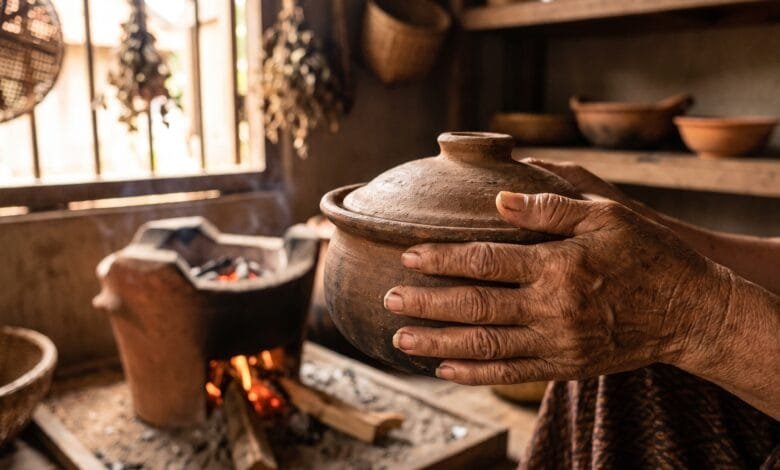
My grandmother’s hands remember the weight of a clay pot that my own hands have never held. She can describe the feel of a coconut-shell ladle, the heat of a clay stove, and the rhythm of pounding spices in a stone mortar. These are not just memories of objects. They are memories of a way of cooking that is quietly disappearing from Cambodian kitchens.
Traditional Cambodian cooking tools — the clay stoves, earthenware pots, wooden mortars, and bamboo utensils that once filled every Khmer kitchen — are being replaced by modern appliances. Gas stoves, electric rice cookers, and blenders now do what hands and fire once did. This is not simply a story about changing equipment. It is a story about what happens when a culture’s kitchen tools begin to vanish.
What Are Traditional Cambodian Cooking Tools?
Traditional Cambodian cooking tools refer to the handmade utensils and equipment that Cambodian families have used for generations to prepare food. These tools were crafted from natural materials found in the local environment: clay from riverbanks, wood from jackfruit trees, bamboo from the countryside, and coconut shells from palm trees.
The most essential traditional Cambodian cooking tools include:
- Clay stoves (cà ràng / ចង្ក្រានដី) — Handcrafted earthenware stoves that burn wood or charcoal. The name cà ràng comes from the Khmer word “kran,” and these stoves were once found in nearly every Cambodian kitchen.
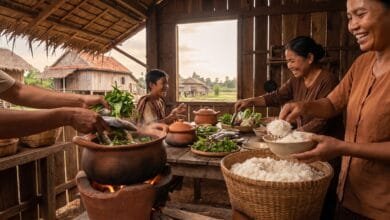
- Clay pots (chhnang / ឆ្នាំង) — Earthenware cooking pots used for rice, soups, and curries. These pots were traditionally made by women potters in Kampong Chhnang province, the “cooking-pots district” of Cambodia.
- Mortar and pestle (krok / សំប៉ុង and champong / ចំប៉ុង) — Large stone or wooden mortars used to grind spice pastes (kroeung), the foundation of countless Khmer dishes.
- Coconut-shell ladles — Hand-carved ladles used for stirring and serving.
- Bamboo utensils — Spoons, trays, and steaming baskets woven from bamboo.
- Wooden rice mills — Traditional tools for husking rice, documented in carvings on the walls of Angkor’s Bayon temple.
These tools were not mass-produced. They were made by hand, often by the same families who used them, and they carried the knowledge of generations.
Why Traditional Cambodian Cooking Tools Are Disappearing
The shift away from traditional Cambodian cooking tools has accelerated dramatically in the last two decades. Several factors explain this change.
Modern materials have displaced clay. The shift to modern materials has displaced traditional clay pottery in the minds of Cambodians. Clay water holders known as k’am in Khmer, clay pots, and clay stoves have almost disappeared, gradually replaced by plastic, metal, and electric equipment.
Gas and electric stoves offer convenience. Gas stoves with timing mechanisms and digital screens have made their way into the kitchens of many Cambodian homes. A villager from Kandal province explained why she switched: “Before we used it, but now we stopped. When I want to cook rice or make soup, I tend to use a stove as it gives out less smoke into my home. When I want to make cookies, I use my gas stove since it cooks faster and easier.”
Traditional tools are fragile. Clay stoves and pots break easily — especially in homes with children. One villager noted: “Clay stoves and pots can easily break when they become wet. They are hard to maintain as day-to-day movements can lead the clay to crack. There are many children in my house. This kind of equipment simply cannot resist the wear and tear.”
The pottery business is declining. In Kampong Chhnang, where traditional clay equipment has been made for generations, sales have collapsed. One seller recalled earning $1,000 to $2,000 monthly between 2000 and 2010. Today, he says: “My business now only makes revenue from selling decorative materials… Some days, I see no demand for traditional clay equipment. Most people prefer modern stoves with strong alloys.”
Younger generations prefer modern tools. A survey of Phnom Penh kitchens found that while every kitchen still had a mortar and pestle, electric rice cookers were found in six out of seven kitchens. Young Cambodians increasingly dream of “modern” kitchens with shiny gas stoves, blenders, and smart appliances — inspired by television shows, Facebook cooking videos, and food vloggers living abroad.
The Human Cost: What Is Being Lost
When traditional Cambodian cooking tools disappear, something more than equipment is lost.
Skill and knowledge vanish. Using a clay stove requires knowing how to manage heat without a dial. Pounding spices in a mortar requires feel and timing. These are skills passed from grandmother to mother to daughter — and they are not being passed on.
Taste and texture change. Food cooked in a clay pot has a distinct character. The clay absorbs and releases moisture differently than metal. Heat distributes unevenly in ways that create depth. One Siem Reap baker who still uses a traditional clay oven explains: “Bread prepared in a clay oven possesses a unique flavour, distinguishing it from bread produced in an electric oven. Customers highlight that during power outages, some bakeries resort to using gas ovens, leading to a lingering gas odour in the bread. In contrast, my clay oven imparts a delightful aroma to the bread.”
Cultural memory fades. The tools themselves carry memory. A clay stove is not just a cooking surface — it is a link to ancestors who cooked on the same kind of stove. When the stove is gone, that link weakens.
Craft traditions die. Pottery-making in Kampong Chhnang was once a thriving industry. In the 1950s and 1960s, there were about 2,400 potters in the district, producing 22,000 water jars, 16,000 cooking pots, and thousands of other items each year. Today, production is much reduced. The potters are aging, and their children do not want to continue the work. One clay stove maker in Phnom Penh noted: “Making the stove is time-consuming, and her children do not want to continue.”
Food, Family, and Community
Traditional cooking tools were never just about cooking. They were about connection.
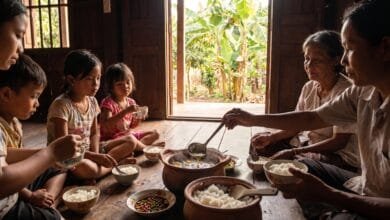
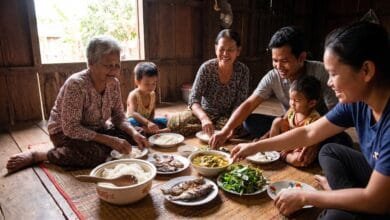
In the traditional Cambodian kitchen, cooking was a family activity. Children watched their mothers pound spices. Grandmothers showed daughters how to regulate the heat of a clay stove. Meals were prepared together, shared together, and the tools themselves became part of family memory.
The mortar and pestle, in particular, remains a symbol of this connection. Nearly every Khmer dish begins with kroeung — a fresh spice paste made by pounding lemongrass, galangal, turmeric, garlic, and shallots. This is not something a blender can fully replicate. The rhythmic pounding releases oils and creates a texture that machines cannot achieve.
But even the mortar and pestle is under threat. While it remains common in Cambodian kitchens today, younger cooks increasingly reach for blenders and food processors. The skill of pounding — the feel of the pestle, the timing, the wrist motion — is fading.
How History Shaped Cambodia’s Cooking Tools
The story of traditional Cambodian cooking tools stretches back centuries. The Chinese envoy Chou Ta-kuan, who spent a year at Angkor in the late 13th century, described Cambodian kitchens in his writings. He noted that Cambodians did not use grindstones for rice, “contenting themselves with bruising it with a mortar and pestle.”
The south wall of the Bayon temple, built in the 12th and 13th centuries, shows food preparation scenes that reveal what utensils were used. Remarkably, many of the utensils and cooking techniques carved into the stone can still be found in homes throughout Cambodia today.
This continuity — a thousand years of using the same kinds of tools — is now breaking. The shift began slowly but has accelerated in the last twenty years. Material science, supply chains, and marketing have changed dramatically. Cheap and durable materials have become the norm, and traditional clay can no longer compete.
Regional and Family Differences
Not all Cambodian kitchens are changing at the same speed.
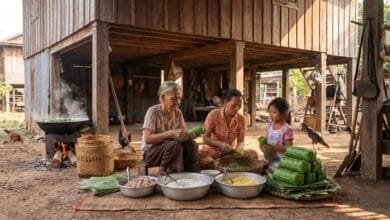
Rural kitchens tend to retain more traditional tools. In villages, clay stoves are still used, especially for cooking rice and soups. The scenic view of villagers carrying clay water holders (k’am) to scoop water from streams is becoming rarer, but it has not entirely disappeared.
Urban kitchens have modernized faster. In Phnom Penh, gas stoves and electric rice cookers are standard. The desire for modern kitchens — big, bright, open spaces with shiny appliances — is strong among younger generations.
Family traditions vary. Some families have kept their grandmother’s clay pot as a treasured object, even if they no longer cook with it. Others have abandoned traditional tools entirely. One villager noted that her parents’ generation filled their houses with traditional clay equipment, but she has none.
How Cambodian Food Culture Is Changing
The disappearance of traditional Cambodian cooking tools is part of a broader transformation of Cambodian food culture.
Urbanization is a major driver. As more Cambodians move to cities, they adopt urban lifestyles — including modern kitchens. Space is limited, and traditional tools take up room. Convenience matters more.
Changing gender roles also play a part. As women enter the workforce, they have less time for traditional cooking methods. Faster, easier tools become necessary.
Global influences shape expectations. Television, social media, and travel expose Cambodians to international cooking styles and kitchen designs. The “dream kitchen” for many young Cambodians looks like something from a Western cooking show.
But tradition persists. Despite the changes, the mortar and pestle remains in every kitchen surveyed in Phnom Penh. And some Cambodians are actively working to preserve traditional tools and techniques. A new generation of chefs is reimagining Cambodian culinary traditions while staying rooted in traditional ingredients and methods.
Why Traditional Cambodian Cooking Tools Still Matter
Why should anyone care about disappearing cooking tools?
They carry identity. Traditional Cambodian cooking tools are part of what it means to be Khmer. They connect Cambodians to their ancestors, their land, and their history.
They shape taste. Food prepared with traditional tools tastes different. The clay pot, the mortar, the wood fire — these are not just methods. They are ingredients in their own right.
They represent resilience. Cambodian food culture survived the Khmer Rouge period, when many recipes and traditions were lost. The fact that traditional tools have survived this long is remarkable. Their continued disappearance is a loss worth noticing.
They offer lessons. Traditional tools teach patience, skill, and respect for ingredients. They remind us that cooking is not just about speed and convenience — it is about care and connection.
How Travelers Can Experience It Respectfully
For travelers interested in Cambodia’s food culture, traditional cooking tools offer a window into the country’s soul.
Visit Kampong Chhnang to see pottery-making while it still exists. Watch the women potters who use techniques passed down for generations, shaping clay by hand without a wheel.
Look for traditional clay stoves in rural markets and village homes. They are becoming harder to find, but they still exist.
Ask about family recipes and the tools used to make them. Cambodians are proud of their food heritage and happy to share stories.
Support artisans who keep traditional crafts alive. Buying a clay pot or a wooden mortar directly supports the people who preserve these skills.
But remember: this is not a performance. These are living traditions that Cambodians are struggling to maintain. Approach with respect and curiosity, not as a tourist looking for a photo opportunity.
Frequently Asked Questions
What are traditional Cambodian cooking tools?
Traditional Cambodian cooking tools include clay stoves (cà ràng), clay pots (chhnang), wooden mortars and pestles (krok and champong), coconut-shell ladles, bamboo utensils, and wooden rice mills — all handmade from natural materials.
Why are traditional Cambodian cooking tools disappearing?
They are being replaced by modern appliances like gas stoves, electric rice cookers, and blenders. Traditional tools are fragile, harder to maintain, and less convenient. Younger generations prefer modern kitchens.
Where were traditional Cambodian cooking tools made?
Most traditional clay cooking tools were made in Kampong Chhnang province, known as Cambodia’s “cooking-pots district.” Women potters shaped the clay by hand using techniques passed down for generations.
Is the mortar and pestle still used in Cambodia?
What is being lost when traditional tools disappear?
Skill and knowledge, distinct flavours and textures, cultural memory, and the craft traditions of pottery-making. The connection between generations is also weakened.
Can traditional Cambodian cooking tools be preserved?
Some artisans and chefs are working to preserve traditional tools and techniques. Supporting local potters, learning traditional cooking methods, and passing knowledge to younger generations can help.
Conclusion
Traditional Cambodian cooking tools are more than utensils. They are carriers of culture, memory, and identity. When a clay stove breaks and is not replaced, something irreplaceable is lost. When a mortar gathers dust while a blender takes over, a skill fades.
The disappearance of these tools is not a simple story of progress versus tradition. It is a story about choice, convenience, and change — and about what we value. As Cambodia modernizes, some traditions will inevitably fade. But understanding what is being lost — and why it matters — is the first step toward keeping the most important parts alive.
The next time you taste a Khmer dish, consider the hands that made it and the tools they used. In those hands and those tools lies a story that deserves to be remembered.