Pchum Ben Sticky Rice Cakes: A Cambodian Tradition of Ancestors, Family, and Food
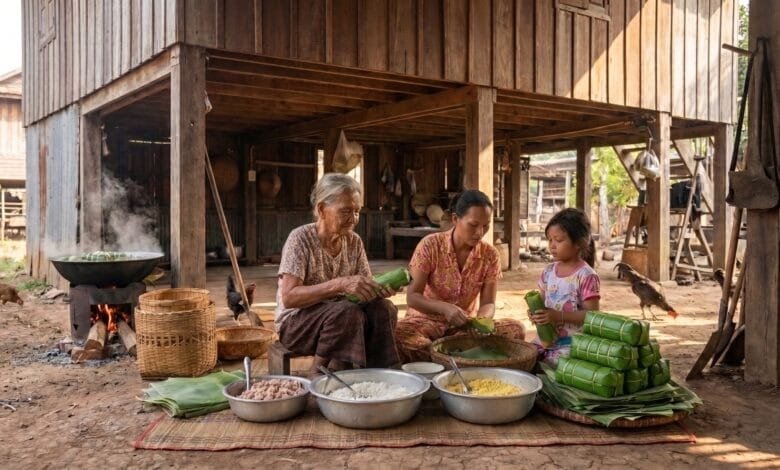
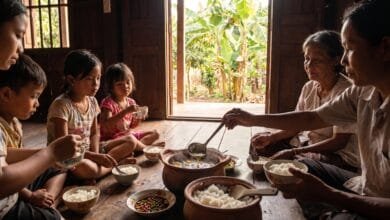
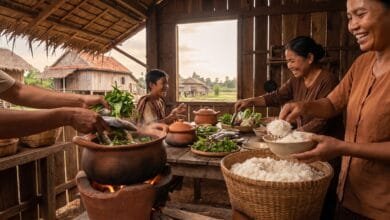
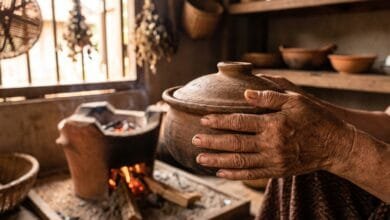
Before the sun rises over a Cambodian village, three generations gather in a kitchen. The grandmother’s hands — weathered by decades of cooking — lay banana leaves on the table. Her daughter measures sticky rice. Her granddaughter watches, learning a tradition that has survived for centuries. This is how Pchum Ben sticky rice cakes are made, and this is how Cambodia remembers its ancestors.
What Are Pchum Ben Sticky Rice Cakes?
Pchum Ben sticky rice cakes are traditional Cambodian foods made during Pchum Ben, the Festival of the Ancestors. Three main cakes are central to the celebration: Num Ansom (នំអន្សម), a cylindrical cake made from glutinous rice filled with pork or banana; Num Korm (នំគម), a pyramid-shaped cake filled with sweet palm sugar and coconut; and Num Bort (នំបត់), a pandan-flavored sticky rice cake.
These cakes are wrapped in banana leaves and steamed until tender and fragrant. While they can be found year-round at celebrations like weddings and Khmer New Year, they are most deeply associated with Pchum Ben — a 15-day festival that is one of the most important events in the Cambodian Buddhist calendar.
Why Pchum Ben Sticky Rice Cakes Matter in Cambodian Food Culture
To understand why Pchum Ben sticky rice cakes matter, you must first understand Pchum Ben itself.
The festival falls in the tenth month of the Khmer lunar calendar, usually between September and October. It lasts 15 days. During the first 14 days — called Kan Ben — families take turns offering food to monks at their local pagodas. On the 15th day, Pchum Ben itself, the entire nation gathers to honor the dead.
Cambodian Buddhists believe that during this time, the gates of hell open and the spirits of ancestors return to the world of the living. Some of these spirits are hungry and suffering, and they depend on their living relatives to provide food and merit. The sticky rice cakes are not merely food — they are offerings, prayers made edible, a way for the living to care for those who came before.
As one senior monk explained, Pchum Ben “reinforces familial bonds and the shared heritage of the Khmer people. It is a time when the past converges with the present, celebrating a legacy that has endured for generations”.
The Food Behind the Tradition
The preparation of Pchum Ben sticky rice cakes is an art form passed down through generations.
Num Ansom (also spelled num ansorm) is the most iconic. It is a cylinder-shaped cake made from glutinous rice that can be filled with sugar bananas (num ansom chek), jackfruit (num ansom khnao), or pork (num ansom chrouk). The rice is mixed with coconut milk, wrapped in banana leaves, and steamed for hours. The result is a dense, sticky cake with a soft, flavorful center.
Chef Ros Rotanak, founder of Rotanak-Home, explains that “other than bananas and pork, Num Ansorm is baked with grated coconut. Sometimes red or black beans along with palm sugar can also be added”.
Num Korm is a pyramid-shaped cake made from sweet sticky rice flour, filled with palm sugar, freshly grated coconut, and roasted sesame seeds. Its triangular shape distinguishes it from the cylindrical Num Ansom.
Num Bort is a pandan-flavored sticky rice cake that adds a green color and fragrant aroma to the festival table.
Beyond these three main cakes, families also prepare bay ben — small balls of sticky rice cooked in coconut milk with sesame seeds. These are scattered on the ground at pagodas to feed spirits believed to have very small mouths.
How the Tradition Works
During the 15 days of Pchum Ben, Cambodian families rise before dawn — often as early as 4 a.m. — to prepare food offerings. They dress in white, the traditional color of mourning, and carry baskets of food to their local pagoda.
The offerings are presented to Buddhist monks, who chant sacred prayers and perform rituals. Through the virtue of the monks’ sermons, the offerings are believed to reach the souls of ancestors.
At the pagoda, families also throw bay ben — small sticky rice balls — into the air or onto the ground. Some traditions involve throwing them into rice fields as a fertility ritual, asking ancestors to bless the coming harvest.
As one observer noted, “The tradition is to throw sticky rice balls known as ben bay onto the ground in order to feed the spirits, some of which are said to possess small mouths that require the food to be broken up”.
Food, Family, and Community
The making of Pchum Ben sticky rice cakes is never a solitary activity. It is a family affair.
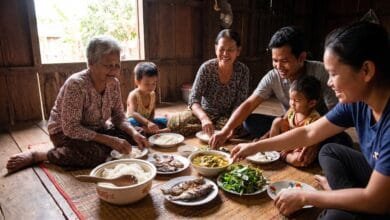
In villages across Cambodia, three generations gather in kitchens to prepare the cakes. Grandmothers — who hold the knowledge of traditional techniques — lead the process. Mothers assist. Children watch and learn.
A VICE documentary captured this beautifully in Baray village, where three generations of women gathered to make num ansom. The grandmother — known simply as “Yay” — carefully removed skins from mung beans, while her daughter and granddaughter prepared banana leaves and binding strips. “Food preparation here has barely changed since the time when the only clock was the vaulting sun,” the journalist observed.
This intergenerational cooking is itself a form of cultural preservation. As one writer noted, “only a small group of people — mainly elderly women — know how to prepare it and wrap it in the traditional banana leaf. It is to be feared that this knowledge will one day be lost”.
The Symbolism of the Cakes
The shapes of Pchum Ben sticky rice cakes carry profound meaning.
According to Dok Sophorn, a lecturer at the Secondary School of Fine Arts, the cakes were likely introduced to Cambodia during the reign of Kaundinya in the 1st century. Religiously, Num Ansom — with its cylindrical shape — represents Lord Shiva or the lingam, a symbol of male fertility. Num Korm represents Shiva’s wife Uma, a symbol of female fertility. Num Bort represents the earth.
In Khmer culture, the cylinder shape of num ansom represents a phallus symbolizing Shiva, the masculine principle, while the pyramid shape of num kom symbolizes Uma, his consort. In popular culture, the cakes represent the two heads of the household.
When Cambodia’s temple-building traditions faded, the architectural symbols of Shiva and Uma found new life in the kitchen. As one cultural analysis explains, “the concept of Mea Ba, or the respect of mother and father, persisted, and is still present in Khmer gastronomy”.
Regional and Family Differences
The tradition of making Pchum Ben sticky rice cakes varies across Cambodia.
Some families prefer sweet fillings — banana, jackfruit, or palm sugar and coconut. Others prefer savory — pork with mung beans. Some provinces are known for particular variations. The choice of filling often reflects local ingredients, family preferences, and regional traditions.
Even the method of cooking can vary. While steaming is most common, num ansom can also be fried or grilled depending on the occasion.
These variations remind us that Cambodian food culture is not monolithic. It is a living tradition shaped by geography, family history, and personal taste.
How History Shaped the Tradition
The story of Pchum Ben sticky rice cakes is a story of cultural synthesis.
The cakes reflect Cambodia’s deep engagement with Indian religious traditions. The lingam-yoni symbolism of Num Ansom and Num Korm points to Hindu influences that arrived in Cambodia more than two thousand years ago. Over time, these Hindu symbols were absorbed into Cambodian Buddhist practice.
Pchum Ben itself blends Buddhist and indigenous ancestor veneration. The festival is rooted in Buddhist teachings about merit transfer — the idea that good deeds performed by the living can benefit the deceased. But the specific rituals of offering food to hungry ghosts reflect older, pre-Buddhist beliefs about the spirit world.
In this sense, Pchum Ben sticky rice cakes are edible history. Each cake carries traces of Cambodia’s religious evolution, its agricultural roots, and its enduring commitment to family.
How Cambodian Food Culture Is Changing
The tradition of making Pchum Ben sticky rice cakes is evolving.
With socio-economic development and busier family lives, the baking of cakes has become commercialized. Today, many families buy ready-made cakes from markets rather than preparing them at home.
This shift reflects broader changes in Cambodian society. Urbanization, changing work patterns, and the rise of convenience foods have transformed how families eat and celebrate. Younger generations may not have the time — or the knowledge — to make traditional cakes from scratch.
Yet this does not mean the tradition is dying. It is adapting. Markets now offer a wide variety of Pchum Ben sticky rice cakes year-round. The cakes remain central to the festival, even if they are purchased rather than handmade.
At the same time, there is growing interest in preserving traditional food knowledge. Cultural organizations and food writers are documenting traditional recipes and techniques. Some families continue the practice of making cakes together, recognizing it as a way to connect with their heritage.
Why This Tradition Still Matters
Pchum Ben sticky rice cakes matter because they tell us something essential about Cambodia.
They tell us that Cambodians honor their ancestors. They tell us that family is central to Khmer life. They tell us that food is a language of love, memory, and belonging.
The cakes also remind us that traditions are not static. They change, adapt, and find new forms. What matters is not whether a cake is homemade or store-bought, but that the act of offering — of remembering, of caring for those who came before — continues.
As Preah Meakthy Pheasa Nurak On Ol, deputy chief of monks at Sras Chak pagoda, said, Pchum Ben “celebrates a legacy that has endured for generations and continues to shape the cultural identity of Cambodia”.
How Travelers Can Experience It Respectfully
If you visit Cambodia during Pchum Ben, you can witness this beautiful tradition.
Visit a pagoda in the early morning to see families making offerings. Observe quietly and respectfully. Wear modest clothing — white is traditional, but conservative attire is appropriate for any visitor. Do not interrupt rituals or take photos without permission.
Consider supporting local food vendors who sell Pchum Ben sticky rice cakes. By buying these cakes, you are supporting families and communities who keep the tradition alive.
Most importantly, understand what you are seeing. These are not simply cakes. They are prayers. They are offerings. They are a people’s way of saying: we remember you, we honor you, and we will not forget.
Frequently Asked Questions
1. What are Pchum Ben sticky rice cakes called in Khmer?
2. Why are sticky rice cakes made for Pchum Ben?
3. What is the difference between Num Ansom and Num Korm?
4. How long does Pchum Ben last?
The festival lasts 15 days. The first 14 days are called Kan Ben, and the final day is Pchum Ben.
5. Can travelers eat Pchum Ben sticky rice cakes?
Yes. The cakes are widely available at markets and from vendors during the festival. They are delicious and a wonderful way to experience Cambodian food culture.
Conclusion
Pchum Ben sticky rice cakes are more than a festival food. They are a living tradition that connects Cambodians to their ancestors, their families, and their culture. From the grandmother’s hands wrapping banana leaves to the family’s journey to the pagoda at dawn, these cakes embody the values that define Khmer life: respect for elders, care for family, and the belief that love transcends death.
In a world of rapid change, the tradition of making and offering sticky rice cakes endures. It adapts, it evolves, but it does not disappear. Because in Cambodia, food is never just food. It is memory. It is prayer. It is home.